

Datacenters consume massive amounts of energy, with lighting often accounting for 20% of total facility power usage. At PacLights, we’ve seen firsthand how wireless lighting controls can cut these costs significantly while improving operational efficiency.
The right system gives you real-time visibility into every zone and adapts automatically to occupancy and daylight. This introduction walks you through the benefits, implementation strategies, and practical steps to modernize your datacenter’s lighting infrastructure.
How Much Can Wireless Lighting Cut Your Datacenter Costs?
Datacenters spend roughly 20 to 30 percent of total facility power on lighting alone, which means a 50 percent reduction in lighting energy translates directly to measurable savings on your electricity bill. Wireless lighting controls deliver energy reductions between 30 and 65 percent when you deploy occupancy sensing, daylight harvesting, and scheduled dimming across your facility. A commercial office retrofit documented a 55 percent drop in lighting energy consumption after implementing wireless sensor lighting, and outdoor parking applications achieved 65 percent reductions with motion-activated systems. These aren’t theoretical numbers-they come from real deployments where facilities applied occupancy-based dimming and daylight integration across their spaces.
The Real ROI Timeline
Your payback period typically falls between three and five years, which makes wireless lighting a genuinely attractive investment compared to other facility upgrades. Installation costs run 25 to 40 percent higher upfront than traditional wiring, but total deployment expenses drop 40 to 50 percent because wireless systems eliminate trenching and new electrical runs. Wireless installations complete about 70 percent faster than wired alternatives, with individual switches and sensors taking as little as 15 minutes to deploy without requiring new wiring. This speed matters because labor represents your largest cost during retrofit projects. Start with luminaire-level lighting control in your highest-traffic zones-server aisles and equipment rooms-to validate ROI quickly before you expand facility-wide. Real-time energy dashboards reveal exactly which zones consume the most power, letting you prioritize upgrades where they deliver the fastest returns.
Why Cooling Costs Drop Too
Reducing lighting load also shrinks your cooling expenses because fewer fixtures generate less heat in your server rooms. Lower ambient temperatures mean your HVAC systems work less hard to maintain optimal conditions for your equipment. This dual benefit (lower lighting electricity plus reduced cooling demand) compounds your savings beyond what lighting upgrades alone would deliver. Demand response integration adds another layer when you reduce loads during grid peak events, typically yielding around 15 percent additional load reduction during those windows. These stacked benefits explain why datacenters represent one of the strongest applications for wireless lighting controls, and they also highlight why you need to understand how real-time monitoring transforms your operational visibility.
Real-Time Monitoring and Adaptive Lighting Systems
Wireless lighting systems equipped with luminaire-level monitoring show you exactly which zones consume power, when they consume it, and why. Most facilities operate blind to their actual lighting consumption patterns, relying on estimates or monthly utility bills that arrive weeks after the fact. Each fixture reports its status to a central controller, creating a continuous data stream that feeds into energy dashboards accessible from your facilities team’s computers or mobile devices. This granular visibility reveals inefficiencies that spreadsheets and manual audits miss entirely. A test network of 800 lighting modules processed roughly 3,000 commands per day and tracked every state change with zero recorded failures across over one million messages, demonstrating the reliability required for mission-critical datacenter environments.
Your dashboard should display energy consumption by zone, time of day, and fixture type so you can identify underperforming areas and optimize controls continuously. Thermal monitoring integrated into your lighting system flags fixture degradation and sensor malfunctions early, reducing emergency service calls by roughly 60 percent compared to reactive maintenance schedules. Real-time visibility into lighting performance transforms how you manage datacenter energy.
Occupancy Sensors Respond to Technician Movement
Occupancy sensors detect when technicians enter server aisles or equipment rooms and automatically increase brightness to safe working levels, then dim or turn lights off when spaces empty. Digital PIR sensors mounted in ceiling fixtures eliminate false triggers that plague poorly designed systems by using sensor fusion techniques (combining motion detection with microwave or ultrasonic confirmation). Latency from occupancy-triggered events to light state change typically falls under one second, supporting responsive aisle lighting that prevents dark spots and improves technician safety. These sensors work reliably in complex datacenter spaces where metal racks and dense equipment layouts challenge wireless signal propagation.
Daylight Harvesting Reduces Electric Light Demand
Daylight harvesting dims electric lights when natural light through windows or skylights provides sufficient illumination, a particularly valuable strategy in datacenter support areas and administrative spaces adjacent to server rooms. The system adjusts brightness in real time based on ambient light conditions, accounting for seasonal changes and time of day without requiring manual intervention. Scheduling adds another layer by pre-programming light levels based on your facility’s operational patterns, reducing illumination during nights and weekends when minimal staff occupancy occurs. These adaptive controls work together because a single space might need occupancy-based dimming during business hours, daylight harvesting in afternoon windows, and scheduled shutdown at night.
Building Management System Integration Eliminates Silos
Your wireless lighting system must communicate seamlessly with existing building management infrastructure rather than operating as an isolated silo. Open standards like BACnet and gateway interfaces enable lighting data to flow into your HVAC, security, and energy management platforms without custom programming. About 62 percent of retrofit projects encounter interoperability challenges that delay deployments and inflate costs, making standard compatibility a genuine differentiator when selecting systems. HVAC integration via contact closure or BACnet allows coordinated energy management where reduced lighting loads automatically signal your climate control system to lower cooling demand, compounding efficiency gains.
Phased Rollout Validates Performance Before Scaling
A phased rollout starting in high-use zones like server aisles and equipment rooms validates ROI before facility-wide deployment while allowing your team to learn the system’s capabilities on a manageable scale. Real-time energy dashboards should track consumption by zone and time period, identifying which areas justify additional optimization investment.
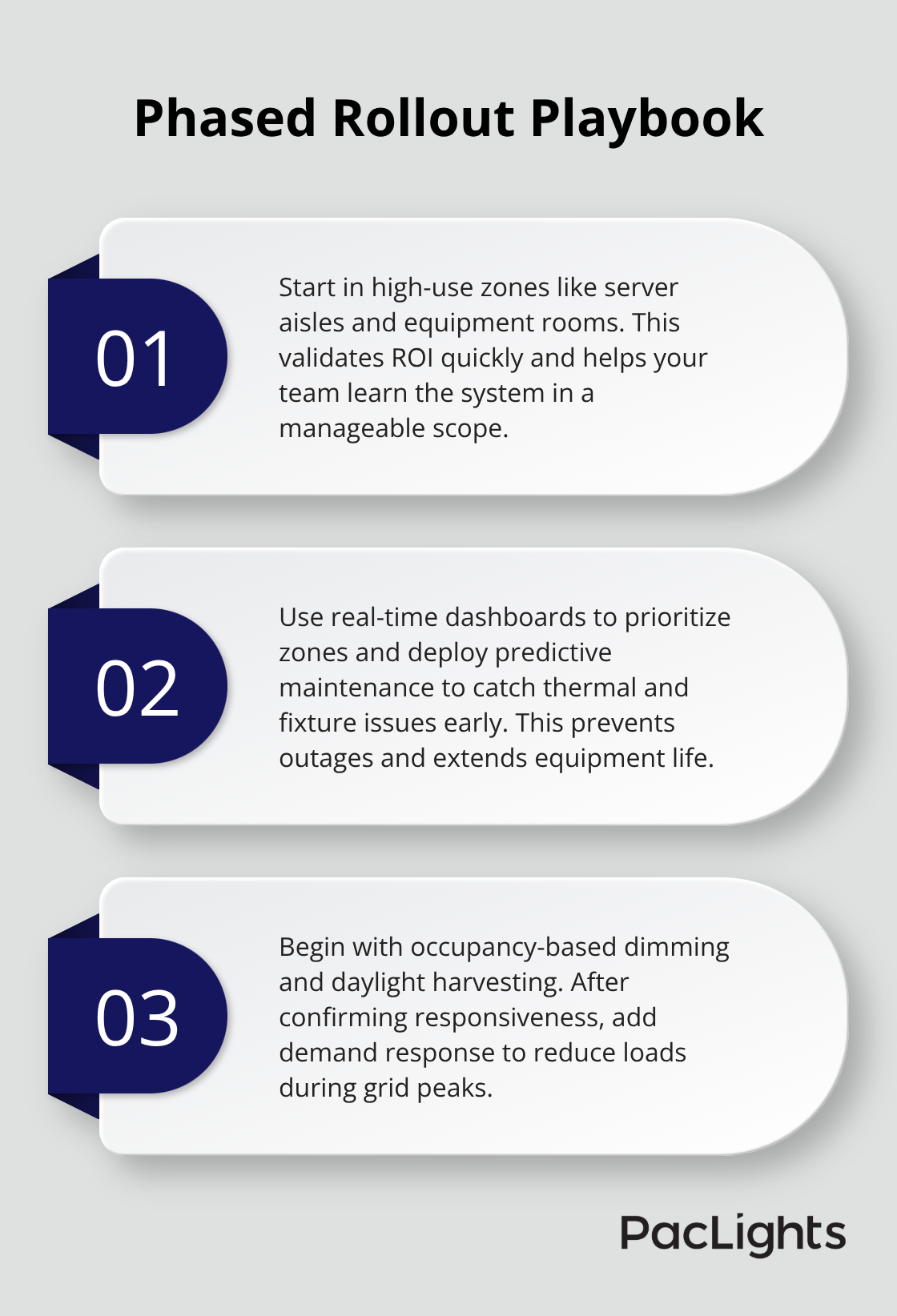
Predictive maintenance alerts flag thermal issues and fixture degradation early, preventing unexpected outages and extending equipment life across your datacenter infrastructure. Starting with occupancy-based dimming and daylight harvesting first validates responsiveness before adding demand response capabilities that reduce loads during grid peak events. Once you confirm performance in these initial zones, you’ll understand exactly how to configure controls across the rest of your facility and what implementation challenges your team will face during expansion.
Overcoming Wireless Lighting Implementation Barriers
Wireless lighting systems face real obstacles in datacenter environments, but none of them are insurmountable if you plan strategically. Metal server racks, dense equipment layouts, and electromagnetic interference from high-powered systems create signal propagation challenges that wireless site surveys must address before deployment begins. Conduct a comprehensive analysis using signal strength analyzers to map coverage gaps in your facility, then position access points and mesh repeaters to maintain latency under one second for occupancy-triggered events. High-power PoE runs can raise cable bundle temperatures by 12 to 15 degrees Celsius, so plan cable routing away from cooling intake paths and integrate thermal monitoring into your network design. The 100-meter Ethernet limit requires a star topology with multiple PoE switches distributed across zones rather than a single centralized switch, which means your electrical infrastructure audit should identify switch locations before equipment procurement begins. About 62 percent of retrofit projects encounter interoperability challenges according to industry data, making open standards like BACnet non-negotiable when selecting vendors. Demand that your system integrates with existing building management platforms through documented gateway interfaces or standard protocols rather than proprietary connections that lock you into future vendor dependencies.
Plan Your Phased Rollout Strategy
A phased rollout beginning in server aisles and equipment rooms validates technical performance and ROI before facility-wide expansion, while allowing your operations team to master the system on a manageable scale. Run a complete implementation audit before purchasing any hardware, mapping current lighting layouts, electrical capacity, network topology, and baseline energy consumption by zone to inform realistic project planning. Configure occupancy-based dimming and daylight harvesting first to establish baseline performance, then add demand response capabilities after confirming responsiveness in your initial zones. Real-time energy dashboards should track consumption by zone and time period so you identify which areas justify additional optimization investment and which zones already perform efficiently. Predictive maintenance alerts flag thermal issues and sensor malfunctions, reducing emergency service calls by roughly 60 percent compared to reactive schedules and protecting your datacenter uptime while extending equipment life. Once your initial zones validate the ROI timeline and operational benefits, you’ll understand exactly how to configure controls across remaining facility areas and what staff training gaps your team needs to address during expansion.
Equip Your Team with Proper Training
Your facilities team must understand how occupancy sensors, daylight harvesting, and scheduled dimming work together rather than viewing the system as a black box controlled by IT. Provide user-centric interfaces including mobile apps and wall panels with clear scheduling controls and manual overrides, then document procedures for common scenarios like emergency lighting activation or temporary occupancy adjustments. Many deployments fail because technicians lack sensitivity adjustments or override capabilities, causing frustration that undermines adoption and creates pressure to disable features. Train staff on reading real-time energy dashboards and interpreting alerts so they can troubleshoot common issues without escalating every problem to vendors or consultants. Inadequate sensor placement remains a common pitfall, so map traffic patterns and high-traffic zones during initial deployment and revisit sensor locations after three months of operation to catch placement errors before they become entrenched in your facility procedures.
Address Signal Propagation Challenges
Metal racks and dense equipment layouts challenge wireless signal propagation in ways that wired systems never face. Perform wireless site surveys using signal strength analyzers before you finalize your network topology, identifying dead zones where mesh repeaters or additional access points will maintain reliable coverage. Position sensors and controllers strategically to avoid signal blockage from large metal structures, and test latency under full operational load to confirm that occupancy-triggered events respond within one second. Sensor fusion techniques (combining motion detection with microwave or ultrasonic confirmation) reduce false triggers that plague poorly designed systems in complex datacenter spaces. Your network design should account for the physical layout of your specific facility rather than relying on generic recommendations that may not account for your unique equipment configurations and architectural constraints.
Validate Interoperability Before Commitment
Open standards like BACnet and documented gateway interfaces separate systems that integrate seamlessly with your existing infrastructure from proprietary solutions that create vendor lock-in and future cost escalation. Request detailed integration documentation from vendors and test compatibility with your current building management platform before signing contracts. About 62 percent of retrofit projects encounter interoperability challenges that delay deployments and inflate costs, making standard compatibility a genuine differentiator when selecting systems. Demand that your vendor provides clear pathways for future upgrades and technology changes rather than forcing you to replace entire systems when standards evolve or your facility needs shift.
Final Thoughts
Wireless lighting transforms datacenter operations by replacing static infrastructure with dynamic systems that respond to actual occupancy and environmental conditions. Energy savings between 30 and 65 percent, payback periods of three to five years, and installation costs that drop 40 to 50 percent compared to traditional wiring represent genuine operational transformation. Real-time energy dashboards reveal exactly where your facility consumes power, and predictive maintenance alerts catch problems early, reducing emergency service calls by roughly 60 percent while protecting datacenter uptime.
Implementation requires strategic planning before deployment begins. Start with a comprehensive audit of your current infrastructure, then deploy wireless lighting controls in high-use zones like server aisles and equipment rooms to validate ROI before expanding facility-wide. Demand open standards like BACnet from your vendor to avoid interoperability challenges that plague 62 percent of retrofit projects, and train your team thoroughly so they understand how the system works.
We at PacLights understand that modern datacenters need lighting solutions that balance performance with cost efficiency. Explore how our wireless lighting solutions can reduce your operational costs while improving datacenter management, and contact us today for a free ROI assessment tailored to your specific facility.
Disclaimer: PacLights is not responsible for any actions taken based on the suggestions and information provided in this article, and readers should consult local building and electrical codes for proper guidance.