

Flush mount downlights are one of the most practical lighting solutions for modern homes and offices. They sit seamlessly against your ceiling, offering a clean look while delivering reliable illumination.
At PacLights, we know that flush mount downlight selection involves more than just picking a fixture that looks good. The right choice depends on understanding lumens, matching your interior style, and finding the balance between performance and budget.
What Makes Flush Mount Downlights Different
[TASK_CLASS=ACTIVE]Flush mount downlights sit directly against your ceiling surface, creating a seamless, low-profile appearance that works especially well in rooms with 8-foot ceilings or shallow plenums where headroom matters. Unlike recessed fixtures that recess into the ceiling cavity, flush mounts deliver light straight downward while maintaining a clean sightline, making them ideal for kitchens, hallways, bathrooms, and commercial offices where uniform illumination takes priority over decorative impact. A 10W LED flush mount typically produces around 800 lumens, matching a 60W incandescent bulb while cutting energy consumption by roughly 75 percent. The real cost advantage shows up monthly: a 60W incandescent at 5 hours per day costs about 11 dollars per fixture, while a 10W LED runs under 2 dollars, saving approximately 9 dollars monthly per fixture.
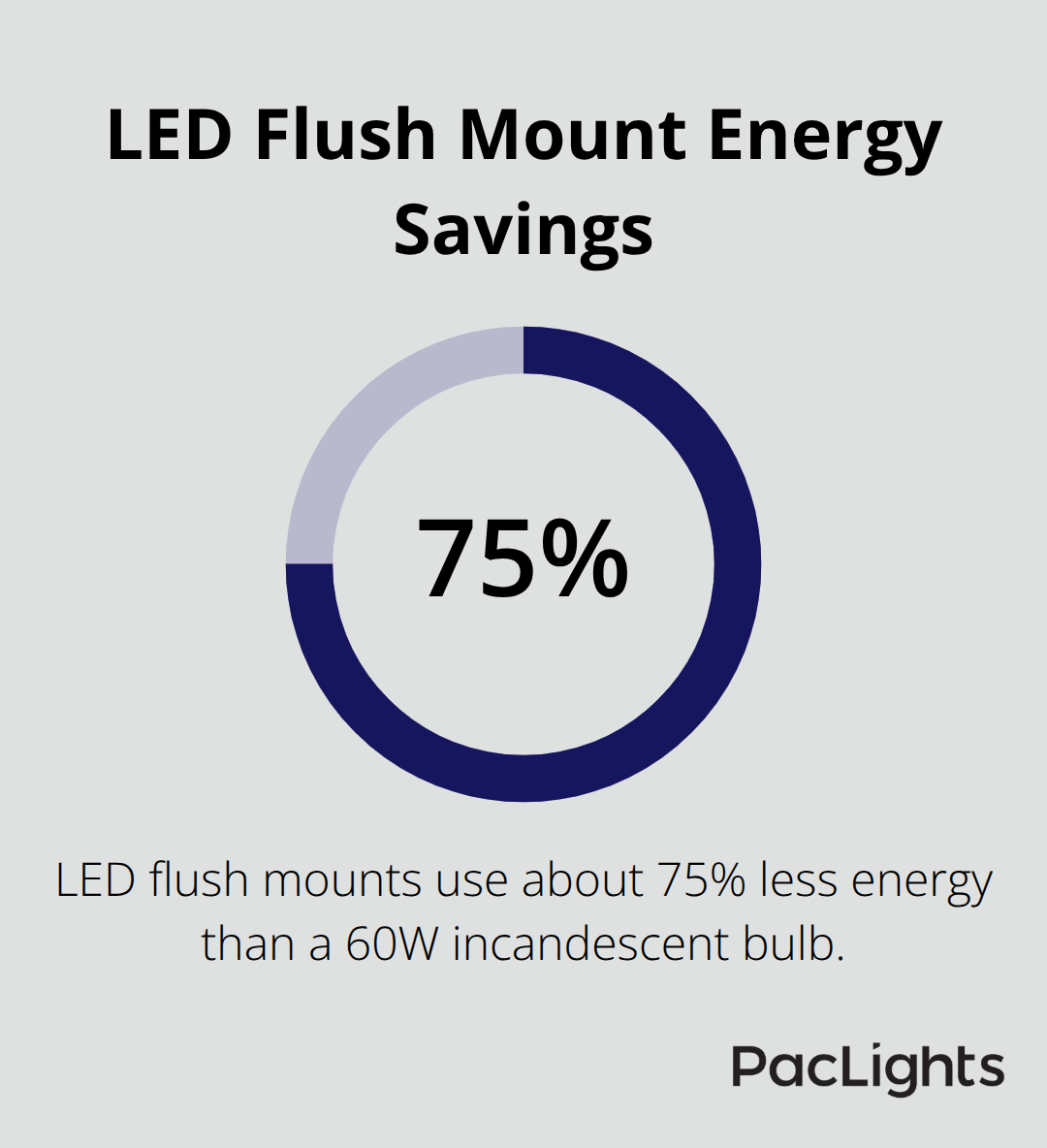
Over a 25,000-hour lifespan, this translates to roughly 2,700 dollars in energy savings per fixture compared to incandescent alternatives.
New Construction vs. Retrofit Installation
New construction fixtures install before drywall for cleaner aesthetics and easier wire routing, while retrofit models use spring-loaded clips to fit existing ceilings with minimal disruption (typically 20 to 30 minutes per fixture). Retrofit installations require access to your ceiling junction box and confirmation that your circuit can handle the load; a 15-amp circuit typically supports 4 to 5 LED downlights, while a 20-amp circuit handles 6 to 8. The total project investment breaks down simply: multiply your fixture count by roughly 35 dollars per unit, then add labor costs of 75 to 150 dollars per hour.
Wiring and Electrical Safety
Safety comes first during installation, so always turn off power at the breaker and test with a voltage tester before touching any wiring. Strip about half an inch of insulation from each wire, then connect black to black (hot), white to white (neutral), and green or bare copper to ground using proper connectors. Push the fixture upward until the spring-loaded clips click into place; no audible click means it is not secured properly and will fail. After mounting, use a bubble level to ensure each fixture sits level, as misalignment impacts light distribution across your space.
Once you understand how flush mounts install and perform, the next critical decision involves selecting the right lumen output for your specific room and activities.
Style and Design That Matches Your Space
Understanding Trim Styles and Their Impact
Flush mount downlights come in three primary trim styles, and your choice directly impacts both aesthetics and light control. Flangeless trims create a seamless, minimalist appearance where the fixture sits completely flush with the ceiling surface, making them ideal for modern interiors where visual interruption matters. Flanged trims feature a visible ring around the fixture opening, creating a bold architectural statement that works well in contemporary or transitional spaces.
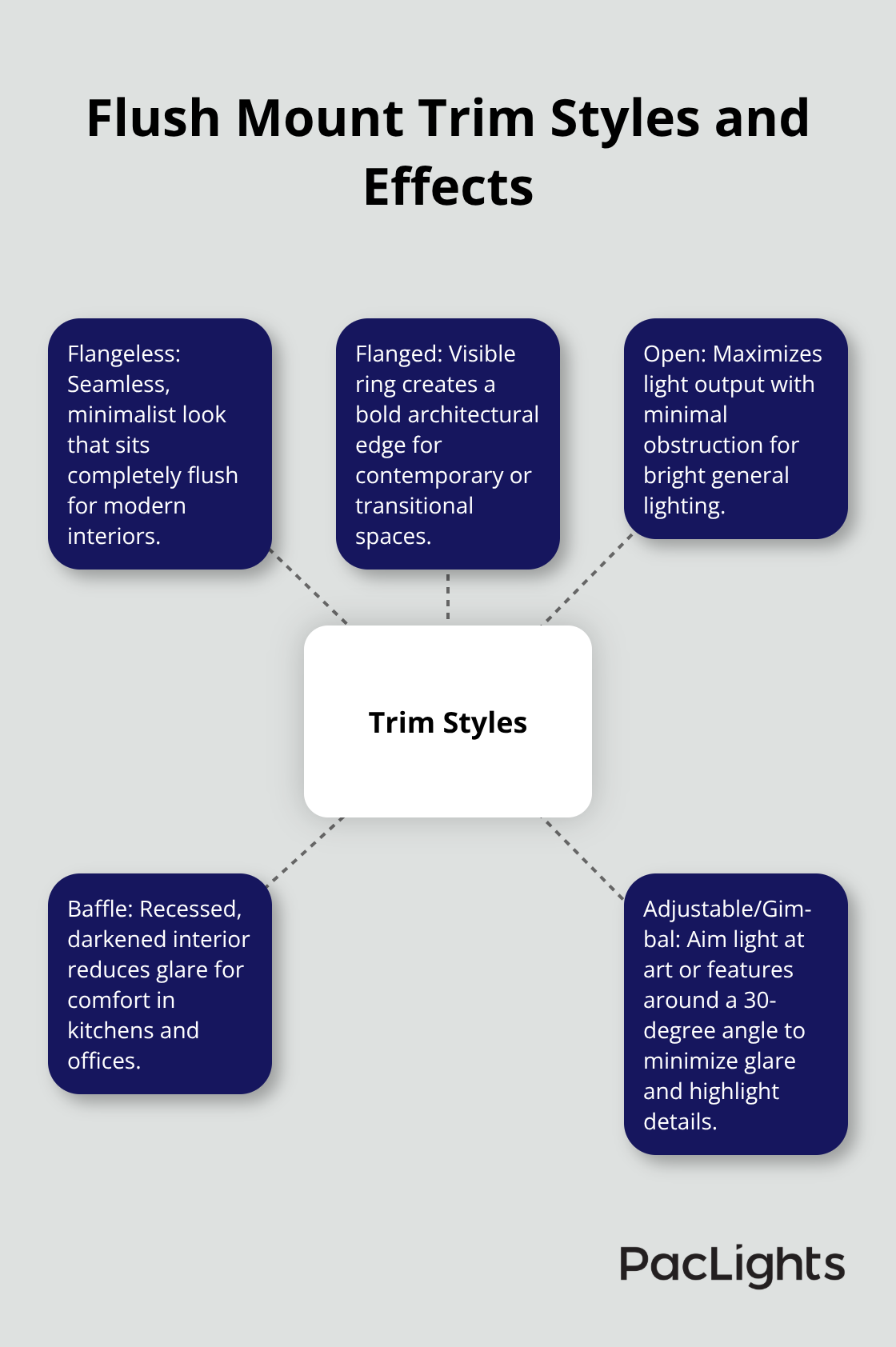
Open trims allow maximum light output with minimal obstruction, while baffle trims reduce glare significantly through a recessed darkened interior-a practical choice for offices or kitchens where bright downward light can cause discomfort. For accent lighting, adjustable or gimbal trims let you aim light at artwork or architectural features at roughly a 30-degree angle to minimize glare while maximizing detail visibility.
Selecting the Right Aperture Shape
Square apertures suit contemporary rooms and create sharper visual lines, whereas circular trims work better in traditional or transitional designs where softer edges feel more appropriate. Your aperture choice reinforces your overall design direction and influences how the fixture integrates with your ceiling plane. The shape you select affects not just aesthetics but also how light spreads across your room.
Sizing Fixtures to Your Room Dimensions
Fixture size matters more than most people realize, and oversizing or undersizing your downlights creates visual imbalance and uneven light distribution. Target a fixture diameter roughly one-third of your room width: a 12-by-14-foot kitchen works well with 14-to-16-inch fixtures, while a 20-by-20-foot space requires 18-to-20-inch fixtures to avoid creating dark pockets between lights. For ceiling heights under 8 feet, choose slim-profile fixtures that don’t protrude noticeably into your headspace. Above 10 feet, you can use slightly deeper housings without affecting the room’s proportions.
Color Temperature and Dimming Options
Color temperature selection shapes the mood and functionality of your space. Warm white at 2700 to 3000 Kelvin suits bedrooms, living rooms, and dining areas where relaxation takes priority, while cool white at 4000 to 5000 Kelvin sharpens focus in kitchens, bathrooms, and offices where task clarity and accurate color perception matter. Dimmable fixtures cost 15 to 25 percent more upfront but deliver noticeable energy savings when you dim during low-usage periods, plus they let you adjust brightness to match different times of day or activities.
Once you’ve settled on style and size, the real performance question emerges: how many lumens does your specific room actually need?
How Many Lumens Does Your Room Actually Need
Lumens measure the total amount of visible light a fixture produces, and getting this number right separates comfortable, functional spaces from dim or harshly overlit rooms. The IES footcandles standard provides the practical baseline: living rooms need 10 to 20 foot-candles, kitchens require 30 to 40 foot-candles for general work, bathrooms demand 70 to 80 foot-candles for grooming tasks, and hallways function well at 5 to 10 foot-candles.

Converting Foot-Candles to Lumens
To convert foot-candles to lumens, multiply your room square footage by the recommended foot-candles value. A 100-square-foot kitchen at 40 foot-candles requires roughly 4,000 lumens total across all fixtures. A 12-by-14-foot kitchen works well with six flush mount fixtures at approximately 500 lumens each, hitting the 3,000-lumen target that supports safe food preparation and accurate color perception.
Adjusting for Ceiling Height and Wall Color
Ceiling height changes this calculation significantly. A 12-by-12-foot space needs about 3,600 lumens at 11 feet high, 3,900 lumens at 12 feet, and 4,400 lumens at 15 feet, because taller ceilings spread light over greater distances. Wall color amplifies or reduces these needs dramatically-medium-dark walls roughly double your required lumens, while very dark surfaces quadruple them. A space painted charcoal gray or black demands far more fixtures than the same room with light neutral walls.
Calculating Per-Fixture Output
Start with total lumens first, then divide by your planned fixture count to determine per-fixture output. A typical spacing rule places one downlight per 25 square feet with fixtures spaced 4 to 6 feet apart in a grid pattern, but this works only if you hit your lumen target. LED fixtures at 10 watts produce around 800 lumens, while 15-watt models deliver roughly 1,200 lumens. Verify the actual lumen rating on the spec sheet rather than relying on wattage alone, since LED efficiency varies between manufacturers.
Room-Specific Lumen Targets
For bathrooms, try 500 to 800 lumens per fixture. For hallways, space fixtures 6 to 8 feet apart and try for 400 to 800 lumens total. The energy math reinforces the lumen-first approach: a 10W LED at 800 lumens costs under 2 dollars monthly to run, whereas a 60W incandescent producing similar brightness costs about 11 dollars monthly, delivering that 2,700-dollar savings over 25,000 hours.
Dimmable Fixtures for Long-Term Savings
If you want flexibility, install dimmable fixtures-they cost 15 to 25 percent more upfront but let you reduce brightness during low-usage periods (recovering that premium through lower energy bills while extending fixture lifespan through reduced runtime stress).
Final Thoughts
Flush mount downlight selection requires you to balance three core factors: your style preferences, your lumen targets, and your budget constraints. A 10W LED flush mount costs roughly 2 dollars monthly to operate, while a 60W incandescent costs about 11 dollars, saving you 9 dollars per fixture each month-and that gap widens dramatically over a 25,000-hour lifespan, totaling approximately 2,700 dollars in energy savings per fixture. Dimmable fixtures cost 15 to 25 percent more upfront but recover that premium through lower energy bills when you reduce brightness during low-usage periods.
Before you purchase, verify your electrical capacity (a 15-amp circuit supports 4 to 5 LED downlights, while a 20-amp circuit handles 6 to 8), measure your ceiling height and wall color, and calculate your total lumen requirement using the IES foot-candles standard. Wall color matters enormously-medium-dark walls roughly double your lumen needs, while very dark surfaces quadruple them. A kitchen demands 3,000 lumens or more for safe food prep and accurate color perception, while a hallway functions well at 400 to 800 lumens total.
We at PacLights offer free lighting layout designs and ROI assessments to help you plan your flush mount downlight selection and confirm your electrical readiness before installation begins. A professional assessment removes the guesswork from fixture selection and ensures your investment delivers the performance and savings you expect.
Disclaimer: PacLights is not responsible for any actions taken based on the suggestions and information provided in this article, and readers should consult local building and electrical codes for proper guidance.