

Warehouse dock lights upgrade isn’t just about visibility-it’s about protecting your team and moving product faster. Poor lighting in loading areas costs money through accidents, injuries, and wasted time.
At PacLights, we’ve seen firsthand how the right lighting transforms dock operations. Modern LED solutions cut energy bills while keeping your facility safer and more productive.
Why Dock Lighting Directly Impacts Your Bottom Line
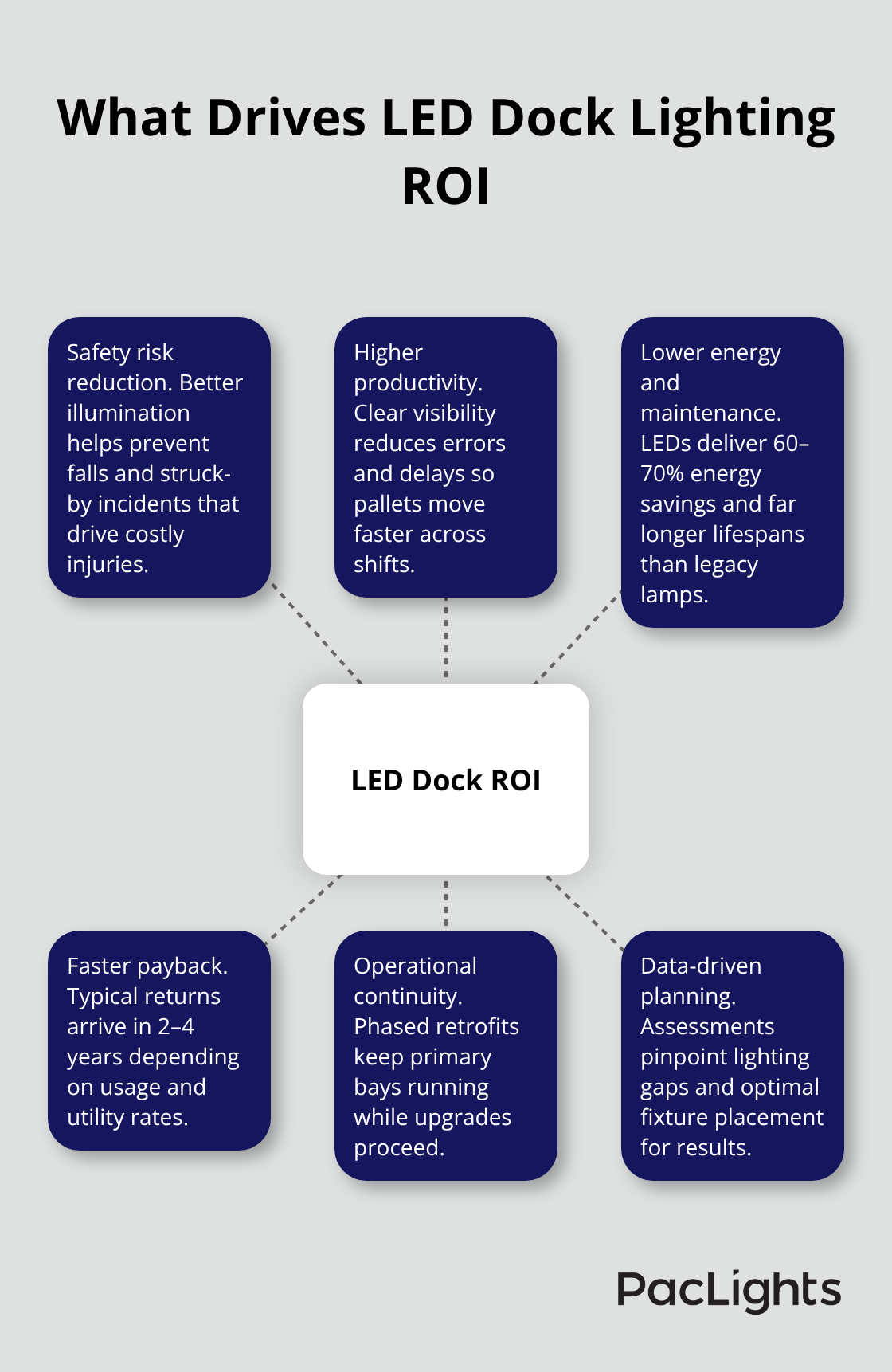
Poor dock lighting creates a cascade of operational problems that drain your budget faster than most facility managers realize. According to the Occupational Safety and Health Administration, falls and struck-by incidents account for roughly 36% of all serious injuries in warehouse environments, and inadequate lighting amplifies this risk significantly. When your loading dock lacks proper lighting, workers move slower because they cannot see product condition, dock edges, or potential hazards clearly. A 2023 study from the Journal of Safety Research found that workers in poorly lit environments operate at 20-30% reduced efficiency compared to adequately lit spaces. This slowdown compounds across shifts, meaning fewer pallets move, longer dock times occur, and delayed shipments frustrate customers and damage your reputation.
Accidents Cost More Than You Think
Warehouse injuries tied to poor visibility generate immediate and long-term expenses that most operations underestimate. A single serious dock injury costs between $40,000 and $100,000 when accounting for medical expenses, workers compensation claims, lost productivity, and potential legal liability. The National Safety Council reports that unintentional workplace injuries cost American businesses over $163 billion annually, with warehouse operations representing a disproportionate share. Beyond the financial hit, injuries create staffing gaps that force remaining workers into overtime, further degrading safety because fatigued employees make more mistakes. Upgrading dock lighting represents prevention spending that protects your people and your margins simultaneously.
Energy Waste From Outdated Fixtures Bleeds Money Continuously
Many warehouses still operate dock areas with older metal halide or high-pressure sodium fixtures that consume 30-40% more electricity than modern LED alternatives while delivering inferior light quality. These aging systems generate excessive heat, require frequent maintenance and bulb replacements, and provide inconsistent illumination that creates shadows and dark spots where accidents happen. A facility running 24/7 dock operations with outdated 400-watt metal halide fixtures pays roughly $2,000-$3,000 annually per fixture in electricity costs alone, not including maintenance labor and replacement bulbs.
LED Solutions Transform Your Operating Costs
LED retrofit solutions reduce energy consumption to 150-200 watts per fixture, cutting your dock lighting energy costs by approximately 60-70% while improving visibility and reliability across your operation. The transition from outdated fixtures to modern LEDs happens without major facility disruption, and the payback period typically falls within 2-4 years depending on your current system and usage patterns. Advanced lighting controls (such as motion sensors and daylight harvesting) stack additional savings on top of the base LED efficiency gains. Your next step involves assessing your current dock conditions and understanding exactly where lighting gaps exist in your operation.
Assessing Your Dock and Building Your Lighting Plan
Measure Your Current Light Levels
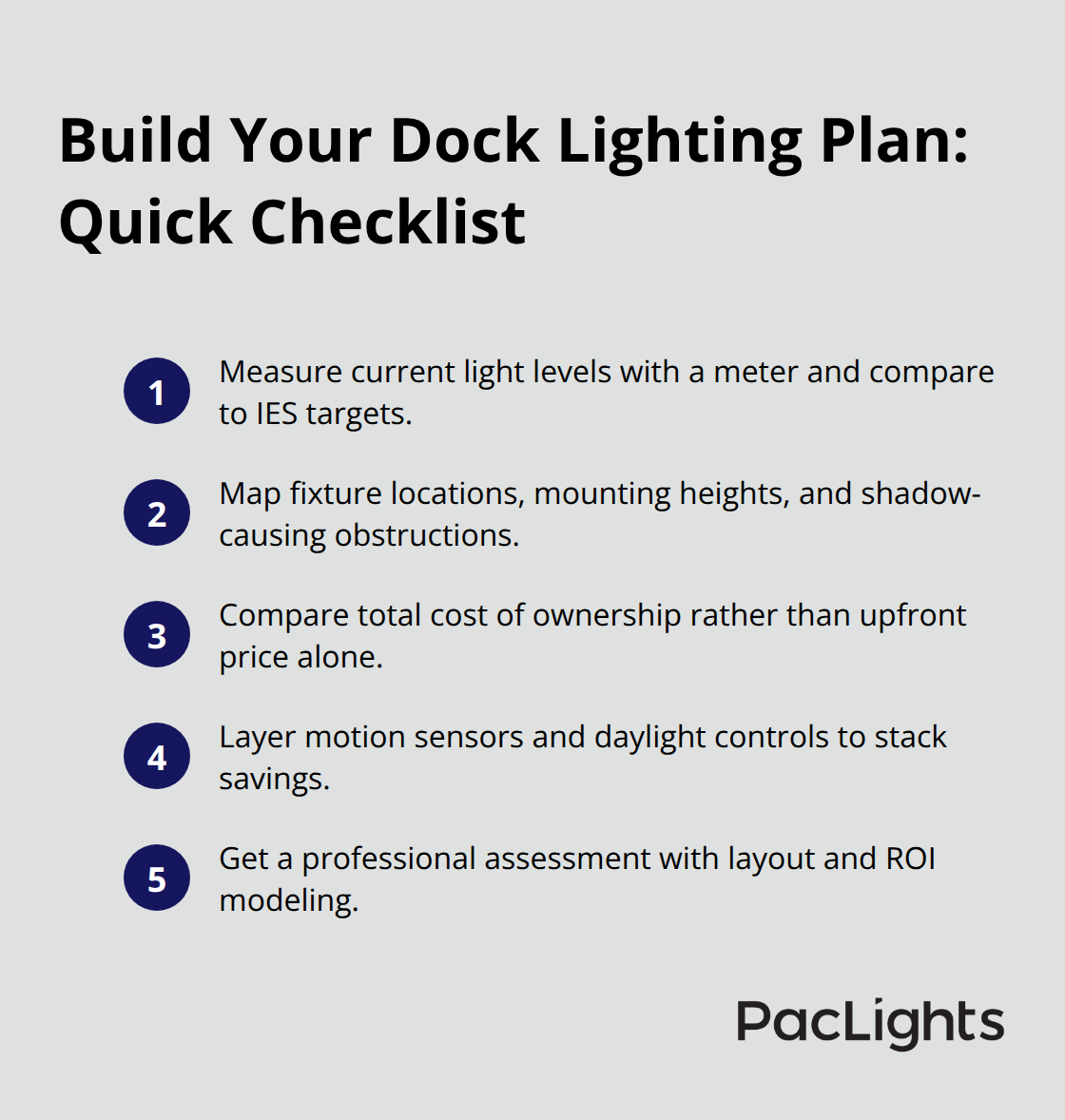
You need to measure the actual light levels across your dock with a simple light meter (available for $20-50 online) and compare readings to industry standards. The Illuminating Engineering Society recommends 50 foot-candles for general dock areas and 100 foot-candles for detailed inspection zones. Most warehouses fall well below these targets, especially in corners and around bay doors where shadows accumulate. Walk your dock at different times of day and note where workers struggle to see clearly, where accidents have occurred, and which areas rely on supplemental portable lights.
This assessment reveals your real gaps rather than assumptions. Photograph problem areas in natural lighting conditions to document current performance.
Map Your Dock Layout and Identify Obstructions
You should map your dock layout including fixture locations, mounting heights, and any obstructions like racking or equipment that cast shadows. This information becomes essential when evaluating replacement options because fixture placement matters as much as wattage. A poorly positioned LED fixture delivers better light than an outdated system in the wrong location, but optimal results require both proper positioning and the right equipment.
Calculate Total Cost of Ownership, Not Just Upfront Price
When evaluating LED retrofit options, compare total cost of ownership rather than upfront price alone. A 150-watt LED fixture costs more initially than an old metal halide unit, but operates for 50,000+ hours versus 15,000 hours for traditional bulbs, meaning fewer replacements over 10 years. You can calculate your specific payback using your current energy rates (check your utility bill for per-kilowatt-hour cost) and operating hours. At an average commercial rate of $0.12 per kilowatt-hour and 24/7 operation, switching a 400-watt fixture to a 150-watt LED saves approximately $2,200 annually in electricity alone.
Layer in Motion Sensors and Daylight Controls
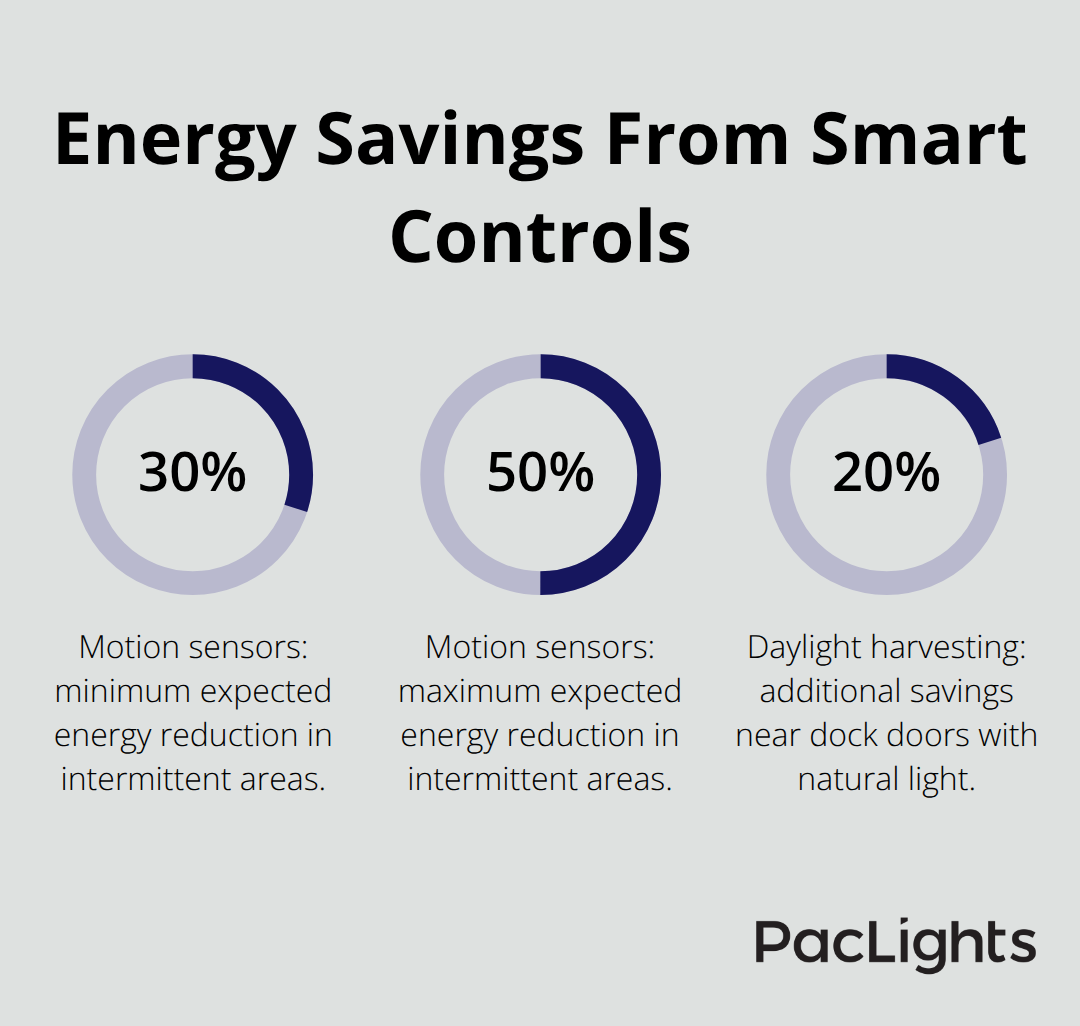
Motion sensors reduce run time by 30-50% in areas with intermittent activity like staging zones or secondary docks. Daylight harvesting systems sense exterior brightness and dim indoor fixtures accordingly, capturing additional savings in facilities with significant natural light near dock doors. These controls stack additional savings on top of the base LED efficiency gains and transform your operating costs further.
Get Professional Assessment Before You Commit
Your dock assessment reveals exactly where lighting gaps exist and what fixture configurations work best for your operation. Professional lighting layout designs and ROI assessments eliminate guesswork from your decision and show precisely what your facility saves with specific upgrades. With this data in hand, you can move forward with confidence toward implementation.
Making the Switch to LED Without Disrupting Operations
LED retrofit projects at working docks require careful sequencing to avoid halting your loading schedule. The smart approach involves upgrading fixtures in phases, starting with the lowest-traffic areas or secondary docks while keeping primary bays operational. Most facilities complete a full dock retrofit within 2-4 weeks depending on size, with installation crews working during off-peak hours or scheduling work around your busiest shipping windows.
Installation That Fits Your Schedule
Retrofit fixtures mount directly into existing infrastructure, allowing your electrician to install each unit in under an hour with minimal disruption to daily operations. Your team can coordinate installation timing to avoid peak shipping windows, spreading the work across multiple nights or weekends if needed. This phased approach means your dock stays productive throughout the transition.
Immediate Energy Savings Add Up Fast
Facilities switching from 400-watt metal halide systems to 150-watt LED fixtures report energy bills dropping by $2,200 annually per fixture at standard commercial rates of $0.12 per kilowatt-hour. Over a dock with 20 fixtures running 24/7, that translates to $44,000 in annual electricity savings alone. The payback period lands between 2-4 years, after which every dollar saved flows directly to your bottom line for the remaining 10-15 years of fixture life.
Advanced Controls Multiply Your Savings
Motion sensors cut energy consumption by 30-50% in staging areas and secondary docks where activity remains sporadic rather than constant. Daylight harvesting systems sense brightness near dock doors and automatically dim interior fixtures when natural light suffices, capturing 10-20% additional savings in facilities with significant window exposure.
These controls integrate into fixture design without requiring separate systems that complicate wiring and maintenance.
Calculate Your Specific ROI
Your facility’s actual operating hours, current energy costs, and dock layout determine the exact payback timeline. Most warehouses discover their retrofit investment pays for itself within 36 months while simultaneously improving worker safety and reducing injury-related downtime. Professional lighting layout designs and ROI assessments eliminate guesswork from your retrofit decision and reveal exactly which fixture types and placements deliver maximum performance for your unique dock configuration.
Final Thoughts
Your warehouse dock lights upgrade delivers measurable returns that extend far beyond the initial investment. The combination of improved worker safety, faster loading operations, and dramatically lower energy costs creates a business case that justifies action now rather than later. Facilities that switch to modern LED systems report 60-70% reductions in dock lighting energy consumption, translating to $2,200+ in annual savings per fixture at standard commercial rates.
A professional lighting assessment reveals the specific fixture types and placements that work best for your operation, eliminating guesswork from your retrofit decision. This data-driven approach shows your precise payback timeline and helps you sequence the upgrade to minimize disruption to your loading schedule. Understanding your current dock conditions and identifying exactly where lighting gaps exist starts the path forward.
We at PacLights specialize in helping warehouses transform their dock operations through energy-efficient LED retrofit solutions tailored to your facility’s unique needs. Our team provides free lighting layout designs and ROI assessments that show exactly what your warehouse saves with specific upgrades, and we offer advanced lighting controls including motion sensors and daylight harvesting systems that stack additional savings on top of base LED efficiency gains. Contact us at PacLights to schedule your dock assessment and start capturing the safety and cost benefits that modern lighting delivers.
Disclaimer: PacLights is not responsible for any actions taken based on the suggestions and information provided in this article, and readers should consult local building and electrical codes for proper guidance.