

Warehouse LED lighting ideas aren’t just about swapping out old bulbs. They’re about transforming how your facility operates, cuts costs, and keeps workers safe.
At PacLights, we’ve seen firsthand how the right lighting strategy can reduce energy bills by 50% or more while boosting productivity. This guide walks you through the fixtures, controls, and implementation steps that actually work.
How Much Can LED Warehouse Lighting Actually Save You
Energy Consumption Reductions That Impact Your Bottom Line
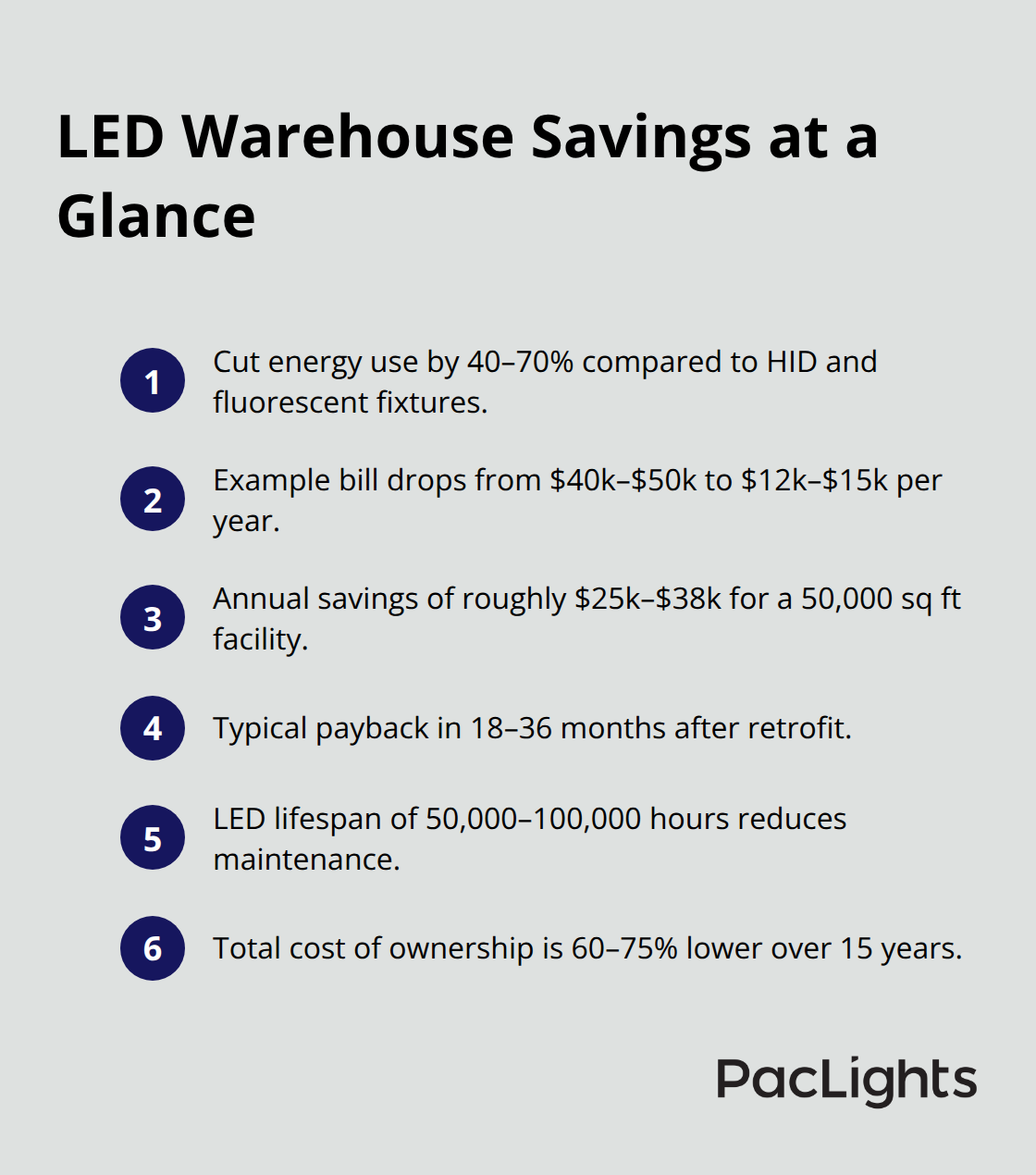
LED warehouse lighting cuts energy consumption by 40 to 70 percent compared to traditional high-intensity discharge and fluorescent fixtures, according to the U.S. Department of Energy. This isn’t a marginal improvement. A 50,000-square-foot warehouse running metal halide high bays 16 hours daily typically spends around 40,000 to 50,000 dollars annually on lighting electricity alone. Switching to LED high bays reduces that to roughly 12,000 to 15,000 dollars per year, translating to 25,000 to 38,000 dollars in annual savings.
Payback Periods That Justify the Investment
The payback period for most warehouse LED retrofits falls between 18 and 36 months, after which your facility operates on nearly pure savings. This timeline makes LED a financial necessity rather than an optional upgrade. The math works because LED fixtures consume substantially less power while delivering superior light quality and consistency.
Extended Lifespan Compounds Your Savings
Traditional metal halide and high-pressure sodium fixtures last 15,000 to 20,000 hours, while LED warehouse fixtures deliver 50,000 to 100,000 hours of operation. This means fewer replacement cycles, lower labor costs for maintenance crews, and reduced inventory management for spare parts. A facility replacing 200 high bays every five years spends thousands on labor, equipment rental, and downtime. LED fixtures eliminate most of this burden for 10 to 15 years.
Consistent Light Output Reduces Over-Installation
Traditional fixtures experience significant lumen depreciation after 8,000 to 10,000 hours, forcing warehouse managers to over-install fixtures to maintain required illumination levels. This inflates initial costs unnecessarily. LED’s stable output means you install exactly what you need, nothing more (no excess capacity sitting idle). When you factor in energy savings, maintenance reduction, and extended replacement intervals, total cost of ownership for LED systems runs 60 to 75 percent lower than traditional alternatives over a 15-year period.
What Controls Add to Your Savings Potential
Advanced lighting controls like motion sensors and daylight harvesting features amplify these financial gains even further. These systems prevent unnecessary operation during unoccupied periods or when natural light suffices, pushing energy reductions beyond the baseline LED advantage.
Advanced Controls That Cut Energy Waste
Motion Sensors Eliminate Wasted Hours in Low-Traffic Areas
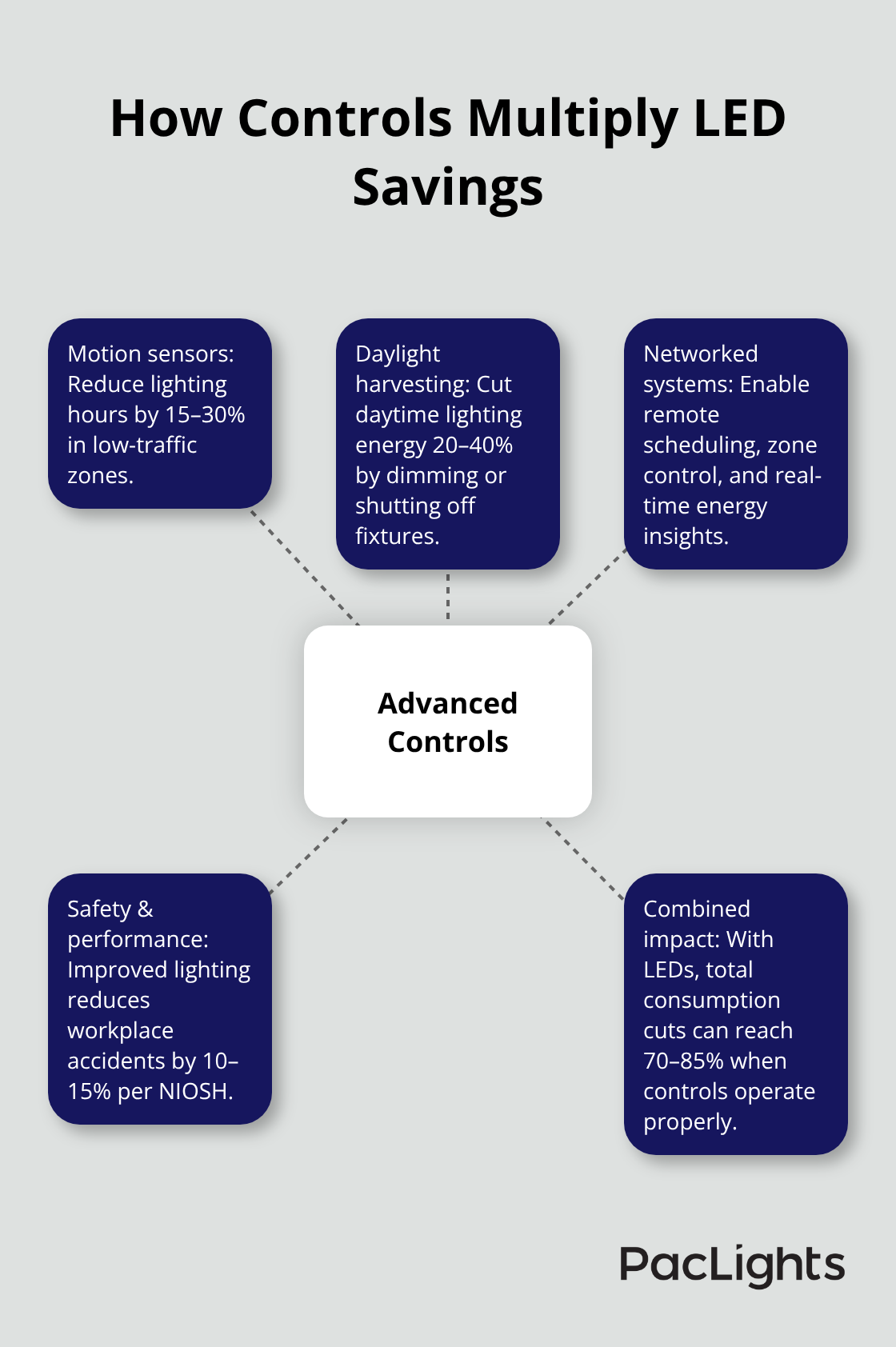
Motion sensors and daylight harvesting systems transform passive LED installation into active energy optimization. A warehouse with motion sensors reduces lighting hours by 15 to 30 percent in low-traffic areas like storage aisles and administrative zones, according to energy studies from the Illuminating Engineering Society. If your facility runs 16 hours daily, motion sensors prevent 2 to 5 unnecessary hours of operation per day in spaces that sit empty for extended periods.
That compounds to 730 to 1,825 wasted hours annually per zone. The financial impact alone justifies the sensor investment within months.
Daylight Harvesting Captures Natural Light Advantages
Daylight harvesting works through a different mechanism but delivers comparable results. Photosensors detect natural light levels during daylight hours and automatically dim or shut off artificial fixtures. A warehouse with significant window exposure can reduce daytime lighting energy consumption by 20 to 40 percent. The combination of both technologies pushes total energy reduction beyond the baseline LED advantage, making your 50 to 70 percent consumption cut potentially reach 70 to 85 percent when controls operate properly.
Networked Systems Provide Real-Time Visibility and Control
Networked lighting control systems eliminate the guesswork from managing distributed fixtures across large facilities. Unlike standalone motion sensors that operate independently, networked systems allow you to monitor and adjust lighting zones remotely through a central interface or mobile application. You can modify schedules instantly without physically visiting each fixture, respond to seasonal changes without manual intervention, and gather real-time data on energy consumption patterns across your warehouse. This visibility helps you identify inefficiencies before they accumulate into significant expenses.
Better Illumination Improves Safety and Worker Performance
Properly calibrated controls maintain consistent light levels in high-traffic areas and reduce eye strain during extended shifts. Studies from the National Institute for Occupational Safety and Health show that improved lighting reduces workplace accidents by 10 to 15 percent, lowering injury-related costs and insurance premiums. Workers in well-lit environments complete tasks faster and make fewer errors, directly increasing operational efficiency and output quality. These safety and productivity gains often exceed the energy savings alone.
Selecting the Right Control Strategy for Your Facility
The control approach you select depends on your warehouse layout, occupancy patterns, and budget constraints. High-traffic areas benefit most from networked systems that provide granular control, while storage zones perform well with basic motion sensors. PacLights offers LED fixtures with optional daylight and motion control features, plus advanced networked lighting controls to optimize energy use across your entire facility. Understanding which areas waste the most energy helps you prioritize control installation and maximize your return on investment before you move forward with fixture selection.
Which LED Fixtures Work Best in Each Warehouse Zone
High Bay Lights for Tall Storage Areas
High bay lights dominate tall storage areas because they cast light downward from 20 to 40 feet without creating dark spots or excessive glare. These fixtures typically deliver 100 to 150 lumens per watt, which means a single high bay illuminates 1,000 to 2,000 square feet effectively. The Illuminating Engineering Society recommends 30 to 50 foot-candles for warehouse storage areas, and high bays achieve this consistently without over-lighting. Installation height matters significantly: fixtures mounted at 25 feet need different beam angles than those at 35 feet. Calculate your mounting height first, then select high bays with matching beam spreads to avoid wasting light on walls or creating dead zones between fixtures.
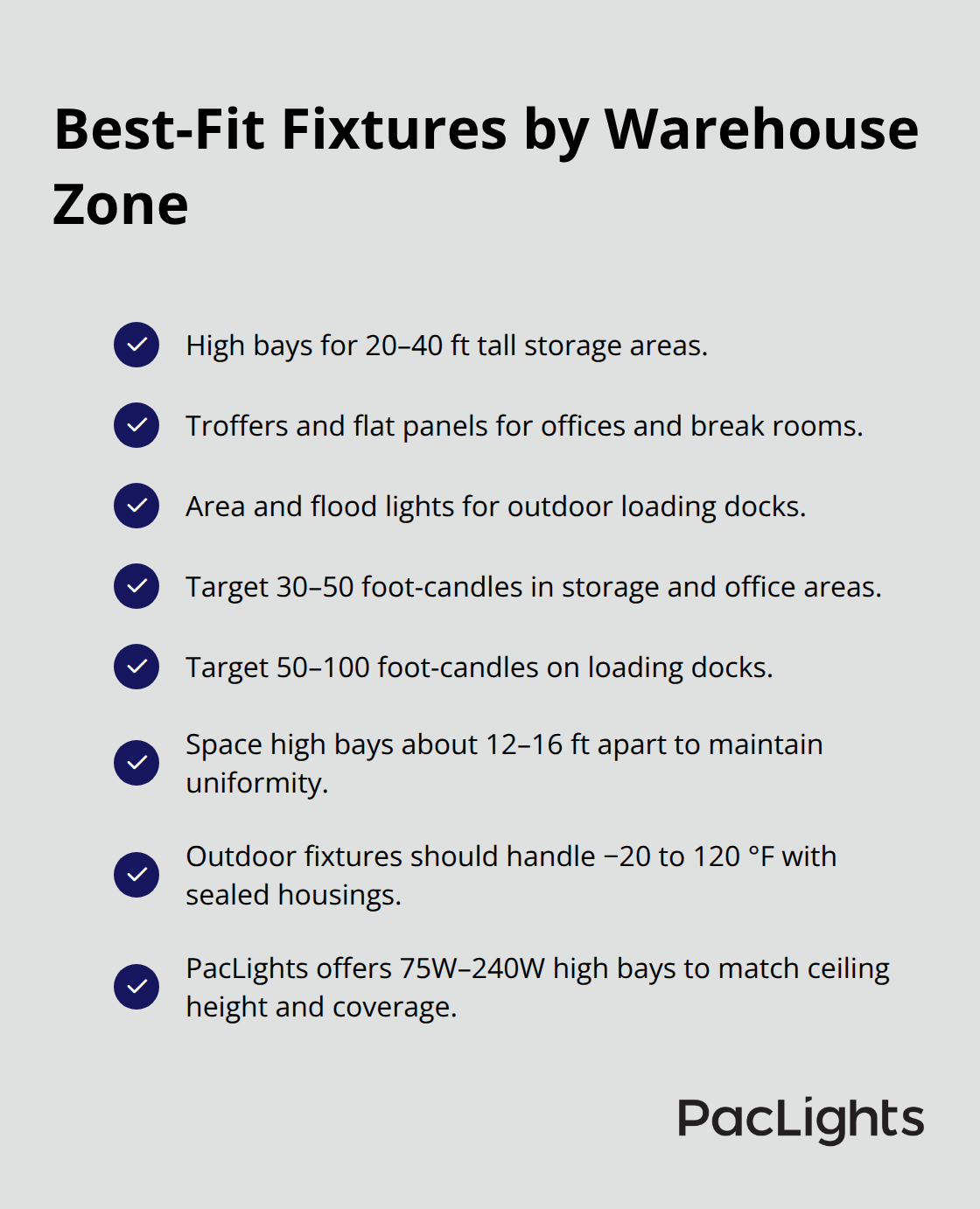
Most warehouses benefit from spacing high bays 12 to 16 feet apart in grid patterns, which prevents shadows and maintains uniform brightness. PacLights provides high bay fixtures in various wattages from 75W to 240W, allowing you to match your specific ceiling height and coverage area without oversizing.
Troffer and Flat Panel Lights for Office Spaces
Administrative offices and break rooms inside warehouses require different lighting entirely. Troffer lights and flat panel lights work better here because they distribute light evenly across desk surfaces and reduce ceiling glare that causes eye strain during extended work periods. These fixtures typically mount flush or semi-recessed into drop ceilings and deliver 80 to 100 lumens per watt. The Illuminating Engineering Society recommends 30 to 50 foot-candles for office work, but flat panels maintain consistent output without the flickering issues common with older fluorescent troffers. Flat panels also provide color rendering indexes above 90, which means colors appear natural and accurate for paperwork, computer screens, and quality inspections.
Area Lighting and Flood Lights for Loading Docks
Outdoor loading docks present a distinct challenge. Area lighting and flood lights must withstand weather exposure while delivering enough brightness for forklift operators and dock workers to see clearly. These fixtures handle temperatures from minus 20 to plus 120 degrees Fahrenheit and resist moisture ingress through sealed housings. Typical dock areas need 50 to 100 foot-candles depending on whether workers handle small parts or large pallets. Flood lights positioned 15 to 25 feet high cover loading zones 60 to 100 feet wide, eliminating shadows where accidents happen. PacLights offers area lighting and flood lights with optional motion sensors that reduce energy consumption when docks sit empty between shifts, since many warehouses operate loading areas only during specific hours rather than continuously.
Final Thoughts
Warehouse LED lighting ideas start with a thorough assessment of your current facility. Walk through your warehouse and document ceiling heights, fixture spacing, occupancy patterns, and areas where workers spend the most time. Photograph problem zones where shadows create safety hazards or where over-lighting wastes energy, as this information becomes the foundation for calculating your potential savings and identifying which fixture types and control strategies deliver the biggest financial impact.
Selecting the right fixtures becomes straightforward once you understand your facility’s lighting needs. High bays work for tall storage areas, troffers and flat panels suit administrative spaces, and area lights handle outdoor loading docks (the key is matching fixture specifications to your specific mounting heights and coverage requirements rather than defaulting to standard sizes). Oversizing fixtures wastes energy and money from day one, so prioritize high-energy areas first, then expand to secondary zones where motion sensors and daylight harvesting in low-traffic storage areas deliver fast payback periods.
Contact PacLights to schedule a free lighting layout design and ROI assessment that removes the guesswork from your retrofit process. Our team evaluates your facility, recommends specific fixtures and controls tailored to your needs, and shows you exactly what your savings will look like. Start transforming your warehouse into an energy-efficient operation today.
Disclaimer: PacLights is not responsible for any actions taken based on the suggestions and information provided in this article, and readers should consult local building and electrical codes for proper guidance.