

NSF certification lighting guidance isn’t optional for facilities handling food, pharmaceuticals, or drinking water. These standards exist because contamination risks are real, and the wrong lighting can compromise safety protocols.
At PacLights, we’ve seen how proper NSF-certified lighting transforms facility compliance from a headache into a straightforward process. This guide walks you through what certification means, which standards apply to your industry, and how to implement solutions that actually work.
What NSF Certification Actually Protects
NSF International started in 1944 as a nonprofit organization focused on public health and safety standards. Today, the organization maintains over 70 standards across multiple industries, with lighting standards representing a critical subset for facilities where contamination poses genuine risks. NSF certification isn’t a marketing label-it’s a third-party verification that your lighting meets specific safety and sanitation requirements established by engineers, regulators, and industry experts.
The verification process and what it confirms
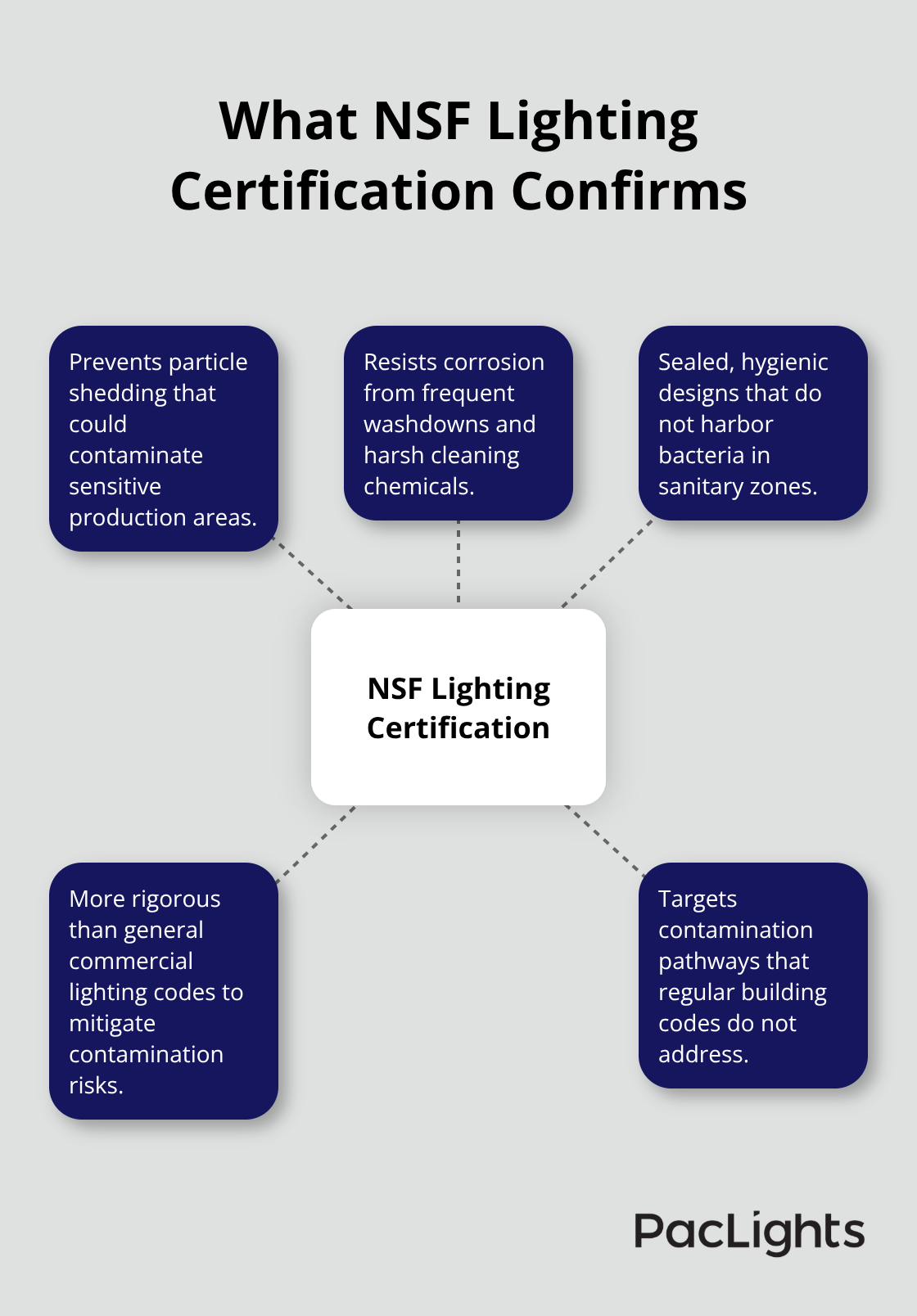
When a facility displays NSF-certified lighting, independent testing has confirmed the fixtures won’t shed particles, corrode, or harbor bacteria in sensitive environments. This distinction matters because standard commercial lighting fixtures lack the design features needed for food processing, pharmaceutical manufacturing, or water treatment operations. NSF standards are more rigorous than general commercial lighting codes because they address contamination pathways that regular building codes ignore.
Why facilities need NSF certification beyond compliance
Food facilities operating under FDA regulations must demonstrate that equipment-including lighting-meets NSF standards as part of their HACCP plans. A single lighting fixture shedding plastic or metal particles into a food production line creates liability that extends far beyond the immediate batch. Pharmaceutical manufacturers face even stricter requirements under cGMP guidelines, where NSF certification documents that lighting won’t introduce contaminants into sterile manufacturing areas.
Water utilities must comply with NSF/ANSI standards because drinking water treatment involves chemicals and processes where lighting materials could leach harmful substances. The reality is that NSF certification reduces your facility’s risk of product recalls, regulatory fines, and operational shutdowns. Without certified fixtures, you operate with incomplete documentation during inspections, which regulators view as a compliance gap.
How NSF differs from other lighting standards
NSF standards focus specifically on sanitation and contamination prevention, whereas standards like UL (Underwriters Laboratories) or IEC primarily address electrical safety and performance. A fixture can be UL-listed for electrical safety but fail NSF requirements because its materials or design allow bacterial growth or particle shedding. OSHA standards set workplace safety minimums but don’t address the contamination risks specific to food or pharmaceutical environments.
ISO standards vary widely depending on which ISO specification applies, and many aren’t designed for North American regulatory frameworks. NSF certification requires testing for corrosion resistance, material compatibility with cleaning chemicals, and structural integrity under sanitization procedures-tests that general electrical standards don’t include. Choosing lighting based on UL certification alone in a food facility leaves you vulnerable because you’ve addressed electrical safety but ignored sanitation requirements.
Moving from standards to implementation
The NSF mark on a fixture tells you that independent testing confirmed it won’t compromise your facility’s safety protocols in ways that other certifications simply don’t measure. Understanding these distinctions prepares you to evaluate which specific NSF standards apply to your operation and what compliance requirements your facility must meet.
NSF Standards That Apply to Your Facility
NSF/ANSI 51 for Food Service and Processing
NSF/ANSI 51 governs lighting in food service and food processing environments, requiring fixtures to withstand frequent washdowns with chlorinated chemicals, hot water, and acidic cleaners without corroding or shedding particles. The standard demands that all materials touching food contact surfaces meet specific corrosion resistance levels, and lighting must remain sealed to prevent moisture infiltration that breeds bacteria. Food facilities inspected under FDA guidelines must display NSF/ANSI 51 certification on overhead fixtures, particularly in prep areas, processing lines, and cold storage zones where contamination risks spike. Without certified fixtures in these zones, inspectors flag your facility as non-compliant, and you face either remediation timelines or operational restrictions.
NSF Standards for Pharmaceutical Manufacturing
Pharmaceutical manufacturers operate under cGMP regulations that reference NSF standards for cleanroom and manufacturing area lighting, though specific requirements depend on your product classification and manufacturing process. These standards protect sterile environments from particle contamination that could compromise product integrity. The regulatory framework treats lighting as part of your overall contamination control strategy, not as a separate electrical component.
NSF/ANSI 2 for Water Treatment Operations
Water treatment utilities must comply with NSF/ANSI 2, which certifies that lighting materials won’t leach harmful chemicals into drinking water systems when exposed to treatment chemicals like chlorine, ozone, or aluminum sulfate. This standard matters because standard aluminum housings corrode rapidly in chemical-heavy environments, creating rust particles that contaminate treated water. Testing for NSF/ANSI 2 includes immersion tests where fixture materials sit in actual treatment chemicals for extended periods, confirming they maintain structural integrity and don’t release contaminants.
Testing Timelines and Certification Costs
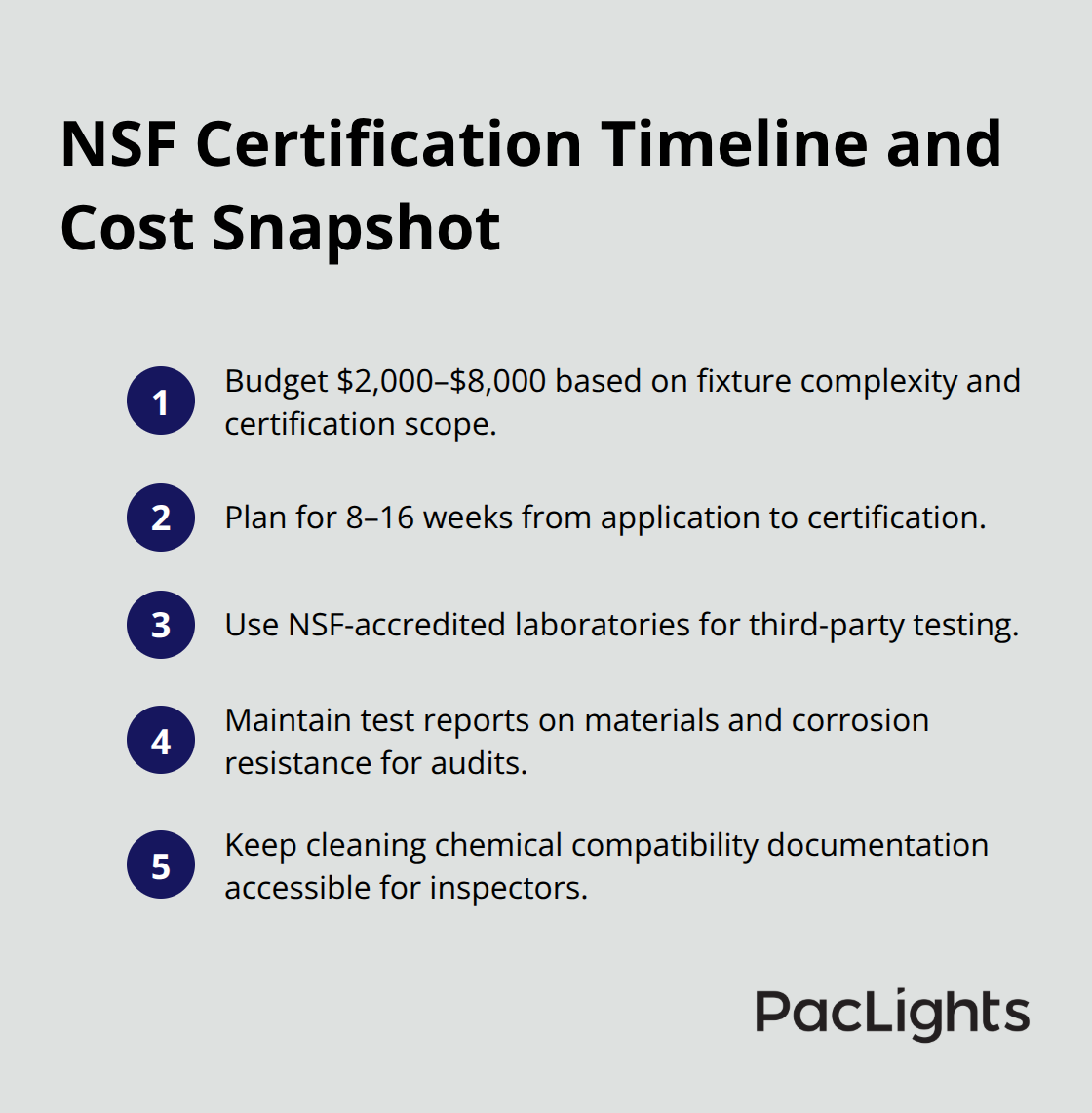
Getting NSF certification requires third-party testing conducted by NSF-accredited laboratories, which typically costs between $2,000 and $8,000 depending on fixture complexity and whether you certify a single model or a product line. The testing process takes 8 to 16 weeks from application to certification, so facilities planning upgrades must account for this timeline. Documentation for certified fixtures includes test reports confirming material composition, corrosion resistance data, and cleaning chemical compatibility results that your facility must maintain during regulatory inspections.
Maintaining Certification Through Parts and Documentation
You must verify that replacement parts meet the same standards, because swapping in a non-certified ballast or lens voids your fixture’s certification status. When evaluating lighting suppliers, request the actual NSF testing documentation rather than relying on marketing claims, as some manufacturers misrepresent certification scope or apply older test results to updated product designs. Maintaining complete documentation and verified parts availability protects your compliance status long-term, eliminating scenarios where a simple maintenance need creates a compliance gap. Understanding these specific standards and their testing requirements positions you to evaluate which lighting solutions actually meet your facility’s regulatory obligations.
Industries and Applications Requiring NSF Certified Lighting
Food Processing and Commercial Kitchen Facilities
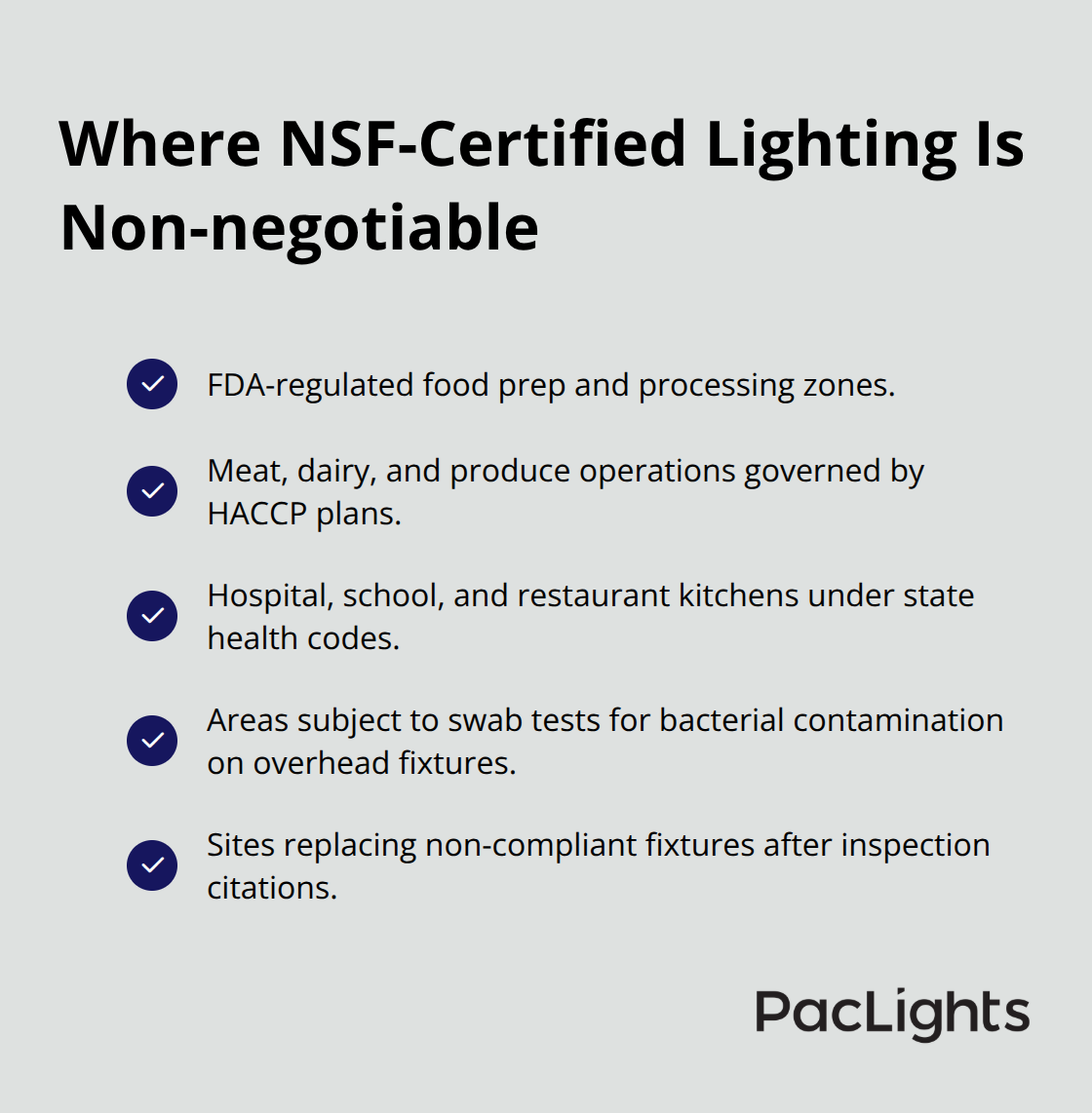
Food processing facilities operate under FDA regulations that treat lighting as a critical control point in HACCP plans, meaning fixtures must withstand constant exposure to sanitizing chemicals, high-pressure washdowns, and temperature fluctuations without degrading or particles. NSF/ANSI 51 certification remains non-negotiable in meat processing plants, dairy facilities, or produce packaging operations because a single corroded fixture housing or loose lens contaminates an entire production batch. The FDA’s Food Safety Modernization Act requires facilities to document that equipment, including lighting, meets NSF standards during inspections.
Commercial kitchens in hospitals, schools, and restaurants operate under state health codes that mandate NSF/ANSI 51 compliance, particularly in food prep areas where inspectors conduct swab tests on overhead fixtures to detect bacterial contamination. Many facilities face non-compliance citations during inspections when standard commercial fixtures installed in food zones create immediate violations, forcing costly emergency replacements with tight timelines.
Pharmaceutical Manufacturing Environments
Pharmaceutical manufacturers face stricter contamination controls because their operations involve sterile environments where a single particle compromises an entire batch of medication or injectable products. cGMP regulations require that cleanroom lighting fixtures prevent particle shedding and withstand frequent sanitization with isopropyl alcohol and other aggressive disinfectants without material degradation. These standards protect sterile environments from particle contamination that could compromise product integrity and patient safety.
Water Treatment and Utility Operations
Water utilities treating drinking water must comply with NSF/ANSI 2 standards because fixture materials exposed to chlorine, ozone, and chemical coagulants leach contaminants into treated water supplies. NSF/ANSI 2 testing includes immersion protocols where fixture components sit in actual treatment chemicals for extended periods, simulating real-world exposure that standard electrical certifications ignore. Utilities that cut corners on lighting certification face potential violations under the Safe Drinking Water Act, which holds them accountable for any chemical contamination traced to equipment materials.
Fixture materials must maintain structural integrity when exposed to treatment chemicals (chlorine, aluminum sulfate, and ozone among others), preventing rust particles or chemical leaching that standard aluminum housings cannot withstand. Specifying NSF/ANSI 2 certified fixtures eliminates the compliance gaps that create regulatory friction during inspections and operational shutdowns.
Final Thoughts
NSF certification lighting guidance cuts through compliance confusion by establishing clear requirements that protect your facility from contamination risks, regulatory fines, and operational shutdowns. The standards we’ve covered-NSF/ANSI 51 for food processing, NSF standards for pharmaceutical manufacturing, and NSF/ANSI 2 for water treatment-aren’t bureaucratic obstacles. They represent documented proof that your lighting won’t compromise product safety or violate federal regulations during inspections.
Selecting NSF certified fixtures requires verifying actual third-party testing documentation rather than accepting manufacturer claims. Request the NSF testing reports, confirm that replacement parts maintain certification status, and ensure your supplier can provide documentation for regulatory audits. The investment in certified fixtures pays for itself by eliminating compliance gaps that inspectors identify and the emergency replacements that follow non-compliance citations.
Implementation starts with identifying which NSF standards apply to your specific operations (food facilities need NSF/ANSI 51 compliance in prep areas and processing zones, pharmaceutical manufacturers must address cleanroom contamination controls, and water utilities require NSF/ANSI 2 certified materials that withstand chemical exposure). Once you’ve determined your requirements, work with suppliers who understand these distinctions and can deliver fixtures with complete certification documentation. Visit PacLights to explore fixtures designed for your facility’s specific NSF compliance needs and begin your implementation timeline.
Disclaimer: PacLights is not responsible for any actions taken based on the suggestions and information provided in this article, and readers should consult local building and electrical codes for proper guidance.