

Commercial spaces demand lighting that works as hard as your business does. Recessed commercial downlights deliver the clean aesthetics and performance that modern facilities need, without the clutter or wasted energy.
At PacLights, we’ve seen firsthand how the right lighting transforms both the look and operating costs of commercial environments. This guide walks you through why these fixtures matter and how to make them work for your space.
Why Recessed Downlights Transform Commercial Spaces
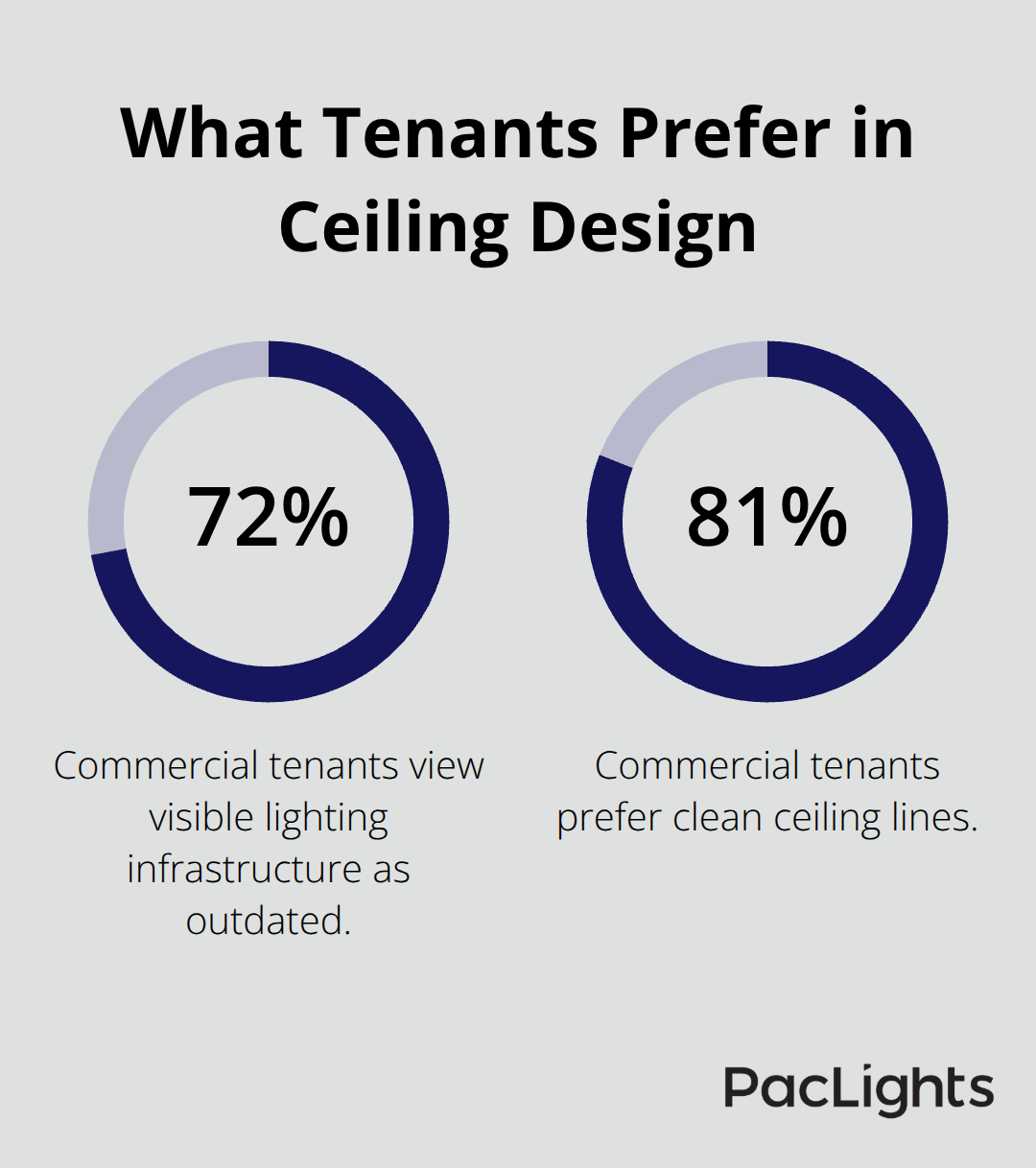
Recessed downlights vanish into your ceiling, which means your space looks intentional rather than cluttered with visible fixtures. This matters more than aesthetics alone. When lighting fixtures disappear into the architecture, clients and customers focus on your business, not the hardware overhead. Facilities managers across retail, healthcare, and office environments report consistent feedback: recessed fixtures make spaces feel more professional and controlled. A 2023 study from the International Association of Lighting Designers found that 72% of commercial tenants view visible lighting infrastructure as outdated, while 81% prefer clean ceiling lines. That preference directly affects how people perceive your facility’s quality.
The Real Space Advantage
Recessed downlights mount flush with your ceiling, eliminating the depth required by surface-mounted or pendant fixtures. In commercial spaces where ceiling height matters, this changes everything. A 10-foot ceiling with recessed lighting feels different from one crowded with hanging fixtures. Office buildings, retail stores, and warehouses all benefit from this clearance. Installation into existing drop ceilings requires minimal effort because recessed fixtures work with standard ceiling grids. If you’re renovating or upgrading, you avoid tearing out infrastructure-you work within it. This approach delivers faster installation timelines and lower labor costs compared to rewiring for entirely new fixture types.
Lighting That Adapts to Your Needs
Different commercial spaces need different light distributions. Recessed downlights come in various beam angles and color temperatures, so a narrow beam concentrates light on merchandise in retail settings, while a wider beam spreads illumination evenly across an office floor. Optional motion sensors and daylight controls allow your lighting to respond to actual occupancy and natural light levels rather than running on fixed schedules. A conference room with south-facing windows reduces artificial light during midday hours, automatically increasing it as daylight fades. Parking areas and warehouses benefit from motion-triggered lighting that activates only when movement is detected (eliminating wasted energy in unoccupied zones). This flexibility addresses real operational challenges without requiring complex rewiring or multiple fixture types.
Why Energy Efficiency Matters Now
LED recessed downlights consume significantly less power than traditional incandescent or fluorescent fixtures. The U.S. Department of Energy reports that LED lighting uses 75% less energy than incandescent bulbs while lasting 25 times longer. For commercial facilities running lights 12+ hours daily, this difference compounds quickly. A typical office space with 50 recessed fixtures switching from fluorescent to LED can reduce annual energy costs by thousands of dollars. Motion sensors and daylight controls amplify these savings further by preventing unnecessary operation. These controls work particularly well in spaces with variable occupancy (conference rooms, restrooms, storage areas) where lights often run without anyone present.
Moving Forward With Your Lighting Strategy
The combination of aesthetic appeal, space efficiency, and energy savings makes recessed downlights a practical choice for commercial upgrades. Your next step involves assessing your current lighting layout and identifying which spaces benefit most from this transition.
How Much Can LED Recessed Downlights Save Your Facility?
LED recessed downlights cut energy consumption dramatically compared to what most commercial facilities currently operate. The U.S. Department of Energy confirms that LED fixtures use 75% less energy than incandescent bulbs, and they outlast fluorescents by a significant margin. For a commercial space running 50 recessed fixtures for 12 hours daily, switching from fluorescent to LED typically reduces annual energy bills by $3,000 to $5,000 depending on local electricity rates and fixture wattage. That’s real money that goes directly to your bottom line. A 40-watt fluorescent downlight consumes roughly 480 kilowatt-hours annually in a 12-hour operation schedule, while an equivalent LED fixture uses only 120 kilowatt-hours. Across a 10,000-square-foot office or retail space with 80 fixtures, the annual energy difference reaches 28,800 kilowatt-hours. At the U.S. average commercial electricity rate of approximately $0.12 per kilowatt-hour, that translates to $3,456 in annual savings before any rebate programs.
Payback Timelines That Make Financial Sense
Most facilities recoup their LED retrofit investment within three to five years through energy reduction alone, after which every operating year becomes pure savings. LED recessed downlights last 25,000 to 50,000 hours compared to 8,000 hours for fluorescent tubes, which means fewer replacement cycles and dramatically lower maintenance labor. A facility replacing fluorescent fixtures every two years switches to a five-year or longer replacement interval with LEDs, eliminating recurring labor expenses and downtime.
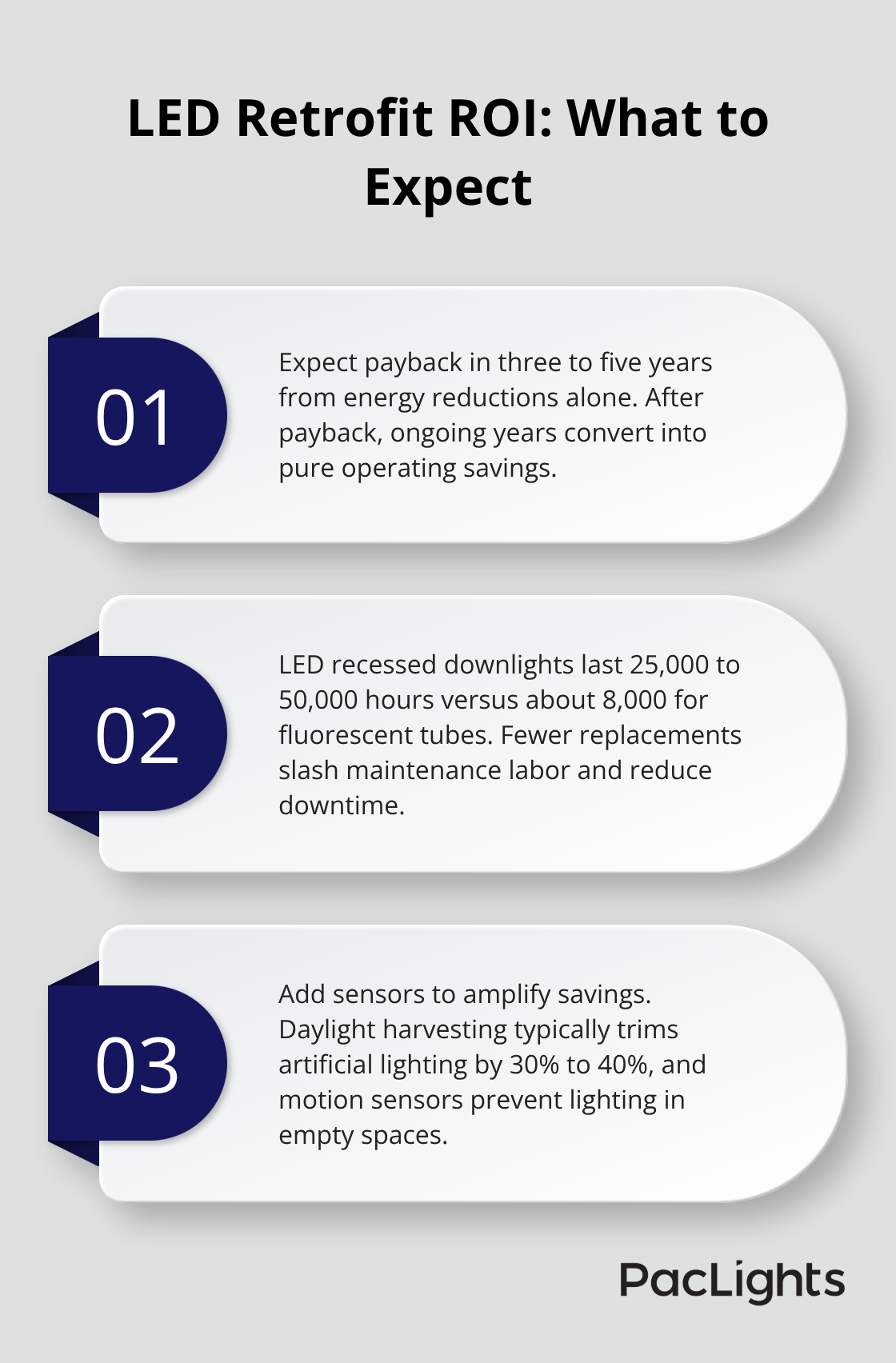
Motion sensors and daylight controls amplify these savings further. A conference room with automatic daylight harvesting reduces artificial lighting by 30% to 40% during daylight hours, while motion sensors in restrooms and storage areas eliminate lighting in spaces that sit empty for extended periods.
Controls That Optimize Real Occupancy Patterns
Motion sensors and daylight controls work particularly well in facilities with variable occupancy patterns where manual switching isn’t reliable. These controls respond to actual conditions rather than fixed schedules, preventing operation in unoccupied spaces. When combined, energy reduction from LED technology plus optimization from sensors typically delivers 40% to 50% total energy savings compared to older fixture systems. Facilities in states with aggressive energy efficiency rebate programs often qualify for $15 to $30 per fixture in utility rebates, which accelerates payback timelines considerably.
Environmental Impact and Operational Reality
LED recessed downlights generate measurable carbon footprint reduction because they consume less electricity and require fewer replacements. A typical commercial facility with 100 recessed fixtures operating 12 hours daily produces approximately 15 metric tons of carbon dioxide annually from electricity consumption with fluorescent fixtures, dropping to roughly 3.75 metric tons with LED technology. That 11.25-ton annual reduction compounds over the fixture lifespan, delivering significant environmental impact. Fewer replacement cycles also mean less waste enters landfills. Fluorescent tubes contain trace amounts of mercury and require proper disposal, adding compliance costs and environmental concern. LED fixtures contain no mercury and present minimal disposal challenges. For facility managers tracking sustainability commitments or corporate environmental goals, LED recessed downlights provide measurable progress toward carbon reduction targets. The financial and environmental benefits align completely, eliminating any tradeoff between cost control and environmental responsibility.
Making the Upgrade Decision
The numbers support LED conversion, but implementation requires understanding your current fixture inventory and space-specific needs. Different commercial environments benefit from different beam angles, color temperatures, and control options-factors that affect both performance and final savings calculations.
Installation, Maintenance, and Advanced Controls
Quick Installation Into Existing Ceilings
Recessed downlights mount directly into standard ceiling grids without structural modifications or extensive rewiring. A single technician installs 10 to 15 recessed fixtures per day in a typical office environment, meaning a 50-fixture retrofit completes in three to four days rather than weeks. The fixture housing sits above the ceiling plane while the trim ring and lens sit flush below, so no special framing or reinforcement is needed for most commercial ceilings rated for standard fixture loads. Existing electrical runs often work with new LED fixtures through simple ballast removal and rewiring, eliminating the need to run entirely new circuits. This approach keeps labor costs down and minimizes operational disruption.
Long Lifespan Reduces Replacement Cycles
LED recessed downlights last 25,000 to 50,000 hours depending on quality and operating conditions, which translates to 8 to 16 years of continuous operation in a typical 12-hour daily schedule. That lifespan dramatically reduces maintenance frequency compared to fluorescent fixtures requiring replacement every two years. A facility with 80 recessed fixtures switches from replacing 40 tubes annually to replacing perhaps 5 to 10 LED fixtures across the entire lifespan, eliminating recurring labor expenses and the associated downtime.
Motion Sensors Eliminate Wasted Operation
Motion sensors activate lighting only when movement is detected and shut off after 15 to 20 minutes of inactivity, preventing operation during lunch breaks or after meetings end. A parking garage with motion-triggered recessed downlights operates only in actively used areas, eliminating lighting in empty sections and reducing annual energy consumption by 50 percent or more. Wireless motion sensors avoid the cost and complexity of running control wiring through existing ceilings, making retrofits faster and cheaper. Facilities in states offering utility rebates for motion sensors often receive $5 to $15 per control in incentives, which further accelerates return on investment.
Daylight Harvesting Cuts Artificial Light Proportionally
Daylight harvesting sensors measure incoming natural light and reduce artificial illumination proportionally, which cuts energy use by 30 to 40 percent in spaces with significant window exposure. These controls integrate into standard recessed fixtures through wired or wireless installation depending on your facility infrastructure. Conference rooms with south-facing windows reduce artificial light during midday hours, automatically increasing it as daylight fades. The combination of motion sensors and daylight controls (when deployed together) typically delivers 40 to 50 percent total energy savings compared to older fixture systems.
Advanced Controls for Centralized Management
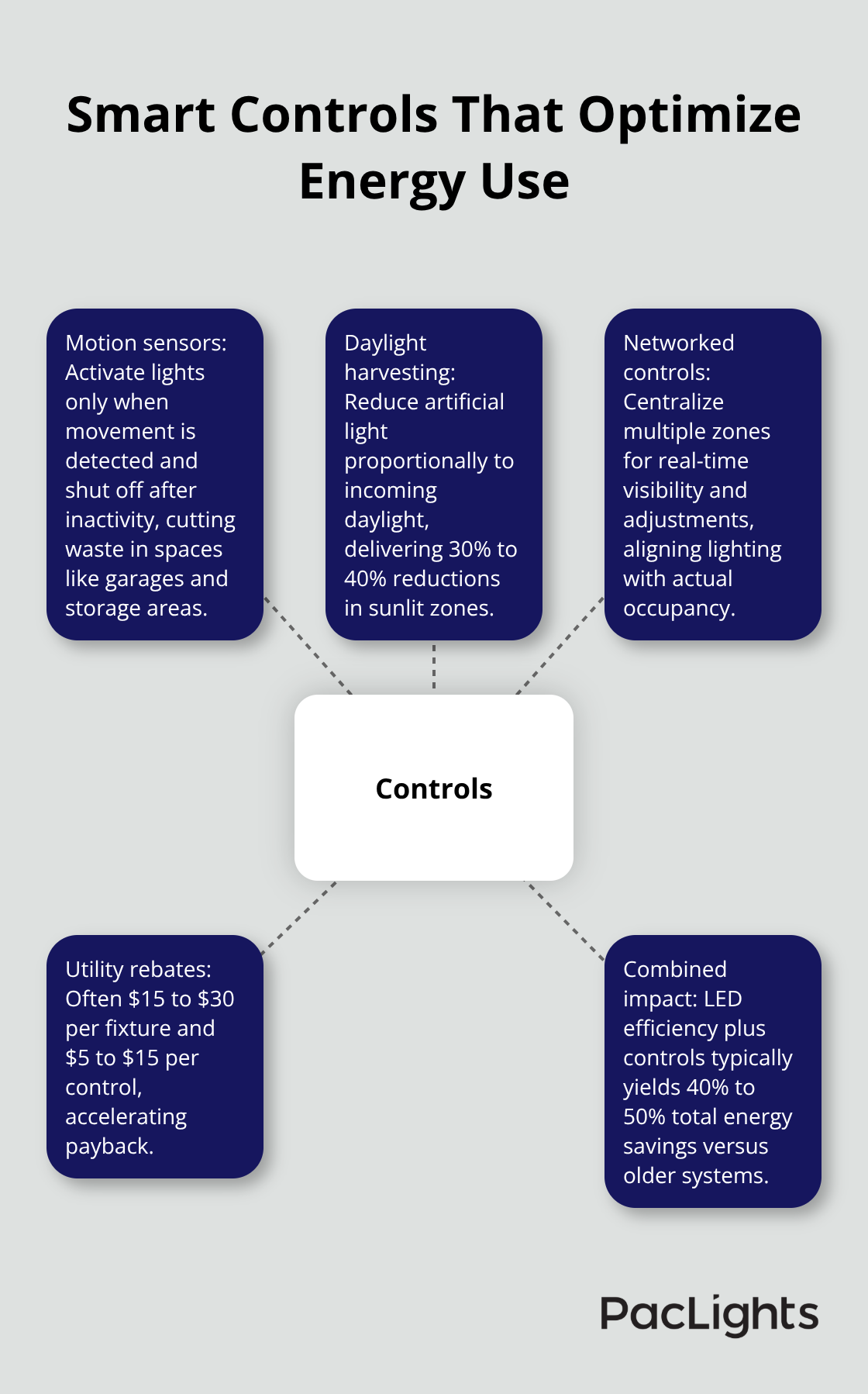
Networked lighting controls allow centralized management of multiple zones from a single interface, giving facility managers real-time visibility into energy consumption and fixture performance. PacLights offers advanced lighting controls alongside motion and daylight control options on recessed downlights, providing the flexibility to optimize energy use across your entire facility. These systems respond to actual conditions rather than fixed schedules, preventing operation in unoccupied spaces and matching illumination to real occupancy patterns.
Final Thoughts
Recessed commercial downlights address three business priorities at once: professional appearance, lower operating costs, and reliable performance. A typical commercial space reduces energy consumption by 75% when switching from older fixtures to LED recessed downlights, which translates to thousands of dollars in annual savings. Motion sensors and daylight controls amplify those savings further by preventing operation in unoccupied spaces and matching illumination to actual conditions rather than fixed schedules.
Installation into existing ceiling systems happens quickly without structural modifications or extensive rewiring, which minimizes operational disruption during the upgrade process. The payback timeline of three to five years means your facility operates at lower cost for the remainder of the fixture lifespan, which extends 25,000 to 50,000 hours depending on quality and conditions. Recessed downlights also deliver the clean aesthetic that commercial tenants and customers expect, making spaces feel intentional and professional rather than cluttered with visible infrastructure.
We at PacLights provide free lighting layout designs and ROI assessments to help you understand exactly what your facility will save before you commit to any investment. Our recessed downlights come with optional motion and daylight controls, plus advanced networked lighting controls that give you centralized management across multiple zones. Request a free lighting assessment for your facility and explore how recessed commercial downlights perform in your specific space.
Disclaimer: PacLights is not responsible for any actions taken based on the suggestions and information provided in this article, and readers should consult local building and electrical codes for proper guidance.