

Harsh environments demand lighting that won’t fail when you need it most. Corrosion, moisture, and chemical exposure destroy standard fixtures within months, but IP-rated vapor tight solutions stand up to these conditions for years.
At PacLights, we’ve seen facilities lose production time and money because their lighting wasn’t built for the job. The right protection makes all the difference.
What IP Ratings Actually Protect
The Two-Digit System That Tells You Everything
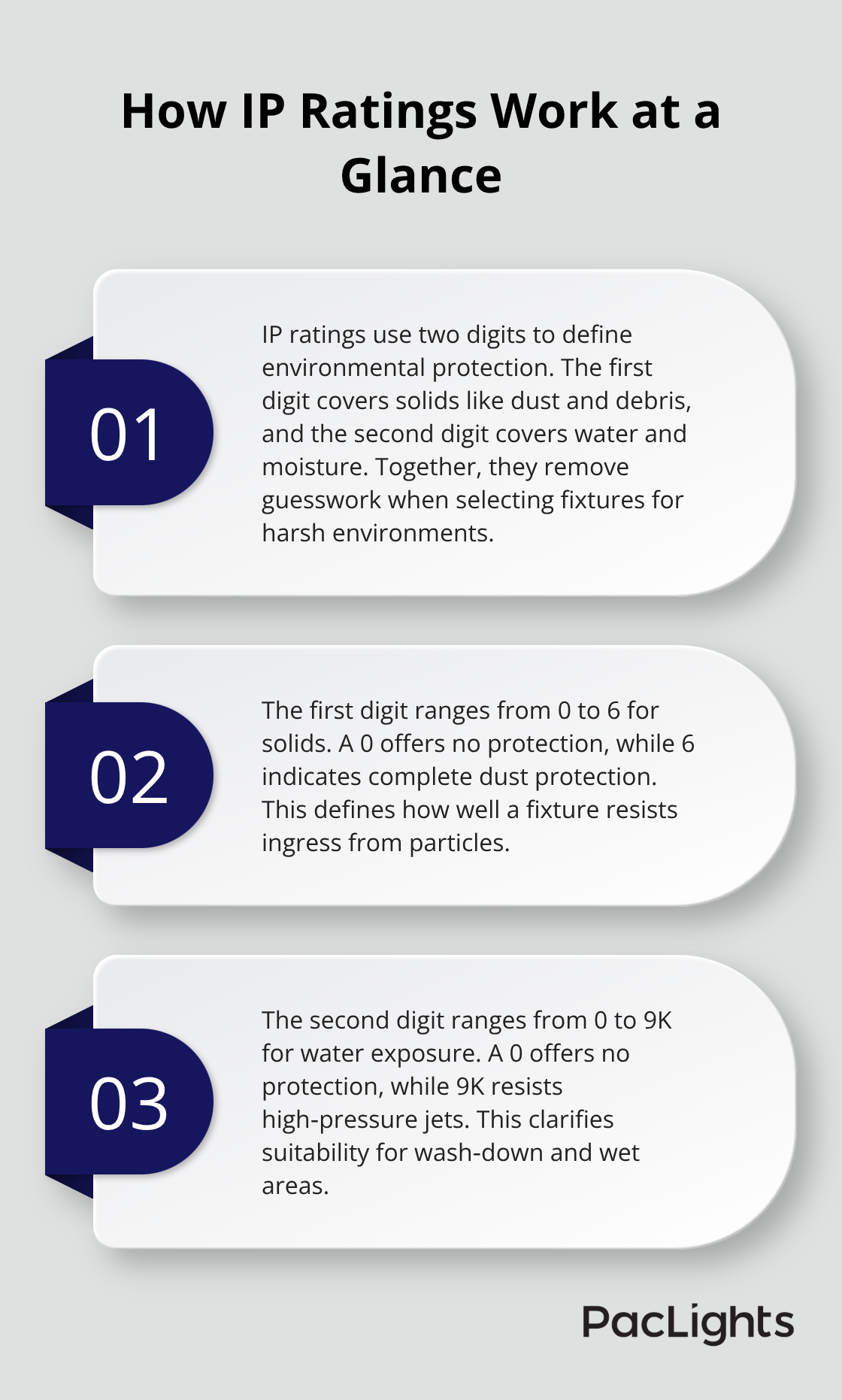
The IP rating system uses two digits to communicate exactly what a fixture can withstand. The first digit rates protection against solid objects and dust, ranging from 0 (no protection) to 6 (complete dust protection). The second digit rates protection against water and moisture, ranging from 0 (no protection) to 9K (protection against high-pressure jets). This straightforward approach removes guesswork from equipment selection.
Understanding Each Rating Level
An IP65 rating means the fixture is completely dust-tight and can handle water jets from any direction. An IP67 rating goes further, allowing brief submersion in water up to 1 meter deep. IP68 fixtures survive continuous submersion. For vapor tight applications in chemical plants or food processing facilities, you need at least IP65, but IP67 or IP68 provides the margin of safety that prevents unexpected failures. A fixture rated IP54 looks similar to an IP65 on the surface, but that single digit difference means it will corrode faster in aggressive environments.
The Real Cost of Cutting Corners
The cost difference between IP54 and IP65 fixtures typically runs 15 to 25 percent, yet facilities with inadequate ratings replace equipment every 2 to 4 years instead of 8 to 12 years. Manufacturing plants that switched from unrated fixtures to proper IP-rated vapor tight solutions reported 40 to 50 percent reductions in maintenance costs within the first year, according to data from industrial facility maintenance studies. Moisture and chemical vapors penetrate inadequate seals within weeks, not months.
When Corrosion Accelerates Exponentially
Corrosion accelerates exponentially once it starts, meaning a small leak today becomes catastrophic failure tomorrow. A chemical processing plant that installed standard fixtures instead of vapor tight IP67 units lost $180,000 in production downtime over 18 months when corrosion forced emergency replacements. That same facility could have installed proper fixtures for $35,000 and avoided the entire problem. Facilities that treat lighting as disposable in harsh environments destroy their bottom line through constant replacements and maintenance labor costs.
Matching Ratings to Real Conditions
The investment in proper vapor tight protection pays for itself through reduced replacements, lower maintenance labor costs, and zero production interruptions from lighting failures. Selecting the right IP rating requires understanding your specific environmental conditions-not guessing based on industry assumptions. This precision in fixture selection determines whether your facility experiences reliable operation or constant emergency repairs.
How Vapor Tight Fixtures Stop Corrosion Before It Starts
Sealing Out Moisture and Chemical Vapors
Vapor tight fixtures create a complete seal that prevents moisture and chemical vapors from reaching internal components. Standard fixtures allow air circulation for cooling, but vapor tight designs use gaskets, sealed connectors, and potted electronics to block corrosion at every entry point. The difference appears immediately in harsh environments. A food processing facility using standard IP54 fixtures experienced visible corrosion on ballasts and wiring within six weeks of installation, while an adjacent production line with IP67 vapor tight fixtures showed zero degradation after two years.
How Vapor Penetration Destroys Standard Fixtures
Moisture travels as vapor through unsealed gaps and corrodes metal components from the inside out, even without liquid water present. Vapor tight seals stop this process entirely because vapors cannot penetrate potted electronics or sealed cable entries. Chemical plants report that fixtures rated below IP67 fail within 12 to 18 months in environments with chlorine, ammonia, or sulfur dioxide vapors, while properly sealed vapor tight units operate for 8 to 12 years without maintenance. The investment in vapor tight construction prevents the exponential corrosion cycle that destroys cheaper fixtures.
Industries That Demand Vapor Tight Protection
Wastewater treatment facilities, chemical manufacturing plants, food and beverage processing, pharmaceutical production, metal finishing shops, and marine environments all require IP67 or IP68 ratings as a baseline requirement. Automotive manufacturing facilities that spray-wash components daily switched their overhead lighting to vapor tight IP67 fixtures and eliminated the monthly bulb replacements that plagued their previous setup.
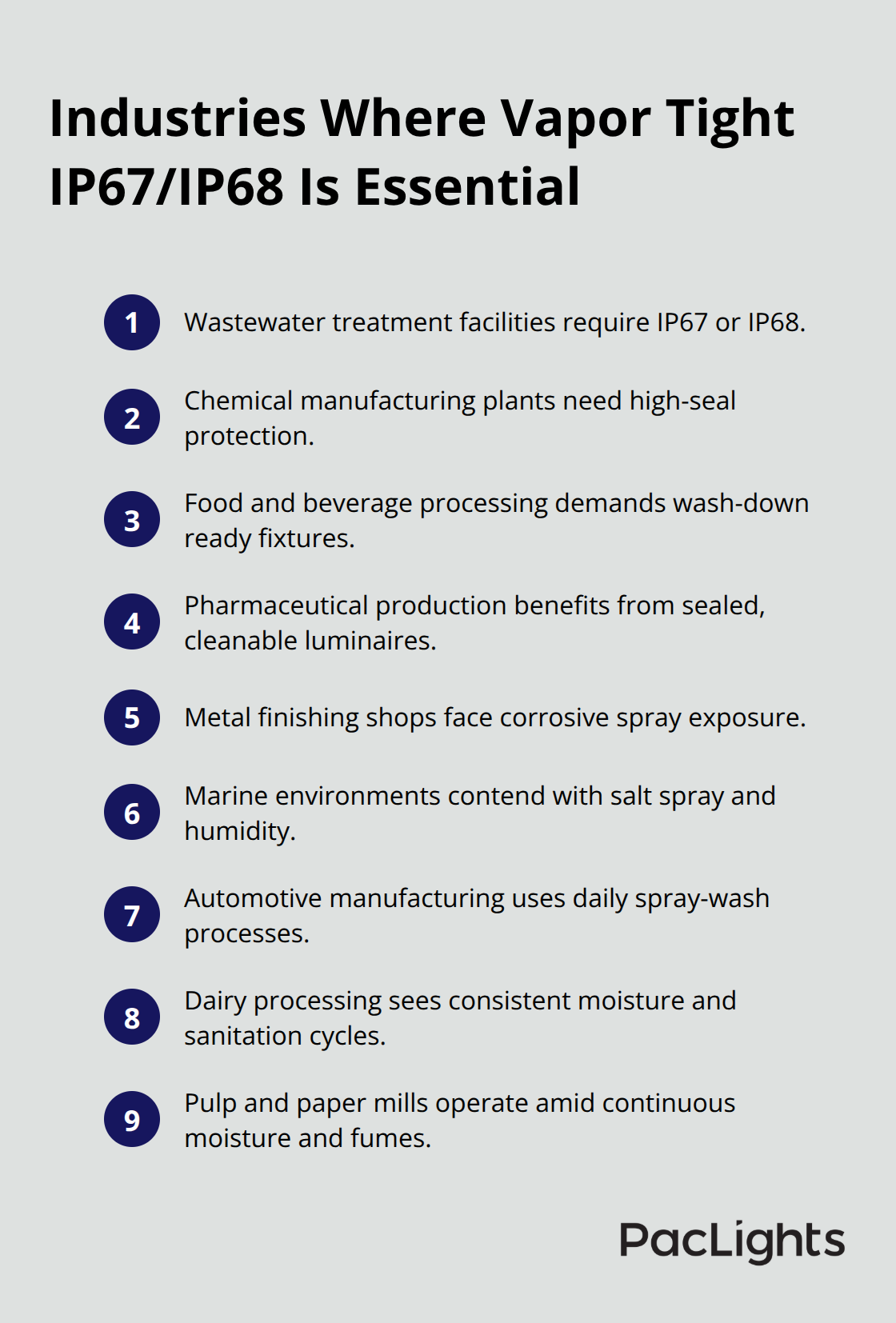
Dairy processing plants discovered that standard fixtures lasted four months before corrosion forced replacement, while vapor tight IP67 fixtures required zero maintenance interventions over three years. Pulp and paper mills dealing with continuous moisture and chemical fumes standardized on IP68 fixtures after experiencing repeated production shutdowns from lighting failures.
The False Economy of Cutting Corners
These industries learned through costly experience that cutting corners on fixture ratings creates false economy (the upfront savings disappear within months when emergency replacements and production interruptions mount up). Facilities operating in salt spray, chemical exposure, high humidity, or food washing environments have no choice but vapor tight fixtures if they want reliable operation. The question shifts from whether to invest in proper protection to which IP rating matches your specific conditions-a decision that determines whether your facility experiences reliable operation or constant emergency repairs.
Selecting the Right IP-Rated Vapor Tight Fixtures
Map Your Actual Environmental Conditions
Start by mapping your actual environmental conditions instead of making assumptions based on industry type. Temperature swings, chemical presence, humidity levels, and wash-down frequency determine your IP rating needs far more than your industry classification. A food processing plant with daily high-pressure wash-downs needs IP67 minimum, but a dairy facility with consistent humidity and occasional cleaning might operate reliably with IP65.
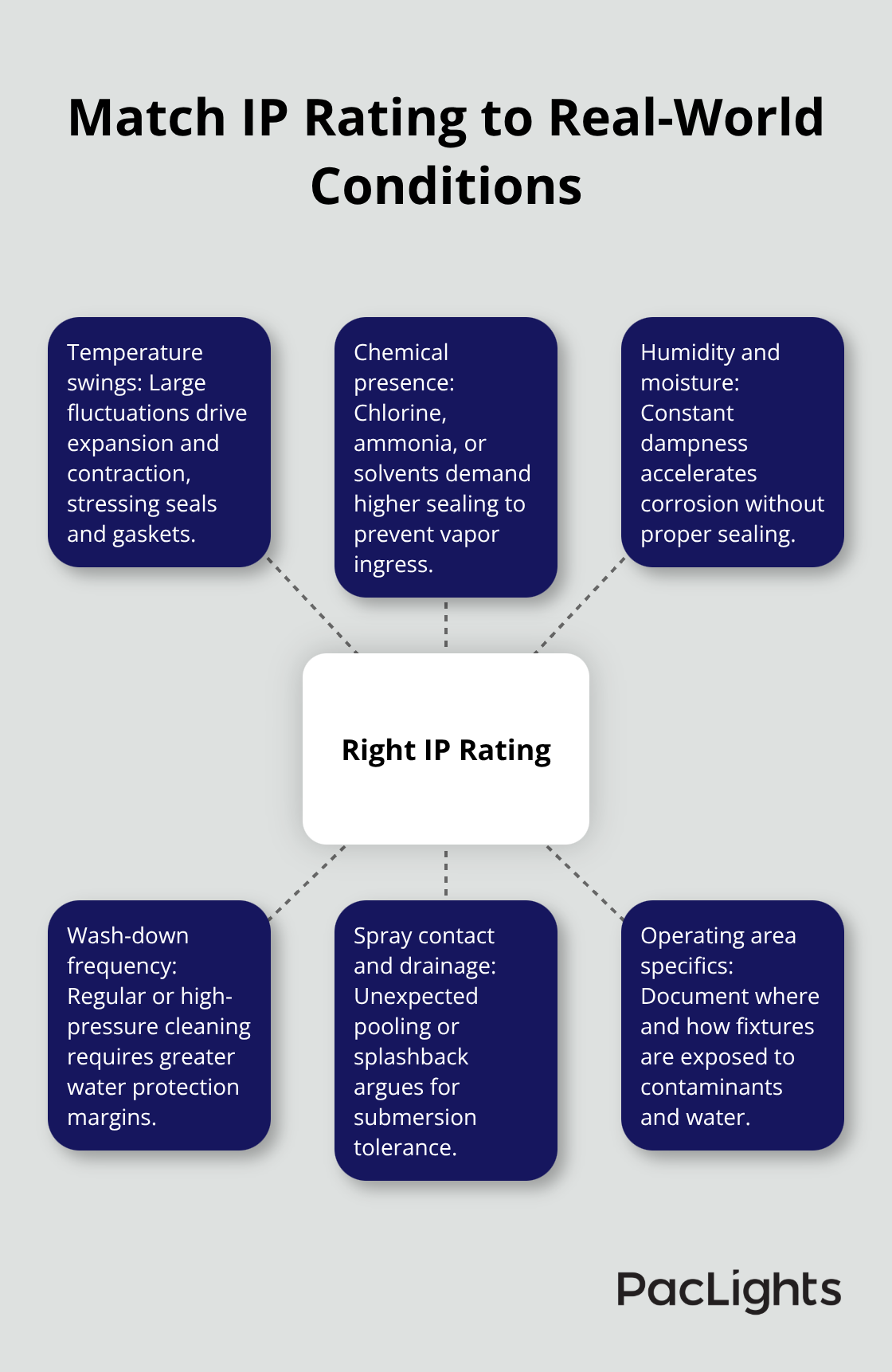
Document your specific conditions: What chemicals are present? How often does moisture or spray contact the fixtures? What temperature range does the space experience? This data drives your selection far more effectively than generic industry recommendations. Facilities that skip this step often purchase fixtures rated for conditions they don’t actually face, wasting money on overspecified equipment or, worse, installing underrated fixtures that fail prematurely.
Compare IP65 and IP67 Ratings for Your Specific Needs
The comparison between IP65 and IP67 ratings reveals where most facilities make costly mistakes. IP65 fixtures handle water jets but cannot survive brief submersion, making them suitable for spray environments with good drainage. IP67 fixtures tolerate temporary submersion up to 1 meter, providing the safety margin that prevents failures when unexpected water accumulation occurs. The price difference typically runs 20 to 30 percent higher for IP67, yet facilities operating in food processing, chemical manufacturing, or wastewater treatment consistently report that IP67 becomes mandatory after their first IP65 failure. Pharmaceutical production environments with humidity control often succeed with IP65, while metal finishing shops spraying corrosive solutions daily require IP67 or IP68.
Work with Suppliers Who Understand Your Environment
Your supplier should ask detailed questions about your specific environment rather than recommending a one-size-fits-all solution. Facilities working with suppliers who take time to understand moisture exposure patterns, chemical vapor presence, and temperature cycling make better decisions than those purchasing based on catalog ratings alone. At PacLights, we provide free lighting layout designs and ROI assessments that include environmental analysis, ensuring you select fixtures matched to your actual conditions rather than generic assumptions. Suppliers who invest time in understanding your facility’s unique challenges help you avoid costly mistakes and select equipment that performs reliably for years.
Final Thoughts
IP-rated vapor tight fixtures represent the only reliable solution for facilities operating in harsh environments. The protection standards outlined throughout this guide-from IP65’s dust-tight and water-jet resistance to IP67’s submersion tolerance and IP68’s continuous protection-directly determine whether your facility experiences years of reliable operation or months of costly failures and emergency replacements. A 20 to 30 percent premium on fixture cost disappears within the first year when you factor in eliminated emergency replacements, reduced maintenance labor, and zero production downtime from lighting failures.
Facilities that cut corners on IP ratings consistently report replacement cycles of 2 to 4 years, while those investing in proper vapor tight solutions operate for 8 to 12 years without intervention. The $180,000 production loss from a single corrosion failure dwarfs the upfront investment in correct equipment. Your next step involves mapping your actual environmental conditions rather than making assumptions based on industry type alone.
Document your specific moisture exposure, chemical vapor presence, temperature cycling, and wash-down frequency to determine whether IP65, IP67, or IP68 fixtures match your needs. Work with suppliers who ask detailed questions about your facility instead of recommending generic solutions. Visit PacLights to discuss your facility’s specific requirements and discover how proper IP-rated vapor tight protection transforms your lighting reliability and operating costs.
Disclaimer: PacLights is not responsible for any actions taken based on the suggestions and information provided in this article, and readers should consult local building and electrical codes for proper guidance.