

A power outage in your data center isn’t just an inconvenience-it’s a threat to your entire operation. When the lights go out, your team can’t safely navigate critical infrastructure, and compliance violations pile up fast.
At PacLights, we’ve seen firsthand how proper data center emergency lighting separates facilities that recover quickly from those that face costly downtime. The right system keeps your personnel safe, protects your equipment, and maintains business continuity when it matters most.
Why Data Centers Need Emergency Lighting
Power outages cost U.S. businesses roughly $150 billion annually, according to the Department of Energy. For data centers, even a five-minute blackout triggers cascading failures that take hours to resolve. Without emergency lighting, your team operates blind during these critical moments. Staff cannot safely reach circuit breakers, cannot perform manual shutdowns, and cannot evacuate if needed. The result is longer recovery times, higher equipment damage, and serious liability exposure.
The Real Cost of Darkness During Power Failures
When main power fails, your facility faces immediate operational paralysis. Technicians cannot navigate server rooms to perform emergency procedures. Staff resort to flashlights and phones, creating safety hazards and slowing response times significantly. A five-minute outage without proper lighting can stretch into hours of recovery work because your team moves cautiously through darkness. The financial impact extends beyond downtime-equipment damage from improper emergency shutdowns, personnel injuries, and liability claims accumulate rapidly. Emergency lighting eliminates this cascade of secondary failures.
Compliance Violations Carry Steep Penalties
Data centers fall under multiple compliance frameworks that mandate emergency lighting systems. OSHA requires adequate lighting for safe evacuation and equipment access during power failures. The National Electrical Code specifies that exit routes must remain illuminated with backup power for at least 90 minutes. Facilities that fail inspection face penalties starting at $16,131 per violation, according to OSHA’s 2024 penalty adjustments. If someone is injured during a power outage and your emergency lighting failed, you face personal injury lawsuits that dwarf the cost of proper installation. The International Building Code also requires emergency systems in facilities housing critical infrastructure.
Equipment Protection Requires Visible Access
Data center fires account for roughly 3% of all facility incidents but cause disproportionate damage because firefighters cannot navigate dark server rooms effectively. Emergency lighting that covers your hot aisles and equipment corridors reduces emergency response time significantly. Technicians can identify problems faster, execute manual procedures correctly, and prevent the secondary damage that comes from delayed response. Proper illumination of cable runs and control panels (especially in restricted-access areas) allows your team to work with precision rather than guesswork. This visibility directly translates to faster recovery and lower equipment losses.
Selecting the Right Emergency Lighting Solution
Your data center’s specific layout and operational requirements determine which emergency lighting approach works best. Battery backup systems, LED fixtures, and automatic switchover controls each serve different functions within your facility. Understanding these options helps you build a system that matches your actual needs rather than over-investing in unnecessary capacity.
Emergency Lighting Technologies That Actually Work
Battery backup systems and uninterruptible power supplies form the foundation of data center emergency lighting, but they’re not interchangeable. UPS systems keep your entire facility operational during outages, while dedicated emergency lighting batteries power only lights and exit signs, consuming far less capacity. A 10 kW UPS costs significantly more than a dedicated emergency lighting battery system, yet most data centers oversize their UPS to compensate for poor emergency lighting design. Separating these functions entirely makes financial sense. Dedicated emergency lighting batteries typically cost 60-70% less than equivalent UPS capacity and charge faster between outages. Standard emergency lighting batteries maintain a 90-minute runtime under code requirements, though many facilities exceed this with larger capacity systems. LED emergency fixtures drain batteries 40-50% slower than older fluorescent or incandescent designs, extending your runtime without additional hardware investment. Test your battery runtime quarterly under load rather than annually, because battery degradation accelerates in data center environments where ambient temperatures exceed 75 degrees Fahrenheit.
LED Fixtures Outperform Traditional Emergency Lighting
LED emergency fixtures outperform traditional options across every metric that matters for data center operations. A 5-watt LED emergency light produces equivalent illumination to a 13-watt fluorescent fixture while consuming 60% less battery power.
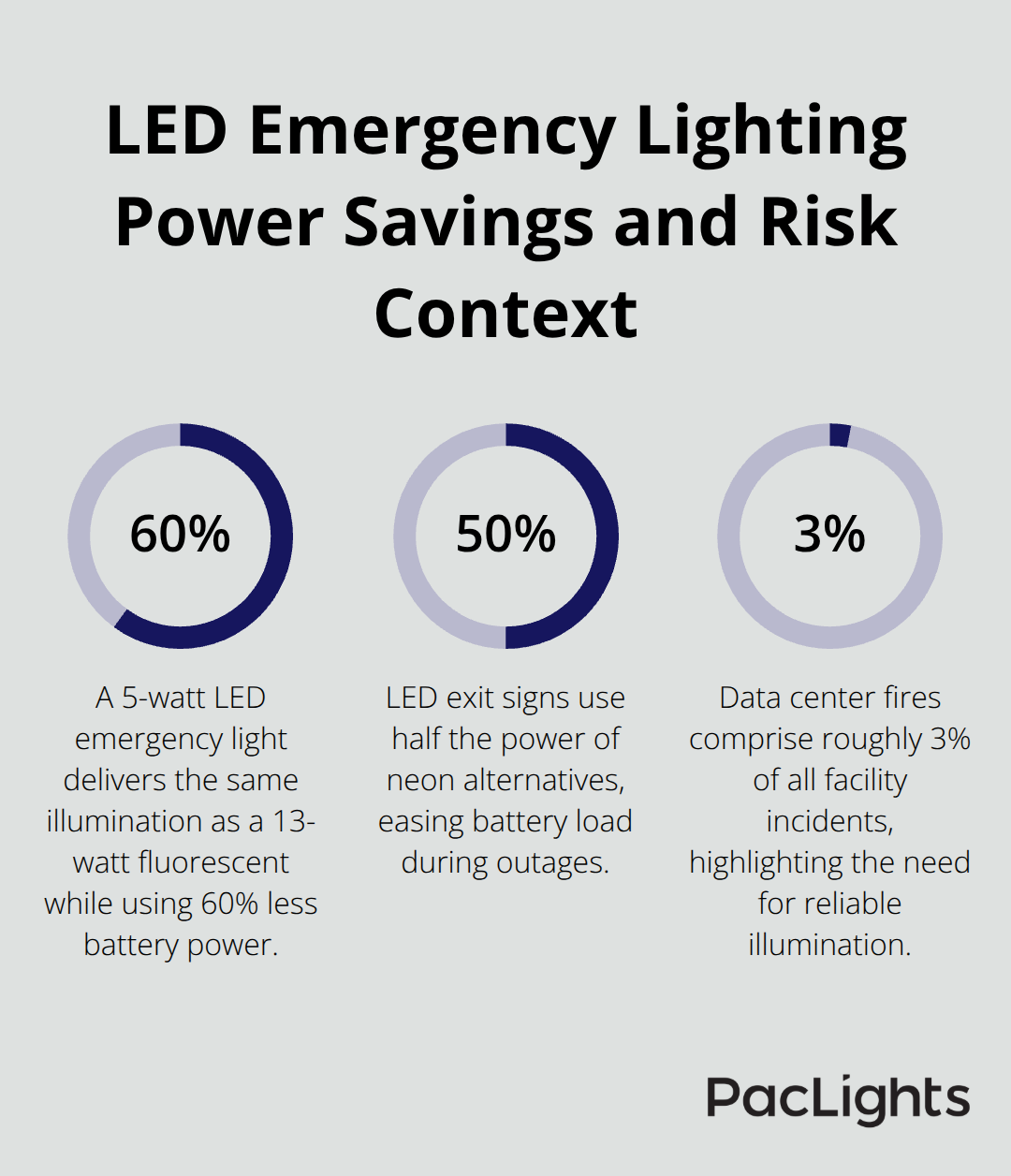
Exit signs represent a major battery drain in facilities with multiple evacuation routes, yet LED exit signs operate on half the power of neon alternatives. Install exit signs at every server room entrance, not just main building exits, because your technicians need clear navigation paths during emergencies.
Automatic Switchover Systems Require Proper Testing
Automatic switchover systems activate within 10 seconds of main power loss according to the National Electrical Code, though many inferior systems exceed this threshold. Test switchover response monthly using a circuit breaker disconnect rather than waiting for actual outages. Networked lighting controls allow you to monitor emergency system status remotely, alerting you to battery degradation or failed fixtures before they fail during an actual emergency.
Strategic Positioning Maximizes Emergency Response
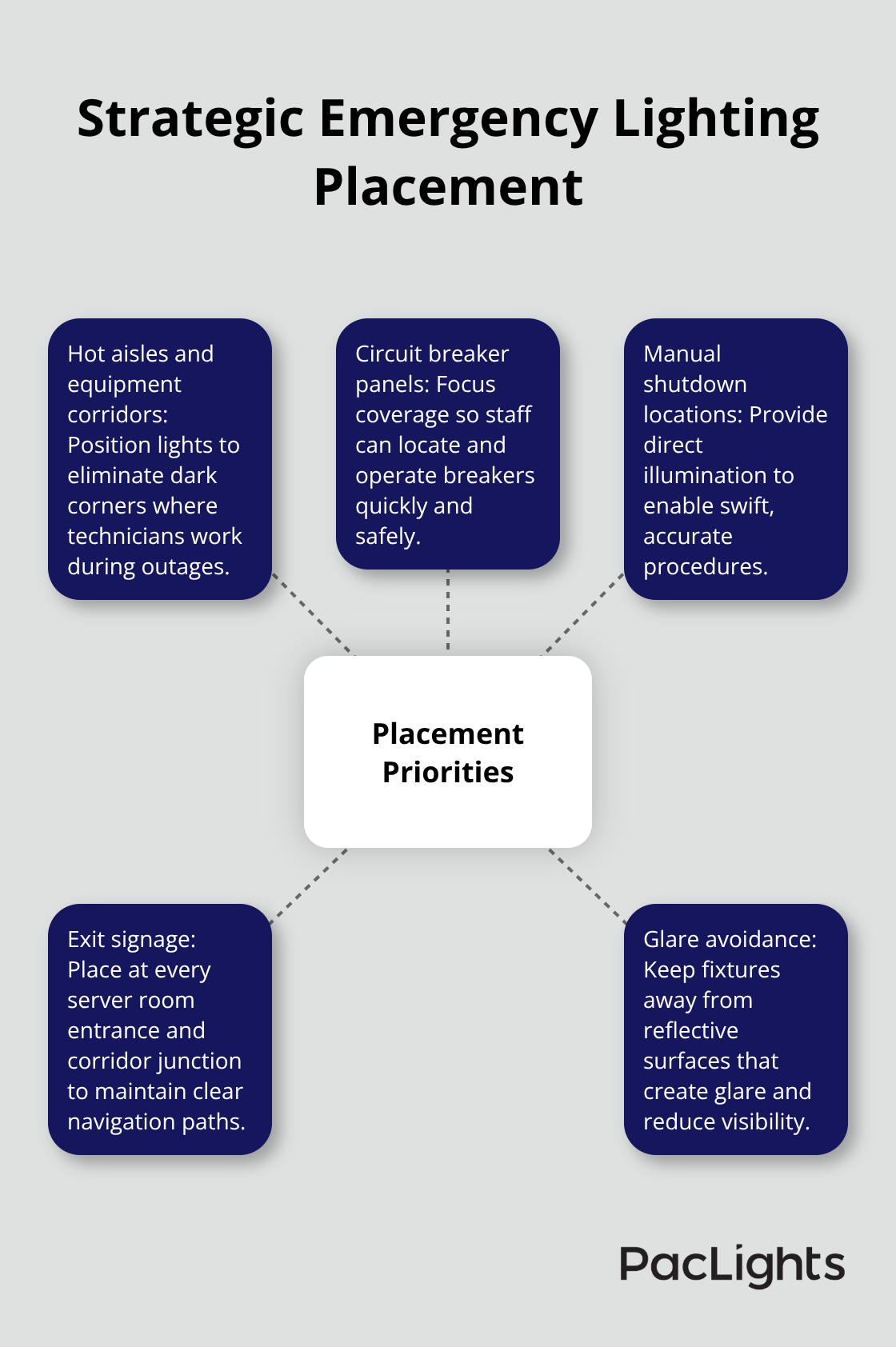
Position emergency lights to eliminate dark corners in hot aisles and equipment corridors where technicians work during outages. Focus coverage on circuit breaker panels and manual shutdown locations rather than distributing light evenly throughout the space. This targeted approach ensures your team can execute critical procedures quickly when seconds matter most.
Proper fixture placement (combined with adequate battery capacity and LED efficiency) creates a system that actually supports your operational needs during power failures. Your next step involves assessing your current facility layout and identifying gaps in emergency lighting coverage.
How to Keep Emergency Lighting Systems Working When You Need Them
Test Your System Monthly Under Real Conditions
Monthly load testing under actual power loss separates facilities that respond quickly during outages from those that face surprise failures. Most data centers test only annually or skip testing entirely, discovering problems only when power fails and technicians flip the manual override switch. Disconnect main power at a circuit breaker for 10-15 minutes while monitoring fixture brightness and switchover speed. Document the exact time main power cuts and when emergency lights reach full brightness-anything exceeding 10 seconds indicates a control system problem requiring immediate attention.
Check that every fixture illuminates to design specifications rather than assuming all lights function identically. Use a light meter to verify illumination levels in critical areas like server room entrances and circuit breaker panels, targeting minimum 10 foot-candles as specified by OSHA for safe work environments. Replace any battery that cannot sustain full brightness for the required 90-minute runtime.
Monitor Battery Degradation Before It Fails
Battery capacity degrades 15-20% annually in data center environments, so quarterly load testing reveals degradation trends before batteries fail completely. Networked lighting controls allow you to monitor system status remotely and receive alerts when battery voltage drops below safe thresholds, eliminating the need for physical inspections to catch deterioration. Test your battery-backed emergency lighting quarterly rather than annually, because data center ambient temperatures exceeding 75 degrees Fahrenheit accelerate battery degradation significantly.
Position Fixtures Where Technicians Actually Work
Strategic fixture positioning matters far more than achieving uniform brightness throughout the facility. Install fixtures directly above circuit breaker panels, manual shutdown switches, and hot aisle access points where technicians actually work during emergencies. Place exit signs at every server room entrance and equipment corridor junction, not just building exits, because your staff needs clear navigation paths through restricted areas when main power fails. Avoid positioning lights near reflective surfaces like polished metal cabinets that create glare and reduce visibility rather than improving it.
Execute a Preventive Maintenance Schedule
Maintain a preventive maintenance schedule that includes quarterly battery inspections, semi-annual fixture cleaning to remove dust that reduces output by 20-30%, and annual replacement of any battery showing voltage degradation. Test backup power transfer switches monthly by intentionally triggering switchover without waiting for actual outages. This proactive approach identifies failed components before emergencies occur and prevents the cascading failures that extend recovery time significantly.
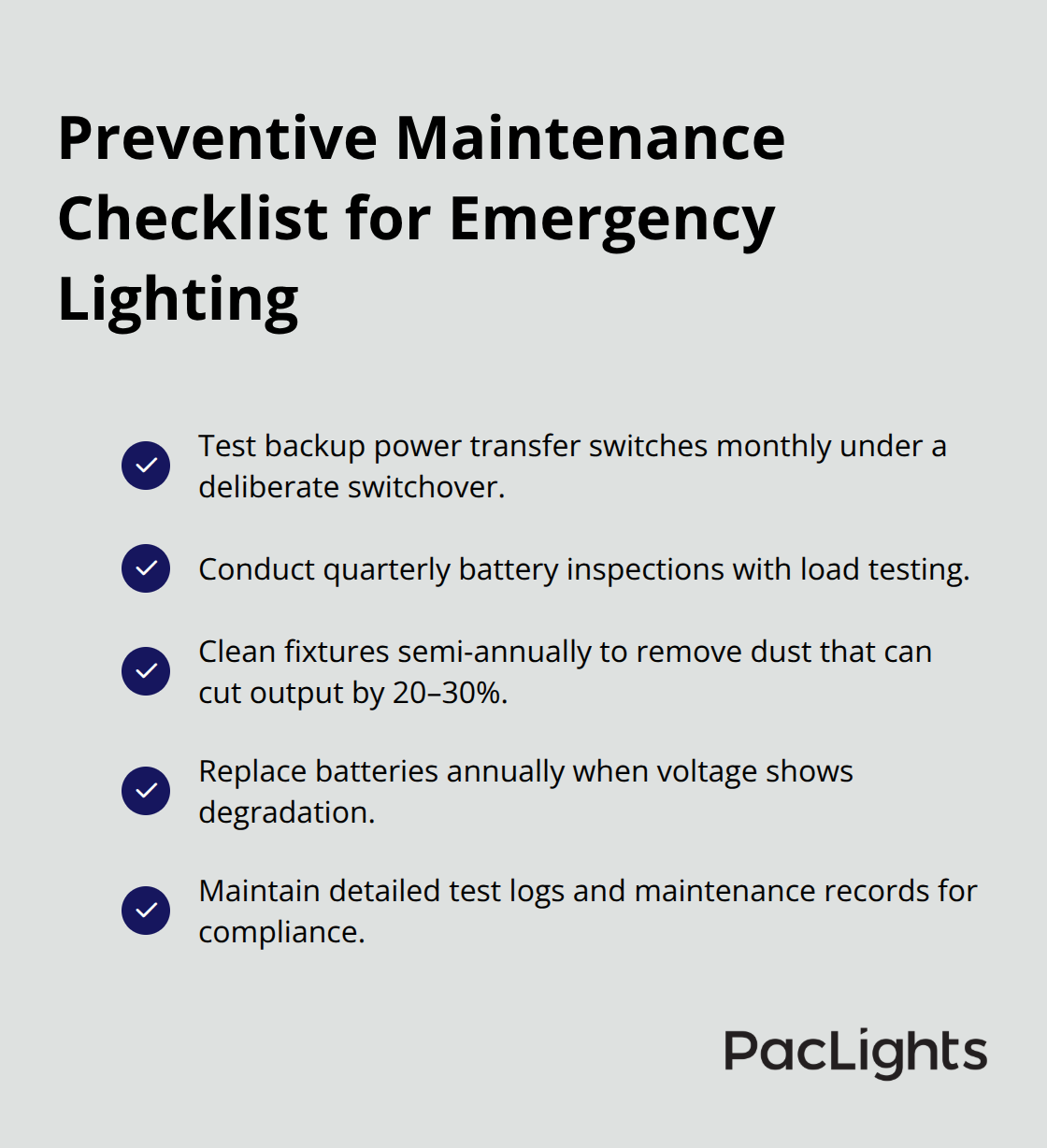
Your facility manager should maintain detailed records documenting every test result, battery replacement date, and fixture maintenance activity to demonstrate compliance during regulatory inspections. These records prove that your emergency lighting system receives proper attention and functions reliably when power fails.
Final Thoughts
Data center emergency lighting separates facilities that recover quickly from those that face extended downtime and equipment damage. OSHA penalties start at $16,131 per violation, while personal injury lawsuits from accidents during power outages cost substantially more. The financial case for proper emergency lighting systems remains straightforward when you calculate compliance costs, liability exposure, and equipment losses against the modest investment required for installation and maintenance.
Facilities with properly maintained emergency lighting systems recover from outages 40-60% faster than those with inadequate backup systems. Your team executes critical procedures with precision rather than caution when technicians can navigate server rooms and access control panels without darkness. Quarterly battery testing, semi-annual fixture cleaning, and annual component replacement prevent the surprise failures that compound recovery time and damage equipment.
Conduct a facility assessment to identify gaps in your current emergency lighting coverage and test your existing system under actual power loss conditions. Visit PacLights to explore how our energy-efficient LED fixtures and advanced lighting controls can strengthen your data center emergency lighting capabilities and support your facility’s emergency response.
Disclaimer: PacLights is not responsible for any actions taken based on the suggestions and information provided in this article, and readers should consult local building and electrical codes for proper guidance.