

Poor lighting in storage facilities costs money and creates safety hazards. Employees make more picking errors, accidents happen more frequently, and energy bills climb unnecessarily high.
At PacLights, we’ve seen how the right area light for racks transforms warehouse operations. Uniform coverage across aisles eliminates shadows, reduces strain on workers, and makes inventory management faster and more accurate.
Why Poor Lighting Costs You More Than You Think
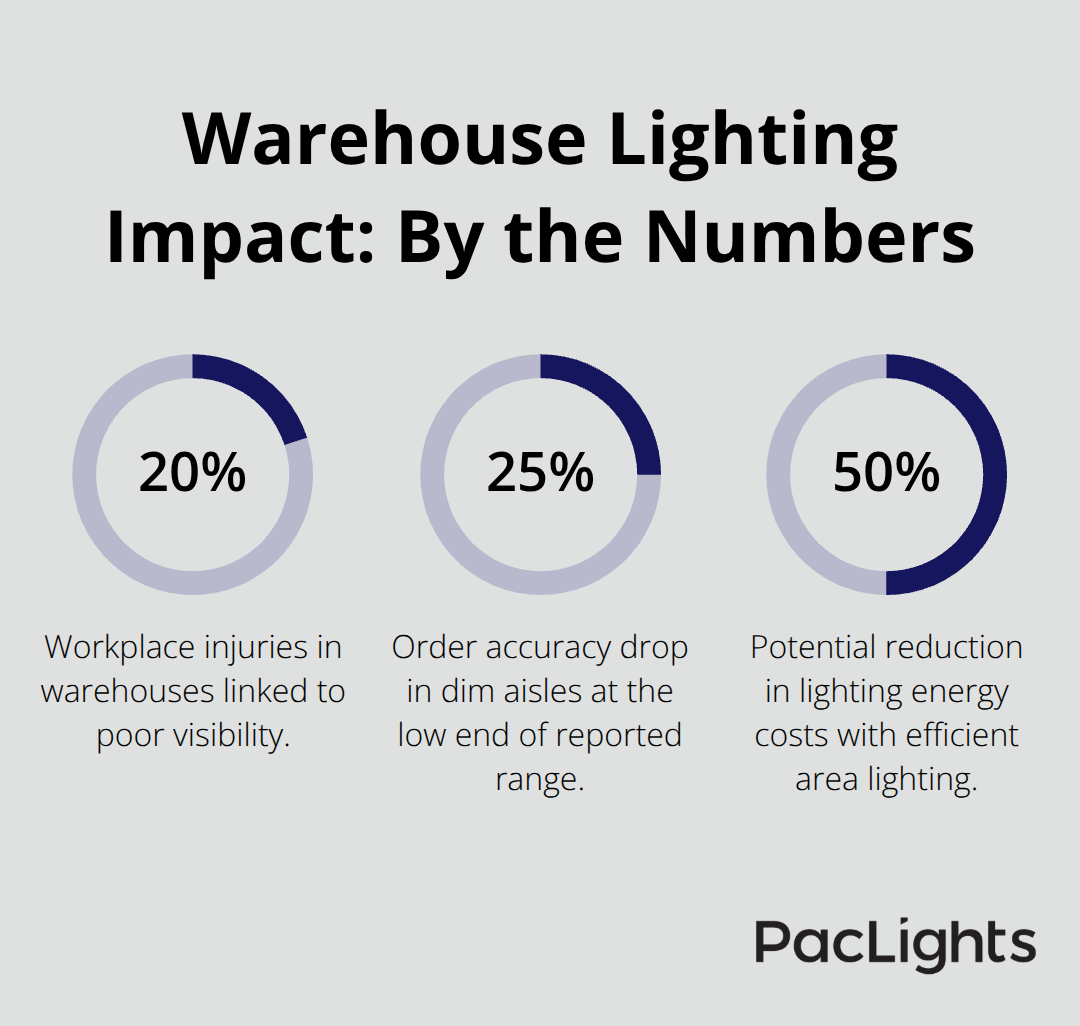
Inadequate lighting in storage facilities creates a cascade of operational problems that directly impact your bottom line. According to OSHA data, poor visibility contributes to approximately 20% of workplace injuries in warehouse settings, and many of these incidents result in workers’ compensation claims that average $40,000 per incident. Beyond safety, picking errors skyrocket in dim aisles-studies show that order accuracy drops by 25% to 30% when workers struggle to read labels and identify inventory. These mistakes compound quickly: a single mispicked item triggers customer returns, restocking costs, and administrative overhead that far exceeds the cost of proper lighting.
The Real Cost of Shadows and Uneven Light
Shadows and dark zones in storage aisles force employees to work slower and less accurately. When workers cannot see clearly, they move cautiously, double-check locations, and waste time navigating around poorly lit sections. A warehouse with 10,000 square feet of racking that relies on outdated or sparse fixtures loses significant productivity-some facilities report 15% to 20% slower picking speeds in dimly lit zones.
Energy costs add another layer to this problem: many older warehouses use inefficient lighting systems that consume far more power than modern LED solutions while delivering inferior results. A typical 40,000-square-foot warehouse spending $15,000 annually on lighting could reduce that expense by 50% to 60% through efficient area lighting without sacrificing visibility. The transition to LED area lights with proper spacing and lumen output eliminates the false economy of under-lighting.
Uniform Coverage Removes Operational Guesswork
Even light distribution across aisles removes the guesswork from inventory management. When every section receives consistent illumination, workers identify stock locations faster, count inventory more reliably, and spot damaged goods before they reach customers. Facilities that implement proper area lighting report inventory cycle time reductions of 10% to 15%, which translates directly to faster order fulfillment and improved customer satisfaction.
The uniformity also reduces eye strain, which matters more than many warehouse managers realize-NIOSH research indicates that inadequate or uneven lighting increases employee fatigue and reduces concentration, both of which contribute to errors and safety incidents. Proper area lighting for racks addresses these challenges head-on, and the next section examines the specific features that make this solution work.
What Makes Area Lights Work in Storage Racks
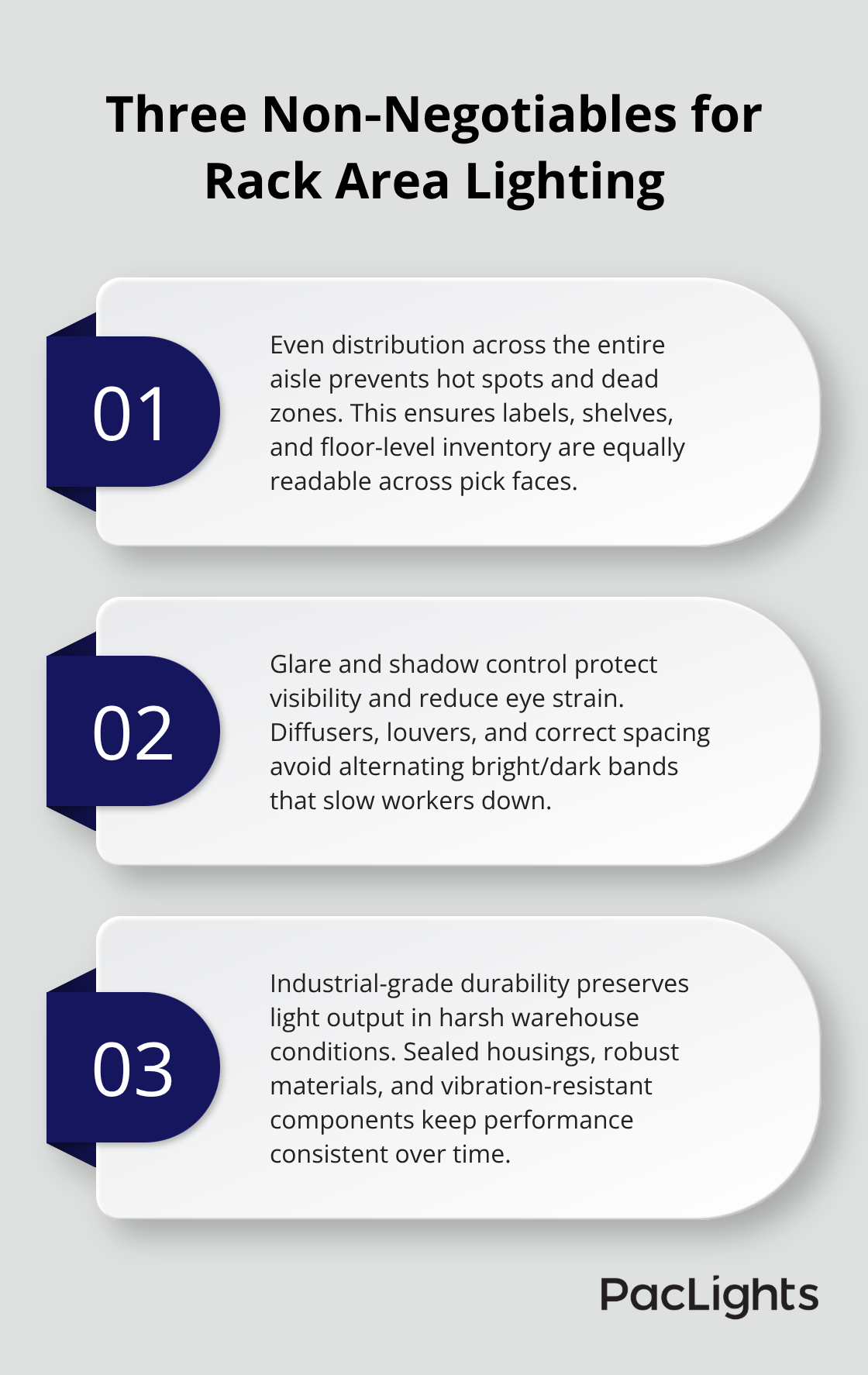
Effective area lighting for racks delivers three non-negotiable performance standards that separate functional solutions from mediocre installations. The light must distribute evenly across the entire aisle without creating hot spots or dead zones where visibility drops suddenly. The fixture design must control glare and eliminate shadows that force workers to compensate by moving or tilting their heads. The construction must withstand warehouse conditions-temperature fluctuations, dust, vibration from equipment, and the occasional impact from forklifts or pallet jacks. Most warehouses fail on at least one of these criteria, which is why so many facilities continue operating with outdated or poorly positioned fixtures.
Even Distribution Requires Careful Fixture Selection and Positioning
Uniform light distribution across storage aisles demands more than installing additional lights. The key metric is maintained illuminance, which measures the actual light reaching work surfaces after accounting for dust accumulation and fixture aging. A well-designed area light for racks maintains between 300 to 500 lux across picking heights, depending on whether workers read small labels or handle larger items. The Illuminating Engineering Society specifies that picking areas need adequate brightness to prevent errors without creating excessive glare. Many facilities install fixtures with high lumen output but poor beam geometry, resulting in bright spots directly under the light and dim zones between fixtures. Fixtures with medium beam angles (typically 90 to 120 degrees) spread light gradually rather than concentrating it in a narrow cone. Area lighting designed for rack heights between 8 and 20 feet ensures that light reaches both the top shelf and the floor-level inventory without creating shadows on intermediate levels.
Glare and Shadows Require Proper Fixture Design and Placement
Glare forces workers to squint and look away, reducing their ability to spot details on labels, packaging, and inventory. Direct glare occurs when workers look directly at bright fixtures, while reflected glare bounces off shiny surfaces like polished concrete or metal racks. Fixtures with diffusing lenses or louvers soften the light output and reduce brightness in the worker’s direct line of sight. Fixture spacing matters enormously-placing lights too far apart creates alternating bright and dark zones, while spacing them too close wastes energy and creates excessive glare. For a standard 12-foot-wide aisle, mounting fixtures at 16 to 20-foot intervals provides even coverage when combined with proper mounting height. Shadows disappear when the light source illuminates from multiple angles rather than from a single point directly overhead. Two smaller fixtures per aisle section instead of one large fixture distribute light more evenly and reduce harsh shadows cast by tall racks or equipment.
Durability Determines Long-Term Performance in Harsh Conditions
Warehouse environments accelerate fixture degradation through dust accumulation, temperature swings, humidity, and vibration. LED fixtures designed for industrial use feature sealed housings rated IP65 or higher, which prevent dust and moisture from entering internal components. Aluminum or powder-coated steel resists corrosion better than plastic, which becomes brittle in extreme temperatures. Polycarbonate or hardened glass lens and diffuser materials outperform acrylic, which yellows over time and reduces light output. LED performance degrades in extreme heat or cold; fixtures rated for warehouse conditions typically operate reliably between minus 10 and 50 degrees Celsius. Vibration from nearby equipment or machinery can loosen connections and damage drivers, so industrial-grade fixtures include reinforced mounting brackets and potted electronics that absorb vibration. Manufacturers specify maintenance schedules recommending lens cleaning every 12 to 18 months in dusty environments, which prevents the 20 to 30 percent light loss that dust accumulation typically causes.
Installation Quality Separates Effective Solutions From Wasted Investment
Proper installation transforms fixture specifications into actual warehouse performance. Mounting height, angle, and spacing determine whether light reaches inventory at all levels or concentrates only on upper shelves. Electrical connections must handle the power demands of multiple fixtures without voltage drops that reduce brightness. Fixture alignment ensures that adjacent lights create seamless coverage rather than overlapping bright zones or dark gaps. Professional installation also accounts for existing warehouse infrastructure-ceiling height, structural limitations, and proximity to sprinkler systems or HVAC equipment. The difference between amateur and professional installation often determines whether a facility achieves the 300 to 500 lux target or falls short by 30 to 40 percent. Once fixtures are properly installed and performing at specification, the next step involves selecting controls that optimize energy consumption while maintaining consistent visibility throughout your operating hours.
How to Plan and Install Area Lighting That Actually Works
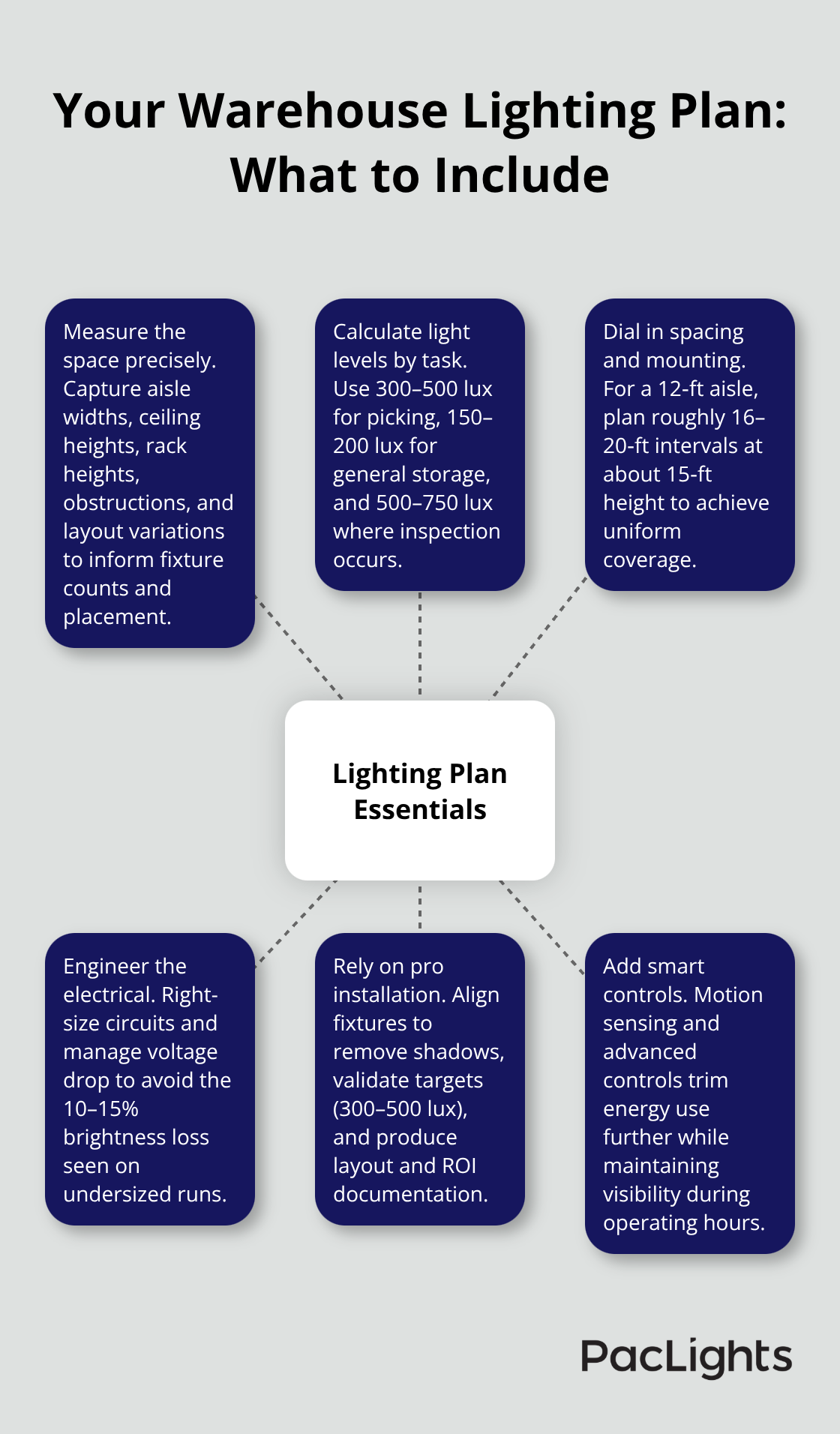
Start with precise measurements of your facility because vague estimates lead to undersized or oversized lighting systems that waste money. Walk each aisle and record the width, height from floor to ceiling, and the height of your tallest racks. Note the distance between rows and any obstructions like HVAC ducts, sprinkler lines, or structural columns that affect fixture placement. Create a simple floor plan sketch showing these dimensions, since professional installers need exact measurements to calculate proper fixture spacing and mounting height. For a 12-foot-wide aisle with 16-foot ceiling height and 10-foot-tall racks, the fixture spacing and height requirements differ dramatically from a 20-foot-wide aisle with 25-foot ceilings. Measure at least three different sections of your facility, because warehouses often have layout variations that affect lighting needs.
Calculate Light Output Based on Task Requirements
The actual light output required depends on what workers do in each area. Picking operations where employees read small labels and barcodes need 300 to 500 lux maintained on the work surface, according to Illuminating Engineering Society standards. General storage areas with larger items visible from a distance function at 150 to 200 lux. Receiving and shipping areas where quality inspection happens often require 500 to 750 lux. Start with the most demanding task in each zone, then work backward to determine fixture specifications.
A 12-foot-wide aisle with standard picking tasks typically needs two fixtures per 20-foot section when mounted at 15 feet high with proper beam geometry. Dust accumulation reduces light output by 20 to 30 percent over 12 to 18 months, so add 25 percent to your calculated lumen requirement to account for this depreciation. If calculations show you need 5,000 lumens total per aisle section, specify fixtures that deliver 6,250 lumens to maintain adequate light after dust builds up. Many facilities make the mistake of calculating lux requirements without factoring in dust, then wonder why their new lighting system underperforms after a few months.
Account for Fixture Spacing and Mounting Height
The aisle width and ceiling height directly determine how many fixtures you need and where to mount them for even coverage without dark zones or excessive glare. Improper spacing creates alternating bright and dark zones that cause eye strain and reduce worker productivity. Mounting height and angle affect whether light reaches floor-level inventory or concentrates only on upper shelves. For a standard 12-foot-wide aisle, mount fixtures at 16 to 20-foot intervals when positioned at 15 feet high to achieve seamless coverage across the entire work surface.
Ensure Electrical Design Supports Full Performance
Electrical design matters tremendously because running multiple high-output fixtures on undersized circuits causes voltage drops that reduce brightness by 10 to 15 percent. Professional installers assess your facility’s electrical capacity, calculate voltage drop across fixture runs, and design circuits that maintain proper voltage at every fixture. They also position fixtures to minimize shadows cast by tall racks and create seamless coverage across adjacent aisles. Installation quality determines whether your facility achieves the 300 to 500 lux target or falls 30 to 40 percent short.
Partner With Qualified Installation Professionals
Proper installation requires expertise that goes beyond mounting fixtures to a ceiling. Professional installers assess your facility’s electrical capacity, calculate voltage drop across fixture runs, and design circuits that maintain proper voltage at every fixture. They position fixtures to minimize shadows cast by tall racks and create seamless coverage across adjacent aisles. We at PacLights provide free lighting layout designs and ROI assessments that show exactly how many fixtures you need, where to mount them, and what your energy costs will be before installation starts. This approach eliminates guesswork and ensures your investment delivers the brightness and uniform coverage that transforms warehouse operations.
Final Thoughts
Proper area light for racks eliminates the operational drag that dim, uneven illumination creates across your warehouse. Reducing picking errors by 25% to 30%, cutting energy costs by 50% to 60%, and preventing workplace injuries that average $40,000 per incident generates returns that far exceed your investment in quality fixtures. Facilities that implement uniform coverage across storage aisles report inventory cycle time reductions of 10% to 15%, faster order fulfillment, and measurable improvements in worker productivity and safety.
The transition from outdated lighting to modern LED area lights pays dividends immediately and compounds over time. Your facility operates more efficiently from day one, and the durability of industrial-grade fixtures means you avoid the constant maintenance and replacement costs that plague older systems. Proper fixture selection, spacing, and installation determine whether you achieve these results or waste money on undersized or poorly positioned solutions.
We at PacLights provide free lighting layout designs and ROI assessments that show exactly what your facility needs, where fixtures should mount, and what your energy savings will be before installation begins. Our industrial-grade LED fixtures are built for warehouse conditions and come with optional motion control and advanced lighting controls to optimize energy use even further. Contact PacLights to discuss your facility’s lighting needs and receive a customized plan that transforms your storage operations.
Disclaimer: PacLights is not responsible for any actions taken based on the suggestions and information provided in this article, and readers should consult local building and electrical codes for proper guidance.