

Picking the wrong lighting fixtures for your commercial space can cost you thousands in compliance violations and equipment replacements. NSF certified fixtures aren’t just a nice-to-have-they’re the foundation of a safe, compliant facility.
At PacLights, we’ve seen firsthand how proper certification protects both your operations and your bottom line. This guide walks you through what NSF standards mean and how to choose the right fixtures for your specific needs.
What NSF Certification Actually Protects
Understanding NSF International’s Role
NSF International is an independent, non-profit organization that sets and verifies standards for public health and safety. Founded in 1944, NSF has become the gold standard for certification in food service, water treatment, and commercial environments. When a fixture carries NSF certification, it means the product has undergone rigorous third-party testing and meets specific safety requirements for its intended environment.
This isn’t theoretical compliance. NSF standards exist because real contamination incidents, equipment failures, and health violations happened in commercial facilities. The certification proves your fixtures won’t leach harmful chemicals into food preparation areas, won’t corrode in wet environments, and won’t create electrical hazards in regulated spaces.
The Real Cost of Ignoring NSF Requirements
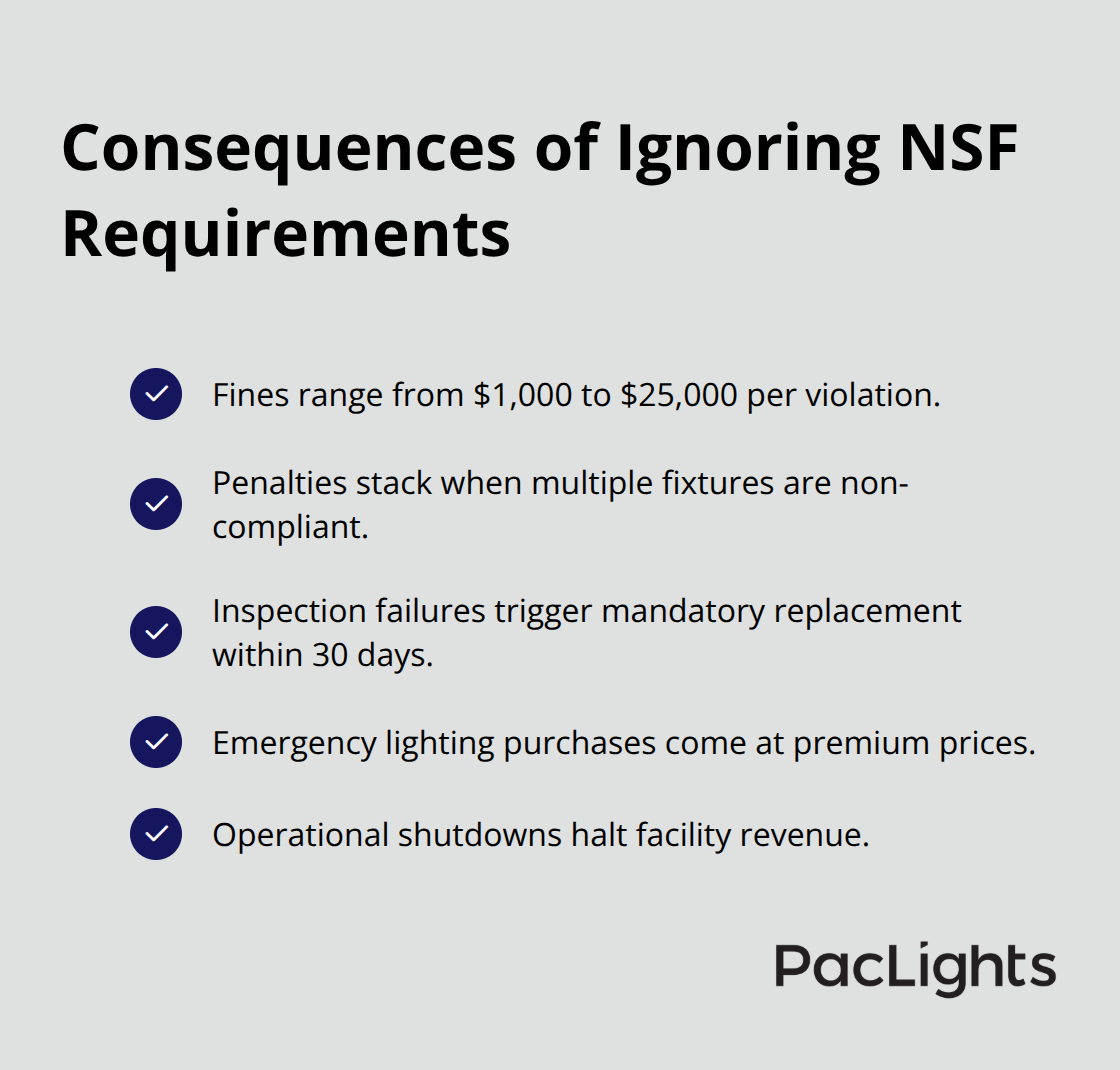
Facility managers who ignore NSF requirements face fines ranging from $1,000 to $25,000 per violation according to FDA enforcement data. These penalties stack quickly when inspectors identify multiple non-compliant fixtures. Beyond fines, you’ll pay for equipment replacement and operational shutdowns that halt your facility’s revenue.
Food service facilities operating without NSF certified lighting face immediate inspection failures. The FDA and local health departments don’t negotiate on this-if your fixtures don’t meet NSF/ANSI 51 standards for food service environments, you’ll be cited. A single inspection failure can trigger mandatory equipment replacement within 30 days, forcing you to source emergency lighting solutions at premium prices.
Why NSF Standards Protect Your Investment
Facilities handling drinking water, medical equipment, or pharmaceutical products need NSF certification to maintain their operating licenses. NSF standards protect your long-term investment by specifying durability requirements, material composition, and performance thresholds that generic commercial fixtures often ignore.
A certified fixture lasts longer because NSF standards mandate testing for corrosion resistance, impact durability, and electrical safety under real-world conditions. This means fewer replacements, less downtime, and predictable maintenance costs over the fixture’s lifetime. The upfront cost of certified fixtures pays for itself through extended service life and avoided compliance penalties.
Moving Forward With Compliance
Selecting the right NSF certified fixtures requires understanding your facility’s specific environment and regulatory obligations. The next section walks you through identifying which NSF standards apply to your operations and how to verify that your supplier’s fixtures actually meet those standards.
Key NSF Standards for Industrial and Commercial Fixtures
NSF/ANSI 51: The Food Service Standard
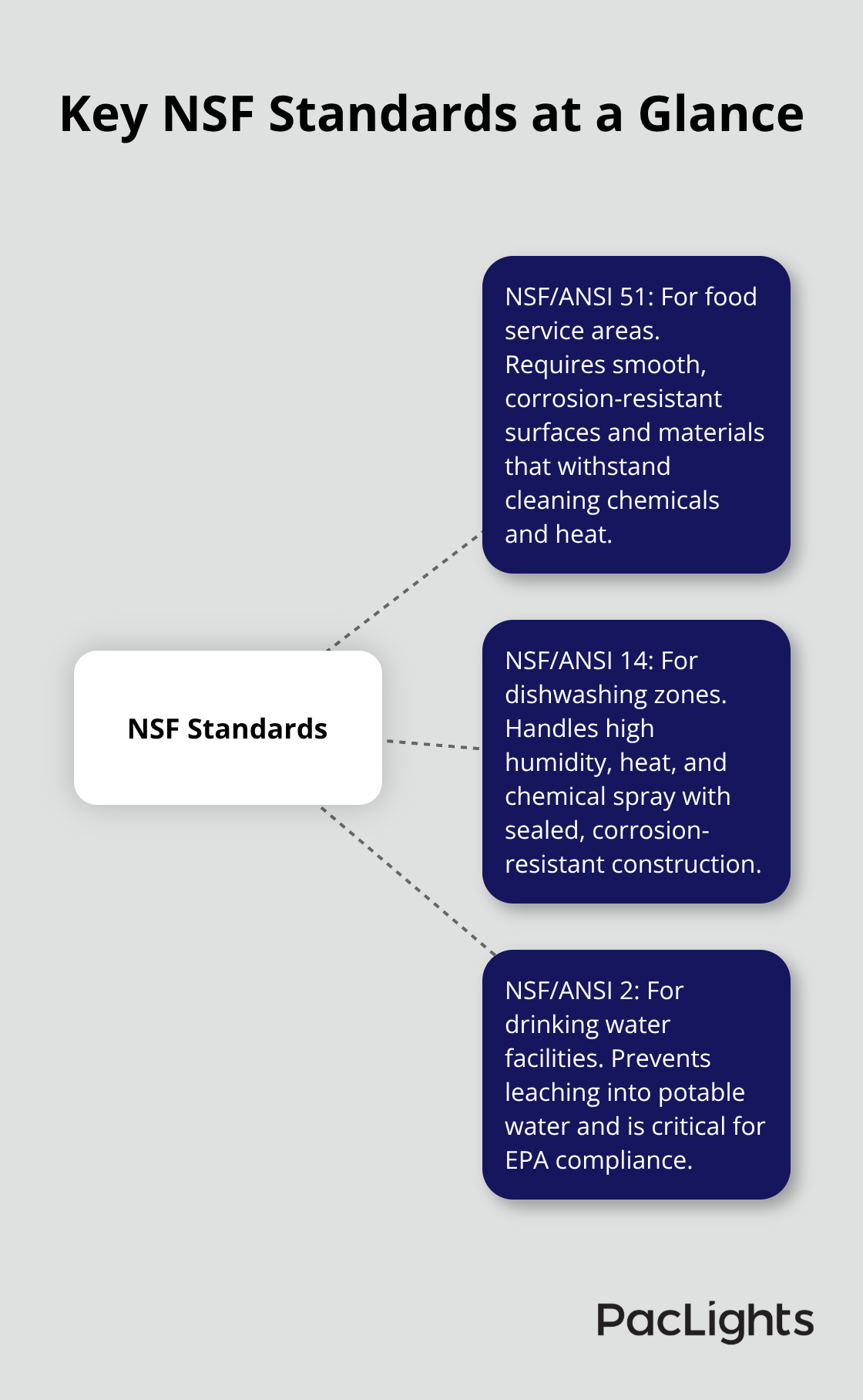
NSF/ANSI 51 governs food service lighting and applies to any commercial kitchen, cafeteria, or food preparation area. This standard requires fixtures to have smooth, corrosion-resistant surfaces that won’t leach contaminants into food or food-contact surfaces. The standard specifically prohibits materials that shed particles or corrode when exposed to cleaning chemicals and moisture.
Food service facilities must use fixtures with smooth surfaces that allow for proper cleaning without harboring bacteria. Inspectors check fixture construction during health department visits, and non-compliance results in immediate citations. NSF/ANSI 51 certification mandates that fixture components withstand repeated exposure to high-temperature sanitizing equipment and commercial-grade cleaning solutions.
Your fixtures must survive 500 hours of salt-spray testing according to ASTM B117 standards to prove corrosion resistance. Standard commercial lighting fails in food service environments because manufacturers don’t design them for the chemical exposure that kitchens demand.
NSF/ANSI 14: Dishwashing Equipment Areas
NSF/ANSI 14 applies specifically to areas surrounding commercial dishwashing equipment where moisture, heat, and chemical spray create extreme conditions. These fixtures endure constant exposure to water vapor, detergent residue, and temperature fluctuations that corrode standard metals and degrade electrical components. Fixtures must maintain electrical safety and structural integrity despite sustained humidity levels that exceed 85 percent.
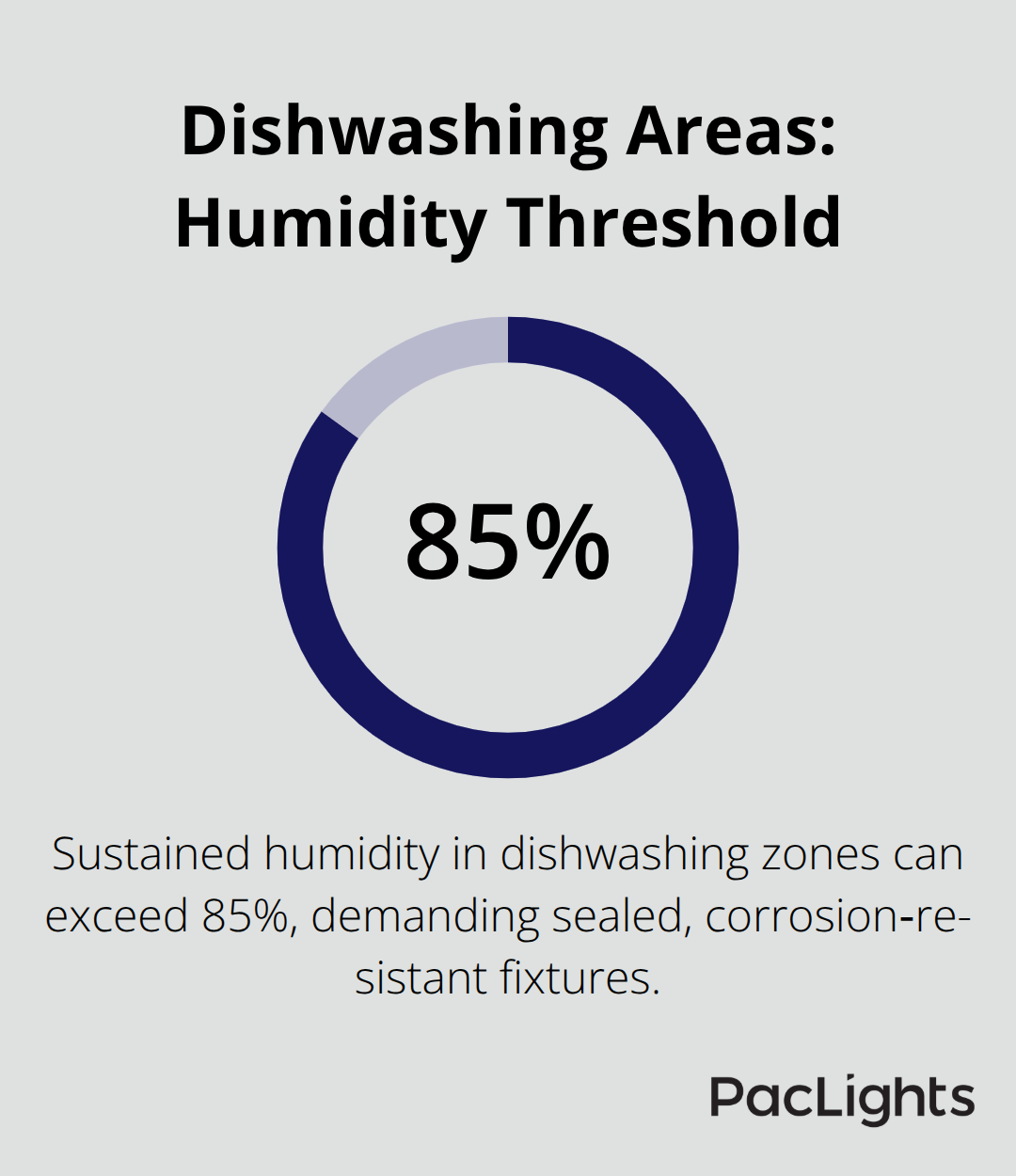
The harsh environment around dishwashing stations tests fixture durability in ways that standard commercial lighting cannot handle. Manufacturers who understand NSF/ANSI 14 requirements design fixtures with sealed components and corrosion-resistant materials that survive this demanding application.
NSF/ANSI 2: Drinking Water Treatment Facilities
NSF/ANSI 2 covers fixtures in drinking water treatment facilities and relates to materials that contact potable water or chemicals used in water treatment processes. This standard prevents fixtures from leaching harmful substances into drinking water supplies. Facilities treating municipal water systems face EPA enforcement if fixtures fail NSF certification.
The EPA enforces Safe Drinking Water Act compliance through routine facility inspections, and violations carry penalties up to $43,280 per day according to EPA enforcement guidelines. Your fixture selection directly impacts your facility’s ability to maintain its operating permit. Selecting certified fixtures from manufacturers who understand these specific environmental demands eliminates guesswork and protects your facility from both regulatory action and equipment failures that halt operations.
Understanding which standard applies to your facility is the first step toward compliance. The next section shows you how to verify that fixtures actually carry the certification your facility needs and how to work with suppliers who prioritize meeting these standards.
How to Select NSF Certified Lighting for Your Facility
Identify Your Facility’s Specific Needs
Start by identifying which NSF standards apply to your facility type, then verify that any fixture you’re considering actually carries the certification your environment requires. Food service facilities need NSF/ANSI 51 certification, not just any NSF mark. Dishwashing areas require NSF/ANSI 14. Drinking water treatment plants need NSF/ANSI 2. Purchasing a fixture certified for one environment but installing it in another creates compliance exposure and wastes money on equipment that won’t survive the actual conditions.
Many facility managers purchase fixtures labeled as commercial-grade without confirming they meet the specific NSF standard their operation demands. This mistake costs thousands in wasted equipment and regulatory penalties. Your facility type determines which standard applies, and no shortcuts exist in this process.
Verify Certification Documentation and Labels
Verification starts with documentation. Legitimate NSF certified fixtures come with a product data sheet that clearly states which NSF/ANSI standard the fixture meets. Request this documentation from your supplier before purchasing anything. The NSF website maintains a searchable product directory where you can confirm whether a specific fixture model actually carries certification.
Many manufacturers claim NSF compliance without providing the actual certification number or standard reference. If your supplier can’t produce the certification number within 24 hours, that’s a red flag. The certification number follows a specific format, such as NSF/ANSI 51-2024, and appears on both the product label and the technical documentation.
Physical inspection matters too. Certified fixtures display the NSF mark directly on the fixture itself, typically near the electrical connections or on a label affixed to the housing. The mark includes the NSF logo and the specific standard number. If you receive fixtures without this marking, they haven’t been certified regardless of what the sales representative claims. Inspect every fixture upon delivery because suppliers sometimes send non-certified units by mistake or substitute cheaper alternatives that look similar but lack the required testing.
Work with Compliant Suppliers
Work exclusively with suppliers who maintain current NSF certifications for their product lines and can provide updated documentation. Suppliers who prioritize compliance keep detailed records of their certification status and understand that facilities face real penalties for using non-certified equipment. Suppliers who hesitate to share certification details or who pressure you to purchase before reviewing documentation are prioritizing speed over your compliance.
Your facility’s operating license depends on using certified fixtures, so supplier selection directly impacts your regulatory standing. Choose suppliers that treat certification documentation as standard practice, not as an afterthought or special request. This approach eliminates guesswork and protects your facility from both regulatory action and equipment failures that halt operations.
Final Thoughts
NSF certification protects your facility from penalties that range from $1,000 to $43,280 per day, depending on your industry and the violations inspectors find. Regulatory agencies enforce these standards through routine inspections, and non-compliance triggers fines, equipment replacement mandates, and operational shutdowns that halt your revenue. The upfront cost of NSF certified fixtures costs far less than the financial damage that violations create.
Your facility’s environment determines which NSF standard applies, and selecting fixtures certified for the wrong standard wastes money and creates compliance exposure. Food service operations require NSF/ANSI 51, dishwashing areas require NSF/ANSI 14, and drinking water treatment plants require NSF/ANSI 2. Verification starts with requesting certification documentation from your supplier and confirming the certification number matches the NSF product directory.
We at PacLights provide NSF certified fixtures designed to perform in demanding environments while reducing your operational costs through energy efficiency. Our team offers free lighting layout designs and ROI assessments to help you select the right solutions for your facility’s specific needs. Visit PacLights to explore NSF certified fixtures tailored to your operation and build a compliant lighting strategy that protects your facility.
Disclaimer: PacLights is not responsible for any actions taken based on the suggestions and information provided in this article, and readers should consult local building and electrical codes for proper guidance.