

Warehouse productivity hinges on one often-overlooked factor: lighting. Poor illumination leads to slower picking speeds, higher error rates, and worker fatigue that compounds over time.
Task lighting for warehouses solves this problem by directing focused light exactly where your team needs it. At PacLights, we’ve seen firsthand how strategic illumination transforms warehouse operations, cutting picking errors by up to 20% while reducing energy costs.
Why Task Lighting Transforms Warehouse Safety and Output
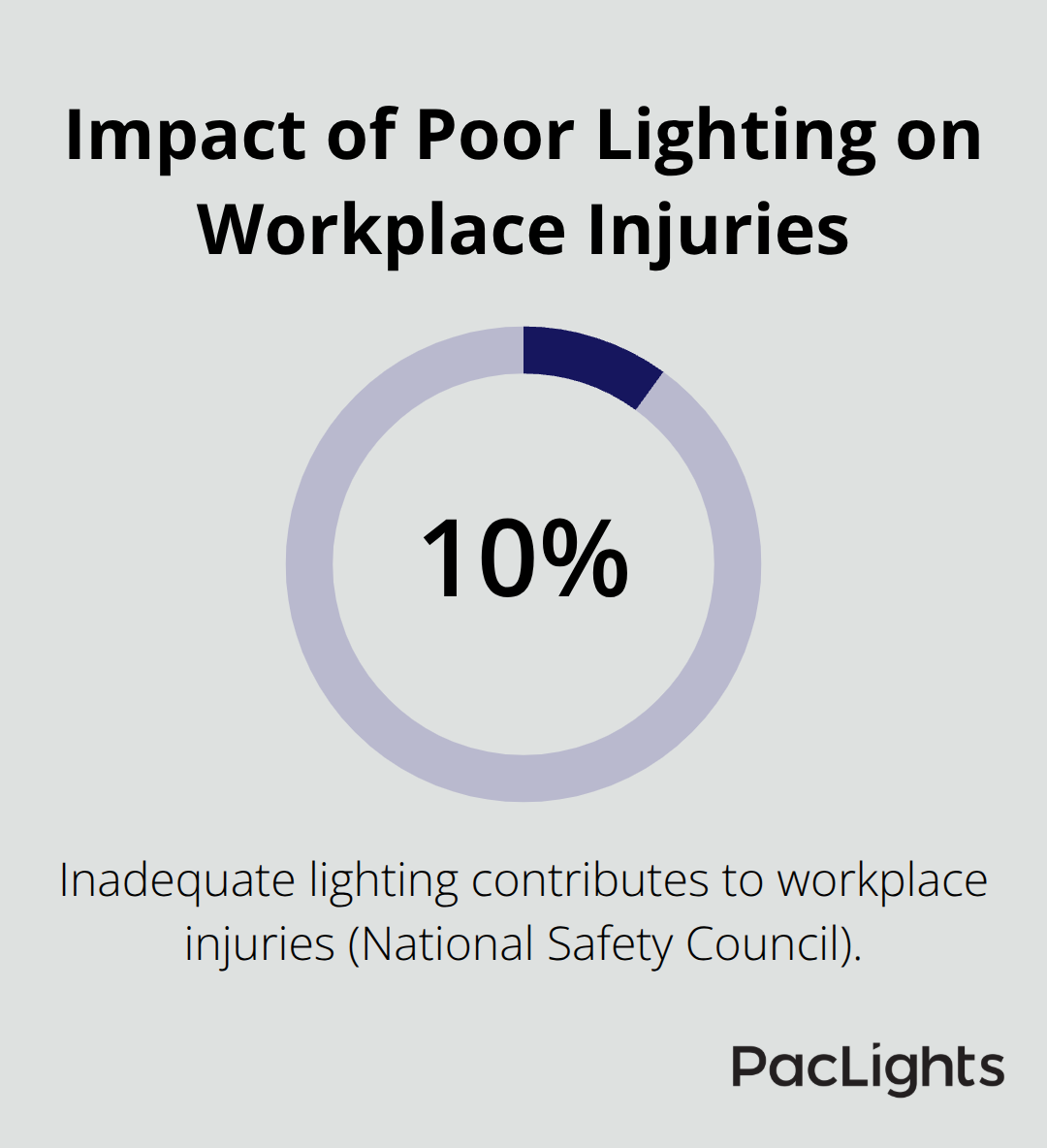
Warehouse accidents happen fast and often stem from poor visibility. The National Safety Council reports that inadequate lighting contributes to roughly 10% of workplace injuries, a figure that climbs in warehouse environments where workers navigate high shelves and fast-paced picking operations. When your team cannot see clearly, they move cautiously, miss obstacles, and suffer eye strain that compounds fatigue.
Task lighting eliminates this problem by placing bright, focused illumination exactly where workers need it. The result is not just safer operations-it is faster ones.
How Task Lighting Cuts Errors and Accidents
Studies show that proper task lighting increases picking accuracy by 15-20%, directly reducing costly order fulfillment errors. Focused overhead linear strip lights and pendant fixtures over picking zones cut errors and accident rates simultaneously. Workers also report less eye discomfort, fewer headaches, and better morale when task lighting replaces dim or uneven warehouse-wide illumination. This matters because warehouse turnover costs roughly $15,000 per employee in replacement and training expenses. Better lighting conditions reduce fatigue-related mistakes and help retain experienced staff.
The Picking Speed Advantage
Proper task lighting does not just prevent errors-it accelerates your entire operation. A warehouse that cannot see clearly operates at reduced speed. Workers squint, hesitate, and double-check items unnecessarily. Add focused lighting over picking stations and conveyor areas, and workers move with confidence and speed. Pendant lights suspended above work zones and high bay fixtures with concentrated beams allow pickers to read labels instantly and verify quantities without second-guessing themselves. This speed translates to throughput gains of 10-25% depending on your current lighting conditions. For a mid-sized operation processing 5,000 picks daily, that represents hundreds of additional orders fulfilled per shift. Motion-activated controls on task lighting also prevent wasted energy in low-traffic zones while keeping critical areas bright during peak hours.
Eye Strain and Worker Retention
Warehouse staff who work under poor lighting develop eye fatigue within hours, leading to reduced focus and higher error rates as the shift progresses. Task lighting with appropriate color temperature and brightness eliminates this problem. LED task fixtures deliver consistent, flicker-free illumination that reduces strain significantly. Workers stay alert, make fewer mistakes in hour eight than in hour one, and report better job satisfaction. In competitive labor markets, this matters tremendously for retention. The next step involves selecting the right task lighting solutions for your specific warehouse layout and operations.
Types of Task Lighting Solutions for Warehouses
High Bay and Linear Strip Lights for Large Picking Areas
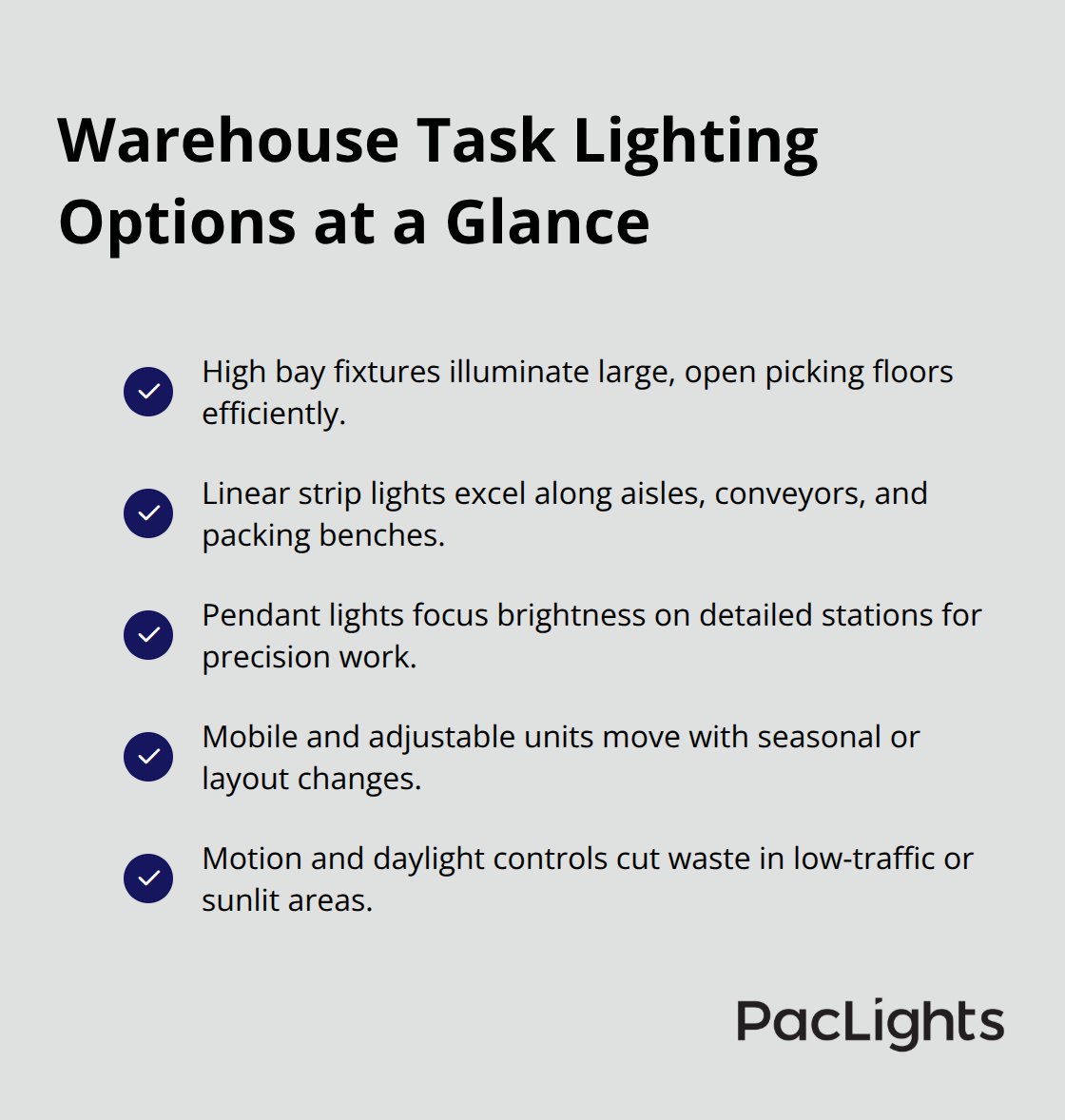
Overhead linear strip lights and high bay fixtures dominate warehouse task lighting because they deliver concentrated illumination across large picking zones without creating shadows that slow workers down. High bay fixtures mounted 20-40 feet above floor level work best for general picking areas, while linear strip lights perform better over conveyor belts and packing stations where workers need precision visibility on smaller items. The key difference matters: high bays cast light downward in a wide cone, suitable for open picking floors, whereas linear strips run along aisles and workbenches to eliminate the dark spots that cause hesitation and errors. PacLights offers both options with customizable beam angles so you can match your specific layout rather than forcing your warehouse into a one-size-fits-all solution.
Pendant Lights for Detailed Work Stations
Pendant lights suspended 8-12 feet above detailed work areas like quality control stations or small parts picking outperform both alternatives in tight spaces because they focus light exactly where hands work, reducing the eye fatigue that comes from looking up or down constantly. These fixtures concentrate illumination on precise tasks without wasting energy on surrounding floor space. Workers at inspection stations and assembly benches experience significantly less strain when pendant lights replace general overhead fixtures.
Mobile and Adjustable Systems for Changing Operations
Mobile and adjustable lighting systems solve a different problem: warehouse layouts change. Seasonal peaks demand temporary picking zones, new product lines require different shelf heights, and equipment upgrades shift where workers spend their time. Portable task lights on adjustable arms or magnetic bases let you move illumination without rewiring or installing new fixtures, cutting implementation time from weeks to days. This flexibility prevents the costly mistake of installing permanent systems that become obsolete when operations shift.
Motion Sensors and Daylight Controls for Energy Optimization
Motion sensors paired with task lighting eliminate the biggest energy waste in warehouses-lights running full brightness in empty zones during night shifts or slow periods. A warehouse running 24 hours loses roughly 30-40% of lighting energy in low-traffic areas, according to data from the American Society of Heating, Refrigerating and Air-Conditioning Engineers. Daylight controls work similarly by dimming task lights when natural light enters through skylights or windows, automatically adjusting brightness to maintain consistent visibility without overexposure. PacLights products feature optional daylight and motion control capabilities that adapt to your specific operational patterns.
Matching Your System to Actual Warehouse Operations
The practical advantage comes down to this: a warehouse with fixed overhead lighting wastes energy and struggles when operations shift, while one with adjustable task lighting adapts instantly and cuts costs simultaneously. Your warehouse layout, shift patterns, and product mix determine which combination of fixtures and controls delivers the best results. The next step involves calculating the financial return on your lighting investment and planning the specific layout that fits your operation.
Building Your Task Lighting System Without Breaking the Budget
LED Technology Cuts Energy Costs Dramatically
LED technology has fundamentally changed warehouse economics. A standard 400-watt metal halide high bay fixture consumes roughly 400 watts per hour, while an equivalent LED high bay uses 150 watts for identical brightness. Over a year, running 16 hours daily, that single fixture saves approximately 1,460 kilowatt-hours annually. At an average industrial electricity rate of $0.12 per kilowatt-hour, one fixture saves $175 per year.
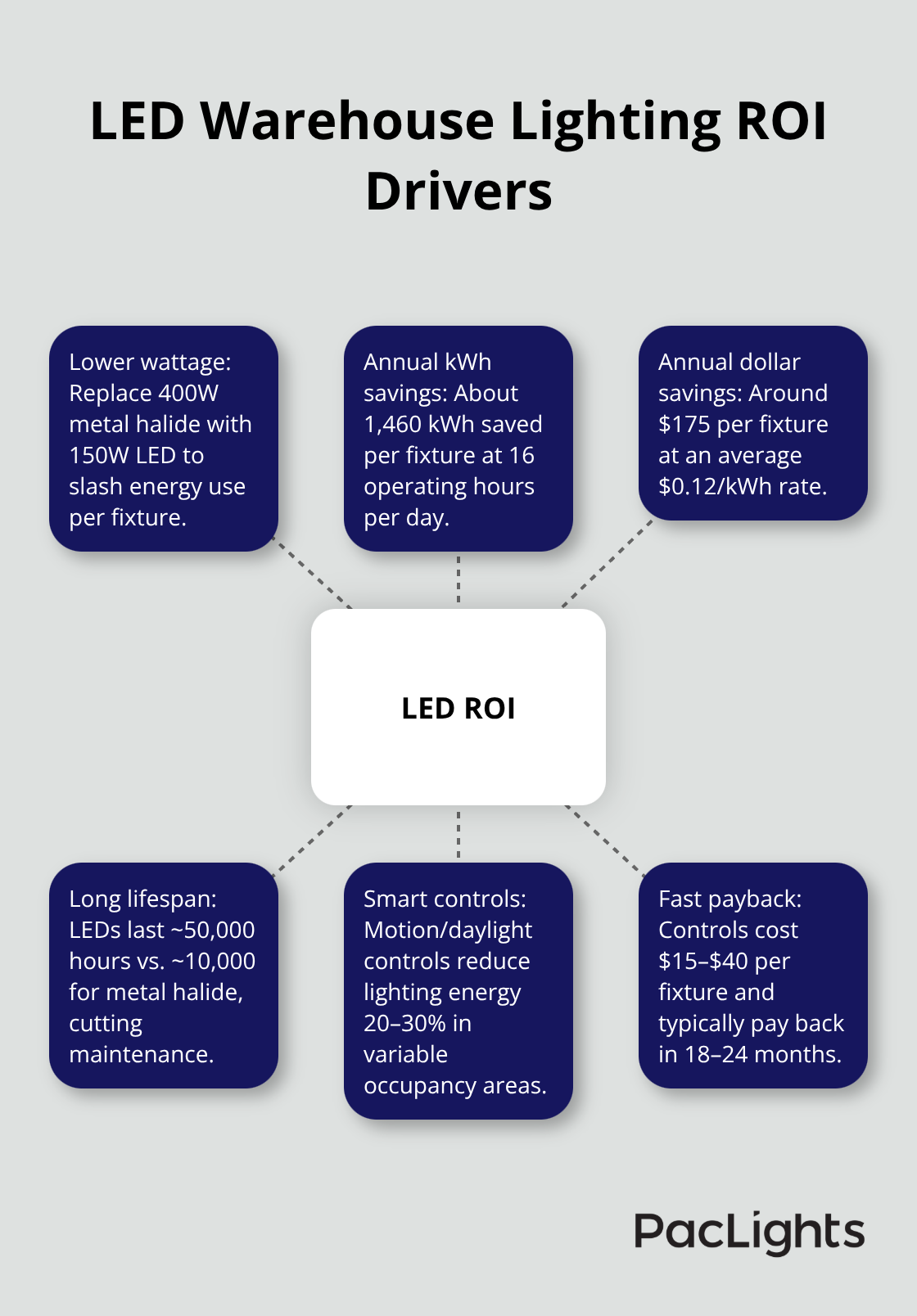
A warehouse with 100 high bay fixtures saves $17,500 annually just from the efficiency gain, without accounting for the 50,000-hour lifespan of LED bulbs versus 10,000 hours for metal halide. Replacement labor costs plummet when you change fixtures once every decade instead of every two years. The upfront cost difference between LED and older technologies has narrowed so dramatically that choosing anything else represents poor financial management.
Motion Sensors and Daylight Controls Multiply Savings
Motion sensors and daylight controls multiply these savings further. A warehouse operating two 8-hour shifts loses roughly 8 hours daily to minimal activity-night security patrols, occasional restocking, equipment maintenance. Installing motion sensors on 60% of your fixtures means those lights run at full brightness only when workers occupy the space. The Energy Information Administration reports that motion controls reduce lighting energy consumption by 20-30% in facilities with variable occupancy patterns. Daylight harvesting systems automatically dim task lights when natural light enters through skylights or loading dock doors, maintaining consistent visibility without wasteful overexposure. These controls cost $15-40 per fixture to install but pay for themselves within 18-24 months through energy reduction alone.
Calculate Your Actual ROI Before Upgrading
Calculating your actual ROI requires measuring three variables: current energy consumption, labor costs for maintenance, and downtime from installation. Start with your existing monthly energy bills and identify the lighting section-most utilities itemize this clearly. Next, photograph your current fixtures and count them by type. Contact your utility company; many offer free energy audits for commercial customers. PacLights provides free lighting layout designs and ROI assessments that compare your current system against LED alternatives with motion controls, showing exact payback timelines based on your specific electricity rates and operational hours. These assessments reveal whether you’ll recover your investment in 2 years or 5 years, helping you prioritize which areas to upgrade first. High-traffic picking zones generate faster ROI than low-traffic storage areas, so upgrading picking stations before backup inventory areas maximizes your year-one financial return.
Final Thoughts
Task lighting for warehouses delivers measurable returns that extend far beyond improved visibility. The numbers speak clearly: warehouses implementing focused illumination systems cut picking errors by 15-20%, accelerate throughput by 10-25%, and reduce energy consumption by 20-30% when motion controls are added. For a mid-sized operation, these gains translate to hundreds of additional orders fulfilled daily, fewer costly mistakes, and significantly lower utility bills.
The financial case is straightforward. LED high bay fixtures consume 62% less energy than metal halide alternatives, saving $175 per fixture annually. A warehouse with 100 fixtures recovers its entire LED upgrade investment within 3-4 years through energy savings alone, while simultaneously extending maintenance intervals from every two years to every decade. Warehouses with poor lighting lose productivity, experience higher turnover due to worker fatigue, and waste money on energy and maintenance.
Those with strategic task lighting operate faster, retain experienced staff, and reduce operating costs systematically. We at PacLights provide free lighting layout designs and ROI assessments that show your exact payback timeline based on your specific electricity rates and warehouse hours. Visit PacLights to request your free assessment and see how task lighting for warehouses transforms your operation into a faster, safer, and more profitable facility.
Disclaimer: PacLights is not responsible for any actions taken based on the suggestions and information provided in this article, and readers should consult local building and electrical codes for proper guidance.