

Datacenter exterior lighting isn’t an afterthought-it’s a foundational component of your facility’s security, efficiency, and operational reliability. Most datacenter managers underestimate how much poor lighting design costs them in energy waste and security vulnerabilities.
At PacLights, we’ve helped facilities across the industry get this right. This guide walks you through the exact specifications and best practices you need to specify exterior lighting that actually works.
What Makes Datacenter Exterior Lighting Actually Work
Security Starts with Visibility
Security at a datacenter starts with visibility. Poor exterior lighting creates blind spots where intruders can operate undetected, and it degrades surveillance camera performance. You need illumination that stays uniform across perimeter zones, entry points, loading docks, and fence lines without creating glare that washes out camera feeds. DarkSky International’s guidance emphasizes that perimeter lighting must be fully shielded and directed inward, with motion activation where feasible, using warm white fixtures at 3000K or cooler to minimize sky glow while maintaining security. This means you should specify fixtures with full cutoff ratings, typically Type III or IV photometric distributions, that keep light on surfaces rather than scattering into the sky.
A photometric study before you purchase anything is non-negotiable. It verifies coverage, identifies dark spots, and confirms that your fixture choices support camera performance without over-lighting. Access Fixtures and other lighting professionals recommend this study as standard practice because it prevents costly under-lighting or wasteful over-purchasing.
Energy Consumption and Operational Efficiency
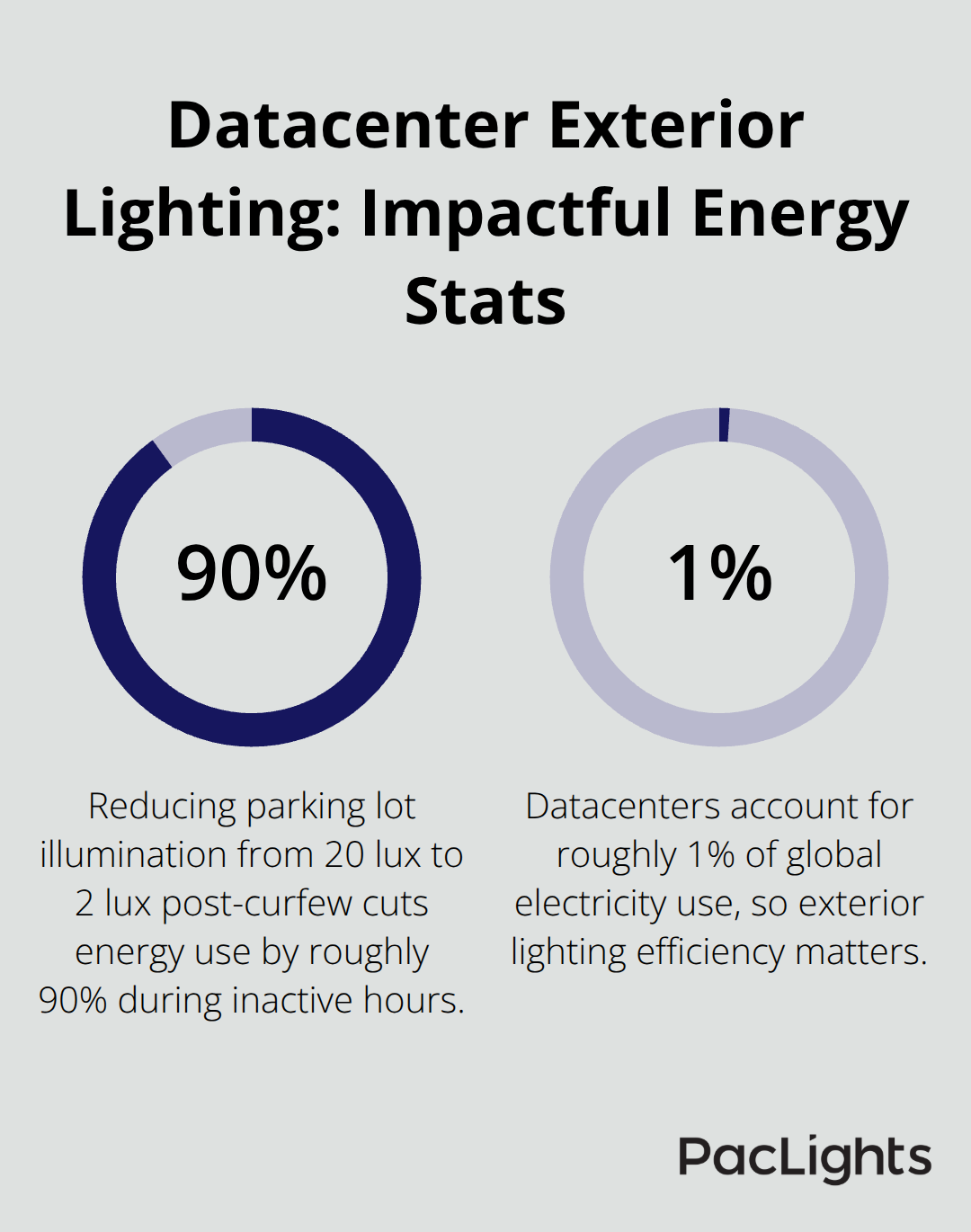
Energy consumption in datacenters represents roughly 1% of global electricity use, making exterior lighting efficiency a real operational lever. LED fixtures cut energy consumption significantly compared to older technologies, and networked controls like dimming and motion sensors further reduce waste. For parking lots and access roads, DarkSky guidance targets 2 lux during post-curfew hours, yet typical unmanaged industrial lots operate at 10 to 30 lux-a gap that represents pure energy waste and unnecessary light pollution.
You can implement 0–10V dimming with timers and occupancy sensors to maintain security during active hours while dropping to minimal levels during low-activity periods. This approach lets you keep critical zones protected without running fixtures at full capacity around the clock.
Reliability Through Longevity and Redundancy
Reliability depends on three factors: fixture longevity, redundancy, and emergency power integration. LED luminaires last roughly 30 times longer than incandescent bulbs and five times longer than CFLs, reducing maintenance cycles and the risk of dark perimeter areas during peak security needs. You should plan exterior lighting to run on emergency power systems, such as inverter backup, so critical zones remain illuminated during outages.
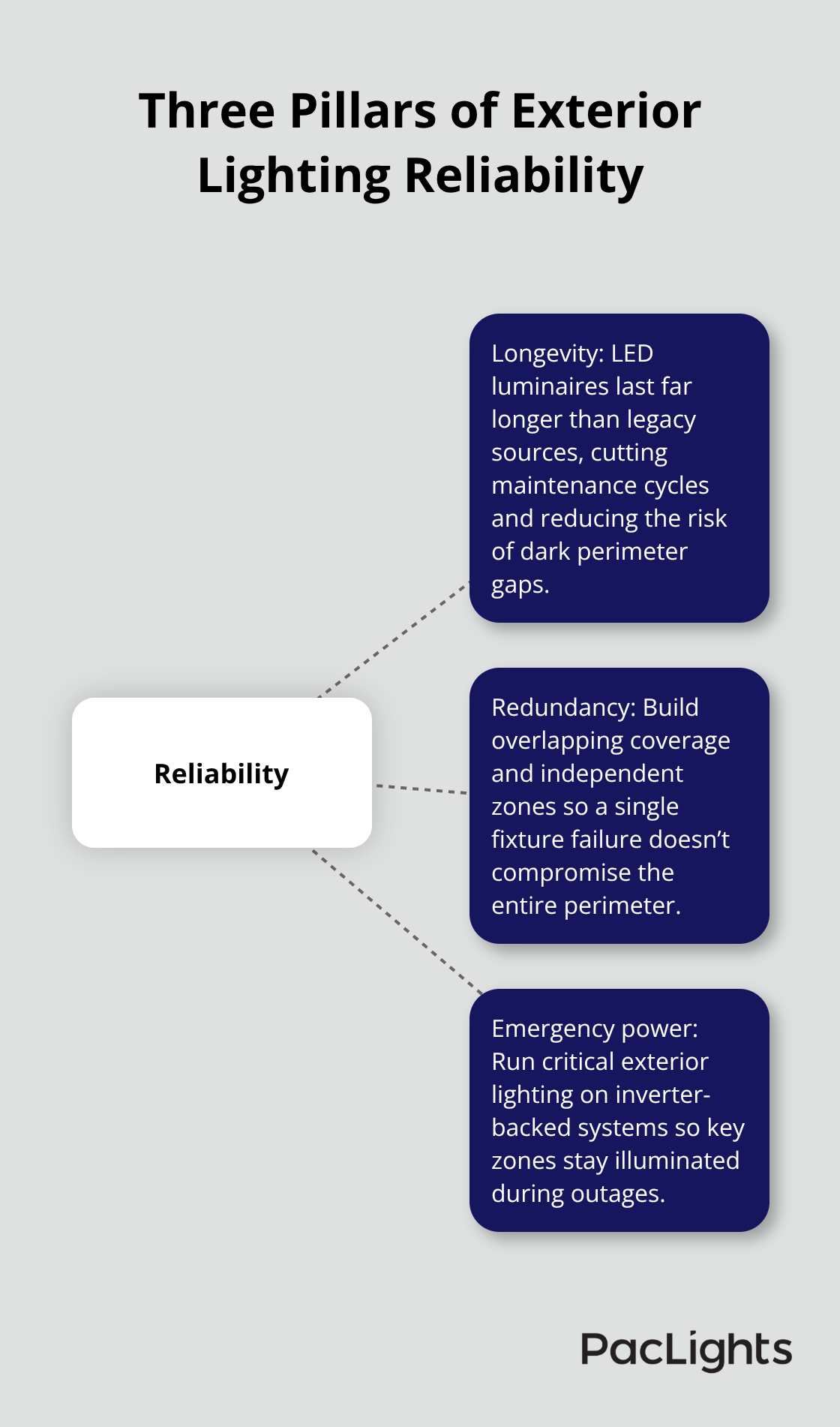
You can segment your exterior lighting into zones-area and site lighting, wall packs, floodlighting, and poles-so each zone operates independently and you can maintain or repair individual sections without compromising your entire perimeter. This zoning approach prevents a single failure from leaving your facility vulnerable.
Selecting the Right Fixtures for Your Facility
The fixtures you select determine whether your lighting plan succeeds or fails. PacLights offers outdoor fixtures such as area lighting, flood lights, wall lights, canopy lights, and parking garage lights, all tailored to diverse industrial needs. These products feature optional daylight or motion control, and advanced lighting controls to further optimize energy use. We also provide free lighting layout designs and ROI assessments to help you make informed decisions about which fixtures work best for your specific perimeter layout and security requirements.
With proper fixture selection, photometric planning, and control strategies in place, your exterior lighting becomes a strategic asset rather than a cost center. The next section covers the specific lighting solutions you need for different datacenter areas.
Where to Place Fixtures for Maximum Security and Efficiency
Perimeter and Fence Line Lighting
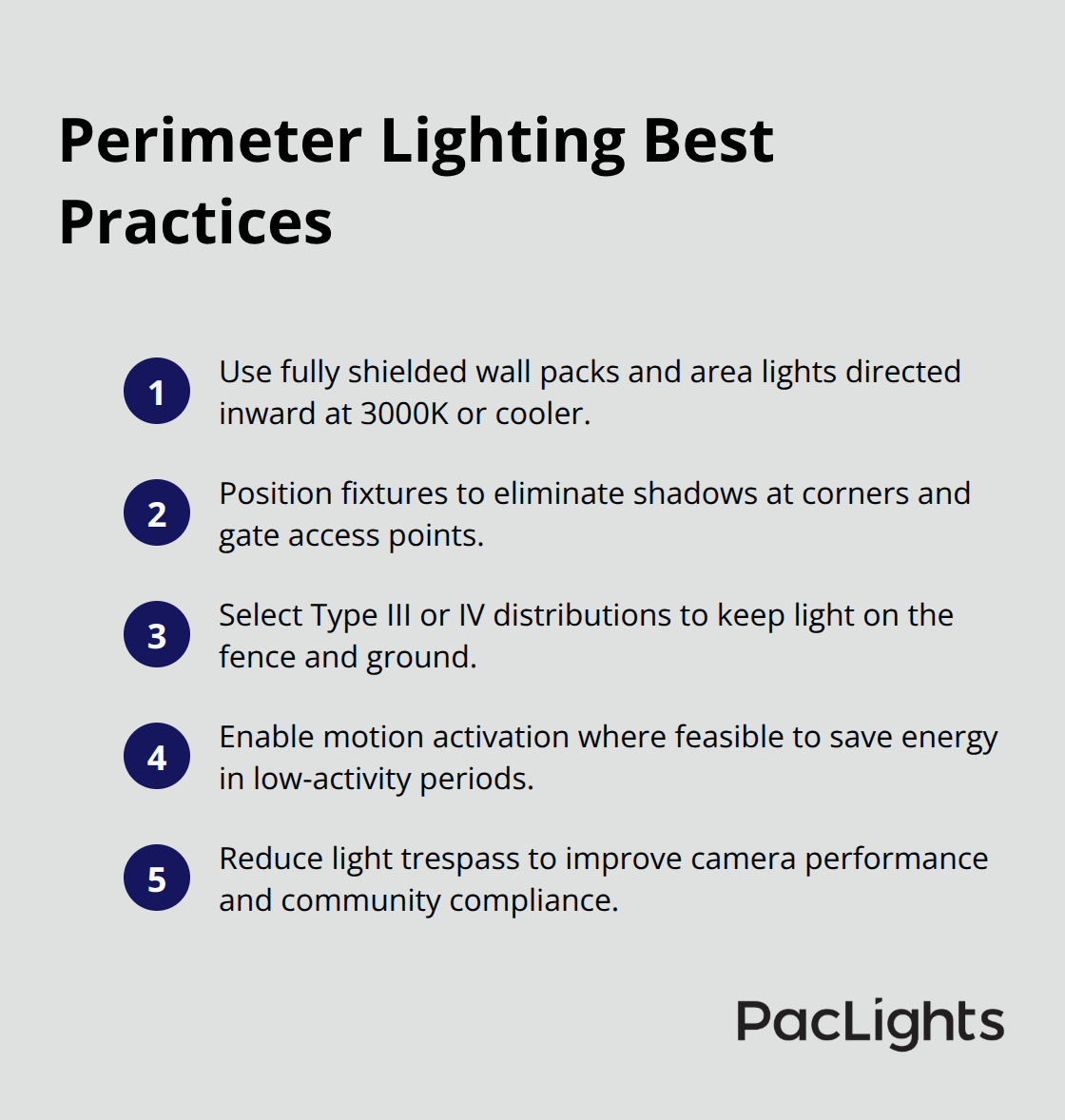
Perimeter and fence line lighting demands a different approach than parking areas or loading docks. Your fence line serves as the first line of defense, and it needs continuous illumination without gaps. DarkSky International recommends fully shielded wall packs and area lights directed inward at 3000K or cooler, with motion activation where feasible to save energy during low-activity periods. Position fixtures to eliminate shadows along the entire perimeter, especially at corners and gate access points where intruders test security. A Type III or IV photometric distribution keeps light on your fence and ground rather than scattering skyward, which also reduces light trespass onto neighboring properties and improves camera performance.
Pole-mounted lighting works well for large datacenter campuses because a single pole can provide broad perimeter coverage. Each pole must be positioned so its beam pattern overlaps with adjacent fixtures to prevent dark zones. Install fixtures at heights between 12 and 20 feet depending on your site layout. A photometric study before you purchase anything verifies coverage and identifies any blind spots that could compromise security.
Parking Lots and Access Roads
Parking lots and access roads present a different challenge because they cover larger areas and experience variable traffic patterns. DarkSky guidance targets 2 lux during post-curfew hours, yet most unmanaged industrial lots operate at 10 to 30 lux, wasting significant energy. Specify full-cutoff LED area lights in 2700 to 3000K with 0 to 10V dimming capabilities and motion sensors in low-traffic zones. This approach maintains adequate visibility during peak hours while dropping to minimal levels when your facility is quiet.
The energy savings compound over time. A datacenter that reduces parking lot illumination from 20 lux to 2 lux post-curfew cuts energy consumption by roughly 90 percent in those zones during inactive hours. Motion sensors reactivate full output when activity resumes, so security never suffers.
Loading Docks and Equipment Yards
Loading docks and equipment yards need task-specific lighting because technicians work at ground level with equipment that creates shadows. Position wall packs and floodlights to illuminate dock doors, equipment staging areas, and cable runs without creating glare that washes out camera feeds. Equipment yards with exposed infrastructure benefit from targeted floodlighting with proper aiming angles to light work surfaces while keeping light off the sky.
All three areas should integrate with your emergency power system so critical zones stay lit during outages. Segmenting these areas into independent zones means you can adjust controls and maintenance schedules for each without affecting facility-wide security. This zoning strategy also simplifies troubleshooting when a fixture fails or requires service.
Control Integration Across All Zones
Networked lighting controls tie your perimeter, parking, and equipment areas into a unified system that responds to occupancy, time of day, and emergency conditions. Motion sensors in low-traffic zones conserve energy while maintaining security during active periods. Dimming controls reduce output during curfew hours without leaving dark spots that compromise surveillance or create safety hazards. Emergency power integration ensures that critical exterior zones remain illuminated if your main electrical system fails, protecting both personnel and assets.
The next section covers the technical specifications that determine whether your fixtures perform as intended.
Specifying the Right Light Quality and Output
Color Temperature Sets the Foundation
Color temperature and lumen output are not decorative choices-they directly impact whether your cameras capture usable footage and whether your technicians can work safely. We at PacLights recommend 2700K to 3000K for all exterior datacenter lighting, and DarkSky International aligns with this guidance because warm light minimizes sky glow while maintaining visibility. Cooler temperatures like 4000K or 5000K increase light pollution and reduce camera performance in low-light conditions, yet many facilities default to these higher temperatures out of habit. Specify warm white fixtures from the start and you avoid retrofit costs later.
Lumen Output and Uniformity Requirements
For lumen output, your photometric study should target specific illumination levels: 2 lux post-curfew in parking areas according to DarkSky standards, 10 to 20 lux during active hours in those same zones, and higher levels around loading docks and equipment yards where technicians perform detailed work. Most unmanaged industrial parking lots operate at 10 to 30 lux around the clock, wasting roughly 90 percent of energy during low-activity periods. Uniformity matters as much as raw output-dark spots and hot spots compromise both security and camera performance. Your photometric plan must show consistent illumination across perimeter zones, fence lines, and access roads without glare that washes out surveillance feeds. Type III and Type IV photometric distributions keep light on surfaces rather than scattering skyward, which also reduces light trespass onto neighboring properties and meets stricter local ordinances that increasingly adopt DarkSky standards.
Control Systems Drive Efficiency and Security
Control systems determine whether your lighting actually delivers the efficiency and security you specified. Implement 0–10V dimming with occupancy sensors and time-based scheduling so parking areas and low-traffic zones drop to 2 lux post-curfew while perimeter and security zones maintain continuous operation with motion activation for emergency response. Motion sensors in parking areas reactivate full output when activity resumes, so you never sacrifice security for energy savings. Networked controls allow remote monitoring and outage detection across all zones, reducing maintenance visits and preventing dark perimeters that compromise facility security.
Emergency Power and Zone Segmentation
Emergency power integration is non-negotiable-your critical exterior zones must remain illuminated during electrical outages, which means specifying fixtures compatible with inverter backup systems. Segment your lighting into independent zones for perimeter, parking, loading docks, and equipment areas so you can adjust controls and maintenance schedules without affecting facility-wide operations. This zoning strategy also simplifies troubleshooting when individual fixtures fail. DarkSky International recommends curfew-based dimming combined with motion reactivation, which your control system must support through scheduling capabilities and sensor integration. Test your control logic before full deployment to confirm that motion sensors trigger appropriately, dimming schedules align with your facility’s actual activity patterns, and emergency fallback modes keep critical zones lit if the primary control system fails.
Final Thoughts
Proper datacenter exterior lighting specifications deliver measurable returns across security, energy efficiency, and operational reliability. The foundation rests on three decisions: selecting warm white fixtures at 2700K to 3000K with full cutoff ratings, implementing photometric studies to verify coverage and eliminate dark spots, and integrating networked controls that dim during low-activity periods while maintaining continuous operation in security-critical zones. These choices compound over time-a facility that reduces parking lot illumination from 20 lux to 2 lux post-curfew cuts energy consumption by roughly 90 percent during inactive hours, while motion sensors and emergency power integration protect both personnel and assets without sacrificing visibility.
LED fixtures last 30 times longer than incandescent bulbs, which reduces maintenance cycles and prevents dark perimeter areas during peak security needs. Zoning your datacenter exterior lighting into independent sections for perimeter, parking, loading docks, and equipment areas simplifies troubleshooting and allows you to adjust controls without affecting facility-wide operations. Compliance with DarkSky standards and local ordinances becomes easier when your lighting plan demonstrates full cutoff distributions, warm color temperatures, and curfew-based dimming-factors that increasingly influence community approvals and regulatory requirements.
Start your project by establishing target illumination levels for each zone based on your facility’s security requirements and activity patterns, then commission a photometric study to verify coverage before purchasing fixtures. We at PacLights offer outdoor fixtures including area lighting, flood lights, wall lights, canopy lights, and parking garage lights tailored to datacenter needs, along with free lighting layout designs and ROI assessments to support your decision-making. Proper specification today prevents costly retrofits and security vulnerabilities tomorrow.
Disclaimer: PacLights is not responsible for any actions taken based on the suggestions and information provided in this article, and readers should consult local building and electrical codes for proper guidance.