

Modular datacenters demand lighting that balances performance with efficiency. Poor lighting choices waste energy and compromise safety, while strategic solutions cut costs and improve operations.
At PacLights, we’ve seen firsthand how the right modular datacenter lighting approach transforms facility management. This guide covers what you need to know to get it right.
What Lighting Specs Does a Modular Datacenter Actually Need
Power Density and Heat Management
Modular datacenters operate under constraints that traditional facilities don’t face. Higher rack power density, compact footprints, and the need to scale quickly mean lighting can’t be an afterthought. The Illuminating Engineering Society recommends 50 foot-candles in server rooms and 20–30 foot-candles in corridors, but modular designs often pack equipment more densely, requiring fixture placement that avoids shadows and heat interference. Liquid cooling systems in high-density racks create significant thermal loads, so every watt of lighting energy adds to cooling demand. LED fixtures produce roughly 90% less heat than traditional fluorescent systems, making them essential for modular builds where cooling represents 40–50% of total energy costs according to DOE research.
Visibility and Safety Standards
Color temperature should sit between 4000K and 5000K with a color rendering index above 80 to help technicians accurately identify cables and labels during maintenance. NFPA 101 sets the baseline for emergency egress lighting, but modular datacenters benefit from exceeding minimums with redundant circuits and battery-backed systems that keep critical aisles lit during power events. The fixture placement strategy matters more in modular designs than traditional layouts-position narrow linear strips or pendant fixtures directly above cold aisles where technicians access equipment, spacing them 8–12 feet apart to eliminate dark zones without over-illuminating hot aisles. This approach cuts fixture counts by 20–30% while maintaining safety standards and preserving the thermal separation that hot/cold aisle containment requires.
Scalability and Control Integration
Scalability shapes every lighting decision in modular datacenters. A facility that doubles in size within two years needs lighting infrastructure that grows without rewiring entire sections or replacing control systems. Networked LED controls with open interoperability standards like WaveLinx DALI Unlocked allow modular pods to integrate seamlessly as capacity expands, enabling centralized management from a single dashboard across zones. Motion sensors and occupancy-based dimming add 25–30% energy savings on top of LED efficiency, critical for modular datacenters where occupancy patterns shift unpredictably. Daylight harvesting works best in facilities with perimeter windows or skylights, automatically reducing artificial lighting by 30–40% during daylight hours and ramping up as natural light fades.
Tiered Lighting Protocols for Remote Locations
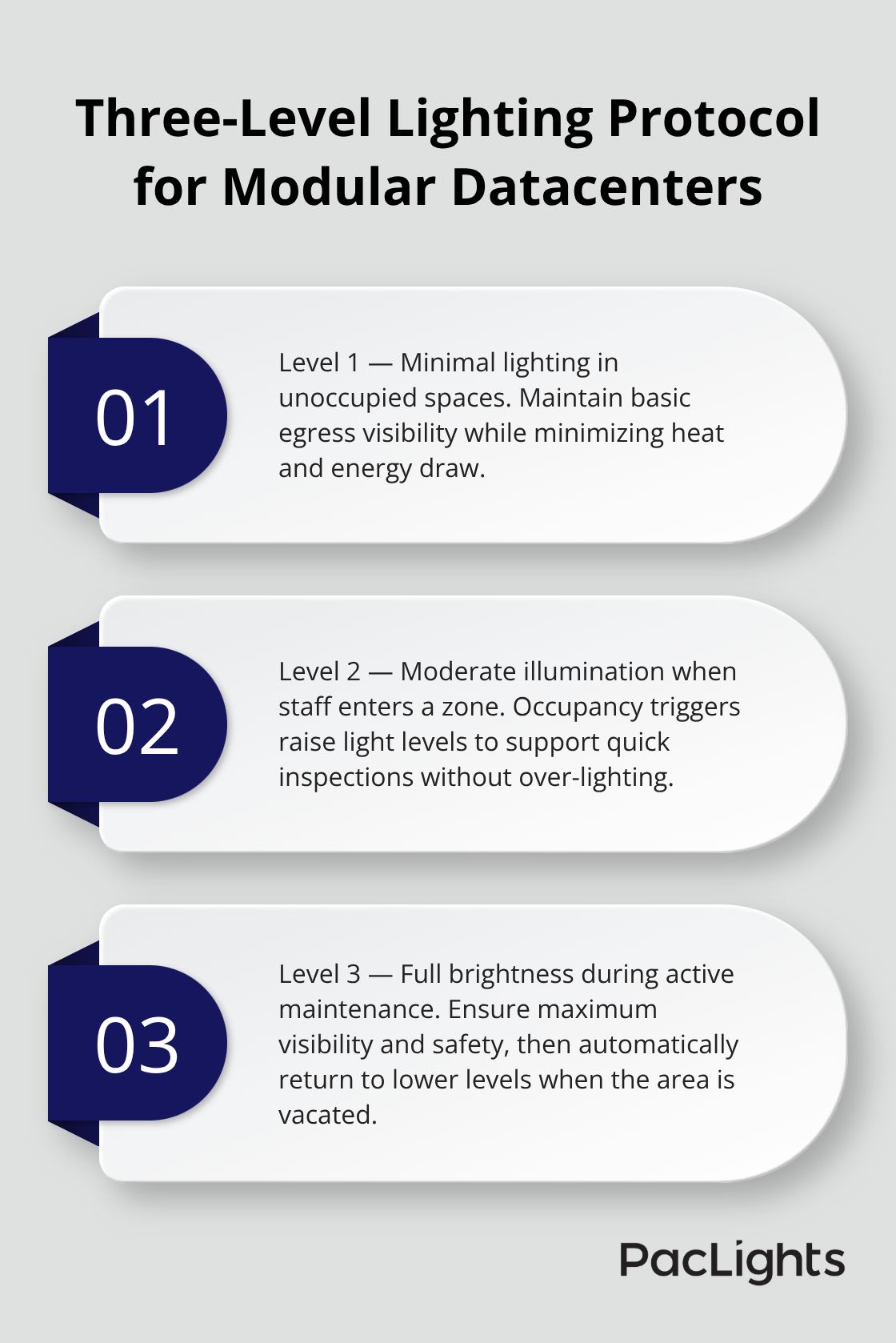
For modular datacenters in remote locations or windowless environments, a three-level control protocol minimizes wasted energy: Level 1 provides minimal lighting in vacant spaces, Level 2 activates moderate illumination when staff enters, and Level 3 delivers full brightness during active maintenance. This tiered approach can halve annual lighting energy consumption in low-occupancy periods.
Integration with building management systems enables lighting to respond dynamically to equipment load and ambient conditions, creating unified facility intelligence that supports both reliability and cost control. Free lighting layout assessments help identify the right fixture types and control strategies for your facility’s specific growth trajectory and thermal constraints.
Energy-Efficient Lighting Solutions for Datacenters
LED Technology Cuts Energy and Heat
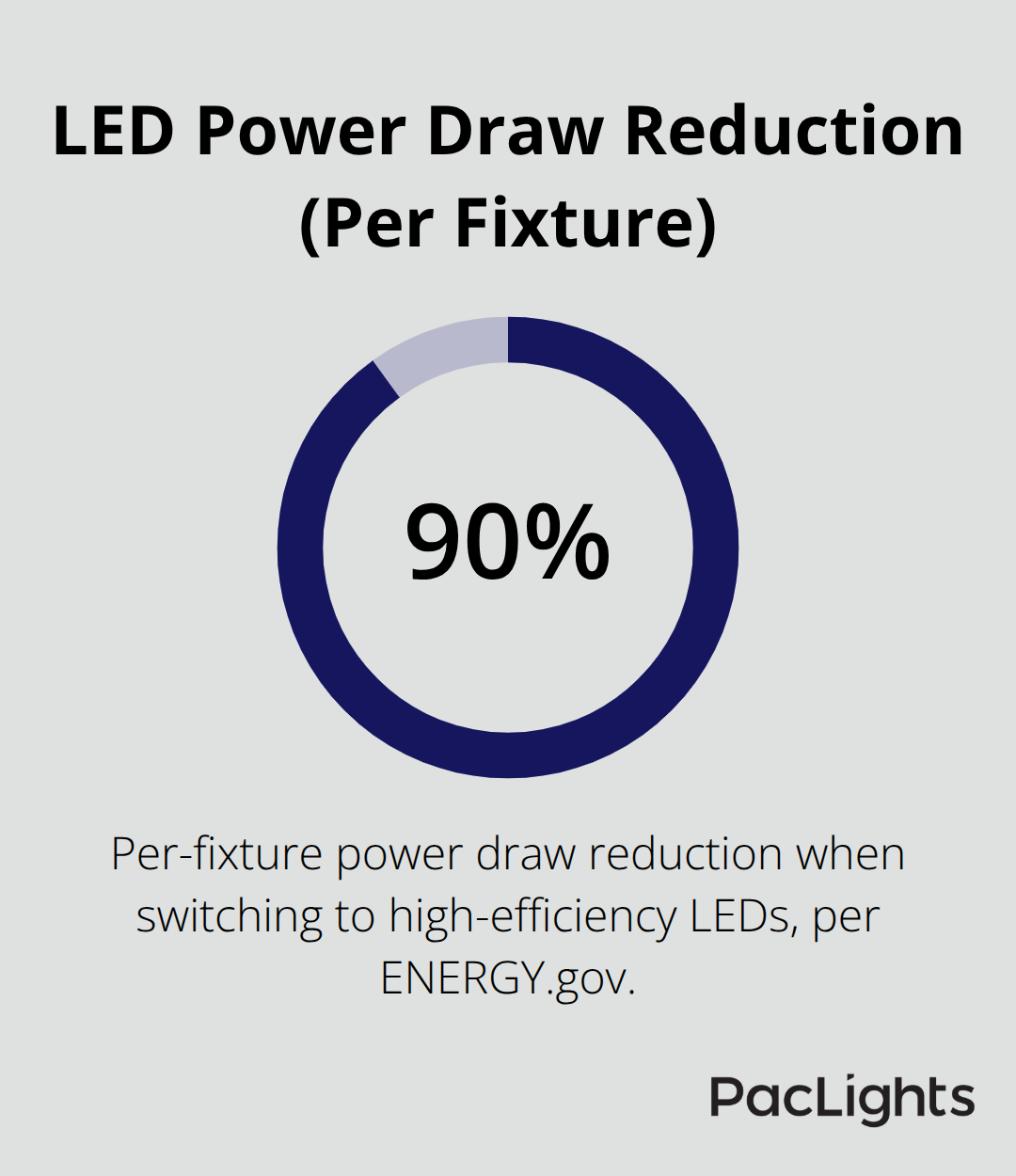
LED technology dominates modular datacenter lighting for one reason: the math is undeniable. Switching from fluorescent or older LED systems to high-efficiency LEDs cuts per-fixture energy consumption from roughly 500 watts down to 50 watts, delivering a 90% reduction in power draw per fixture according to ENERGY.gov.
A 10,000 square foot modular datacenter using standard fluorescent fixtures burns 50,000 to 100,000 kilowatt-hours annually for lighting alone, costing between $6,000 and $12,000 per year at typical utility rates. That same facility retrofitted with efficient LED fixtures drops to a fraction of that consumption.
The payback timeline is aggressive: most LED upgrades recover their investment within 2 to 4 years, then deliver another 15 to 20 years of operational life with minimal maintenance interruptions. LEDs last around 50,000 hours or longer-roughly 30 times longer than incandescent bulbs-eliminating the constant maintenance cycle that drains technician time and disrupts facility operations.
Heat reduction matters equally in modular designs where cooling already consumes 40 to 50% of total energy. LED fixtures produce far less waste heat than traditional systems, reducing cooling load by approximately 2 to 3 percent. That seemingly small percentage compounds across an entire facility and multiplies further when combined with rising electricity costs.
Advanced Controls Amplify LED Savings
Motion sensors and occupancy-based dimming add 25 to 30 percent energy savings on top of LED efficiency alone, critical for modular datacenters where staff presence varies unpredictably across zones. Networked controls with open standards like WaveLinx DALI Unlocked enable centralized management from a single dashboard, letting you track energy consumption by zone and generate performance reports without manual audits.
Real-world deployments show 40 to 60 percent total energy reductions in facilities ranging from 5,000 to 50,000 square feet when networked controls pair with three-level occupancy protocols. Integration with your building management system creates unified facility intelligence where lighting responds dynamically to equipment load, ambient conditions, and occupancy patterns simultaneously.
Daylight Harvesting and Smart Automation
Daylight harvesting automatically reduces artificial lighting by 30 to 40 percent during daylight hours in facilities with perimeter windows or skylights, ramping brightness up as natural light fades without manual intervention. This approach works particularly well in modular datacenters positioned near natural light sources, where sensors detect ambient conditions and adjust fixture output in real time.
The control system itself typically pays for itself within 18 to 24 months through energy savings, then runs essentially free for the remainder of its operational life. Retrofit solutions allow you to upgrade existing fixtures without costly rewiring or ceiling modifications, fitting new LED technology into current sockets and infrastructure.
Implementation Pathways for Modular Growth
Modular datacenters benefit from lighting systems that scale alongside facility expansion. Networked controls support incremental upgrades as your footprint grows, adding new zones and fixtures without replacing core infrastructure. Free lighting layout assessments help identify the right fixture types and control strategies for your facility’s specific growth trajectory and thermal constraints, ensuring that each expansion phase maintains energy efficiency and operational reliability.
The next phase of optimization involves strategic fixture placement and zoning-decisions that directly impact both energy consumption and maintenance workflows across your modular environment.
Implementation Best Practices for Datacenter Lighting
Audit Your Current State First
Modular datacenters live or die on execution details that seem minor until they cost you thousands in wasted energy or downtime. The difference between a 40 percent energy reduction and a mediocre 10 percent comes down to where you mount fixtures and how aggressively you control them. Start with a current-state lighting audit before touching anything. Measure foot-candles in your cold aisles, hot aisles, and corridors using a light meter, then compare against IES standards of 50 foot-candles in server rooms and 20–30 foot-candles in corridors. Most modular facilities over-illuminate hot aisles and under-light cold aisles where technicians actually work, wasting energy while creating safety blind spots.
Strategic Fixture Placement Cuts Waste
Position narrow linear strips or pendant fixtures directly above cold aisles at 8–12 foot spacing to eliminate shadows without heating up equipment zones. This single decision cuts fixture counts by 20–30 percent according to IES guidance while maintaining visibility where it matters. Avoid spreading fixtures across the full ceiling grid; that approach belongs to office buildings, not datacenters. Proper placement reduces both energy consumption and maintenance disruptions across your modular environment.
Control Systems Drive Real Savings
Integration with your building management system matters more in modular setups than retrofit projects because you design controls from the start rather than bolting them onto legacy infrastructure. Networked lighting controls with open standards like WaveLinx DALI Unlocked allow you to add zones incrementally as your facility expands without replacing central management hardware. Set up three distinct control levels before deployment: Level 1 minimal lighting in unoccupied spaces, Level 2 moderate brightness when staff enters a zone, and Level 3 full illumination during active maintenance work. Real-world deployments show this approach cuts annual lighting energy in half compared to always-on systems. Test your motion sensors and occupancy thresholds during a quiet shift, not during peak activity, to avoid nuisance dimming that frustrates technicians and defeats the purpose of automation.
Calculate ROI With Precision
ROI calculations for modular datacenter lighting split into two phases: immediate retrofit savings and long-term operational gains. A 10,000 square foot facility burning 50,000–100,000 kWh annually for lighting at $0.12 per kilowatt-hour costs $6,000–$12,000 yearly in lighting alone. Switching to high-efficiency LEDs with networked controls typically recovers the investment in 2–4 years, then delivers another 15–20 years of savings as LED fixtures last 50,000 hours or more.
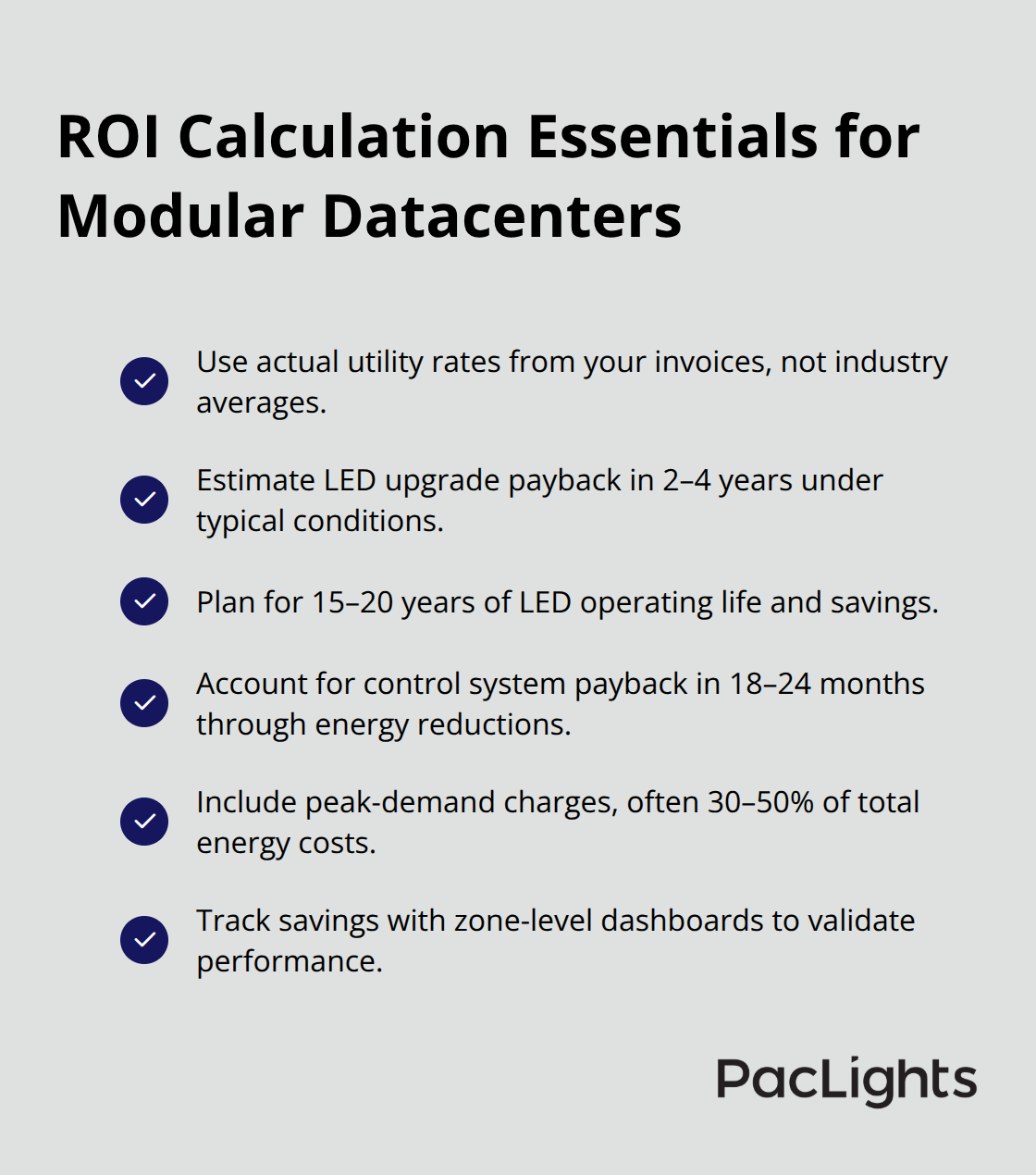
The control system itself pays back in 18–24 months through energy reductions alone, according to real deployments showing 40–60 percent total reductions across 5,000–50,000 square foot facilities. Calculate your payback using actual utility rates from your invoices, not industry averages, because a facility paying $0.18 per kilowatt-hour sees dramatically faster payback than one paying $0.08. Peak-demand charges often represent 30–50 percent of total energy costs according to DOE research, so networked controls that reduce peak draw during high-demand windows deliver outsized financial benefits beyond simple energy consumption math.
Monitor Performance Continuously
Monitor performance monthly using zone-level dashboards rather than waiting for quarterly utility bills to spot problems. If one zone underperforms compared to projections, investigate fixture failures, sensor drift, or control logic errors immediately rather than accepting degraded performance as normal. Free lighting layout designs and ROI assessments help identify the right fixture types and control strategies for your specific thermal constraints and growth timeline.
Final Thoughts
Efficient modular datacenter lighting transforms operations from an afterthought into a measurable competitive advantage. LED fixtures cut energy consumption by 90 percent compared to fluorescent systems, motion sensors add another 25 to 30 percent savings, and networked controls let you manage everything from a single dashboard as your facility scales. Most LED upgrades pay for themselves within 2 to 4 years, then deliver 15 to 20 years of operational life with minimal maintenance disruptions.
Reliable lighting directly supports your facility’s core mission in ways that spreadsheets alone don’t capture. Proper fixture placement eliminates shadows in cold aisles where technicians work, reducing maintenance errors and safety incidents. Three-level control protocols cut annual lighting energy in half by matching illumination to actual occupancy rather than running full brightness around the clock, while integration with building management systems creates unified facility intelligence that responds dynamically to equipment load and ambient conditions.
Start with a current-state audit to measure foot-candles in your existing zones and calculate your actual payback timeline using real utility rates. We at PacLights offer free lighting layout designs and ROI assessments to help you make informed decisions tailored to your specific thermal constraints and growth timeline. Prove the ROI in one zone, then expand systematically across your facility.
Disclaimer: PacLights is not responsible for any actions taken based on the suggestions and information provided in this article, and readers should consult local building and electrical codes for proper guidance.