

Modular utility plants demand lighting systems that balance efficiency with reliability. At PacLights, we’ve seen firsthand how poor lighting choices drain budgets and complicate operations.
This guide walks you through selecting and implementing modular utility plant lighting that cuts costs while improving performance. You’ll learn practical strategies for designing scalable systems that grow with your facility.
Why LED Fixtures Outperform Traditional Lighting in Modular Plants
Energy Consumption and Cost Reduction
LED fixtures cut energy consumption by up to 75% compared to traditional HPS and incandescent systems, making them the only rational choice for modular utility plants where operating costs compound quickly.
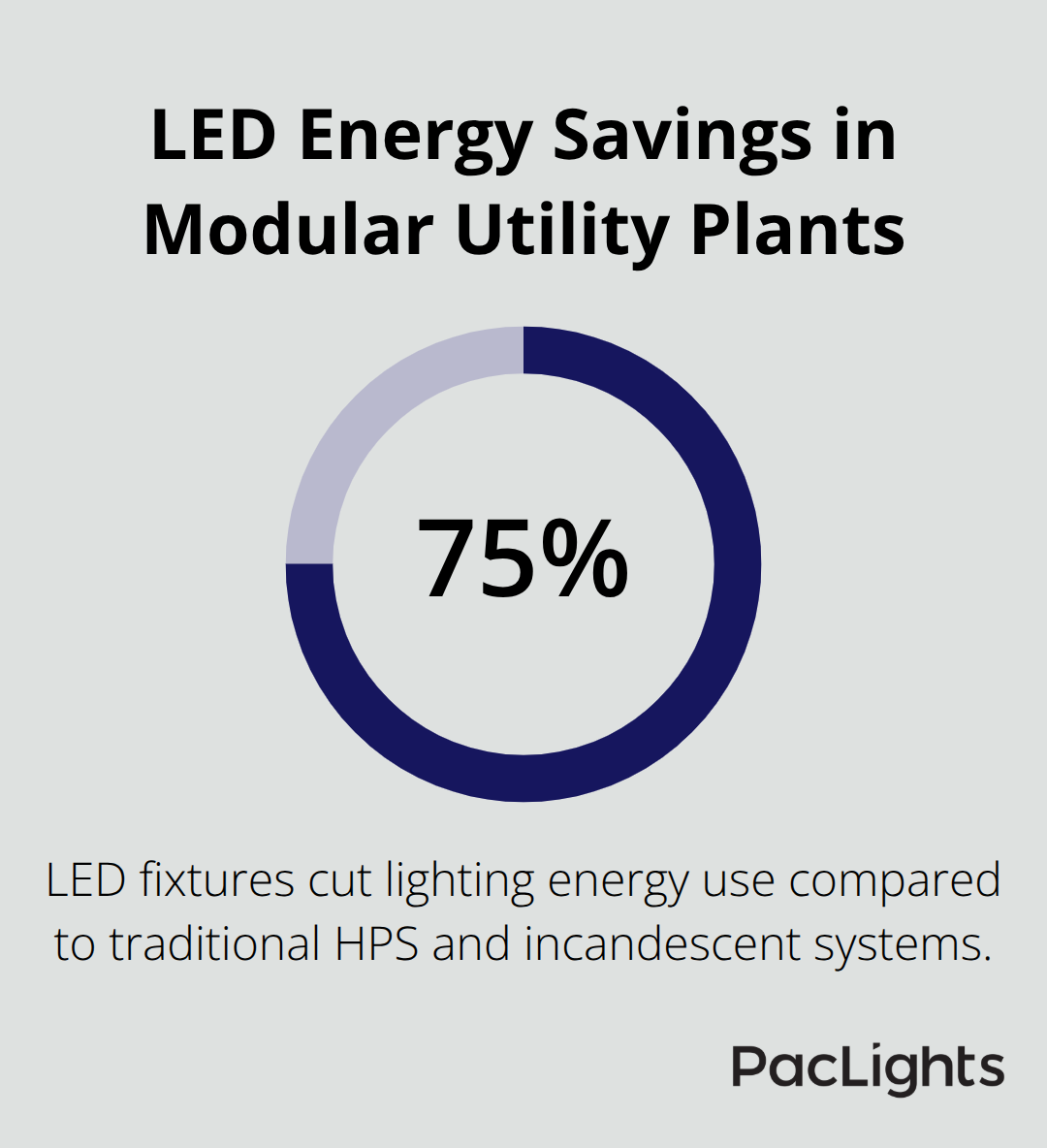
A standard 400-watt HPS fixture consumes roughly 400 watts continuously, while an equivalent LED high bay draws 150–200 watts and delivers superior light distribution. Over a year, that difference translates to thousands of dollars in electricity savings for a single facility. An LED retrofit to your existing modular plant infrastructure pays for itself through energy savings alone within 3–5 years, after which every year of operation is pure cost reduction.
Lifespan and Maintenance Advantages
LED lifespan ranges from 25,000 to 50,000 hours-roughly 25 times longer than incandescent bulbs-which means fewer replacement cycles, lower maintenance labor, and reduced downtime in critical utility spaces. In modular plants where space is tight and operational continuity matters, this reliability eliminates the constant cycle of replacing failed fixtures that drains budgets and pulls technicians away from other priorities. Technicians spend less time on ladder work and more time on strategic facility improvements.
Smart Controls Amplify Savings
Smart fixtures with integrated daylight harvesting and motion sensors reduce lighting energy by an additional 25–40%, depending on facility layout and usage patterns. A modular utility plant with natural light exposure can trim lighting hours significantly by dimming or switching off fixtures when ambient daylight exceeds target levels. Motion sensors work particularly well in corridors, storage areas, and intermittently used zones, cutting energy use by 20–30% in spaces that don’t require constant illumination. Networked lighting controls let you automate these strategies across multiple zones simultaneously, eliminating manual adjustments and human error.
Worker Performance and Environmental Impact
Color temperature matters too: cooler LEDs at 5000K–6500K keep workers alert and reduce eye strain in control rooms and precision workspaces, directly supporting safety and productivity. The environmental benefit is equally tangible: switching a 100-fixture modular plant from HPS to LED eliminates roughly 30 tons of CO2 emissions annually, equivalent to removing six cars from the road. These gains in efficiency and sustainability create a foundation for the control systems that will optimize your lighting further.
Matching Fixtures to Your Modular Plant Layout
Modular utility plants come in wildly different configurations, and treating all spaces the same wastes money on over-lit corridors and under-lit work zones. Start by measuring your facility and categorizing spaces by function: control rooms, equipment areas, corridors, storage zones, and maintenance bays each demand different illuminance levels and fixture types. Control rooms typically need 300 lux to support precision monitoring without glare, while general equipment areas work well at 500 lux according to ANSI/IES standards. Corridors and emergency egress routes require only 50 lux, yet many facilities over-specify these zones out of habit. A modular plant with 40 feet of ceiling height demands high-bay fixtures with tight beam angles to avoid wasting light on empty space above equipment, while low-bay fixtures under 20 feet waste energy if forced into tall spaces.
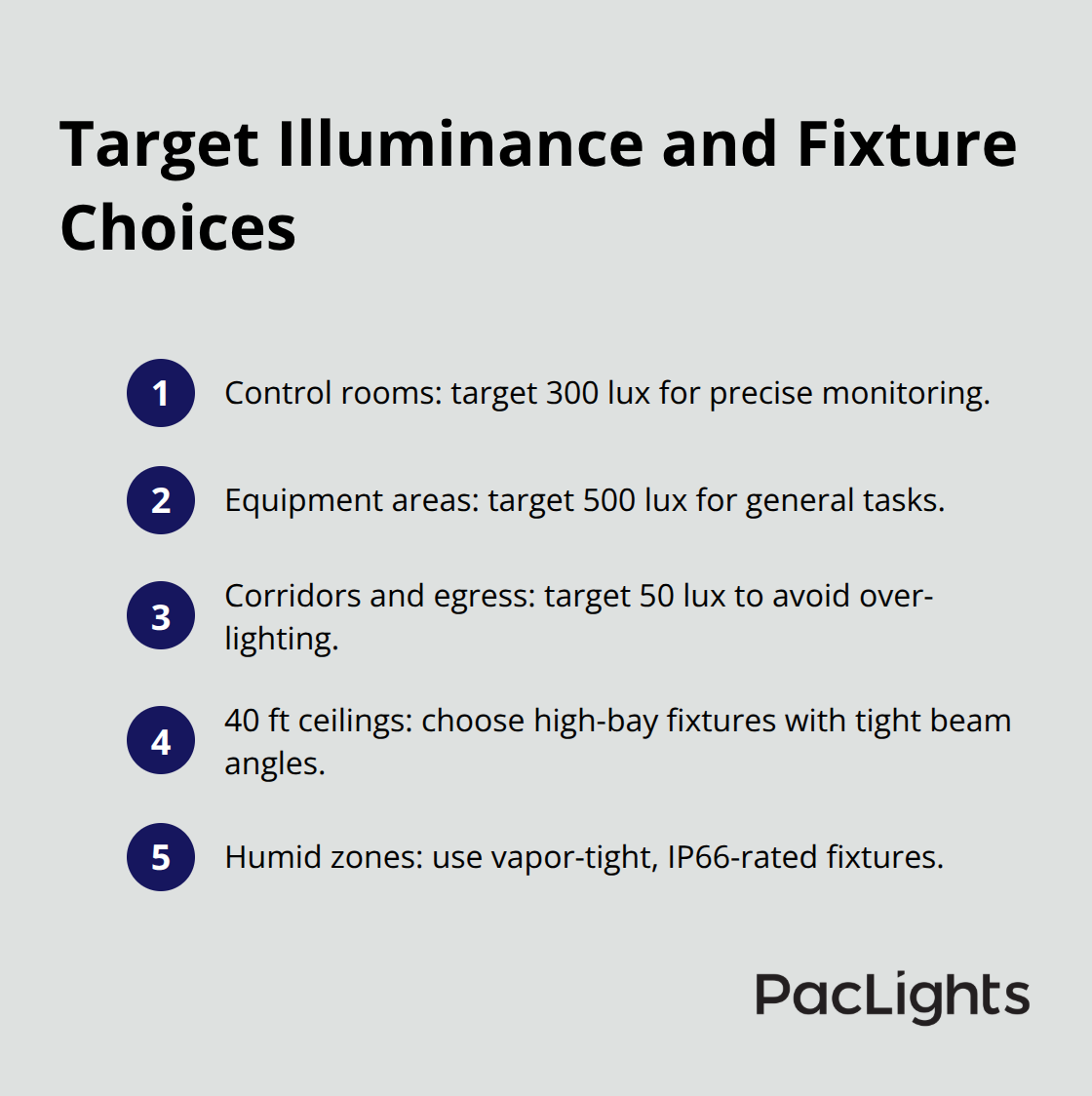
Vapor-tight or weatherproof IP66-rated fixtures prevent moisture ingress in humid utility environments, protecting your investment and eliminating premature failures that pull technicians away from real work.
Selecting Fixtures for Uniform Coverage
Linear LED bars deliver uniform coverage across rows of equipment and mechanical systems, whereas pendant fixtures excel in localized task zones like workshops or diagnostic areas. High-bay fixtures with adjustable beam angles let you dial in exactly the light you need without over-illuminating adjacent zones, directly cutting energy waste. Measure your mounting heights and equipment spacing first, then select beam angles that deliver target illuminance with minimal spillover-standard 120-degree angles often miss the mark. Retrofit-ready mounting systems swap out old HPS fixtures for LEDs without rewiring, cutting installation time and cost significantly.
Planning for Expansion Without Disruption
Modular plants expand frequently, and your lighting system must scale without tearing out infrastructure. Specify fixtures with modular power capacity and flexible control options from day one; networked lighting controls integrate seamlessly as you add zones, unlike hardwired systems that require expensive retrofits. Outdoor MCPs reduce on-site footprint and add via modules later, freeing interior space for lighting layout optimization without disrupting current operations. Design your electrical distribution and control wiring with 30–40% spare capacity to accommodate future fixture additions without costly panel upgrades.
Getting the Design Right From the Start
PacLights offers free lighting layout designs and ROI assessments that account for your facility’s current configuration and realistic expansion plans, helping you avoid over-building today or under-building tomorrow. A custom light plan engineered by horticultural lighting specialists tailors photoperiod, intensity, and spectrum to your specific modular plant needs. These assessments identify which zones benefit most from advanced controls and where standard fixtures suffice, maximizing your return on investment. Once you understand your fixture requirements and layout strategy, the next critical step involves selecting and configuring the control systems that transform static lighting into a dynamic, responsive infrastructure.
How to Turn Static Lighting into Dynamic Infrastructure
Motion Sensors and Daylight Harvesting
Motion sensors cut lighting energy by 20–30% in corridors and storage zones because these spaces sit empty for extended periods, yet most facilities leave them fully lit regardless of occupancy. Daylight harvesting works differently: sensors measure ambient light levels and dim or switch off fixtures when natural daylight exceeds your target illuminance, reducing lighting energy by an additional 25–40% depending on facility orientation and window placement. The catch is that motion sensors only work in spaces with genuinely intermittent use-a control room or equipment monitoring area stays occupied continuously, so motion sensors deliver zero savings there. Daylight harvesting requires honest assessment of your facility’s exposure; a modular utility plant on the north side of a building sees minimal direct sunlight, making the investment marginal unless supplemented by skylights or clerestory windows. Start by auditing which zones experience genuine downtime versus those requiring constant illumination, then specify controls only where occupancy or daylight patterns justify the cost.
Networked Controls Transform Facility Operations
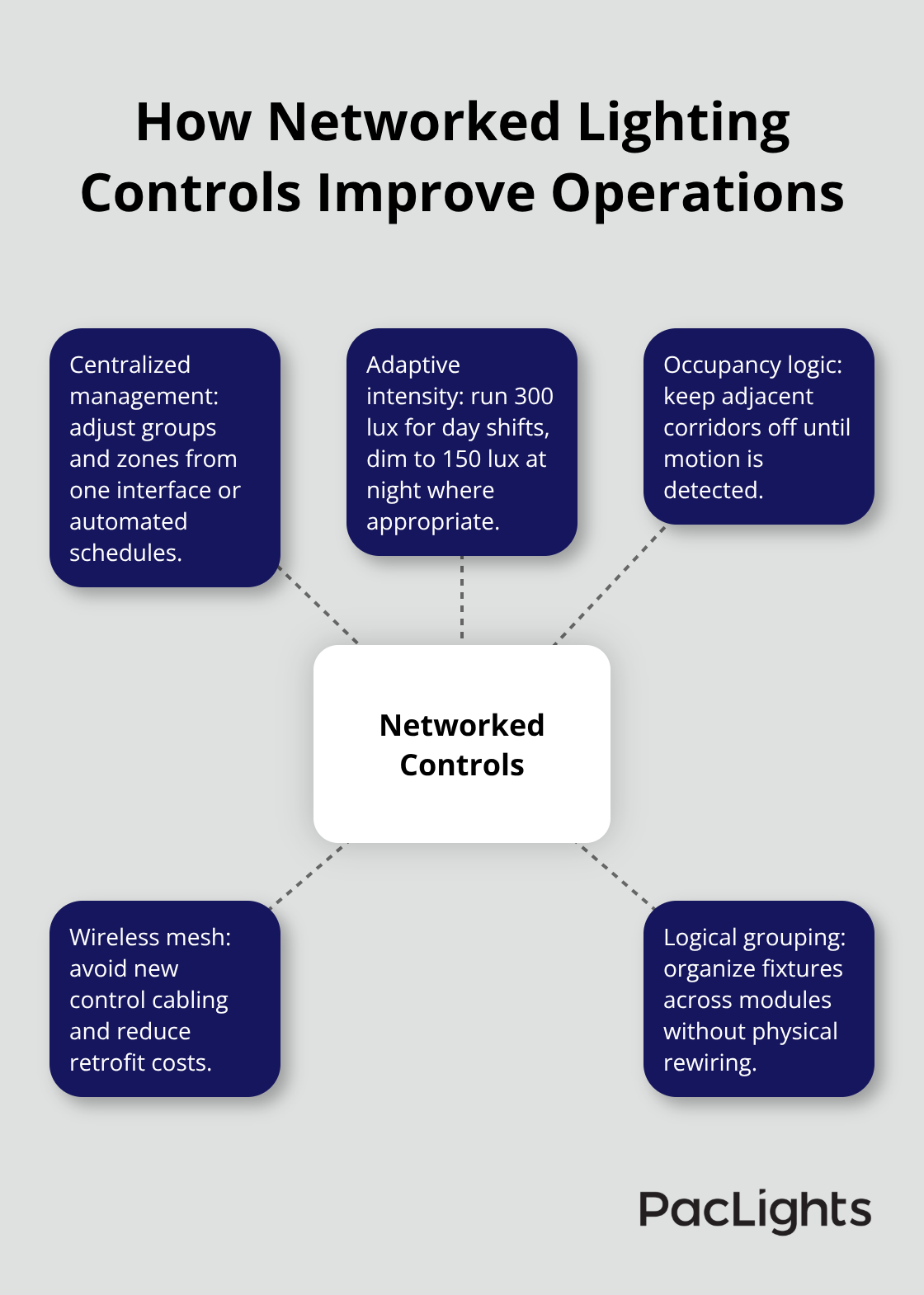
Networked lighting controls transform your facility from a collection of independent fixtures into a coordinated system that responds to real-time conditions. Unlike hardwired systems that require physical rewiring to adjust zones, networked controls let you group fixtures logically across your modular plant and adjust them from a central interface or automated schedule. A control room might operate at full 300 lux intensity during day shifts and dim to 150 lux during night operations, while adjacent corridors remain off until motion is detected. Wireless mesh networks eliminate the expense of running new control cabling through established utility plants, cutting retrofit costs significantly compared to traditional dimming systems.
Real-Time Data Drives Optimization
Real-time sensors for ambient light, temperature, and humidity feed data into your control system, enabling adaptive responses: if ambient temperature drops and heating kicks in, the system can reduce lighting intensity slightly to lower thermal load without compromising visibility. Integration with building management systems amplifies these gains; a BMS that monitors HVAC, power distribution, and lighting simultaneously identifies opportunities you’d miss managing systems independently. Data from these networked controls reveals which zones consume the most energy and which fixture types underperform, guiding future retrofit decisions and preventing wasteful over-specification in new expansions. PacLights offers advanced lighting controls such as networked lighting controls and optional daylight or motion control built into fixtures, enabling this level of optimization without requiring a complete system redesign.
Final Thoughts
Efficient modular utility plant lighting delivers measurable returns that extend far beyond your next electricity bill. The combination of LED fixtures, smart controls, and strategic layout design cuts energy consumption by up to 75% while eliminating the constant maintenance burden of traditional systems. A facility that switches to networked LED controls sees payback within 3–5 years, after which operational savings compound annually.
The environmental case proves equally compelling. A 100-fixture modular plant running on LEDs instead of HPS eliminates roughly 30 tons of CO2 emissions per year-not theoretical, but the direct result of consuming less electricity and replacing fixtures far less frequently. When you factor in reduced cooling loads from lower heat output and optimized controls that dim fixtures during low-occupancy periods, the carbon footprint shrinks further.
Starting this process requires honest assessment of your current layout, realistic expansion timelines, and clear targets for energy reduction. We at PacLights provide free lighting layout designs and ROI assessments that account for your specific facility configuration and future growth plans, and our team works with you to identify which zones benefit most from advanced controls. Visit PacLights to explore our full range of energy-efficient fixtures, retrofit solutions, and networked lighting controls designed for industrial and commercial facilities.
Disclaimer: PacLights is not responsible for any actions taken based on the suggestions and information provided in this article, and readers should consult local building and electrical codes for proper guidance.