

Food looks better under the right light. That’s not opinion-it’s science. At PacLights, we know that wrap light color rendering directly impacts how customers perceive what they’re buying, whether it’s a sandwich, a coffee, or fresh produce.
This guide covers CRI standards, why they matter for your business, and how to choose lighting that makes food look its best while keeping energy costs down.
Understanding Color Rendering Index and CRI Standards
What CRI Actually Measures
Color Rendering Index measures how accurately a light source reproduces colors on a 0–100 scale compared to a reference standard, typically daylight or incandescent light at the same color temperature. The International Commission on Illumination established this metric, and it serves as the industry baseline for evaluating lighting performance in food-service settings. CRI isn’t theoretical-it directly determines whether a sandwich looks appetizing or unappetizing under your fixtures. A light with CRI 95 renders the red in tomatoes, the golden brown of toasted bread, and the green in lettuce far more faithfully than a light with CRI 70. For food businesses, this difference translates directly to perceived quality and customer purchasing decisions. Restaurants and cafés operating with low-CRI lighting lose sales because food appears dull, discolored, or unappetizing under the fixtures, even if the actual product is fresh and high-quality.
CRI Standards Across Food-Service Settings
The FDA Food Code and NSF International establish sanitation standards for food-handling facilities, but color rendering requirements vary by application. Retail grocery stores typically try for CRI 90 or higher to make produce, meat, and packaged goods appear vibrant and true-to-life, which directly influences customer perception of freshness and quality. Restaurants and fine-dining establishments should target CRI 90–95 minimum because food presentation is central to the dining experience and menu pricing justification. Cafés and bakeries benefit from CRI 95+ on display cases and counter areas where pastries, cakes, and prepared items sit under wrap lights-these settings demand exceptional color fidelity to showcase product appeal. Commercial kitchens and prep areas can operate at CRI 80–85 for task lighting since staff focus on food safety and preparation rather than visual presentation, though higher CRI still improves color cues for ingredient recognition and quality assessment. Quick-service restaurants fall in the CRI 85–90 range for counter and menu lighting, balancing cost with the need to make food look fresh and appealing in photographs and real-time viewing. The cost difference between CRI 80, 90, and 95+ fixtures is real but modest-typically 10–20% higher investment for CRI 95+ LEDs compared to CRI 80 alternatives-yet the return on customer perception and repeat purchases far outweighs the upfront expense.
Why CRI 90 Is the Practical Minimum for Food Service
CRI 85–89 show visible color shifts in reds and oranges (precisely the wavelengths that define food appeal), making produce appear slightly dull or meats appear less fresh than they are. CRI 90 and above render these critical colors faithfully, and the jump from CRI 90 to 95+ delivers marginal improvements that matter only in high-end fine-dining or specialty retail environments where every detail drives brand perception. For most food-service operations, CRI 90 LEDs with tunable color temperature options (typically 3000K–4000K for warm, appetizing tones) deliver excellent results at reasonable cost. Avoid the temptation to cut corners with CRI 80 fixtures; the savings rarely justify the lost sales from food appearing less appetizing under inadequate lighting. The next section explores how CRI directly shapes customer behavior and purchasing patterns in real food-service environments.
Color Rendering in Food-Service Environments
How CRI Shapes Customer Perception and Purchase Decisions
CRI directly controls whether food looks fresh, appetizing, and worth the price customers pay. Under CRI 90+ lighting, a roasted chicken appears golden and succulent; under CRI 70, the same chicken looks gray and unappetizing.
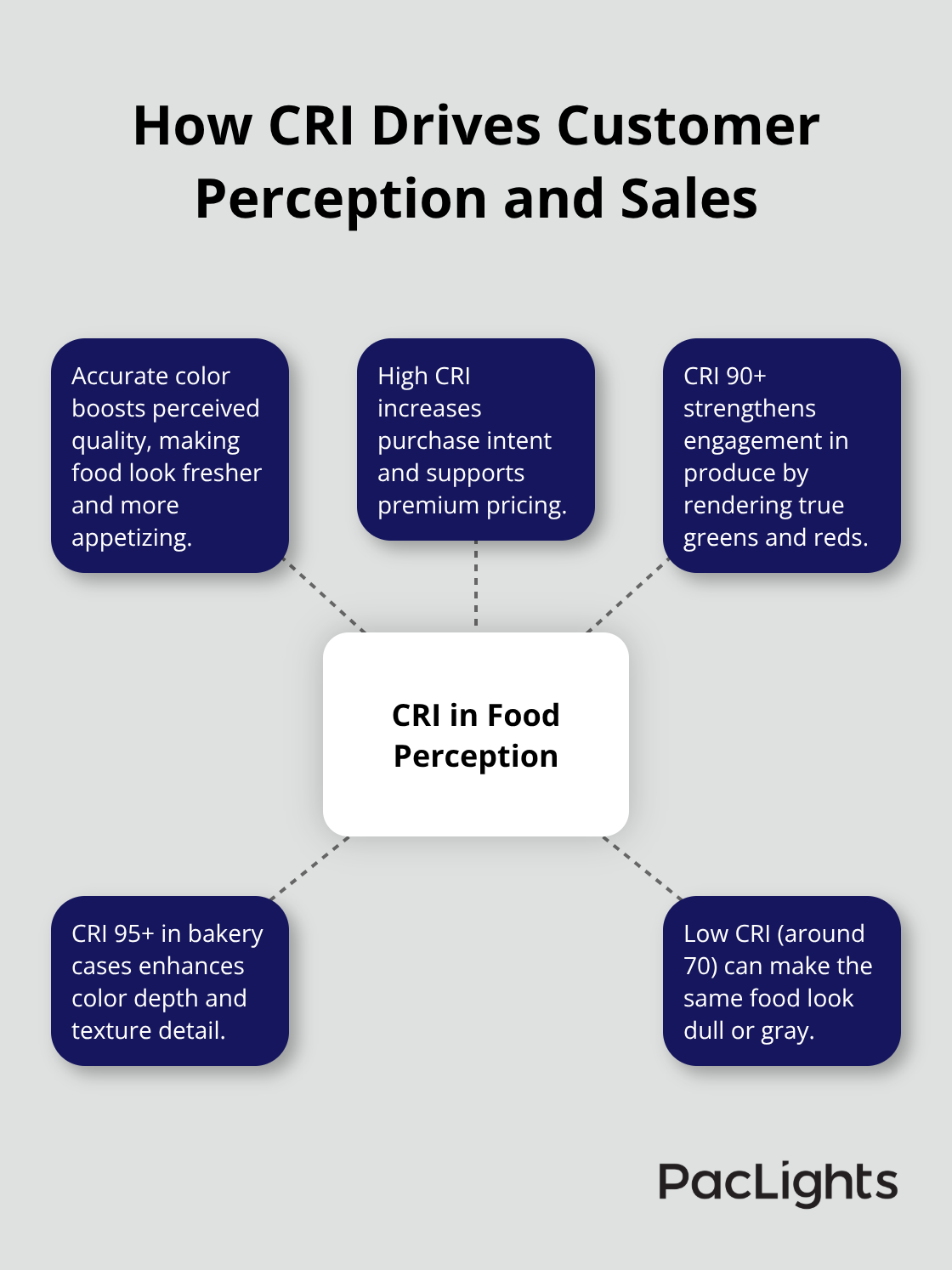
Research from retail environments shows that high-CRI lighting increases perceived product quality, which translates to higher purchase intent and willingness to pay premium prices. In grocery stores, produce departments lit with CRI 90 or higher report stronger customer engagement with fresh items because lettuce appears vibrant green, tomatoes look deep red, and berries display natural sheen. Bakery display cases under CRI 95+ lighting show pastries with true color depth and texture detail, making items appear fresher and more desirable than identical products under CRI 80 fixtures.
The difference matters enough that restaurants and cafés operating with inadequate CRI lose repeat customers who perceive food quality as lower than competitors with better lighting, even when actual ingredients and preparation are identical. Quick-service restaurants that upgraded from CRI 75 to CRI 90 wrap lighting reported improved photo appeal on social media and higher in-store sales because food photographed and appeared more vibrant under the new fixtures. Fine-dining establishments cannot compromise on CRI because plating presentation and food color are central to menu pricing and brand reputation.
CRI Targets by Facility Type
Grocery stores should invest in CRI 90 minimum for produce, meat, and prepared-food sections because customer perception of freshness directly drives sales. Bakery and deli counters benefit from CRI 95+ on display cases where wrap lights highlight product appeal. Restaurants targeting CRI 90–95 on dining areas and food-display zones create visual impact that justifies menu pricing and encourages larger orders. Kitchens and prep areas can operate at CRI 80–85 for task efficiency without sacrificing food quality assessment. Cafés and specialty food shops should prioritize CRI 95+ on pastry cases and counter displays because high-end customers expect premium presentation and accurate color rendering reinforces perceived value.
Cost-Benefit Analysis and Implementation Strategy
The cost gap between CRI 90 and CRI 95+ LEDs is typically 5–15% additional investment, which recovers quickly through improved customer perception and repeat business. Facilities mixing old fluorescent or incandescent fixtures with modern LEDs should standardize on CRI 90+ across customer-facing areas to avoid visible color inconsistencies that undermine brand perception. Testing wrap lights with actual menu items under target fixtures reveals whether color rendering meets expectations before full installation, preventing costly mistakes. Facilities that pair high-CRI LEDs with tunable color temperature (3000K–4000K range) achieve both appetizing warm tones and accurate color fidelity, creating dining environments where food appears both inviting and true-to-life.
The next section examines wrap lights specifically and explains why they outperform other fixture types for food-service applications.
Wrap Lights Dominate Food-Service Lighting
Why Wrap Lights Outperform Other Fixtures
Wrap lights deliver uniform light distribution directly onto product surfaces without harsh shadows or dark zones. The wraparound design eliminates the spotting effect common with pendant or track fixtures, so every item in a display case or counter receives consistent illumination at the same intensity and color temperature. This uniformity matters enormously for CRI performance-a wrap light with CRI 90 maintains that color fidelity across the entire lit surface, whereas a pendant light creates bright zones and dim zones where CRI perception shifts visibly. Wrap lights fit seamlessly into existing counter and display infrastructure, requiring minimal structural changes compared to recessed or track systems. For bakery cases, deli counters, and grab-and-go displays, wrap lights offer the practical advantage of easy installation and maintenance without disrupting daily operations. The fixture’s sealed design resists moisture and food particles, critical in kitchens where steam and splashing occur regularly, which means your CRI performance stays stable over time rather than degrading under harsh conditions.
Selecting the Right CRI for Your Operation
Grocery stores and restaurants displaying prepared foods should install CRI 90 minimum on wrap lights; anything lower visibly shifts reds and oranges, the exact colors customers use to judge freshness and quality. Bakeries and specialty food shops benefit from CRI 95 wrap lights on pastry cases because premium customers expect color accuracy that matches product photography and social media imagery. Commercial kitchens can operate CRI 80 wrap lights for prep areas since staff assess food safety through taste and texture rather than color alone, freeing budget for higher CRI in customer-facing zones. The cost difference between CRI 90 and CRI 95 LEDs remains modest-typically 10–15% higher fixture price without increasing operational electricity expenses.
Energy Efficiency and Long-Term Performance
LED wrap lights rated at 50,000–75,000 hour lifespan eliminate frequent replacement labor and disposal costs associated with older fluorescent or halogen wrap systems. CRI 90 and CRI 95 LEDs consume identical wattage (typically 25–40 watts depending on length), so the CRI upgrade costs only in fixture price without raising electricity bills. The spectral power distribution in quality LED wrap lights maintains CRI stability across color temperatures from 3000K to 5000K, meaning you can adjust warmth for ambiance without sacrificing color accuracy-a capability unavailable in legacy technologies.
Testing Before Installation
Place sample fixtures above representative products and photograph them under both your new lighting and competitor fixtures to verify CRI meets your visual standards. This approach prevents costly mistakes and confirms that color rendering matches your expectations before full installation across your facility.
Final Thoughts
CRI 90 represents the practical floor for any food-service operation serious about customer perception and sales. Below that threshold, reds and oranges shift visibly, making fresh food appear dull and less appetizing than it actually is. The cost difference between CRI 90 and CRI 95 fixtures remains modest-typically 10–15% higher investment-yet the return through improved customer perception and repeat business justifies the expense immediately. Wrap light color rendering performance stays consistent across your entire display because the wraparound design eliminates shadows and dark zones where color perception would otherwise degrade.
Your facility type determines the right CRI target. Grocery stores and restaurants displaying prepared foods need CRI 90 minimum on customer-facing wrap lights, while bakeries and specialty food shops should invest in CRI 95 on pastry cases where premium customers expect color accuracy matching social media imagery. Commercial kitchens can operate CRI 80 for prep areas since staff assess food safety through taste and texture rather than color alone, which frees budget for higher CRI where customers see the product. This strategic allocation maximizes your return on lighting investment across different zones.
Before committing to a full installation, place sample fixtures above representative products and photograph them under both your new lighting and competitor fixtures to prevent costly mistakes. We at PacLights offer customizable wrap light solutions tailored to your specific CRI and color-temperature needs, plus free lighting layout designs and ROI assessments to help you make informed decisions. Contact us for a consultation to identify the right CRI standard for your operation and transform how customers perceive your products.
Disclaimer: PacLights is not responsible for any actions taken based on the suggestions and information provided in this article, and readers should consult local building and electrical codes for proper guidance.