

Moisture and corrosion destroy ordinary lighting systems. Vapor tight LED fixtures are built to survive where standard fixtures fail-in freezers, car washes, chemical plants, and other harsh environments.
At PacLights, we’ve seen firsthand how the right sealed fixture cuts maintenance costs and extends equipment life by years. This guide shows you exactly what to look for and how to calculate your savings.
What Vapor Tight Fixtures Actually Protect Against
Vapor tight LED fixtures aren’t just sealed boxes. They’re engineered systems with liquid silicone perimeter gaskets, polycarbonate housings, and stainless steel components that work together to block moisture, dust, and corrosive particles from reaching electrical connections and LED components.
The Real Cost of Inadequate Sealing
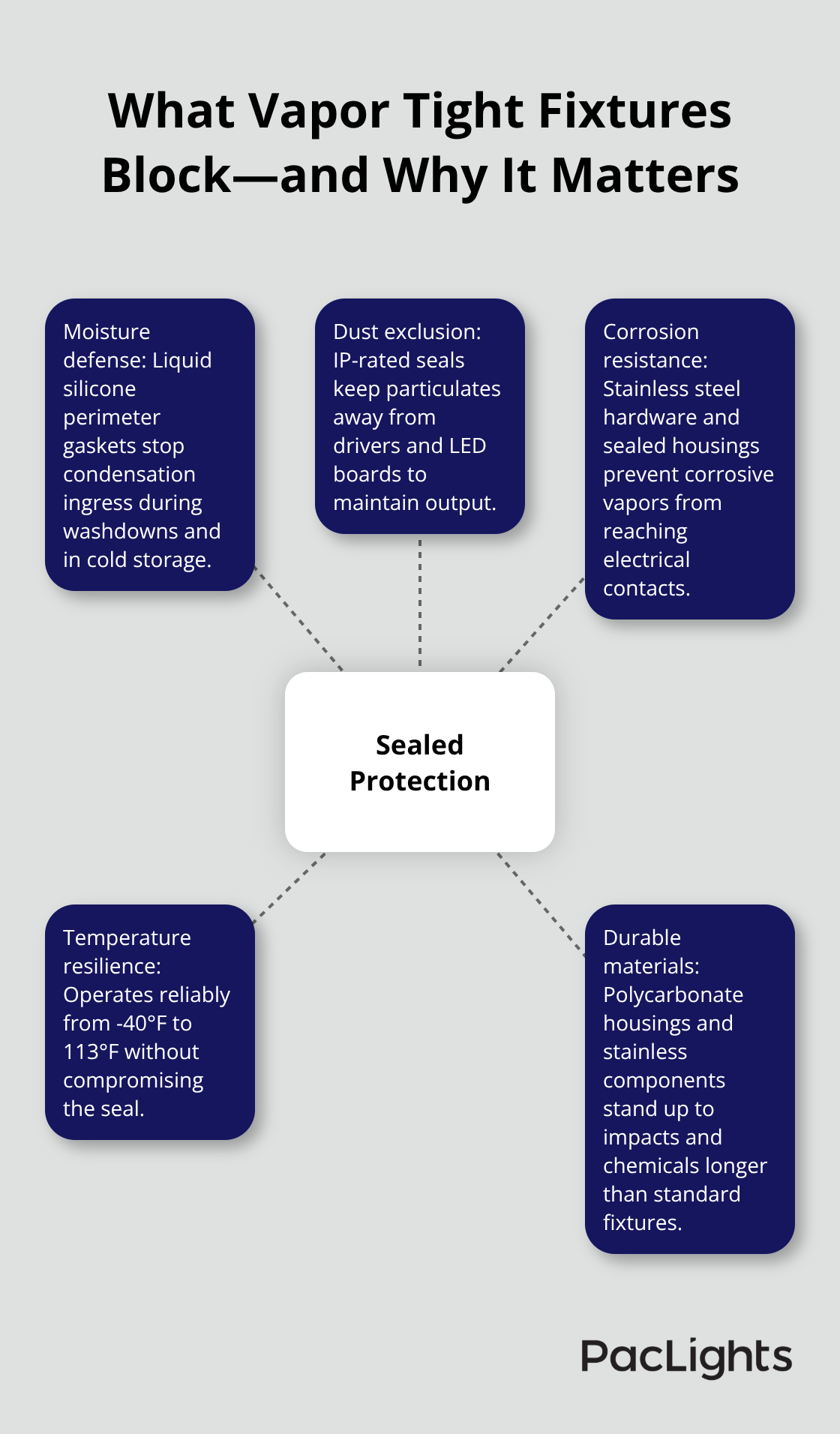
A standard fluorescent fixture in a cold storage facility accumulates condensation inside the housing within weeks, causing corrosion that degrades light output and shortens lifespan from 20,000 hours to perhaps 8,000 hours. Vapor tight fixtures maintain their sealed integrity through temperature swings from -40°F to 113°F, which means they keep working in freezers, car washes, and chemical plants where ordinary fixtures simply fail. The difference between vapor tight and standard fixtures matters in real dollars.
Understanding IP Ratings and Certifications
IP65 and IP67 ratings measure protection numerically-IP67 blocks dust completely and handles temporary water immersion, while IP65 handles water jets and dust exposure. Food processing plants specifically need NSF International certification, which confirms that a fixture won’t harbor bacteria in its crevices or release contaminants during washdown cycles. NSF-certified vapor tight fixtures comply with public health standards that non-certified models cannot meet, making them mandatory rather than optional in regulated facilities.
Energy Efficiency That Justifies the Investment
Vapor tight LED fixtures deliver 133 to 169 lumens per watt depending on the model and wattage configuration. Older high-intensity discharge or fluorescent systems typically produce 60 to 100 lumens per watt, which means you’re looking at energy savings of 50 to 70 percent on lighting costs alone. An 8-foot vapor tight fixture operating at 90W generates 11,970 lumens, which replaces a 200W legacy system while consuming less than half the electricity.
Facilities running 24/7 operations see monthly savings that add up quickly. A warehouse with 50 vapor tight fixtures running continuously can save $3,000 to $5,000 annually depending on local electricity rates, and that calculation doesn’t include the dramatic reduction in maintenance labor. Vapor tight fixtures last 50,000 hours at L70 brightness, meaning they stay at 70 percent of original output for five to six years of continuous operation before replacement becomes necessary. Fluorescent alternatives require replacement every two to three years in harsh environments, so the maintenance cost differential alone justifies the higher upfront price of LED vapor tight systems.
The sealed design and extended lifespan transform how you approach facility lighting. When you understand what these fixtures protect against and how much they save, the next step is identifying which specific models match your environment’s demands.
Real-World Applications and Performance Data
Food Processing and Cold Storage Facilities
Food processing plants operate under strict NSF International standards that prohibit standard fixtures from entering production areas. A sealed vapor tight fixture with NSF certification won’t harbor bacteria in unsealed crevices or release contaminants during washdown cycles, making it mandatory rather than optional. Cold storage facilities present a different challenge: condensation forms rapidly when warm air meets freezing surfaces, and standard fixtures accumulate ice and moisture inside their housings within weeks. Vapor tight fixtures with liquid silicone gaskets maintain their seal through temperature swings from -40°F to 113°F, preserving light output and preventing the corrosion that reduces fluorescent fixture lifespan from 20,000 hours to 8,000 hours in these conditions.
Facilities managing both food safety and extreme temperatures benefit most from vapor tight LED systems rated for IP67 protection, which blocks dust completely and withstands temporary water immersion. The 8-inch Boa vapor tight flush mount delivers 6,900 lumens with NSF certification and operates across 120–347V, making it practical for both compact cold storage corridors and larger processing areas. Stainless steel mounting clips resist corrosion from sanitizing chemicals, and the sealed design simplifies cleaning without creating maintenance headaches.
Car Washes and Chemical Manufacturing Plants
Car washes and chemical manufacturing plants expose fixtures to constant moisture and corrosive atmospheres that destroy electrical connections in ordinary systems. A vapor tight fixture rated IP65 handles water jets and sustained moisture exposure where standard housings fail within months. Manufacturing environments with caustic vapors or salt air demand fixtures with anti-oxidation and anti-corrosion materials built into the housing itself, not just sealed after assembly.
The Mamba linear vapor tight strip achieves 150 lumens per watt and comes in 24-inch and 48-inch lengths, making it suitable for long corridors in warehouses and chemical plants where brightness consistency matters for safety and productivity. Facilities upgrading from high-intensity discharge systems see energy reductions of 50 to 70 percent, and the 50,000-hour lifespan at L70 brightness means replacement intervals extend from every two years to five or six years of continuous operation.
Selecting Fixtures for Harsh Environments
Impact-resistant lenses rated IK10 protect fixtures in high-traffic areas where equipment movement or accidental contact risks damage to standard polycarbonate covers. Conduit-ready options with 1/2-inch and 3/4-inch connections simplify installation in existing infrastructure, reducing downtime during retrofits. Matching IP ratings, certifications, and material specifications to your specific chemical exposures and real-time data on energy usage, fixture status, and environmental conditions determines whether a fixture performs or fails in your facility. The next section walks you through the exact specifications you need to evaluate before making your selection.
Selecting the Right Vapor Tight LED Fixture for Your Facility
Start with Three Core Specifications
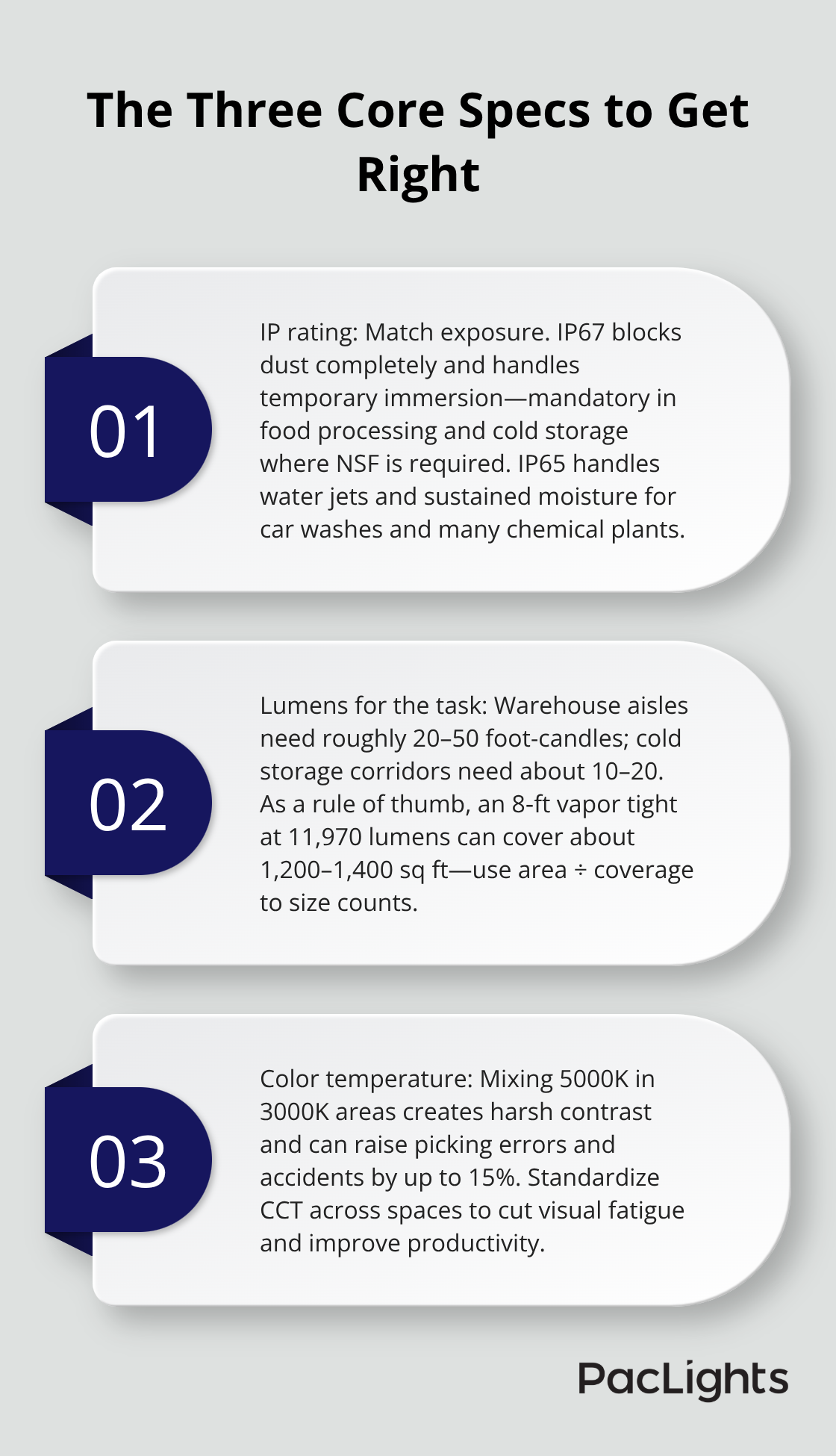
Three measurable factors determine fixture selection: the IP rating your environment demands, the lumens you need for safe task performance, and the color temperature that reduces accidents. An IP67-rated fixture handles temporary water immersion and complete dust protection, making it mandatory for food processing plants and cold storage where NSF certification is non-negotiable. IP65 fixtures suffice for car washes and chemical plants with sustained moisture exposure but no immersion risk.
The difference costs money upfront-NSF-certified models run 15 to 25 percent higher than standard sealed fixtures-but compliance failures in regulated facilities cost far more in fines and operational shutdowns.
Calculate Lumens for Your Specific Task
Warehouse aisles need 20 to 50 foot-candles depending on whether workers handle small parts or large pallets, while cold storage corridors managing inventory require only 10 to 20 foot-candles. An 8-foot vapor tight fixture delivering 11,970 lumens at 90W covers roughly 1,200 to 1,400 square feet of warehouse space, so dividing your total area by this coverage gives you an accurate fixture count. This calculation prevents both under-lighting (which creates safety hazards) and over-lighting (which wastes energy and money).
Match Color Temperature Across Your Facility
Color temperature matters more than most facility managers realize: 5000K fixtures in a 3000K environment create harsh shadows that increase picking errors and accidents by up to 15 percent according to research from the Lighting Research Center. Match your existing lighting color temperature or standardize across your facility rather than mixing warm and cool tones. Consistency in color temperature reduces visual fatigue and improves worker productivity in spaces where people spend hours under artificial light.
Calculate Your Three-Year ROI
A warehouse replacing fifty 250W HID fixtures with 90W vapor tight LED units saves 8,000 watts of continuous draw, which translates to roughly 70,080 kilowatt-hours annually at full operation. At an average U.S. industrial rate of $0.07 per kilowatt-hour, that’s $4,906 in annual electricity savings before accounting for demand charges. HID and fluorescent fixtures require replacement every two to three years in harsh environments, while vapor tight LEDs last 50,000 hours at L70 brightness. Each replacement takes four hours of labor at $50 per hour, costing $10,000 every two years for fluorescent maintenance versus $2,500 every five years for LED maintenance. Over three years, vapor tight systems save $4,500 in labor alone.
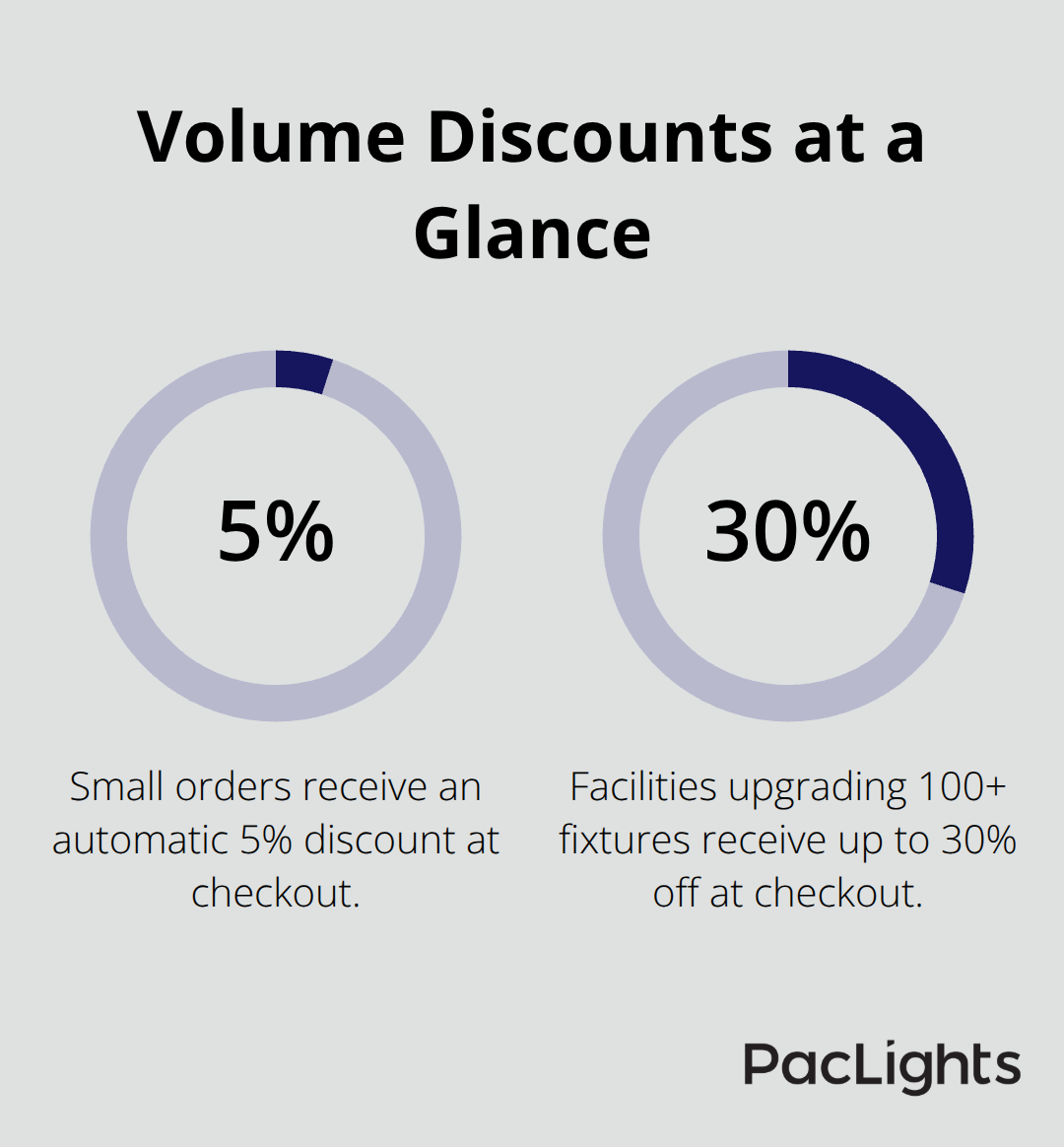
The combined three-year savings of $14,718 against an additional $8,000 to $12,000 in upfront fixture costs yields payback in roughly 20 to 24 months, making the higher initial investment self-funding through operational efficiency. Volume discounts automatically apply at checkout, ranging from 5 percent for small orders up to 30 percent for facilities upgrading 100 or more fixtures, which accelerates your payback timeline significantly. PacLights offers free ROI assessments and lighting layout designs to help you calculate exact savings for your specific facility before you commit to any purchase.
Final Thoughts
Vapor tight LED fixtures solve a problem that standard lighting cannot: they survive where ordinary systems fail, cutting maintenance costs while delivering consistent brightness year after year. The sealed gaskets, corrosion-resistant materials, and extended 50,000-hour lifespan transform facility lighting from a recurring expense into a strategic investment that pays for itself within 20 to 24 months through energy savings and reduced labor. A warehouse upgrading fifty fixtures saves $4,906 annually on electricity alone, plus $4,500 in maintenance labor over three years.
Food processing plants eliminate compliance risks by switching to NSF-certified vapor tight LED fixtures that meet public health standards, while cold storage facilities stop losing light output to condensation damage. Chemical plants and car washes finally obtain fixtures that withstand corrosive atmospheres and constant moisture without failing. We at PacLights understand that harsh environments demand more than sealed boxes-we offer vapor tight LED fixtures engineered for your specific application, whether you need IP67 protection for food processing, impact-resistant lenses for high-traffic warehouses, or conduit-ready designs for retrofit installations.
Our team provides free lighting layout designs and ROI assessments so you see exactly how much you’ll save before making any commitment. Visit PacLights to explore vapor tight options matched to your environment and calculate your three-year savings.
Disclaimer: PacLights is not responsible for any actions taken based on the suggestions and information provided in this article, and readers should consult local building and electrical codes for proper guidance.