

Warehouse lighting design tips often get overlooked, yet they directly affect your bottom line. Poor lighting choices waste energy, compromise worker safety, and create inventory errors that compound over time.
At PacLights, we’ve seen firsthand how the right lighting strategy transforms warehouse operations. This guide walks you through the principles, technologies, and practical steps to get it right.
How Lighting Design Shapes Your Bottom Line
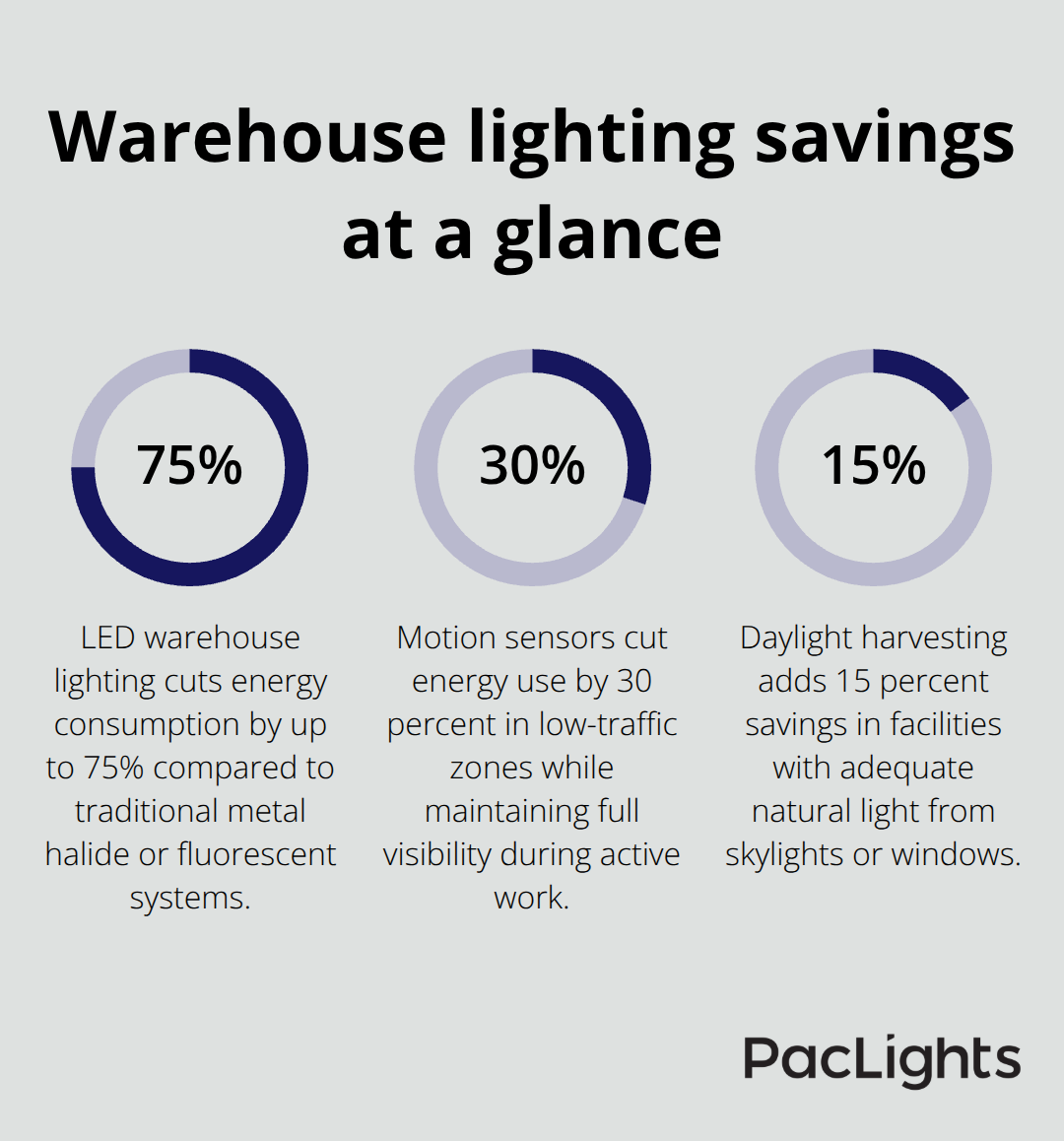
Warehouse lighting directly controls three critical cost centers: energy bills, worker injuries, and inventory errors. LED warehouse lighting cuts energy consumption by up to 75% compared to traditional metal halide or fluorescent systems, according to TCP. That’s not marginal savings-a 50,000 square foot facility running metal halide high bays at 400 watts per fixture across 100 fixtures consumes roughly 400 kilowatts continuously during operating hours. Switching to 150-watt LED equivalents drops that to 15 kilowatts, translating to tens of thousands in annual electricity costs. LEDs last over 50,000 hours versus 10,000 to 20,000 hours for metal halide, which means fewer emergency replacements, less maintenance labor, and fewer work stoppages. Poor lighting design wastes money in less obvious ways too. Under-lit aisles and racking zones force workers to move slowly, squint at labels, and make mistakes. OSHA sets minimum lighting standards-10 foot-candles for general work areas, 5 foot-candles for corridors-but these are bare minimums, not targets for accuracy or speed. Facilities that meet only baseline standards typically experience higher inventory discrepancies because pickers misread SKUs or miss items in shadows.
Task-Specific Brightness Levels Drive Efficiency
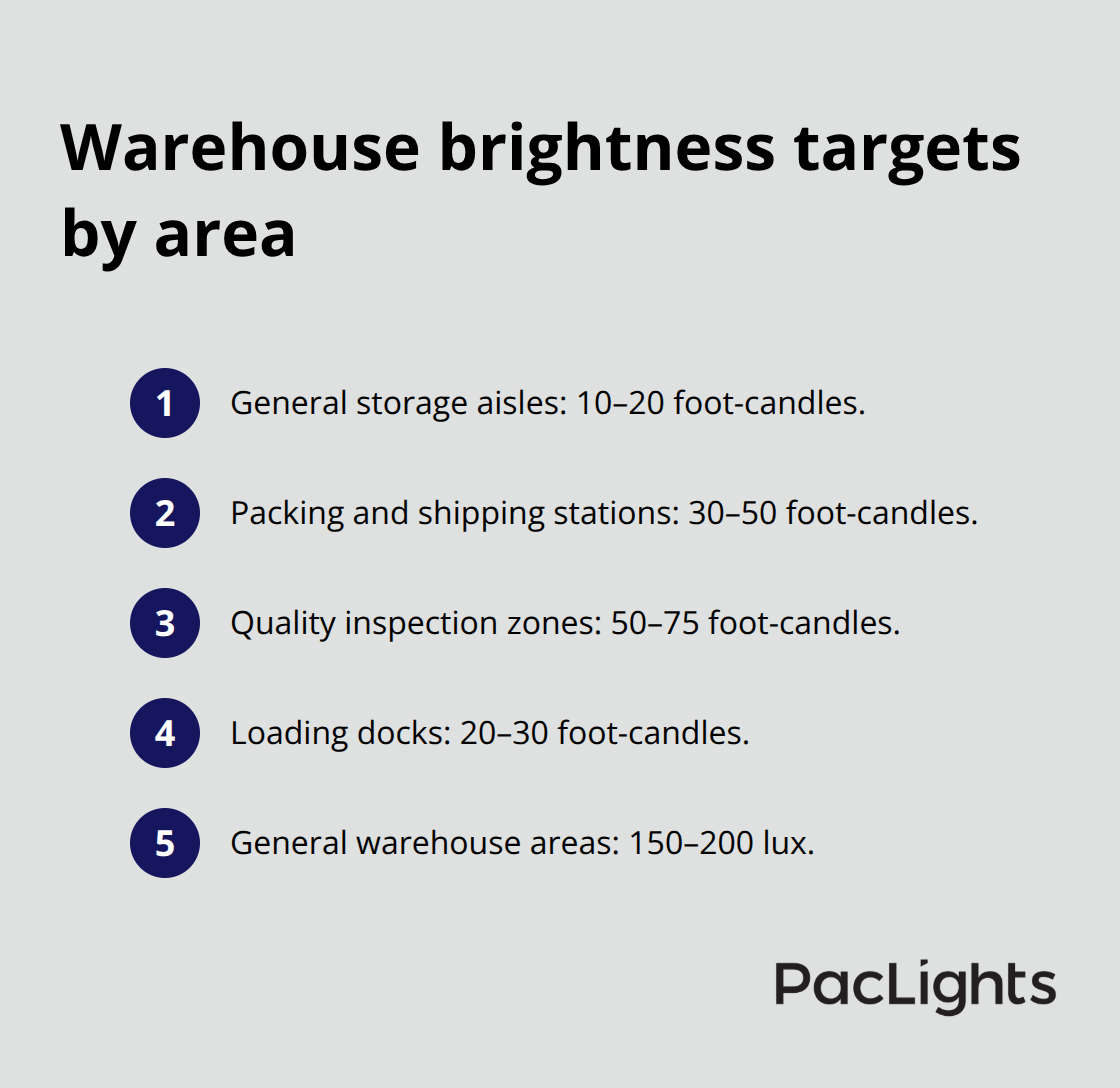
General storage aisles need 10 to 20 foot-candles; packing and shipping stations require 30 to 50 foot-candles; quality inspection zones demand 50 to 75 foot-candles. These numbers reflect the visual complexity of each task. A worker retrieving large items from open shelving needs less light than someone scanning barcodes on small packages or inspecting color-critical goods. Uniformity matters as much as absolute brightness. Shadows cast by racking or uneven fixture spacing create dark pockets where workers miss items or take longer to locate them, directly slowing throughput. Facilities that achieve even illumination with minimal glare report faster cycle times and fewer picking errors.
Controls Eliminate Waste Without Sacrificing Safety
Motion sensors reduce energy waste in low-traffic zones like storage corridors or break areas (cutting lighting levels by 30 to 50% when spaces sit empty), yet they maintain full brightness during active work periods. Daylight harvesting in facilities with windows or skylights automatically dims fixtures when natural light supplements the workplane, further lowering demand charges. These controls don’t compromise safety or visibility-they eliminate waste. Workers continue to see clearly during active operations while the system conserves energy during downtime.
Light Quality Directly Impacts Accuracy and Safety
High color rendering index (CRI) lighting-typically 80 or higher-helps workers see true label colors, safety markings, and product defects more clearly. A 4000K or 5000K color temperature provides crisp visibility without the amber cast of warm lighting or the harsh glare of extremely cool temperatures. Flicker-free LED fixtures reduce eye strain during extended shifts, which directly correlates with fewer accidents and fewer transcription errors when workers process inventory. Improved sightlines in aisles, docks, and storage areas lower warehouse accidents by helping workers spot obstacles, equipment, and hazards faster. The combination of adequate lumens, even distribution, and high color quality transforms a facility from a place where workers rush through tasks to one where they work efficiently and safely.
These operational benefits set the stage for selecting the right fixtures and control systems. The next section covers the specific principles that guide fixture selection and layout planning to maximize both brightness and efficiency.
Key Principles for Optimal Warehouse Lighting
Calculate Brightness Requirements by Task and Height
Start with ceiling height and task type, not with wattage. A 15-foot warehouse ceiling handling large items needs roughly 10 lumens per square foot, while a 20-foot ceiling processing small packages demands 30 lumens per square foot. Mounting height directly dictates fixture spacing and lumen output. At 15 feet, a single 150-watt LED high bay covers approximately 400 to 600 square feet with a 90-degree beam angle, requiring fixtures spaced 12 to 15 feet apart to maintain uniform illumination. At 20 feet, spacing expands to 16 to 19 feet, and coverage grows to a 40-foot diameter circle. Warehouses taller than 30 feet require 200-watt or higher fixtures to achieve adequate light levels across the floor.
Apply Zone-Specific Brightness Targets
The IESNA guidance recommends 150 to 200 lux for general warehouse areas, with peak zones like packing stations reaching 300 lux. Converting to foot-candles (the imperial standard in North America), general storage aisles should hit 10 to 20 foot-candles, loading docks 20 to 30 foot-candles, and inspection zones 50 to 75 foot-candles. Most facilities make the mistake of treating the entire warehouse as one uniform space. Racking zones need different fixture placement than open picking areas, and dispatch stations need more brightness than storage corridors. Calculate total lumens by multiplying your target lux by the square footage of each zone, then divide by fixture lumen output to determine how many fixtures you need. A photometric layout reveals dark spots, glare zones, and spacing errors before installation begins.
Select Fixtures and Color Temperature for Your Tasks
UFO high bays work best for open storage areas because their 90-degree beam distributes light broadly, while linear high bays suit narrow aisles by concentrating light along racking without wasting lumens in unused spaces. Fixture type and beam angle determine how light spreads across your floor. Color temperature matters more than most think: 4000K delivers neutral white light suitable for general warehousing, but 5000K provides the crisp daylight quality that helps workers read small labels faster and spot defects more clearly. High CRI fixtures (80 or higher) are non-negotiable for any area involving color-critical tasks or barcode scanning.
Prioritize LED Longevity and Control Integration
LED fixtures last over 50,000 hours compared to 10,000 to 20,000 hours for metal halide, which cuts maintenance labor and eliminates the disruption of emergency fixture failures. When retrofitting existing facilities, assess whether the fixture housing is sound enough for retrofit kits; if not, full replacement with new LED fixtures delivers superior performance and controls integration. Motion sensors and dimming controls reduce energy consumption by 30 to 50% in low-traffic zones without compromising safety during active operations. DLC-listed fixtures meet performance standards and often qualify for utility rebates that lower upfront costs.
Plan Your Layout Before Installation
Map ceiling height, aisle width, racking configuration, and task zones, then use a supplier’s free photometric layout tool to confirm fixture count and placement before purchasing. This approach prevents costly mistakes and ensures your facility achieves both brightness targets and energy efficiency from day one. With your fixture strategy locked in, the next section covers how advanced controls and retrofit solutions amplify these gains even further.
Smart Controls Transform Energy Waste Into Savings
Motion Sensors Cut Energy Use Without Sacrificing Visibility
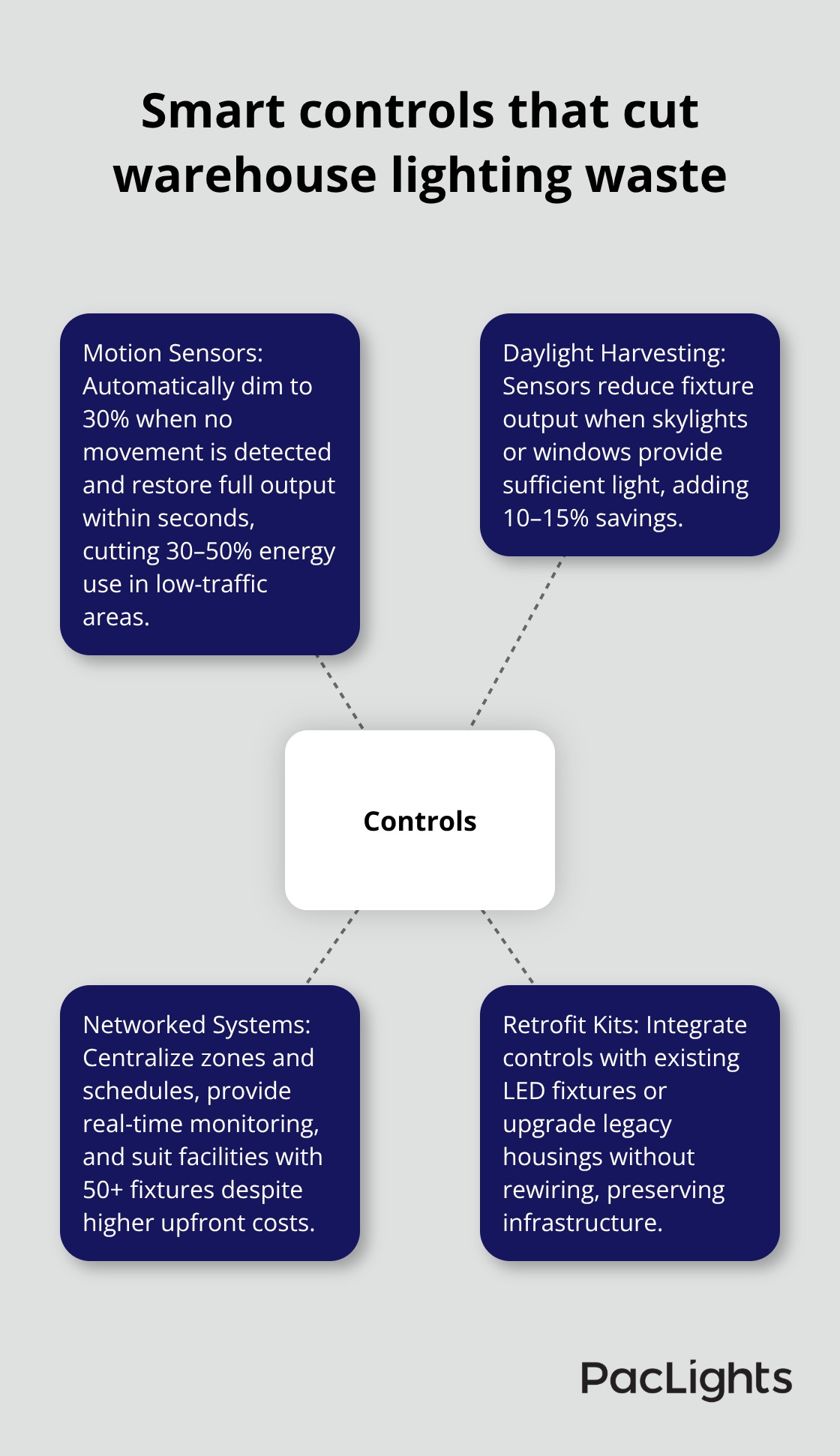
Motion sensors automatically dim fixtures to 30 percent brightness when no movement is detected, then restore full output within seconds of activity. This approach cuts energy use by 30 to 50 percent in zones like break rooms, bathrooms, and rarely accessed storage areas while maintaining full visibility the moment a worker enters. A 50,000 square foot warehouse with 100 LED fixtures running at full brightness costs roughly $18,000 annually in electricity at average U.S. rates. Motion sensors alone trim that to $12,600 by eliminating lighting in unoccupied zones during off-shifts or lunch breaks. These controls require minimal upfront investment compared to fixture replacement and generate payback within 2 to 4 years through reduced kilowatt consumption and demand charges.
Daylight Harvesting Leverages Natural Light
Facilities with skylights or south-facing windows reduce fixture output during daylight hours when sensors measure incoming lumens and adjust artificial lighting downward. Daylight harvesting adds another 10 to 15 percent savings in facilities with adequate fenestration. The key is honest assessment of your space: motion sensors work best in areas with clear occupancy patterns, while daylight harvesting applies only to zones receiving consistent natural light.
Networked Systems Centralize Control Across Your Facility
Networked lighting control systems assign zones and schedules through software, allowing you to adjust brightness across 50 fixtures or 500 with a single command. You can program different lighting levels for first, second, and third shifts, reduce brightness during inventory counts when workers move slowly, or boost output during peak picking periods. Real-time energy monitoring shows which zones consume the most power, revealing opportunities to optimize further. The software interface is designed for warehouse managers rather than electricians, letting you make adjustments without technical expertise. However, networked systems carry higher upfront costs, typically $2,000 to $8,000 depending on facility size and complexity, so they make sense only for facilities with 50 or more fixtures where the energy savings and operational flexibility justify the investment.
LED Retrofit Kits Upgrade Legacy Systems
For retrofit projects, networked controls work with existing LED fixtures equipped with compatible ballasts or smart drivers, eliminating the need for complete replacement if your current housings are sound. Retrofit kits integrate with networked systems, allowing you to upgrade legacy metal halide or fluorescent installations without rewiring or structural modifications. This approach preserves your existing infrastructure while adding modern efficiency and control capabilities to your facility.
Final Thoughts
Warehouse lighting design tips succeed when you treat brightness and energy efficiency as complementary goals rather than competing priorities. The right fixture selection, zone-specific brightness targets, and smart controls work together to cut your energy costs by tens of thousands annually while improving worker safety and inventory accuracy. A 50,000 square foot facility switching from metal halide to LED high bays reduces electricity consumption dramatically, and motion sensors trim another 30 to 50 percent from low-traffic zones where workers rarely spend time.
LED fixtures cost more upfront but last over 50,000 hours compared to 10,000 to 20,000 hours for older technology, which eliminates emergency replacements and maintenance labor that disrupts operations. Your retrofit investment pays for itself within 2 to 4 years through reduced electricity and demand charges alone, and your facility operates at a fraction of previous energy costs indefinitely. Networked lighting controls amplify these gains by letting you adjust brightness across your entire facility based on shift schedules, occupancy patterns, and task demands (revealing optimization opportunities that manual systems miss).
Start by mapping your ceiling height, aisle layout, and task zones, then calculate brightness requirements using lux or foot-candle targets specific to each area. We at PacLights offer free lighting layout designs and ROI assessments to help you make informed decisions about your upgrade, and our energy-efficient fixtures, retrofit solutions, and optional motion and daylight controls are tailored to reduce both costs and carbon footprints. Contact us to evaluate your facility and build a lighting strategy that delivers the brightness your operations need without the waste you can eliminate.
Disclaimer: PacLights is not responsible for any actions taken based on the suggestions and information provided in this article, and readers should consult local building and electrical codes for proper guidance.