

Poor lighting costs businesses money. When pendant optical design fails to direct light where it’s needed, you waste energy and struggle with shadows and glare that slow down work.
At PacLights, we’ve seen how the right optical design transforms spaces. Better light distribution means faster task completion, fewer errors, and lower energy bills.
How Optical Design Controls Light Where It Matters
Beam Angle Determines Coverage and Efficiency
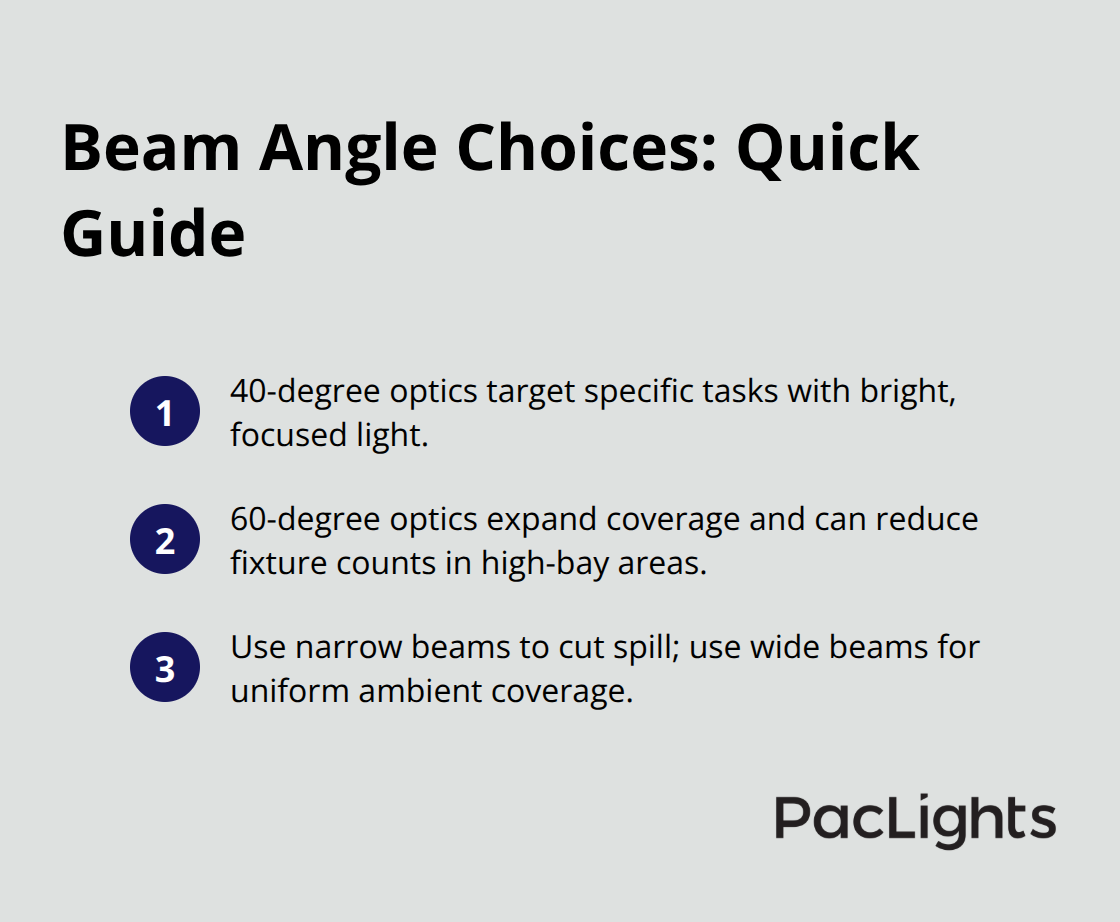
The beam angle of your cylinder pendant directly controls where light lands and how far it spreads. A 40-degree beam angle concentrates illumination in a tight circle beneath the fixture, ideal for task-focused work where you need bright light on specific surfaces. A 60-degree angle spreads light over a wider area, reducing the spacing-to-mounting-height ratio and lowering the number of fixtures you need in high-bay spaces above 25 feet. The Illuminating Engineering Society recommends roughly 30 foot-candles for general industrial work, and your beam angle choice makes the difference between hitting that standard efficiently or overshooting and wasting energy. Narrow beams also reduce light spill to adjacent areas, which matters in warehouses where you want bright task lighting without flooding the entire space. Wide beams work better for ambient illumination in retail or offices where uniform coverage prevents dark zones and shadows that create visual fatigue.
Lenses and Reflectors Eliminate Glare and Shadows
Glare occurs when light scatters off surfaces or hits eyes directly, and poor optical design compounds the problem. Lenses and reflectors in modern cylinder pendants shape light distribution to minimize hotspots and harsh reflections off glossy floors or machinery. Shadows appear when light misses areas between fixtures or when beam patterns are too narrow for the mounting height. A spacing-to-mounting-height ratio of 1.0 or less prevents these dark gaps, meaning fixtures spaced 25 feet apart work well at 25-foot ceiling heights. Matte finishes on pendant housings reduce secondary glare from the fixture itself, while diffusers soften light edges and improve visual comfort without sacrificing brightness.
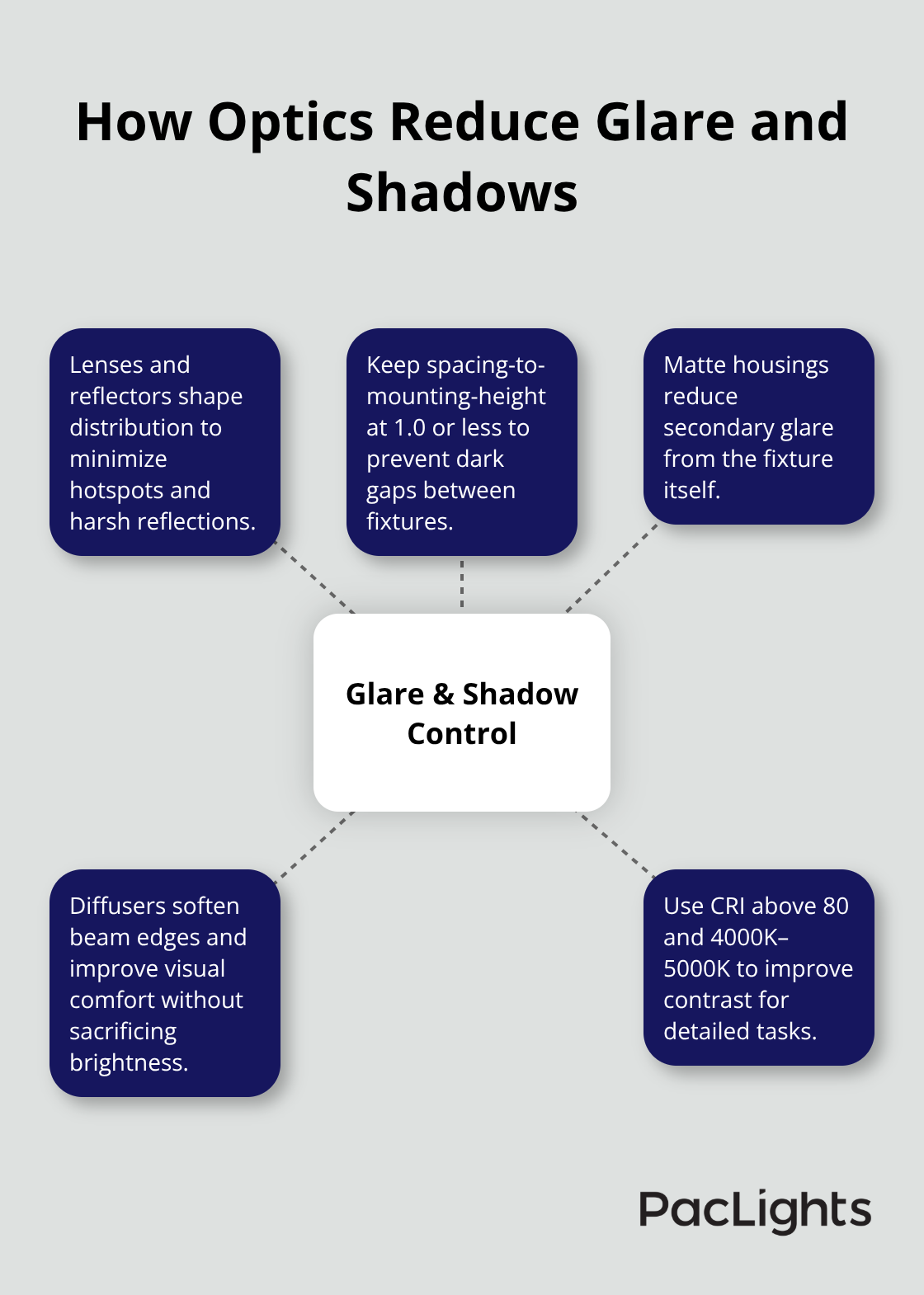
Manufacturing floors benefit from color rendering index above 80 and color temperatures between 4000K and 5000K because these settings improve contrast and reduce eye strain during detailed assembly or inspection tasks.
Precision Optics Reduce Energy Waste and Boost Safety
Optical design lets you point light exactly where workers and customers need it, eliminating wasted illumination on walls or ceilings. Reflectors and micro-optics shape the LED beam so less light scatters beyond the work area, which means you achieve required brightness levels with fewer fixtures or lower power consumption. This directional approach delivers over 50% energy savings compared to fluorescent or HID alternatives because you’re not lighting empty space. Retail spaces use smaller pendants in clusters with precise beam angles to highlight product displays while keeping 50–75 foot-candles on merchandise without overheating stock. Smart controls like occupancy sensors and daylight harvesting add another 30–40% energy reduction in spaces with natural light, but only work effectively when optical design focuses light where sensors detect activity. Industrial facilities reduce maintenance downtime because concentrated light improves visibility of hazards and equipment condition, helping workers spot problems before accidents occur.
The right optical design transforms how light behaves in your space, but selecting the correct technology for your specific environment requires understanding what your facility actually needs.
Where Optical Design Delivers Real Results
Retail: Making Products Shine Under the Right Light
Retail stores live and die by how products look under light. A 40-degree beam angle on cylinder pendants focuses brightness directly onto merchandise displays, hitting the 50–75 foot-candles standard that makes colors pop and draws customers in. Tight beam patterns on smaller clustered pendants prevent washing out product details with flat, uniform light that kills visual interest. Warm color temperatures around 3000K enhance perceived quality of fabrics and food, while cooler 4000K–5000K settings make electronics and jewelry appear sharper. Retailers using precision optical design report faster checkout times because customers make decisions more confidently when they can actually see what they’re buying. Daylight harvesting in retail spaces with windows cuts energy use another 30–40% without dimming product visibility, since optical design concentrates light where it matters rather than flooding the entire ceiling.
Warehouses and Manufacturing: Safety Through Visibility
Warehouses and manufacturing floors demand different optical strategies. A 60-degree beam angle and spacing-to-mounting-height ratio of 1.0 or less eliminate the dark zones that hide inventory or create safety hazards on production lines. Industrial facilities typically need 60–80 cylinder pendants in a 100-by-200-foot space with 30-foot ceilings to hit the 30 foot-candles baseline the Illuminating Engineering Society recommends for general work. Manufacturing floors benefit from color rendering index above 80 and temperatures between 4000K and 5000K because contrast matters during assembly and inspection tasks where missing a defect costs money. Matte finishes on pendant housings cut glare off machinery and glossy floors, reducing eye strain during ten-hour shifts. Smart controls with occupancy sensors make sense here: when workers leave a section, light dims automatically, but the optical design must still concentrate illumination tightly enough that sensors detect actual activity rather than ambient spillover.
Offices: Balancing Task and Ambient Light
Office environments sit between retail and industrial needs. Task lighting with 40-degree optics over desks and meeting tables prevents screen glare while 60-degree pendants handle ambient coverage in corridors and break areas. Color temperature matters here too: 4000K–5000K keeps workers alert during detailed work, while layering in warm accent lighting prevents the clinical feel that tanks productivity. The optical design you select determines whether your office feels energizing or exhausting-and that directly impacts how long employees stay focused on their work.
Understanding these application-specific requirements shapes which optical technologies actually work in your facility. The next step involves assessing your own space to determine which beam angles, color temperatures, and control strategies will eliminate your current visibility problems.
Matching Optical Design to Your Facility’s Real Needs
Assess Your Space Before Selecting Fixtures
Start with a site assessment, not a fixture catalog. Measure your current illumination levels with a light meter across your work areas, note where shadows appear, and identify glare complaints from staff. This data tells you whether you need narrow beam angles for concentrated task lighting or wider spreads for ambient coverage.
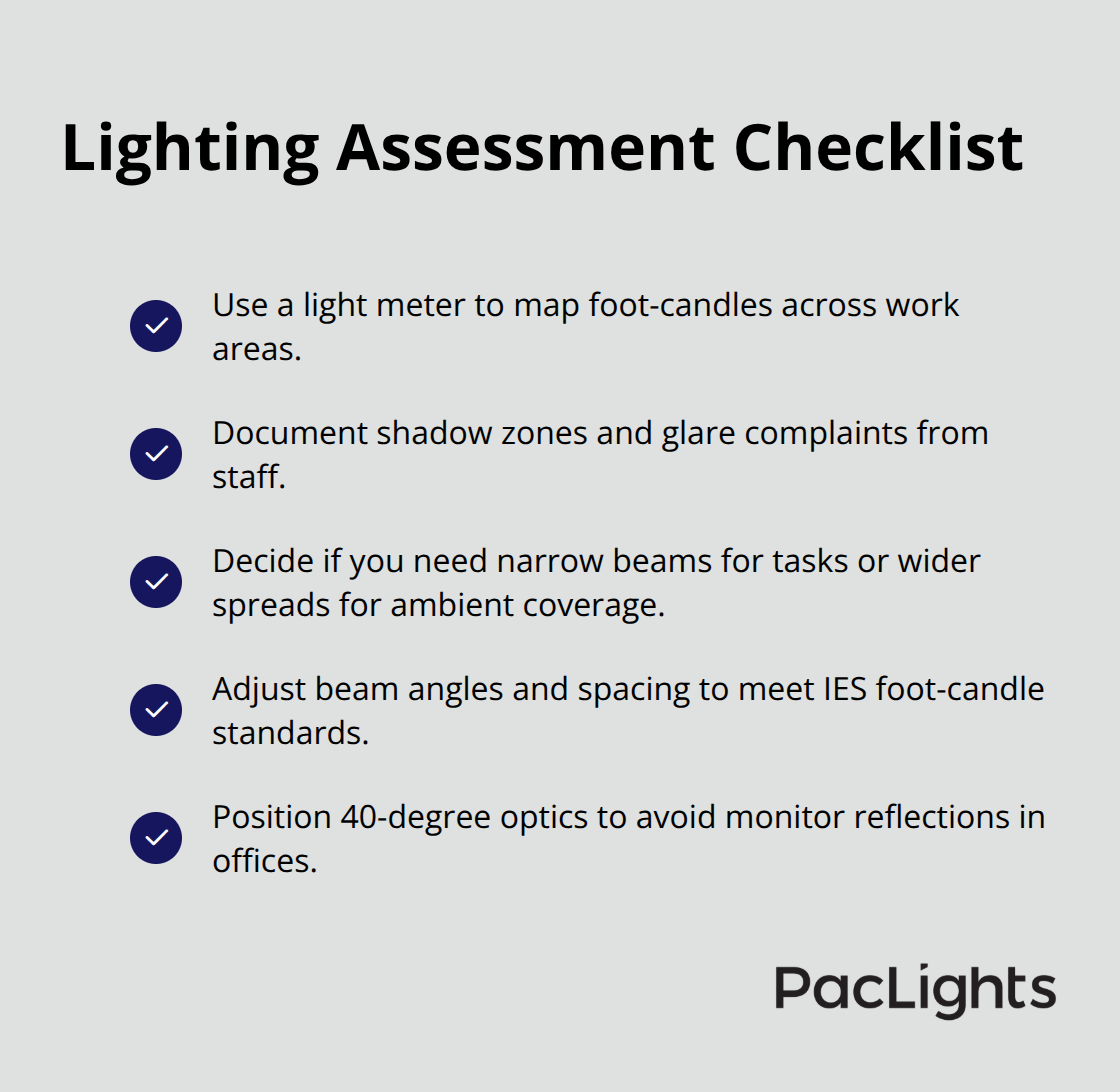
A warehouse manager measuring 15 foot-candles in aisles between fixtures knows immediately that a 60-degree beam angle and tighter spacing will solve the problem without oversizing every fixture. Office spaces with screen glare benefit from 40-degree optics positioned to avoid reflecting off monitors, while retail floors need photometric analysis of display areas to hit the 50–75 foot-candle target without washing out color. The Illuminating Engineering Society publishes footcandle standards for different tasks, and your site assessment should reference these benchmarks rather than assuming uniform lighting across your entire facility.
Choose Between Reflector and Lens Technologies
Reflector and lens technologies serve different priorities, and your choice depends on specific visibility goals. Reflectors concentrate light efficiently and work well in high-bay industrial spaces where durability matters and optical precision takes a backseat to rugged construction. Lenses offer superior beam shaping and glare control, making them the better choice for retail and offices where visual comfort directly affects customer perception or employee productivity. A manufacturing floor tolerating some glare but demanding reliable 24/7 operation might select aluminum reflectors with matte finishes, while a jewelry retailer needs precision lenses that shape light to highlight merchandise without hotspots. Thermal management differs too: reflectors handle heat dissipation through simple aluminum fins, while advanced lens designs sometimes require copper heat sinks to maintain consistent light output above 85°C junction temperature.
Align Color Temperature and CRI with Your Work Type
Color rendering index and color temperature decisions overlap with optical technology. A 4000K lens system with CRI above 80 in a manufacturing setting improves contrast during inspection work, while the same lens in retail with 3000K warm light makes fabrics appear richer. Your work type determines which optical solution actually delivers results-industrial facilities need different specifications than retail environments, and offices sit somewhere between both demands. PacLights offers free lighting layout designs and ROI assessments that measure your space and recommend exact fixture counts, beam angles, and mounting heights (this removes guesswork and prevents costly over-specification). We tailor optical recommendations to your work type and environment rather than pushing one standard solution across all applications.
Final Thoughts
Optical design in cylinder pendant lights directly controls visibility, and visibility drives operational efficiency. When you match beam angles, lenses, and color temperatures to your specific work environment, you eliminate the shadows and glare that slow down tasks and frustrate workers. A warehouse achieving the Illuminating Engineering Society’s 30 foot-candle standard with fewer fixtures cuts both energy consumption and installation costs, while a retail floor hitting 50–75 foot-candles on merchandise with precision optics increases customer confidence and checkout speed.
The financial impact compounds over time. Energy savings from pendant optical design reach 50% or more compared to fluorescent and HID systems, and that gap widens when you add occupancy sensors and daylight harvesting. Over five to ten years, the return on investment becomes obvious: lower power consumption, fewer replacement cycles, and fewer worker errors or safety incidents all add up to thousands in annual savings.
Upgrading your lighting system starts with understanding what your space actually needs. We at PacLights help facilities move past guesswork with free lighting layout designs and ROI assessments that measure your space, recommend exact fixture specifications, and show you the financial impact of upgrading to optimized pendant optical design.
Disclaimer: PacLights is not responsible for any actions taken based on the suggestions and information provided in this article, and readers should consult local building and electrical codes for proper guidance.