

Warehouse lighting directly impacts productivity, safety, and your bottom line. The color temperature you choose for your wafer downlights shapes how workers perform, how much energy you consume, and how comfortable your team feels throughout the day.
At PacLights, we’ve seen firsthand how the right lighting choice transforms warehouse operations. This guide walks you through selecting the optimal color temperature for every zone in your facility.
What Color Temperature Actually Means for Your Warehouse
Understanding the Kelvin Scale in Warehouse Settings
Color temperature measures the warmth or coolness of light on the Kelvin scale, ranging from 2700K at the warm end to 6500K and beyond at the cool end. Warehouse managers need to understand this because the temperature you select directly determines how your team perceives detail, processes information, and maintains alertness during shifts. Most warehouses operate at 5000K, which delivers bright white light that improves visibility of labels, packages, and safety hazards without the harshness of cooler temperatures or the dimness of warmer ones.
This 5000K standard exists for a reason: it sits in the sweet spot where workers read small text, spot misplaced items, and operate equipment safely without experiencing eye strain that comes from excessive brightness or the fatigue that results from insufficient contrast.
How Color Temperature Drives Worker Performance
The relationship between color temperature and worker performance is measurable and significant. Cooler light around 5000K to 6500K enhances wakefulness and alertness, which directly reduces picking errors and safety incidents in high-activity zones like loading docks and aisles. In contrast, warmer light below 4000K causes workers to process visual information more slowly, making it unsuitable for task-heavy areas.
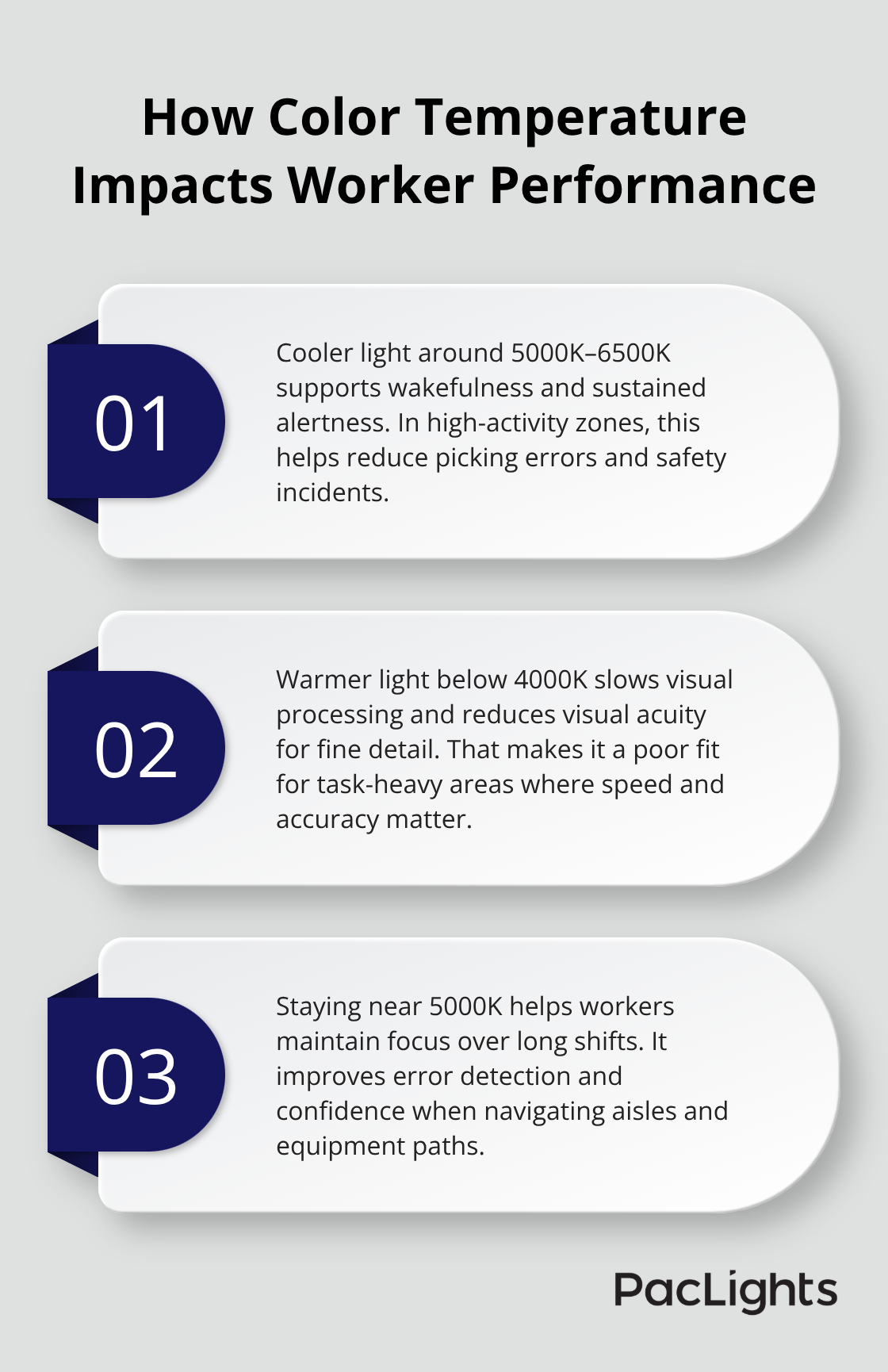
Research shows that the right color temperature prevents fatigue and maintains focus throughout long shifts. Workers in properly lit environments (5000K range) catch errors faster and navigate warehouse spaces with greater confidence.
Energy Efficiency and Color Temperature Trade-offs
Energy efficiency varies considerably across the spectrum, though not always in the way warehouse managers expect. LED fixtures at 5000K consume roughly 70 to 80 percent less electricity than older fluorescent or high-intensity discharge lighting, translating to substantial cost savings. However, the actual energy consumption depends less on the color temperature itself and more on the fixture efficiency and lumens delivered.
A 5000K LED fixture with high efficacy will outperform a warm 3500K fixture with poor optics every time. The key insight here is that you cannot sacrifice brightness for warmth in warehouse operations; the performance and safety gains from proper illumination far outweigh any minor energy differences between color temperatures in the 4000K to 5000K range. This reality shapes how you should approach your lighting strategy across different warehouse zones.
Where to Use Cool, Neutral, and Warm Color Temperatures in Your Warehouse
Task-Heavy Areas Demand Cool White Light
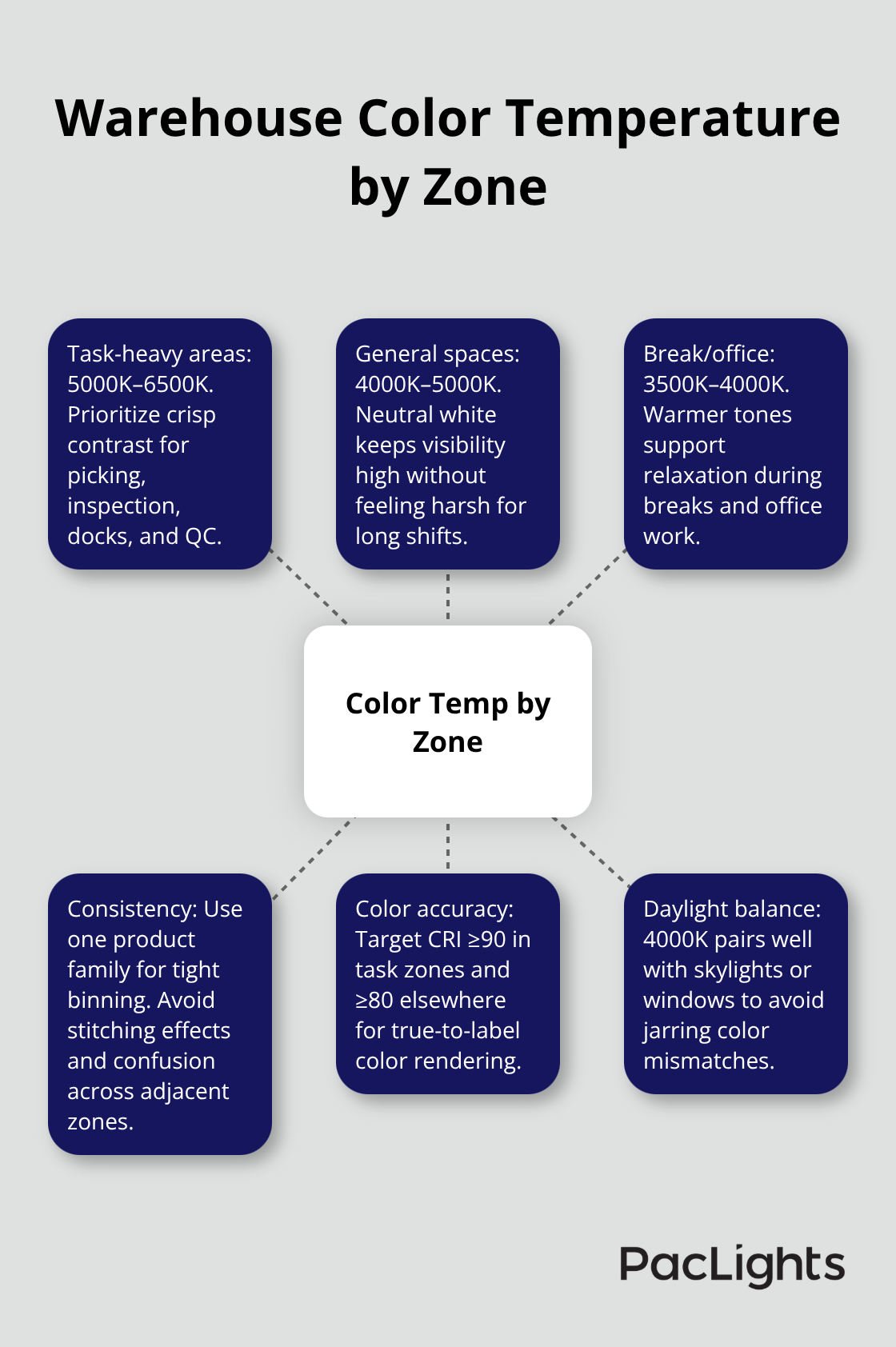
Loading docks, picking aisles, and inspection zones require 5000K to 6500K lighting because these areas combine speed-critical tasks with safety hazards. At 5000K, workers identify misplaced items, read small print on labels, and spot equipment in their path without hesitation. The crisp, daylight-like quality of this range sharpens contrast and reduces the cognitive load your team carries during high-volume operations. If your warehouse handles color-sensitive work like quality control or product inspection, push toward 5000K with a color rendering index of 90 or higher to ensure labels and product colors appear true.
General Warehouse Spaces Thrive at Neutral White
General warehouse spaces-storage areas, moderate-traffic aisles, and receiving zones-perform well at 4000K to 5000K. This neutral white range maintains visibility while feeling less intense than cooler temperatures, which matters when workers spend eight-hour shifts in these environments. The 4000K option works especially well in warehouses with existing daylight through skylights or windows because it balances the incoming natural light without creating a jarring color mismatch. Many facilities find that 4000K in general areas paired with 5000K in task-heavy zones creates a natural visual hierarchy that guides workers toward precision work without feeling harsh in lower-activity spaces.
Break Rooms and Administrative Zones Use Warm Light
Break rooms, office areas, and administrative zones adjacent to warehouse floors benefit from 3500K to 4000K lighting. These spaces serve a different function than the warehouse itself, and workers appreciate the warmer tone during rest periods because it promotes relaxation and reduces eye strain after hours in brighter environments. However, do not use warm lighting in any active warehouse zone. The performance penalty is real: workers process visual information 15 to 20 percent more slowly under warm light, and in a warehouse setting, that delay translates directly to picking errors and safety risks.
Consistency Prevents Worker Confusion
Your color temperature strategy should remain consistent across all active warehouse zones to avoid visual confusion. When workers move from a 5000K aisle into a 3500K storage area, the sudden shift in brightness perception creates temporary disorientation and can mask hazards. Selecting fixtures from the same product family ensures tight color temperature binning, meaning every fixture maintains the same exact shade of white. This consistency prevents the stitching effect where adjacent zones appear to have different brightness levels even when they deliver identical lux values.
If you retrofit an existing system, match the color temperature of your new LED fixtures to your current setup unless you upgrade the entire facility at once. A mixed 4000K and 5000K environment looks unprofessional and confuses workers about which zones demand heightened attention.
Calculating Lumens and Fixture Selection
Calculate your lumen requirements by ceiling height and task type before selecting color temperature. A 15-foot ceiling in a general warehouse area typically requires around 35,000 lumens total, while a 25-foot ceiling needs approximately 39,000 lumens. Once you know your total lumen target, choose fixtures that deliver those lumens efficiently at your selected color temperature. A 5000K LED fixture with 120 lumens per watt will always outperform a 4000K fixture with 100 lumens per watt, even though the cooler temperature alone does not consume more energy. The fixture design, lens quality, and driver efficiency matter far more than the Kelvin value. With your color temperature zones mapped and lumen targets established, the next step involves understanding how to retrofit your existing infrastructure and calculate the financial return on your lighting investment.
How to Plan Your Color Temperature Strategy and Calculate Payback
Map Your Warehouse Zones Before Purchasing Fixtures
Warehouse layout planning prevents costly mistakes and ensures consistent performance across zones. Identify task-heavy areas that require 5000K lighting-loading docks, picking aisles, inspection bays, quality control zones-and separate them visually on a floor plan from general storage areas where 4000K works adequately. This separation provides workers with clear visual cues about where precision matters most. Measure your ceiling heights in each zone because this directly determines your lumen requirements. A 15-foot ceiling in a general area needs roughly 35,000 lumens total, while a 25-foot ceiling requires approximately 39,000 lumens. Once you establish lumen targets by zone and color temperature, you can specify fixtures with matching color rendering index values-try for 90 or higher in task zones and 80 minimum elsewhere. This planning step takes a few hours but saves thousands in wasted purchases and prevents the visual stitching that occurs when fixtures from different manufacturers appear to have different white tones even at the same Kelvin rating.
Choose Between Full Replacement and Phased Retrofits
Retrofitting existing systems offers a practical middle path between doing nothing and replacing everything at once. If your warehouse currently runs fluorescent or high-intensity discharge lighting, LED replacements at your chosen color temperatures will cut electricity consumption by 70 to 80 percent compared to the old technology. Many facilities plan phased upgrades that spread costs across multiple budget cycles-starting with high-traffic zones where safety payback is immediate, then expanding to general areas. This approach delivers measurable improvements early in the project while managing cash flow effectively.
Calculate Your Return on Investment
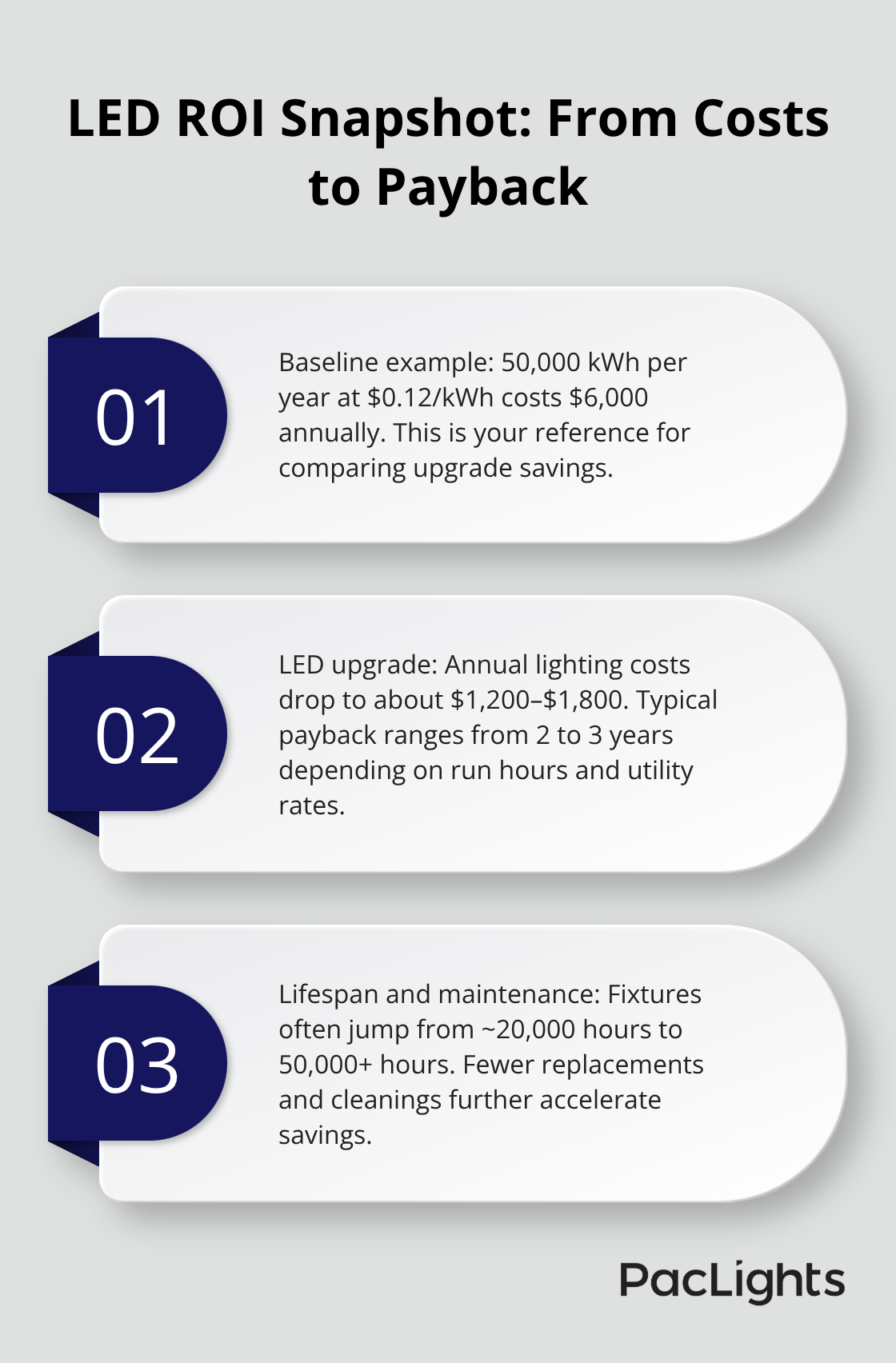
Your specific return on investment depends on current annual lighting costs versus projected LED costs. A warehouse consuming 50,000 kilowatt-hours annually for lighting at 0.12 dollars per kilowatt-hour spends 6,000 dollars yearly on the old system. Switching to efficient LED fixtures reduces that to roughly 1,200 to 1,800 dollars annually, delivering payback in 2 to 3 years while extending fixture lifespan from 20,000 hours to 50,000 hours or more. Reduced maintenance labor accelerates total savings significantly since LED fixtures require far less cleaning and replacement than fluorescent systems.
Consistent color temperature across your retrofit prevents worker confusion during the transition and makes the investment feel cohesive rather than piecemeal.
Leverage Professional Assessment Tools
PacLights offers free lighting layout designs and ROI assessments so you see the exact financial impact before committing to upgrades. Professional assessment tools calculate your payback timeline and identify which zones deliver the fastest return. This data-driven approach removes guesswork from your lighting investment decision.
Final Thoughts
Selecting the right wafer downlight color temperature for your warehouse comes down to matching light output to task demands and worker needs. The 5000K standard for task-heavy zones and 4000K for general areas delivers measurable improvements in safety, productivity, and energy costs. Consistency across your facility prevents worker confusion and creates a professional environment where lighting supports rather than hinders operations.
LED fixtures cut electricity consumption by 70 to 80 percent compared to fluorescent or high-intensity discharge systems, delivering payback within 2 to 3 years while reducing maintenance labor significantly. Your wafer downlight color choice does not drive energy consumption; fixture efficiency and lumen delivery do. A well-designed 5000K LED system outperforms a poorly designed 4000K system every time, so prioritize fixture quality and optical design alongside your Kelvin selection.
We at PacLights understand that warehouse lighting decisions affect your bottom line and your team’s performance. Contact us today to schedule your facility assessment and begin transforming your warehouse lighting into a competitive advantage.
Disclaimer: PacLights is not responsible for any actions taken based on the suggestions and information provided in this article, and readers should consult local building and electrical codes for proper guidance.