

Most commercial spaces waste energy on lighting that stays at full brightness all day, even when it’s not needed. A dimmable flush mount downlight gives you control over light levels, cutting energy costs while improving how your space feels and functions.
At PacLights, we’ve seen firsthand how the right lighting system transforms both productivity and your bottom line. This guide walks you through the benefits, applications, and practical steps to implement dimmable downlights in your facility.
Why Dimmable Downlights Cut Real Energy Costs
The Math Behind Energy Reduction
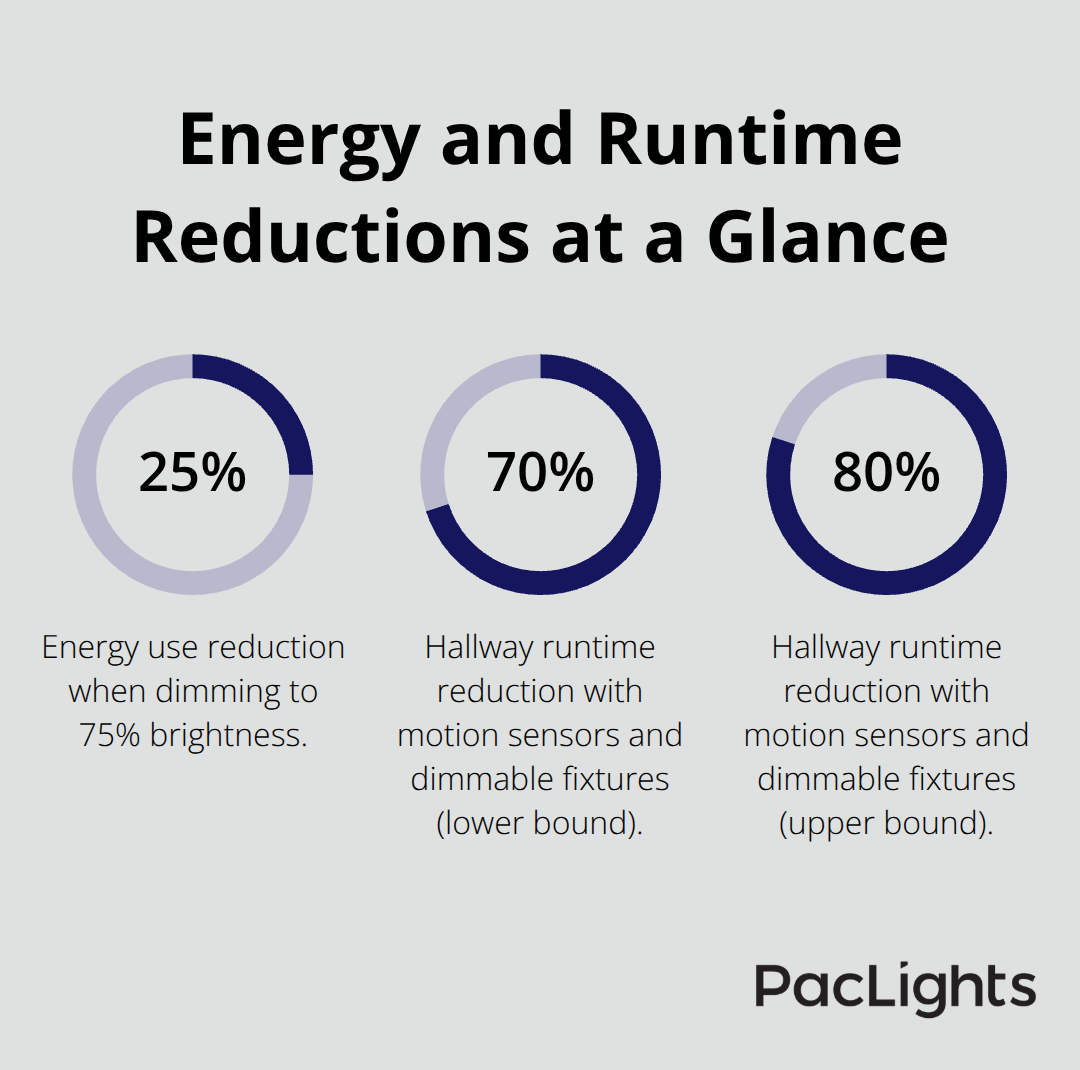
Dimming to 75% brightness cuts energy use by about 25% without noticeable light loss in most spaces.
A typical office with 20 downlights running 10 hours daily at full brightness uses roughly 24,000 watt-hours per year. Switch those same fixtures to dimmable LEDs and reduce brightness during low-activity periods, and you save 6,000 watt-hours or more annually. At commercial electricity rates of 12–15 cents per kilowatt-hour, that translates to $720–$900 yearly for just 20 fixtures. Scale that across a 50-light installation and savings climb to $1,800–$2,250 per year. Over 10 years, you recover a significant portion of your upfront investment through energy reduction alone.
LED downlights already consume 8–12 watts compared to 60 watts for older incandescent fixtures, so adding dimming amplifies those gains further. Facilities that operate extended hours or maintain consistent lighting regardless of natural daylight availability see even stronger results.
Matching Light Output to Actual Needs
Most commercial spaces operate on a one-size-fits-all lighting model where every fixture runs at full brightness regardless of the task or time of day. Dimmable downlights let you adjust brightness to what’s actually needed. Offices require 2,500–3,500 lumens per fixture at 3,500–4,000K to reduce eye strain during focused work, but those same spaces need only 50% brightness during breaks or after-hours cleaning.
Retail environments benefit from 4000–5000K fixtures with adjustable brightness to highlight products during peak shopping hours while reducing glare and heat during slower periods. Warehouses and storage areas often run full lighting across entire spaces when only specific zones see active use. Motion sensors paired with dimmable fixtures solve this problem: hallways and entryways operate at 30% brightness until movement triggers activation, then ramp to full brightness instantly (this combination cuts hallway runtime by 70–80% according to real-world deployments).
The Comfort Factor Employees Notice
Harsh overhead lighting at full intensity causes fatigue and headaches among staff. Properly dimmed ambient lighting at 2700K improves comfort and reduces complaints about lighting quality. Employees work more effectively when their environment supports focus rather than fights against it. The difference between a well-lit space and an over-lit one shows up in productivity metrics and employee satisfaction surveys.
These energy and comfort improvements set the stage for selecting the right control systems to manage your dimmable fixtures across different facility types and operational schedules.
Applications Across Commercial and Industrial Spaces
Office Environments and Work Areas
Office work demands consistent, flicker-free lighting at 3,500–4,000K with 2,500–3,500 lumens per fixture to minimize eye strain during computer-heavy tasks. However, offices rarely need full brightness throughout the day. Conference rooms sit empty for hours. Break areas see sporadic use. Corridors stay illuminated even when unoccupied. Dimmable fixtures solve this problem by operating at 50–75% brightness during low-activity periods, then ramping to full output when needed. This flexibility eliminates the false choice between adequate lighting and wasted energy.
In a typical 50-light office installation, dimming to 60% brightness during administrative tasks and 40% during lunch hours cuts annual energy consumption by roughly 3,600 kilowatt-hours, saving $432–$540 yearly at commercial rates. Over a decade, that single adjustment recovers thousands in energy costs while improving employee comfort through reduced glare and heat.
Retail and Display Lighting
Retail environments present a different challenge. Products require bright, high-color-rendering light at 4000–5000K to look appealing and drive purchase decisions, but that same intensity becomes wasteful during slow hours and increases cooling costs. Dimmable fixtures with adjustable beam angles let you highlight merchandise during peak shopping times while reducing brightness and directional intensity during off-peak periods. This approach maintains product appeal when customers shop while protecting your energy budget during quieter hours.
Warehouses and Storage Facilities
Warehouses and storage facilities waste the most energy because they illuminate entire spaces regardless of where work actually happens. Motion sensors paired with dimmable downlights transform this inefficiency into savings. Hallways and aisles dim to 30% brightness until movement triggers activation, cutting runtime by 70–80% compared to always-on systems.
A warehouse with 100 downlights across circulation areas running 16 hours daily saves approximately 11,520 watt-hours annually through this combination. Pairing motion sensors with dimming also extends fixture lifespan by reducing operating hours and heat stress, lowering maintenance frequency and replacement costs over time. These real-world applications show how dimmable downlights adapt to different operational demands, but selecting the right control system determines whether you achieve these savings or fall short of your facility’s potential.
Installation and Control Options
Manual Dimming vs. Smart Control Systems
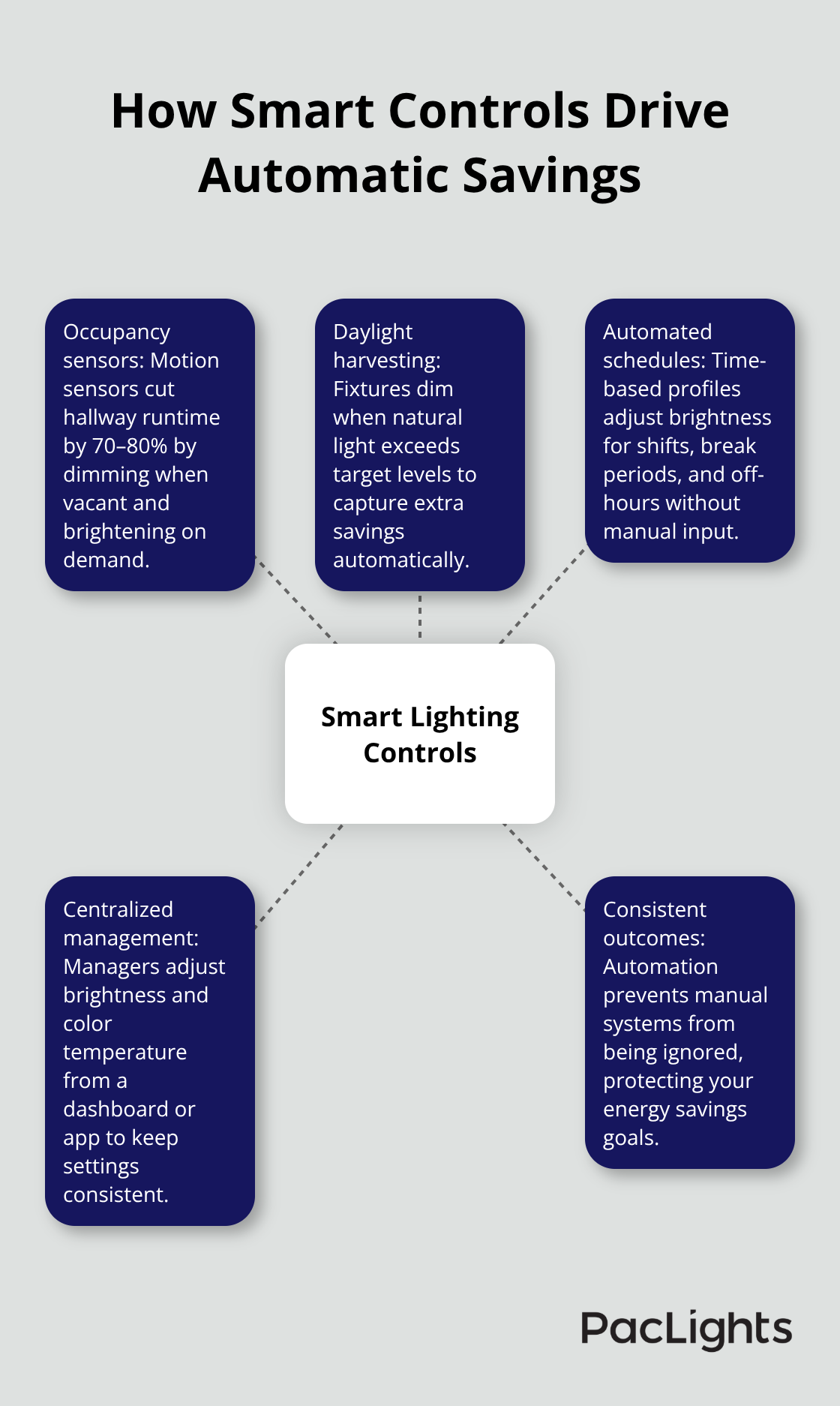
Manual dimmer switches work well for small installations with straightforward layouts, but they create operational friction in larger facilities. A 50-light office or warehouse demands a control strategy that adjusts brightness across zones without requiring staff to walk around flipping switches. Smart dimming systems address this directly. Networked lighting controls let facility managers adjust brightness and color temperature across an entire building from a central dashboard or mobile app, eliminating manual intervention and enabling automated schedules that match operational patterns. For example, a warehouse can program hallways to dim to 30% at 11 PM during night shifts, then ramp to 75% at 6 AM as morning crew arrives, all without human input. This automation consistency prevents the common problem where manual systems get ignored or used inconsistently, undermining your energy savings targets.
Automation and Responsive Lighting
Smart controls integrate with occupancy sensors and daylight harvesting, meaning your facility responds automatically to changing conditions rather than maintaining fixed brightness levels regardless of actual need. Motion sensors reduce hallway runtime by 70–80%, while daylight harvesting dims fixtures automatically when natural light levels exceed your target brightness, capturing additional energy savings without occupant awareness.
Compatibility Requirements for Existing Infrastructure
Integrating dimmable downlights into existing infrastructure requires checking three specific compatibility points before purchasing. First, verify that your current dimmer switches are LED-compatible; older incandescent dimmers often cause flickering or hum with LED loads below 10 watts, wasting the dimming advantage. LED-compatible dimmers like Varilight V-Pro or Hamilton Hartland eliminate this problem and work reliably even with very low LED loads. Second, confirm your electrical infrastructure supports the total wattage of your dimmable fixtures. A 50-light installation with 10-watt LED downlights draws 500 watts total, well within standard commercial circuits, but networked controls add minimal load.
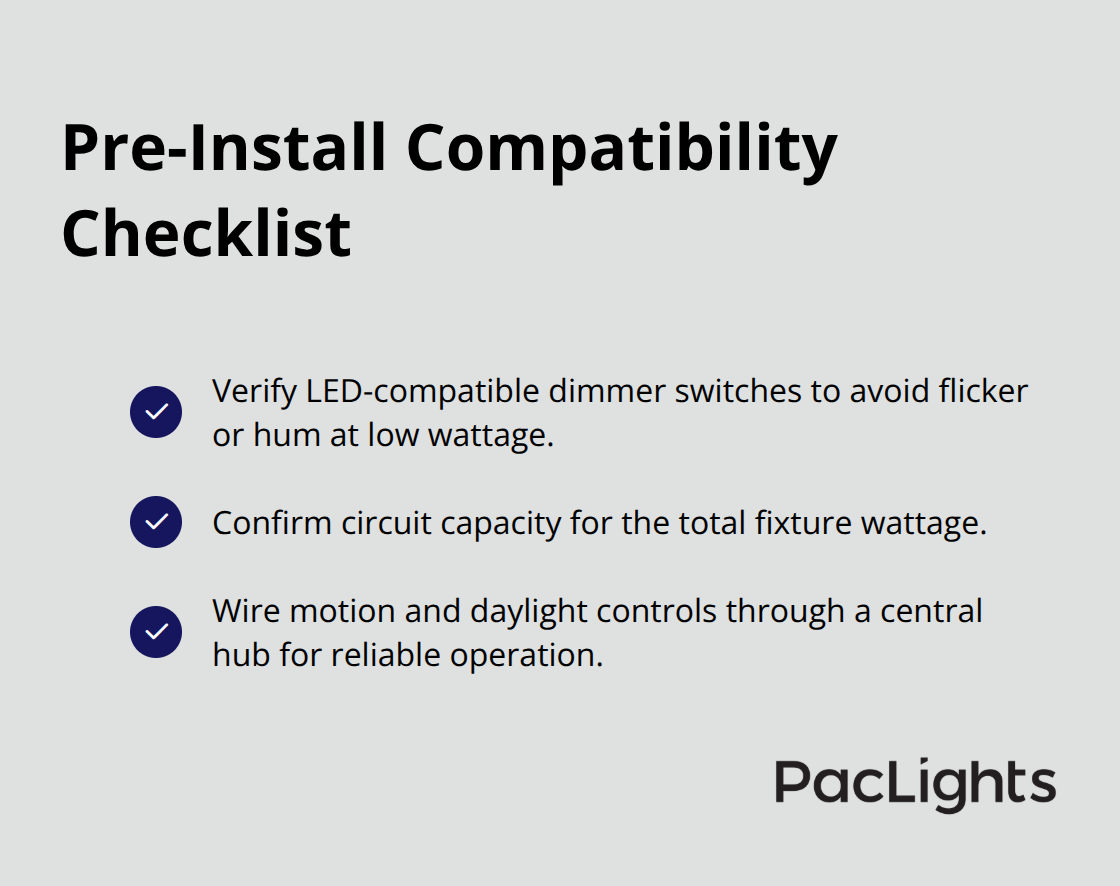
Third, motion sensors and daylight controls pair effectively with dimmable downlights when wired through a central control hub rather than individual switches.
Designing Your Control Architecture
The right control system architecture delivers the energy reductions and operational flexibility your facility needs. PacLights offers free lighting layout designs and ROI assessments that account for integration requirements, helping you select dimmable fixtures and controls matched to your specific operational patterns and facility layout.
Final Thoughts
A 50-light office installation cutting brightness to 60% during low-activity periods saves $432–$540 annually, accumulating to $4,320–$5,400 over a decade. Warehouses paired with motion sensors reduce hallway runtime by 70–80%, recovering thousands in energy costs while extending fixture lifespan through reduced operating hours. These numbers reflect real deployments, not projections, and the return on investment compounds when you factor in reduced maintenance costs since LED downlights last 50,000+ hours compared to 1,000–2,000 hours for incandescent fixtures.
Implementation starts with understanding your facility’s operational patterns-offices need different dimming schedules than warehouses, and retail spaces require brightness flexibility tied to shopping hours. Motion sensors and daylight harvesting capture additional savings automatically without ongoing staff intervention, while smart controls eliminate the operational friction that derails manual dimming systems and ensures your facility actually achieves the energy reductions you planned. A dimmable flush mount downlight paired with the right control strategy transforms how your space operates and performs financially.
We at PacLights provide free lighting layout designs and ROI assessments that account for your specific facility type, operational hours, and existing infrastructure, helping you select dimmable fixtures and control systems matched to your actual needs before you commit to installation.
Disclaimer: PacLights is not responsible for any actions taken based on the suggestions and information provided in this article, and readers should consult local building and electrical codes for proper guidance.