

Server rooms are the backbone of modern operations, yet many facilities overlook one of the simplest ways to protect them: proper lighting. Poor visibility in these spaces leads to costly mistakes during maintenance, equipment failures, and compliance violations.
At PacLights, we’ve seen firsthand how server room luminaire upgrades transform both safety and efficiency. The right lighting solution reduces downtime, cuts energy costs, and makes maintenance work faster and more reliable.
Why Proper Lighting Changes Everything in Server Rooms
Visibility Prevents Costly Maintenance Errors
Technicians working in poorly lit server rooms make mistakes that cost thousands of dollars. A cable connected to the wrong port, a component installed backward, or a missed warning label on equipment-these errors happen faster in dim conditions. Energy.gov confirms that LEDs improve visibility without eye strain, which directly translates to fewer installation errors and faster troubleshooting during outages. The difference between 300 lux and 500 lux in an aisle can mean the gap between spotting a loose connection in seconds versus spending fifteen minutes searching.
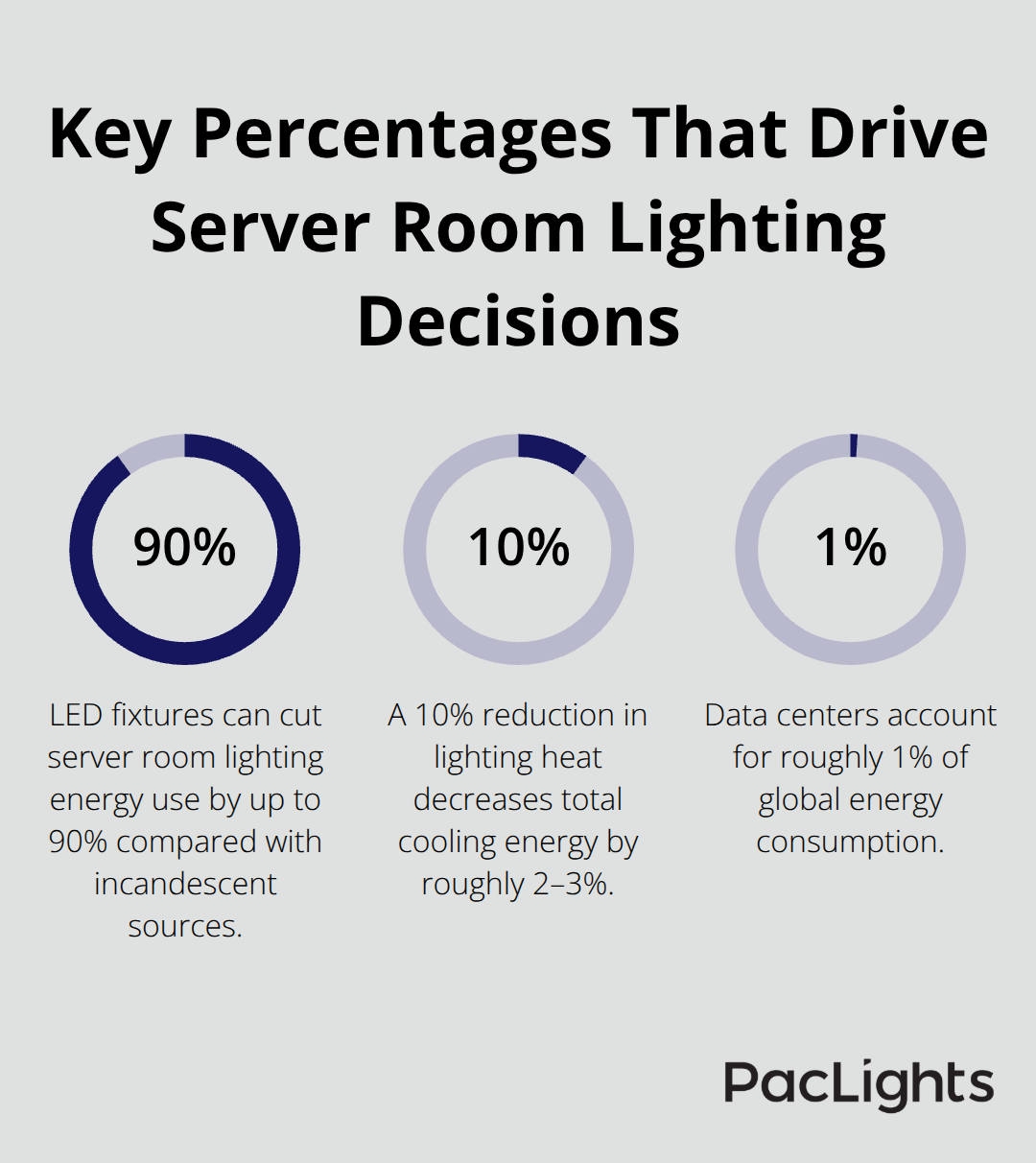
When a server room goes down, every minute without proper illumination extends the recovery time. Data centers account for roughly 1 percent of global energy consumption according to Energy Innovation, and within those facilities, visibility directly impacts how quickly technicians restore service. Poor lighting forces maintenance teams to work slower, use phone flashlights, and second-guess their work-all habits that introduce risk and delay recovery.
Compliance Standards Demand Battery-Backed Emergency Lighting
Compliance standards make proper lighting non-negotiable. NFPA 101 requires emergency lighting in server rooms with battery-backed fixtures that maintain brightness during power outages, and this standard exists because inadequate visibility during emergencies has caused injuries and equipment damage. Beyond safety codes, poor lighting creates liability exposure if a technician suffers injury while working in dim conditions.
Heat Reduction Lowers Cooling Costs
The heat generated by older fluorescent and incandescent fixtures works against server room operations, since that extra thermal load forces cooling systems to work harder and raises overall facility costs. Modern LED fixtures emit far less heat than traditional lighting, according to Energy.gov, which means upgrading lighting directly reduces cooling demand and stabilizes temperatures around 68–71 degrees Fahrenheit. This cooling reduction compounds the financial benefit of switching to LEDs.
A facility running 500-watt fluorescent systems can cut annual lighting energy use from roughly 4,380 kilowatt-hours to around 440 kilowatt-hours with LED upgrades, yielding approximately 527 dollars in annual savings at typical rates of 12 cents per kilowatt-hour. That calculation excludes the additional savings from reduced cooling load.
The Financial Case for Lighting Upgrades
When downtime costs between 5,000 and 10,000 dollars per hour in data center environments, investing in lighting that accelerates maintenance and prevents errors becomes financially obvious rather than optional. The combination of faster troubleshooting, reduced errors, lower energy consumption, and decreased cooling load creates a compelling ROI that extends far beyond the initial fixture investment. Understanding how to select and implement the right LED luminaire solutions determines whether your facility captures these benefits or continues to operate with outdated, inefficient systems.
LED Luminaires That Actually Work in Server Rooms
LED fixtures cut server room lighting energy use by up to 90 percent compared with incandescent sources, according to the US Department of Energy, and this efficiency matters because server rooms operate 24/7 with no seasonal variation. A facility switching from 500-watt fluorescent systems to LEDs reduces annual consumption from approximately 4,380 kilowatt-hours to around 440 kilowatt-hours, translating to roughly 527 dollars in annual savings at standard rates of 12 cents per kilowatt-hour. That figure excludes the additional cooling savings from reduced heat output. The payback period for LED upgrades typically ranges from 2 to 4 years, after which energy reductions accumulate as pure cost savings. LED fixtures last approximately 30 times longer than incandescent bulbs and up to five times longer than CFLs, which means technicians spend far less time replacing burned-out luminaires and more time on actual maintenance work. A 10 percent reduction in lighting heat decreases total cooling energy consumption by roughly 2 to 3 percent, compounding the energy advantage. The US Department of Energy projects that by 2035, LED lighting will dominate most installations, delivering up to 569 terawatt-hours in energy savings nationally, equivalent to the output of roughly 92 large power plants.
Controls That Match Your Actual Maintenance Schedule
Advanced lighting controls separate mediocre LED installations from genuinely efficient ones. Occupancy sensors and scheduling reduce annual operating hours in rarely used zones from a theoretical 8,760 hours to approximately 2,000 hours, delivering dramatic energy reductions without sacrificing safety or visibility. Networked lighting controls provide visibility into when and how lights operate across different zones, enabling data-driven decisions about fixture placement and control strategies. Dimming systems allow technicians to operate at reduced light levels during routine inspections while maintaining full brightness during complex maintenance tasks, cutting energy consumption without creating shadows during critical work.
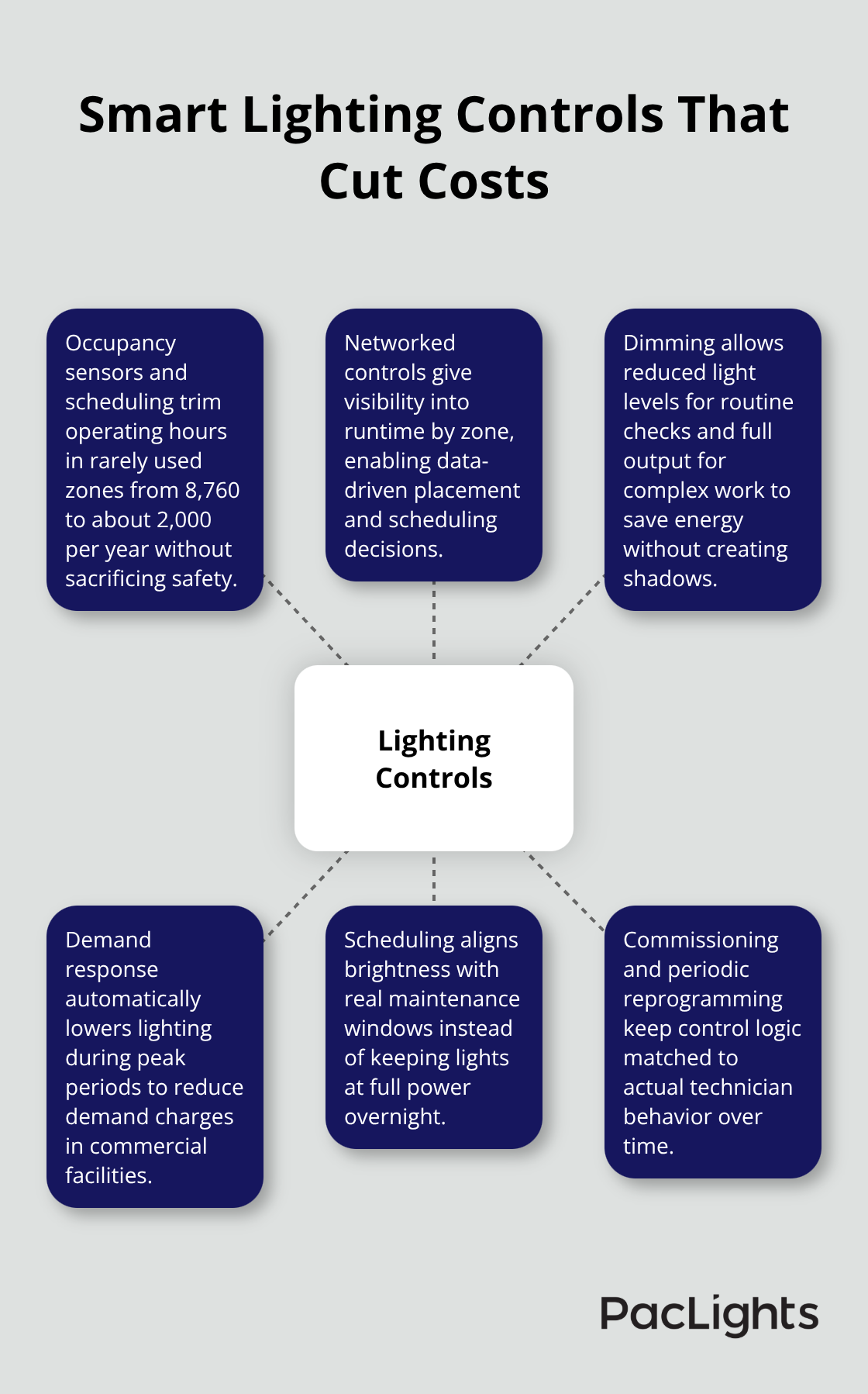
Demand response programs automatically reduce lighting during peak electricity periods, lowering demand charges that often exceed consumption costs in commercial facilities. Matching control strategy to actual maintenance patterns rather than assuming uniform lighting needs across all hours separates exceptional installations from average ones. A server room with concentrated maintenance windows during business hours wastes energy operating at full brightness overnight, whereas one with proper scheduling reduces consumption in those idle periods. This requires honest assessment of when technicians actually work in each zone, then programming controls accordingly rather than defaulting to always-on operation.
Heat Resistance in High-Density Racks
LED fixtures emit far less heat than traditional lighting, enabling reliable operation in high-temperature aisles reaching 90 to 100 degrees Fahrenheit and beyond, which aligns with high-density server strategies that push thermal limits. Flicker-free LED drivers eliminate the 120-hertz flicker that plagued older fluorescent systems, improving both technician comfort during extended maintenance sessions and compatibility with camera monitoring systems that can misread flickering sources. LED fixtures lack infrared and ultraviolet emissions, protecting sensitive equipment and materials from thermal and photochemical damage that accumulates over years of operation.
Fixture Placement and Infrastructure Integration
Proper fixture placement using grid-aligned narrow pendant or linear fixtures directly above aisles with typical spacing of 8 to 10 feet and mounting heights of 8 to 12 feet ensures even coverage and minimizes shadows that force technicians to work around dark zones. Maintaining seven feet of clearance below fixtures prevents obstruction of cable trays while ensuring luminaires do not interfere with overhead infrastructure. Track-based ceiling systems provide flexibility to relocate lighting as server room layouts change without costly ceiling renovations, which matters because equipment configurations shift frequently in active facilities.
Redundancy and Emergency Readiness
Emergency lighting must meet NFPA 101 requirements with battery-backed LED fixtures that maintain brightness during power outages, ensuring technicians can safely navigate and restore service even during extended electrical failures. Building redundancy into circuits (splitting lighting across at least two independent circuits, with different zones served by each) maintains partial visibility during outages and prevents total darkness from disabling recovery efforts. This redundancy approach transforms lighting from a single point of failure into a resilient system that supports rapid response when the facility needs it most.
Implementation and ROI Considerations
Measure Your Current Lighting and Usage Patterns
Start your server room lighting upgrade with a baseline assessment-skipping this step wastes money. Measure your current lighting levels with a lux meter in different zones: aisles, equipment rows, and maintenance areas. Compare your readings against the 500 lux target for active work areas. If your facility runs 300 lux in aisles, you now know the exact gap you need to close.
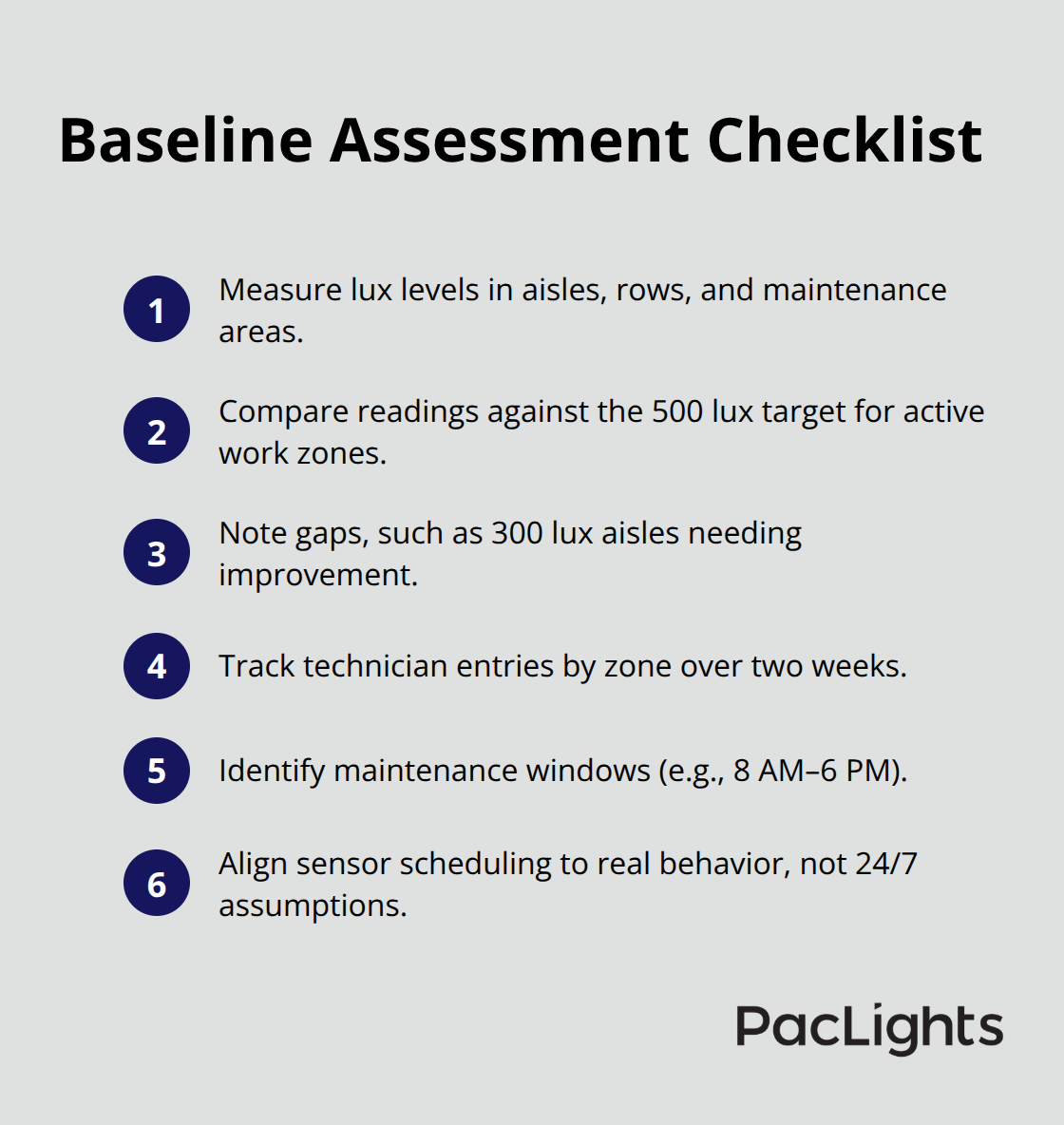
Next, track when technicians actually enter each zone over a two-week period to audit your maintenance schedule. A server room with maintenance concentrated between 8 AM and 6 PM wastes energy running full brightness at midnight. Occupancy sensors and scheduling controls deliver value only when they match real behavior, not theoretical patterns.
Calculate Your Current Energy Consumption and Costs
Document your current fixture types and wattage, then calculate annual energy consumption by multiplying wattage by 8,760 hours. A 500-watt fluorescent system running 24/7 consumes roughly 4,380 kilowatt-hours annually. Check your utility bill for your actual electricity rate-it typically falls between 10 and 15 cents per kilowatt-hour. Multiply your current annual consumption by this rate to establish your baseline cost. This honest number prevents optimistic projections from inflating your ROI estimates later.
Request Photometric Designs and Compare Vendor Quotes
Obtain three quotes from lighting vendors and request photometric layouts showing lux distribution across your specific aisle widths and mounting heights. Avoid vendors who skip this step-proper design prevents dark zones and shadows that force technicians to relocate during maintenance. Photometric data reveals whether a fixture placement strategy actually works for your facility’s dimensions rather than relying on generic assumptions.
Build Your Financial Analysis with Real Numbers
Take your current annual energy consumption, multiply by your electricity rate, and subtract the LED system’s projected consumption at the same rate. A facility cutting consumption from 4,380 to 440 kilowatt-hours saves roughly 527 dollars annually at 12 cents per kilowatt-hour. Factor in fixture cost plus installation labor, then divide total investment by annual savings to find your payback period. Most LED upgrades payback in 2 to 4 years according to Energy.gov, after which you operate on pure savings. Add the cooling benefit: a 10 percent reduction in lighting heat decreases total cooling energy by roughly 2 to 3 percent. Estimate your facility’s current cooling costs and apply that percentage reduction to capture the full financial picture. Include control hardware like occupancy sensors and networked controls in your payback calculation. Many facilities overlook the maintenance cost reduction-LED fixtures last approximately 30 times longer than incandescent bulbs, meaning fewer replacement visits and lower labor costs over a 10-year horizon.
Align Your Upgrade Timeline with Facility Operations
Coordinate the lighting upgrade timeline with your facility’s planned downtime or maintenance windows to minimize disruption. If your building management system already runs networked controls for HVAC or security, LED systems with compatible protocols integrate seamlessly without duplicate infrastructure investments. This compatibility prevents costly rewiring and reduces implementation complexity.
Final Thoughts
Server room luminaire upgrades deliver measurable returns that extend far beyond the initial investment. A facility cutting lighting energy from 4,380 kilowatt-hours annually to 440 kilowatt-hours saves roughly $527 per year at standard electricity rates, with additional cooling savings that compound this benefit. LED fixtures lasting 30 times longer than incandescent bulbs eliminate the constant replacement cycle that drains maintenance budgets and creates downtime risk.
Proper lighting transforms how your team works in ways that spreadsheets alone cannot capture. Technicians operating in well-lit server rooms with 500 lux illumination make fewer mistakes, troubleshoot faster, and complete maintenance tasks with greater confidence. Emergency lighting with battery backup maintains visibility during power failures when recovery speed determines whether downtime costs thousands or tens of thousands of dollars.
The payback period of 2 to 4 years means your facility accumulates pure savings within a reasonable timeframe, and after that window closes, every dollar saved on energy and maintenance flows directly to your bottom line. We at PacLights understand that server room luminaire upgrades require more than standard fixtures-our team offers free lighting assessments to quantify your specific savings potential and plan solutions tailored to your facility’s dimensions and maintenance patterns.
Disclaimer: PacLights is not responsible for any actions taken based on the suggestions and information provided in this article, and readers should consult local building and electrical codes for proper guidance.