

Server lighting directly impacts how your IT team works and how long your equipment lasts. Poor lighting causes eye strain, missed details during maintenance, and wasted energy costs that add up fast.
At PacLights, we’ve seen firsthand how the right lighting setup transforms server rooms. This guide covers the core principles that make the difference.
Lighting Requirements for Server Rooms
Illumination Levels That Keep Technicians Productive
Visibility in server rooms isn’t about brightness for its own sake. Technicians need to see cable connections, read equipment labels, and spot potential issues without straining their eyes for hours. The standard target is 500 lux in active work areas where maintenance happens, which is roughly equivalent to a well-lit office space. Dark spots between racks create real problems-they force technicians to use flashlights and slow down troubleshooting when minutes matter.
Grid-aligned lighting placed directly above aisles eliminates these shadows and ensures even coverage across all equipment rows. Narrow pendant or linear fixtures work best here because they deliver light exactly where it’s needed without wasting energy on spaces behind cabinets.
The Three-Level Lighting Strategy
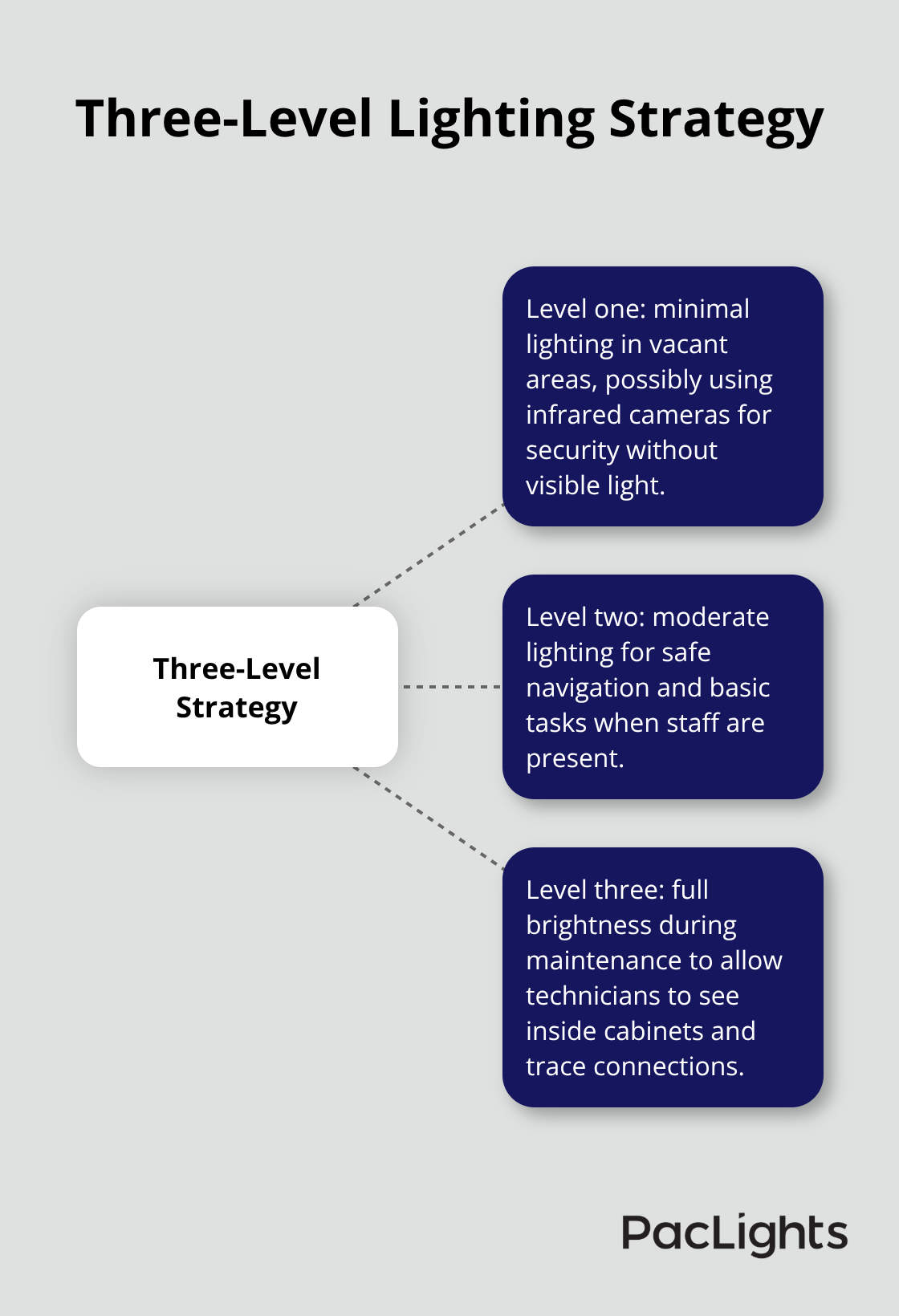
One practical approach uses a three-level lighting strategy that adapts to actual activity in the space. Level one maintains minimal lighting in vacant areas, potentially relying on infrared cameras for security monitoring without visible light. Level two activates moderate lighting when staff is present for safe navigation and basic tasks. Level three delivers full brightness during maintenance work when technicians need to see inside cabinets and trace connections clearly.
This adaptive approach cuts energy costs significantly while maintaining safety standards that comply with NFPA 101 requirements for emergency lighting and illuminated exits.
Color Temperature and Flicker Control
Server rooms benefit from cooler light in the 4000K to 5000K range because it improves focus and reduces errors during technical work. This color temperature keeps technicians alert during long maintenance sessions and helps them spot details they’d miss under warmer light.
Flicker represents another critical factor that facility managers often overlook. Even imperceptible flicker causes eye strain and fatigue over an eight-hour shift, and it can interfere with camera monitoring systems in the data center. LED fixtures eliminate flicker entirely when paired with quality drivers, unlike older fluorescent systems that flicker at 120 Hz and cause measurable discomfort.
The combination of proper illumination levels, correct color temperature, and flicker-free operation creates an environment where your team works faster, makes fewer mistakes, and goes home without headaches. Advanced lighting controls with motion sensors and scheduling let you implement this three-level strategy with precision, giving you exact control over when and where light appears in your facility.
Energy Efficiency and Cost Savings in Server Room Lighting
LED Technology Slashes Energy Consumption
LED technology delivers measurable savings that compound over time in server rooms. Compared to incandescent bulbs, LEDs use up to 90% less energy according to Energy.gov data on LED lighting efficiency.

In a typical server room running 24/7, this difference translates to thousands of dollars annually. A 500-watt fluorescent lighting system in a medium-sized data center consumes about 4,380 kilowatt-hours per year. Switching to LEDs reduces that to roughly 440 kilowatt-hours, assuming equivalent brightness. At an average commercial electricity rate of 12 cents per kilowatt-hour, that’s a $527 annual saving in lighting costs alone. The payback period for LED fixtures typically falls between two and four years, after which every additional year represents pure savings.
Heat Reduction Amplifies Cooling Efficiency
LEDs produce significantly less heat than traditional bulbs, and this matters enormously in server rooms that already struggle with temperature management. When lighting generates less heat, your cooling systems work less hard, creating secondary energy savings that amplify the primary benefit. A data center that reduces lighting heat output by even 10% can lower overall cooling energy consumption by 2-3%. The thermal advantage extends equipment lifespan and reduces strain on HVAC infrastructure that represents a major capital investment.
Occupancy Sensors and Scheduling Multiply Savings
Motion sensors and scheduling controls multiply these savings further. A motion sensor in a rarely-visited equipment area can reduce lighting runtime from 8,760 hours annually to perhaps 2,000 hours, cutting energy use by over 77% in that zone alone. Dimming systems add another layer of efficiency (reducing brightness when full illumination isn’t required for basic monitoring versus active maintenance work). Networked lighting controls enable facility managers to implement the three-level strategy mentioned earlier with precision, automatically shifting between levels based on actual occupancy patterns rather than manual switches that staff forget to use.
Smart Controls Drive Facility-Wide Optimization
Advanced lighting controls integrate with your broader facility management approach. These systems track energy consumption across zones and identify high-usage areas where additional optimization opportunities exist. Facility managers gain visibility into exactly when and where lights operate, making data-driven decisions about fixture placement and control strategies. The combination of LED efficiency, thermal management, and intelligent controls transforms lighting from a fixed operational cost into a variable expense that shrinks as your team learns to operate the system effectively.
With energy costs and heat management addressed, the next critical factor is how you physically arrange lighting throughout your server room to eliminate shadows, maintain reliability, and support safe maintenance work.
Best Practices for Server Room Lighting Layout
Position Lights to Eliminate Dead Zones
Fixture placement determines whether your server room has uniform visibility or dark pockets where technicians struggle to see equipment details. The principle is straightforward: align lights with your aisle layout, not your ceiling grid.
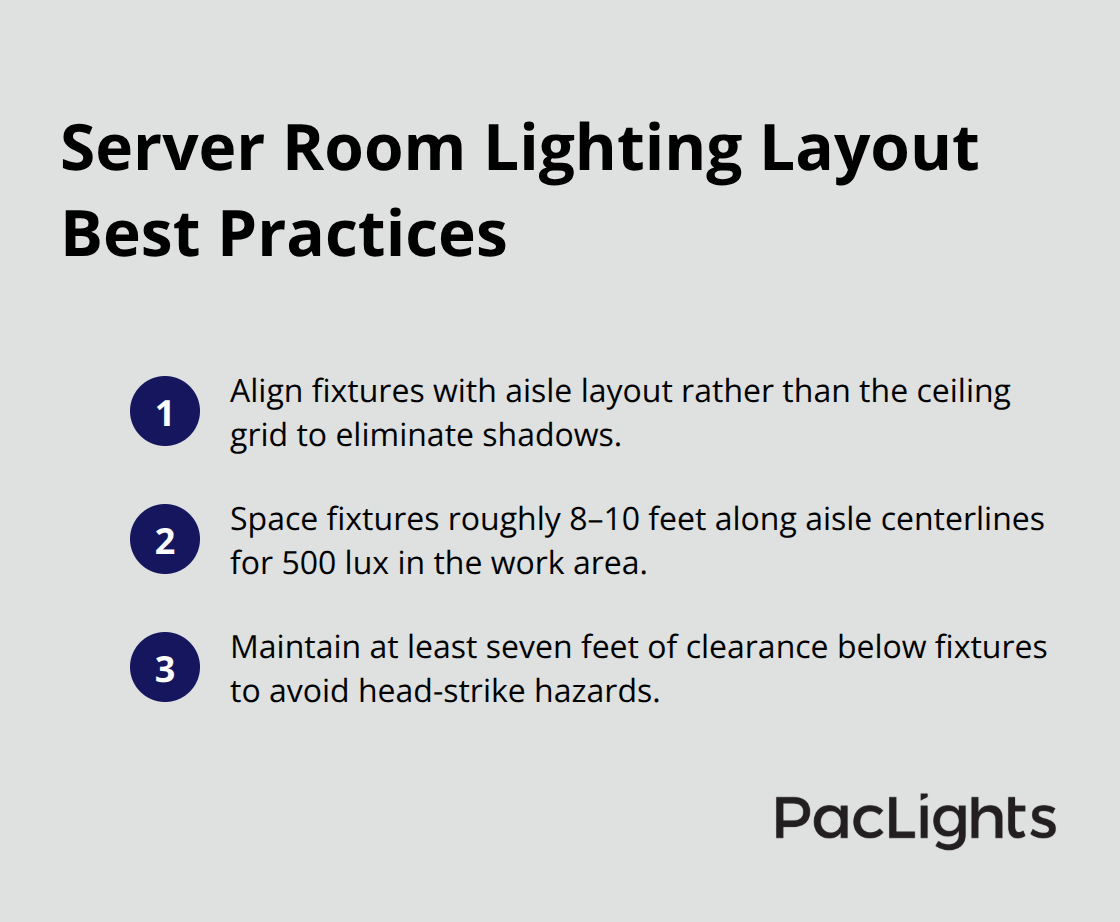
Most facilities make the mistake of spacing fixtures evenly across the entire ceiling, which leaves shadows between racks because light from adjacent fixtures fails to reach into narrow aisle spaces. Instead, position narrow pendant or linear fixtures directly above each aisle so light travels straight down onto cable connections and equipment faces.
This grid-aligned approach eliminates shadows entirely and reduces the number of fixtures you need compared to blanket ceiling coverage. A typical server room with six-foot-wide aisles requires fixtures spaced roughly 8 to 10 feet apart along the aisle centerline, with mounting heights between 8 and 12 feet depending on your ceiling constraints. This spacing delivers approximately 500 lux in the aisle while keeping fixture count manageable. Suspended ceiling track systems offer flexibility here because you can position fixtures precisely where aisles exist rather than being locked into permanent mounting points. If your server room layout changes as equipment gets added or reconfigured, track systems let you relocate fixtures without ceiling modifications.
Build Redundancy Into Your Lighting Circuits
A single lighting circuit failure should not force technicians to work in darkness during emergency maintenance. Split your server room into at least two independent lighting circuits so one circuit can fail without disabling all illumination. This approach mirrors the redundancy your infrastructure already demands from power distribution and cooling systems. Each circuit should cover different zones rather than identical areas, so you maintain partial visibility everywhere if one fails.
Emergency lighting must also comply with NFPA 101 requirements, which mandate illuminated exit paths and minimum lighting levels during power outages. Battery-backed LED fixtures provide this emergency function more efficiently than older fluorescent systems because they draw minimal power from backup batteries and maintain brightness longer. Many facilities overlook the secondary benefit of redundant circuits: they enable maintenance of one circuit while the other keeps the space operational, eliminating downtime for lighting repairs or fixture upgrades.
Integrate Lighting With Cable Management and Safety
Lighting fixtures must not obstruct cable trays or create hazards during maintenance work. Position pendant fixtures where they will not interfere with horizontal cable runs or force technicians to duck around mounting hardware. Vertical clearance matters more than most managers realize-fixtures mounted too low create head-strike hazards and complicate equipment installation. Try for a minimum of seven feet of clearance below fixtures so technicians can work safely without constantly adjusting their position.
When cables run perpendicular to aisles, offset light fixtures slightly or use fixtures with a compact footprint to avoid creating obstacles. The spacing and positioning decisions you make during initial design directly impact how quickly your team responds to outages and equipment failures. Proper fixture placement combined with appropriate circuit redundancy and clearance planning transforms your server room into a space where technicians work efficiently and safely.
Final Thoughts
Server lighting design directly shapes how efficiently your facility operates and how long your equipment performs. LED fixtures consume up to 90% less energy than older systems, heat output decreases significantly, and motion sensors eliminate wasted lighting in rarely-visited areas. These improvements compound over time, with most facilities recovering their investment within two to four years and then enjoying pure savings indefinitely. Your team also benefits from reduced eye strain, faster troubleshooting, and fewer maintenance errors when visibility improves.
Modern server lighting supports your broader infrastructure goals in ways that extend far beyond energy savings. Redundant circuits maintain visibility during emergencies, flicker-free operation protects both technician comfort and camera monitoring systems, and lower heat output reduces cooling demands while extending equipment lifespan. These benefits align with the reliability and efficiency standards your data center already demands from power and cooling infrastructure. An honest assessment of your current lighting performance reveals dark spots where technicians struggle to see details and identifies opportunities to measure energy consumption across your lighting circuits.
We at PacLights offer free lighting assessments that quantify exactly what you’ll save by upgrading to energy-efficient fixtures with advanced controls tailored to your facility’s specific layout and operational patterns. The right server lighting investment pays for itself while transforming your server room into a space where maintenance happens faster, safely, and at lower cost.
Disclaimer: PacLights is not responsible for any actions taken based on the suggestions and information provided in this article, and readers should consult local building and electrical codes for proper guidance.