

Hallways are often overlooked in facility design, yet they’re where safety and efficiency either succeed or fail. Poor lighting creates blind spots, wastes energy, and leaves employees uncomfortable navigating these spaces.
At PacLights, we’ve seen how adjustable cylinder wall lighting transforms hallways from afterthoughts into strategically lit corridors. The right fixtures give you precise control over where light goes, how bright it shines, and when it’s needed most.
Why Hallways Need Better Lighting Control
Hallways in commercial facilities drain energy at alarming rates because fixed lighting systems operate at full brightness regardless of occupancy or daylight availability. A typical office building wastes thousands of dollars annually when lighting empty corridors during off-hours and on bright days when natural light already fills the space. Fixed systems cannot adapt to actual usage patterns, so you pay to illuminate hallways that nobody uses while simultaneously overpaying for uniform brightness that creates wasted lumens. Motion sensors and dimming capabilities address this directly-fixtures that adjust based on real-time conditions reduce energy consumption by 30 to 50 percent compared to always-on systems, according to energy efficiency studies in commercial facilities.
Safety Gaps in Static Lighting
Poor visibility in hallways creates genuine hazards that fixed lighting cannot solve. Corridors with uneven brightness create shadow zones where employees miss obstacles, trip hazards, or directional signage. Adjustable cylinder wall lighting eliminates these dead zones by allowing you to direct light precisely where it’s needed-along walls, across floors, and toward emergency exits. This targeted approach prevents the dark spots that occur when fixtures are spaced too far apart or aim in wrong directions. Employees navigate corridors with confidence when lighting is consistent and intentional, reducing slip-and-fall incidents that cost facilities an average of $10,000 to $50,000 per claim in medical and liability expenses.
Comfort and Productivity Matter
Fixed lighting systems force occupants into uncomfortable lighting conditions because they cannot adjust to individual preferences or task requirements. Some hallways need bright task lighting near workstations or emergency equipment, while others benefit from softer ambient lighting for circulation. Dimmable adjustable fixtures solve this problem by letting you create different lighting zones within the same corridor.
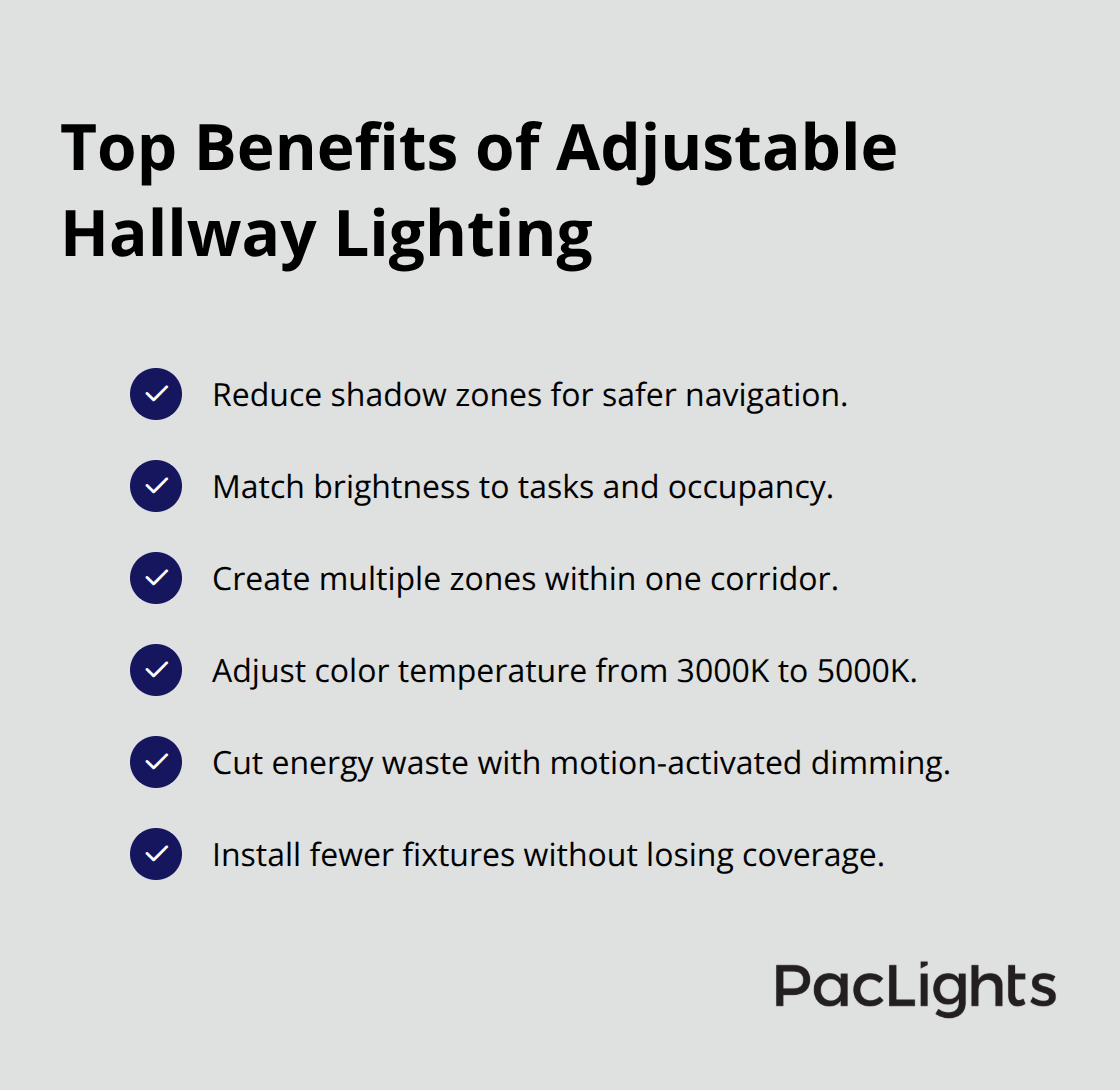
Employees work more efficiently in spaces where lighting matches their actual needs rather than generic defaults. Color temperature control-shifting between 3000K warm white and 4000K to 5000K cooler white-allows you to adapt hallway atmospheres to time of day or activity type. Morning corridors can feel energizing with cooler tones while evening spaces can shift warmer to reduce eye strain.
Energy Waste Compounds Over Time
The financial impact of poor hallway lighting extends beyond monthly utility bills. Facilities that operate fixed lighting systems accumulate unnecessary costs year after year, with no mechanism to respond to seasonal changes or occupancy fluctuations. A warehouse that lights all corridors at full capacity 24/7 wastes far more energy than one that dims fixtures during low-traffic periods or uses motion sensors to activate lighting only when needed. These wasted lumens represent pure expense with no operational benefit. Adjustable fixtures give you control to optimize visibility without installing excessive fixtures that waste space and money.
Moving Forward with Smarter Control
The transition from fixed to adjustable lighting begins with understanding your facility’s actual usage patterns. Different hallways serve different purposes-some require consistent bright lighting for safety-critical areas, while others can operate at lower levels during off-peak hours. Adjustable cylinder wall lighting accommodates these variations within a single product line, eliminating the need for multiple fixture types. The next section explores the specific features that make these fixtures adaptable and how they deliver measurable improvements across commercial environments.
What Makes Adjustable Cylinder Fixtures Work Better Than Fixed Lights
Adjustable cylinder wall lighting succeeds because it puts control where it belongs-in your hands. Unlike fixed fixtures that blast the same brightness in the same direction regardless of conditions, adjustable models let you aim light precisely where it delivers value. The beam direction mechanism, whether a swivel or gimbal trim, rotates to target walls, floors, or architectural features without installing additional fixtures. This precision eliminates the wasted lumens that plague hallways lit by conventional downlights that scatter light everywhere equally. When you can direct a 1,000-lumen fixture toward a wall instead of diffusing it across the entire corridor, you accomplish better visibility with less energy. The adjustment capability also means a single fixture can serve multiple purposes-bright task lighting near emergency exits during business hours, softer accent lighting along walls during evening circulation, and dormant status during unoccupied periods when motion sensors detect no activity. Facilities using adjustable fixtures report installing 20 to 30 percent fewer total fixtures compared to fixed-light designs while maintaining superior illumination, directly reducing upfront material and labor costs.
Dimming Transforms Hallway Efficiency
Dimmable adjustable cylinders eliminate the all-or-nothing problem of fixed systems. A hallway that requires full brightness at 8 AM when employees arrive wastes energy at 2 PM when daylight floods the space through windows, and wastes even more at midnight when the building sits empty. Dimmable fixtures paired with motion sensors create automatic responses to actual occupancy-corridors operate at 30 to 40 percent brightness during low-traffic periods and jump to full output within seconds when movement is detected.
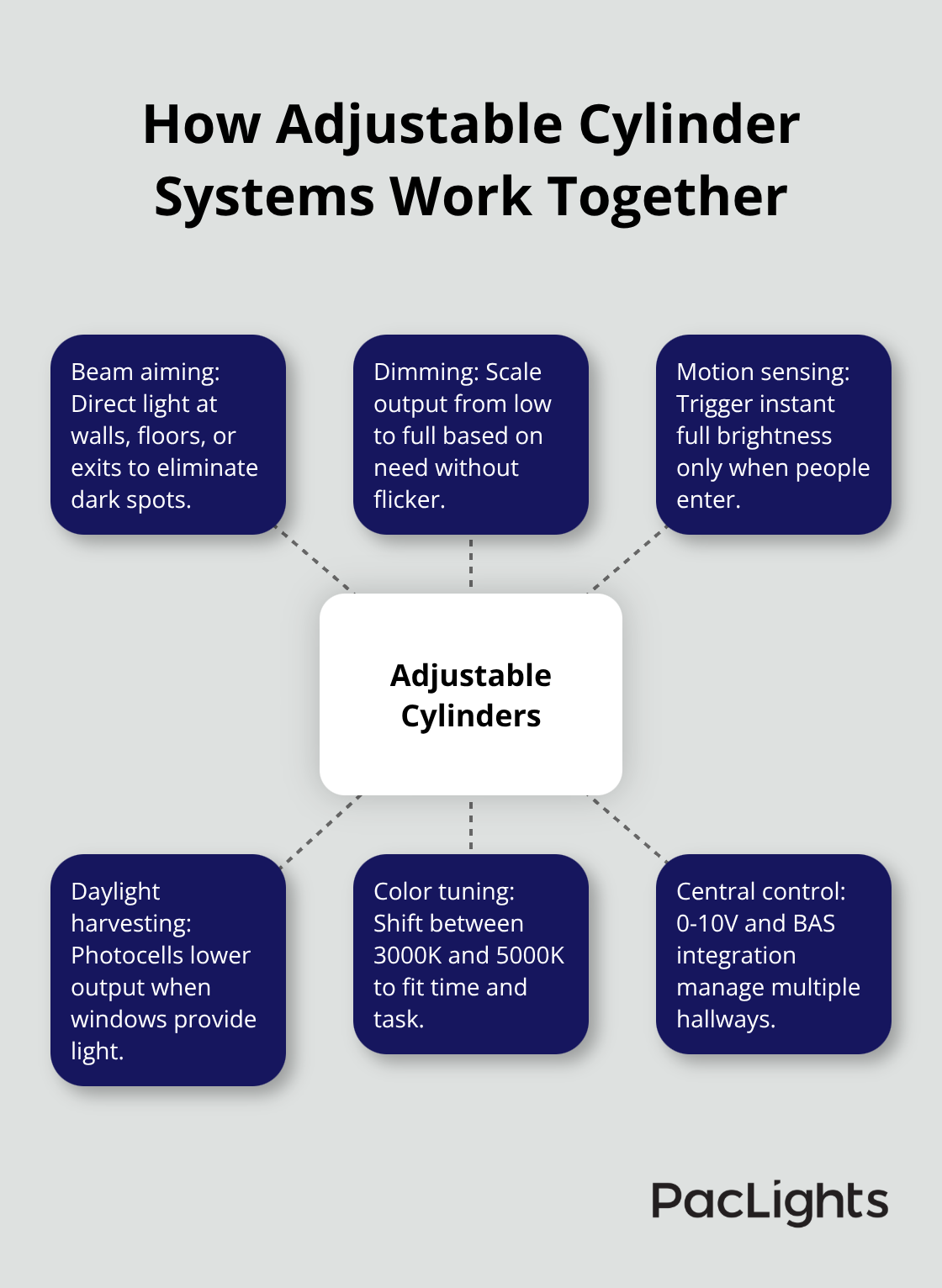
This adaptive approach cuts energy consumption far more effectively than occupancy sensors alone on non-dimming fixtures. Triac dimming compatibility ensures LED bulbs perform smoothly without flicker across the entire brightness range, while 0-10V dimming systems integrate with building automation platforms for centralized control across multiple hallways. Color temperature adjustability adds another efficiency layer-shifting from 4000K cooler white during daytime work hours to 3000K warm white during evening reduces circadian disruption while using the same fixture. Facilities managing multiple hallways across different zones benefit from networked controls that adjust lighting based on time of day, seasonal daylight variations, and occupancy patterns without manual intervention.
Distribution Strategy Prevents Dark Spots
The cylindrical form factor matters because it naturally directs light in a focused beam rather than spreading it omnidirectionally like traditional recessed downlights. A 40 to 45-degree beam angle per side concentrates illumination along wall surfaces where it prevents shadow zones and guides wayfinding. Spacing calculations become straightforward-a 10-foot ceiling typically requires 1,000 to 2,000 lumens per fixture, while 20-foot industrial corridors need 4,000 to 5,000 lumens or more to maintain consistent brightness without dark patches. The adjustable mechanism lets you angle fixtures slightly upward or downward to adapt to actual ceiling height and wall conditions without ordering different product models. In warehouses and manufacturing facilities where ceiling heights vary and obstacles create irregular shadow patterns, this flexibility prevents the expensive retrofit cycles that fixed fixtures demand. Dual-beam designs that emit light upward and downward simultaneously reduce harsh shadows while creating visual depth that makes long corridors feel less oppressive. Facilities retrofitting aging fixed-light systems find that switching to adjustable cylinders with proper spacing calculations eliminates the dim spots that employees have navigated around for years, improving both safety perception and actual visibility metrics measured in foot-candles along the floor.
Control Systems Adapt to Real Conditions
Motion sensors paired with adjustable fixtures create responsive lighting that matches actual facility usage rather than operating on fixed schedules. A corridor that sits empty for hours activates lighting only when someone enters, cutting energy waste during predictable low-occupancy periods. Photocell integration allows fixtures to sense daylight levels and reduce output automatically when windows provide sufficient illumination, further optimizing energy consumption without manual adjustment. Building automation platforms enable facility managers to monitor and adjust multiple hallways from a central location, responding to seasonal changes and unexpected occupancy shifts without visiting each corridor individually. This layered control approach-combining motion detection, daylight harvesting, and dimming-delivers energy reductions that fixed systems simply cannot match.
Installation Flexibility Supports Diverse Hallway Designs
Adjustable cylinder fixtures accommodate various mounting configurations including wall-mounted, surface-mounted, and recessed options, allowing clean installations that match existing architectural styles. The swivel and gimbal mechanisms provide full directional control without requiring additional fixtures or complex rewiring to achieve proper illumination patterns. Facilities with irregular ceiling heights, structural obstacles, or varying corridor widths benefit from this adaptability-a single fixture type adjusts to multiple conditions rather than forcing you to stock different models for different spaces. This standardization simplifies procurement, reduces inventory complexity, and accelerates installation timelines across large facilities. The next section examines how these adjustable fixtures perform in specific commercial environments where their flexibility delivers measurable operational improvements.
Where Adjustable Cylinder Lighting Delivers Real Results
Office Buildings Cut Costs with Smart Corridor Control
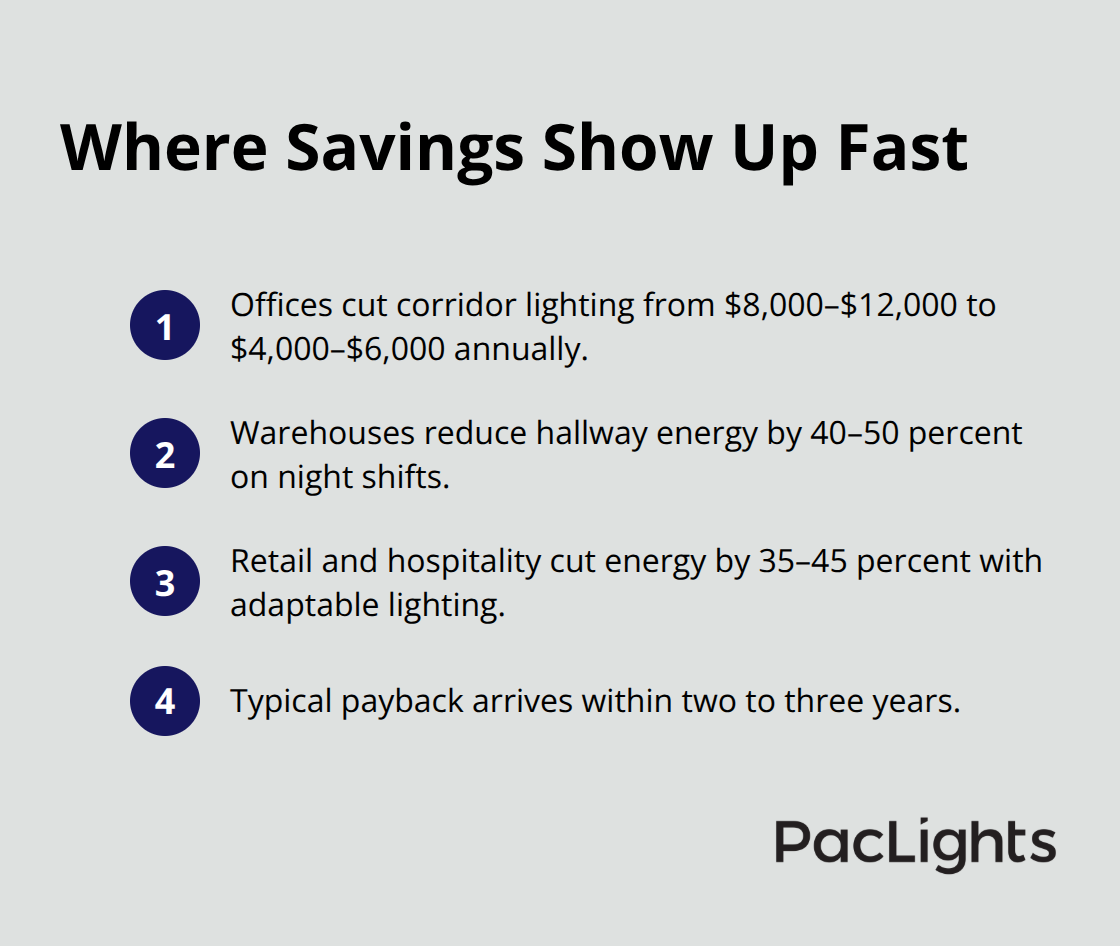
Office buildings waste enormous sums on hallway lighting because corridors operate identically regardless of occupancy patterns. A typical corporate office with 50,000 square feet of hallway space spends $8,000 to $12,000 annually on corridor lighting alone when using fixed systems. Adjustable cylinder fixtures with motion sensors and dimming reduce this cost to $4,000 to $6,000 per year by responding to actual usage patterns.
Conference hallways sit empty most of the day yet receive full illumination on conventional schedules, while executive corridors near corner offices need consistent bright lighting for safety and wayfinding. Adjustable fixtures solve both scenarios with a single product line. Office managers program dimming levels to 40 percent during low-occupancy periods like lunch hours and after-hours, then automatically boost to full brightness when motion sensors detect activity.
Dimmable fixtures with 0-10V control integrate directly into building management systems, allowing facility teams to adjust multiple hallways simultaneously across different floors without manual intervention at each location. The beam angle adjustment also matters in corporate settings where hallways connect open workspaces to private offices. Narrower beam angles prevent light spillover into adjacent spaces where it causes glare and disrupts concentration, while wider angles work better in circulation-only corridors where ambient lighting serves navigation.
Corporate facilities retrofitting fixed lighting report installation costs of $15 to $25 per linear foot for adjustable cylinder systems compared to $20 to $30 per linear foot for conventional downlights, yet achieve superior light distribution with 25 to 30 percent fewer total fixtures.
Warehouses Eliminate Safety Hazards and Energy Waste
Warehouses and manufacturing facilities face entirely different demands where adjustable cylinder lighting proves invaluable for safety and operational efficiency. Industrial hallways with 20 to 30-foot ceilings require 4,000 to 5,000 lumens minimum per fixture to eliminate dark spots where forklifts create hazards and employees miss directional signage. Fixed systems either oversupply light during low-activity shifts or underprovide during peak hours, creating inconsistent conditions that confuse wayfinding.
Adjustable cylinders with motion sensors activate full brightness only in areas with active movement, reducing energy consumption during night shifts and scheduled downtime. A 100,000-square-foot warehouse operating three shifts reduces hallway energy costs by 40 to 50 percent using adjustable fixtures with occupancy control compared to always-on fixed systems.
The directional capability prevents the harsh shadows that occur in warehouses with irregular ceiling heights and structural columns. Facilities angle fixtures slightly upward or downward to adapt to local conditions without ordering different product models, streamlining procurement and installation timelines across large industrial spaces.
Retail and Hospitality Spaces Transform Customer Experience
Retail corridors connecting stockrooms to sales floors need flexible lighting that shifts from bright task lighting during inventory work to softer ambient lighting during customer hours when harsh brightness creates an unwelcoming atmosphere. Hospitality hallways in hotels and restaurants demand lighting that adapts to time of day and occupancy patterns.
Guest corridors operate at 30 percent brightness during overnight hours when occupancy is minimal, then shift to full brightness during morning checkout and evening arrival peaks. Color temperature adjustment from 3000K warm white to 4000K cooler white allows hospitality managers to create different moods throughout the day without changing fixtures.
Retail managers report that flexible lighting control improves customer experience while reducing energy costs by 35 to 45 percent compared to fixed systems that operate at constant brightness regardless of business activity. The investment in adjustable fixtures typically pays for itself within two to three years through energy savings alone, after which the facility operates at a significant cost advantage.
Final Thoughts
Adjustable cylinder wall lighting delivers measurable improvements across every facility type because it replaces one-size-fits-all systems with responsive control that matches actual operational needs. The financial case is straightforward: facilities reduce energy costs by 30 to 50 percent through dimming and motion sensor integration, install 20 to 30 percent fewer fixtures while maintaining superior illumination, and recover their investment within two to three years. Beyond cost savings, adjustable fixtures eliminate the safety hazards created by dark spots and shadow zones, improve employee comfort by adapting to individual preferences and task requirements, and simplify facility management through centralized control systems that adjust multiple hallways simultaneously.
Office buildings cut annual hallway lighting expenses from $8,000 to $12,000 down to $4,000 to $6,000 by responding to occupancy patterns, while warehouses prevent forklift hazards and reduce energy consumption by 40 to 50 percent during night shifts and scheduled downtime. Retail and hospitality spaces transform customer experience while cutting energy costs by 35 to 45 percent compared to fixed systems. These improvements happen because adjustable cylinder wall lighting gives you precise control over where light goes, how bright it shines, and when it operates.
Contact PacLights today to transform your hallways from energy-draining afterthoughts into strategically controlled corridors. Our team provides customizable lighting solutions tailored to your facility’s needs, whether you require motion sensors, dimming controls, or networked systems that integrate with existing building automation platforms. We help you identify which corridors benefit most from upgraded fixtures and calculate your specific energy savings potential.
Disclaimer: PacLights is not responsible for any actions taken based on the suggestions and information provided in this article, and readers should consult local building and electrical codes for proper guidance.