

A single lighting failure in a data center can cost thousands of dollars per minute in lost productivity. At PacLights, we know that redundant lighting systems aren’t optional-they’re essential infrastructure that keeps your operations running.
When your data center goes dark, everything stops. That’s why we’ve built this guide to show you how proper redundancy protects your bottom line and your reputation.
Why Redundant Lighting Matters in Mission-Critical Environments
Operational Impact of Lighting Failures
Lighting failures in data centers create immediate operational chaos. When a single fixture or circuit fails, technicians lose visibility in server aisles, making it impossible to locate ports, identify breakers, or respond to alarms. This isn’t a minor inconvenience-it directly impacts your ability to maintain systems and respond to emergencies. Technicians cannot work safely or efficiently in darkness, and every minute without visibility compounds the problem.
Compliance and Safety Standards
TIA-942, the telecommunications infrastructure standard for data centers, mandates that lighting remain operational during partial or total power loss. NFPA 101 Life Safety Code governs egress illumination, while NEC/NFPA 70 sets electrical separation requirements. Compliance isn’t negotiable; it’s the foundation of safe data center operations. Without redundant lighting, you operate in violation of industry standards that exist specifically to protect your staff and infrastructure.
Financial Case for Redundancy
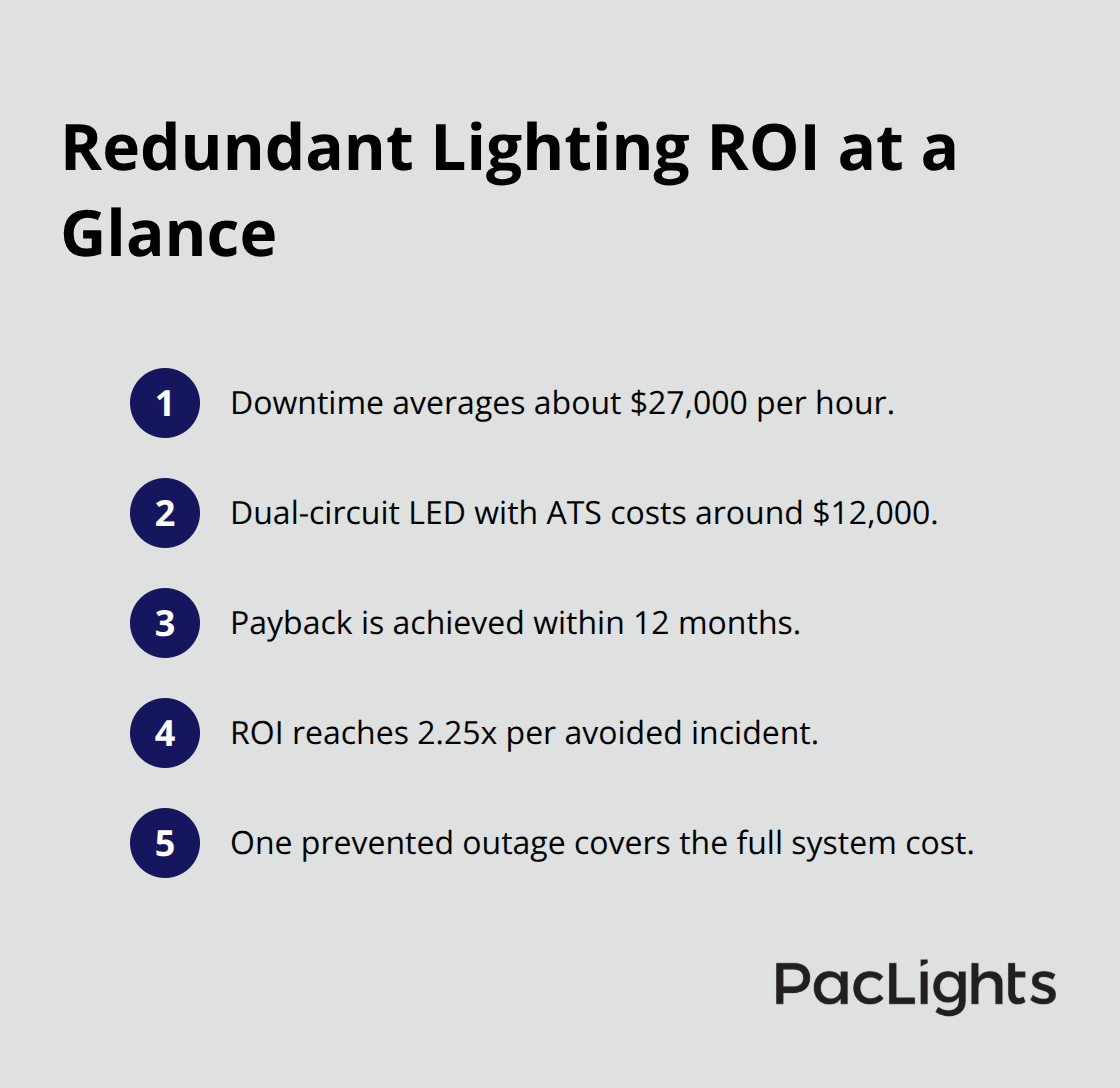
The financial case for redundancy is stark. Data center downtime costs approximately $27,000 per hour according to industry benchmarks. A 30-minute lighting outage that prevents technicians from accessing equipment can trigger cascading failures. A dual-circuit LED installation with automatic transfer switches costs around $12,000 but delivers a 12-month payback period and a 2.25x return on investment per avoided incident-one prevented outage pays for the entire system.
Energy and Thermal Advantages
LED fixtures in redundant configurations draw less than 10W per fixture compared to legacy lighting’s 20-40W, reducing ongoing energy costs while improving thermal management. Legacy fixtures add 2-4°F of heat per fixture, while modern LED solutions stay under 0.5°F. This thermal efficiency matters significantly in data centers where cooling represents the largest energy consumption after IT equipment itself.
Dual-Circuit Architecture and Overspecification
The core design uses two separate power circuits feeding alternating fixtures: one circuit combines utility power with UPS backup, while the second uses an alternate UPS or automatic transfer switch. If one circuit fails, you maintain partial lighting coverage across the entire space. This architecture ensures that technicians never work in complete darkness and that critical maintenance windows remain viable. Overspecifying redundancy by approximately 10% guarantees sufficient light levels even during single-point failures, setting the stage for selecting the right fixtures and control systems that match your specific data center layout and power infrastructure.
Building a Dual-Circuit Foundation
Splitting Power Across Independent Circuits
The architecture of redundant lighting starts with understanding how to split your fixtures across two independent power paths. Circuit A combines utility power with UPS backup, while Circuit B uses an automatic transfer switch connected to a secondary UPS or generator feed. This separation means that if utility power fails, Circuit A remains lit through the battery system, and if that UPS fails, Circuit B activates through its dedicated backup source. Alternating fixtures between circuits across each row ensures continuous illumination even during single-point failures.

Installation and Labeling Protocols
Label every fixture and breaker with its circuit assignment during installation-this simple step prevents confusion during emergencies and speeds up troubleshooting when technicians need visibility immediately. The $12,000 investment for a typical dual-circuit LED system with automatic transfer switches pays for itself within 12 months when you factor in avoided downtime costs at $27,000 per hour. Overspecify your redundancy by approximately 10% to guarantee sufficient light levels during failures, which means if your standard design calls for 50 foot-candles, target 55 foot-candles across the redundant circuits. This buffer absorbs fixture aging and maintains compliance with TIA-942 lighting requirements even when one circuit degrades over time.
Automatic Transfer Switches and Response Times
Automatic transfer switches detect power loss in milliseconds and reroute current to backup feeds without manual intervention, keeping technicians working safely without interruption. Install ATS units at the breaker panel rather than at individual fixtures to reduce complexity and cost while maintaining full-row coverage. Monthly manual cutover tests using a lux meter verify that your system actually works-do not skip this step. Quarterly full-cycle testing that includes UPS discharge under load confirms that backup power can sustain both fixtures and sensors simultaneously.

Maintenance and Strategic Fixture Placement
Annual sensor recalibration and fixture cleaning remove dust accumulation that degrades light output over time. Position fixtures to eliminate dark corners where server racks create shadows, and keep backup fixtures within 8 feet of critical access points like breaker panels and equipment ports. Integration with your building management system or data center infrastructure management platform enables real-time fault alerts, so you know about a failed fixture before technicians discover it in the dark.
Selecting Fixtures That Match Your Environment
Practical fixture selection matters-choose models like SeamLine Battens for fast installation in existing facilities or Squarebeam Elite units for superior thermal management in dense rack environments. These design decisions transform redundant lighting from theoretical protection into operational reality. With your dual-circuit foundation in place and the right fixtures selected, you now need to address how smart controls and monitoring systems detect failures before they impact your operations.
Energy Efficiency in Redundant Systems
LED Power Consumption Cuts Operating Costs
LED fixtures operating at less than 10W per unit versus legacy systems drawing 20–40W represent the foundation of energy-efficient redundancy. This isn’t marginal improvement-it’s a 50–75% reduction in power draw that compounds across hundreds of fixtures. A typical data center running 200 fixtures on dual circuits sees annual energy savings of approximately $4,800 to $9,600 when migrating from legacy to modern LED solutions. The thermal benefit amplifies these savings: LED fixtures release under 0.5°F of heat per unit while legacy fixtures add 2–4°F, directly reducing the cooling load that represents the largest operational expense after IT equipment itself.
Since cooling consumes roughly 40% of total data center energy, cutting fixture heat output meaningfully lowers your overall facility power draw and cooling infrastructure strain. When you overspecify redundancy by 10% as recommended, you add minimal cost while ensuring light levels remain compliant even as fixtures age-this buffer costs far less than upgrading cooling systems to compensate for inefficient legacy lighting.
Smart Controls Reduce Energy Waste
Motion sensors and occupancy detection eliminate unnecessary illumination in aisles and spaces between maintenance windows, while daylight harvesting reduces artificial lighting during daylight hours. These controls typically cut redundant lighting energy use by an additional 20–30% beyond the LED efficiency gains. Integration with your building management system or data center infrastructure management platform enables real-time tracking of fixture performance, power consumption, and fault conditions, allowing you to catch degraded fixtures before they compromise your redundancy coverage.
Thermal Monitoring Optimizes Cooling Performance
Thermal monitoring integrated into your control system detects rack-area hotspots before they escalate, enabling proactive cooling adjustments that work in concert with your efficient lighting design. Annual sensor recalibration and quarterly testing cycles maintain this efficiency over the fixture lifetime, preventing the degradation that causes redundant systems to underperform when you actually need them.
ROI Timeline and Long-Term Savings
A dual-circuit LED installation with ATS backup costs around $12,000 and delivers full payback within 12 months through avoided downtime costs alone. Add energy savings and the true ROI climbs to 2.25x within the first year. Your redundant lighting investment continues generating savings through reduced energy consumption for the next 10–15 years as LED fixtures outlast multiple generations of legacy equipment.
Final Thoughts
Redundant lighting systems transform data center operations from reactive crisis management into proactive reliability. A $12,000 investment in dual-circuit LED architecture with automatic transfer switches pays for itself within 12 months through avoided downtime costs alone, then continues generating savings through reduced energy consumption for the next decade. Your technicians work safely and efficiently, your compliance obligations are met, and your bottom line improves measurably.
Implementation starts with an honest assessment of your current lighting infrastructure. Legacy fixtures drawing 20–40W per unit cost you thousands annually in wasted energy and excess heat load, while modern LED solutions operating below 10W per fixture cut those costs dramatically while releasing minimal thermal output that strains your cooling systems. Surface-mount LED battens and parallel circuits enable retrofit installations in existing facilities without major infrastructure overhauls, and monthly manual cutover tests with a lux meter verify that your redundant lighting system actually works when needed.
The path forward requires selecting fixtures engineered for data center environments and control systems that integrate with your building management platform. We at PacLights provide energy-efficient lighting solutions with optional motion and daylight controls, plus advanced networked lighting controls that optimize your entire system. Contact us at https://www.paclights.com to begin your redundancy assessment and discover how proper lighting infrastructure becomes your competitive advantage.
Disclaimer: PacLights is not responsible for any actions taken based on the suggestions and information provided in this article, and readers should consult local building and electrical codes for proper guidance.