

Modern workspaces demand lighting that balances functionality with employee comfort. Office linear lighting has become the go-to solution for businesses seeking efficient, uniform illumination.
We at PacLights see companies transforming their work environments with linear systems that reduce energy costs by up to 60% while improving productivity. The right linear lighting design creates comfortable spaces that support focus and wellbeing.
Which Linear Lighting Type Fits Your Office Space
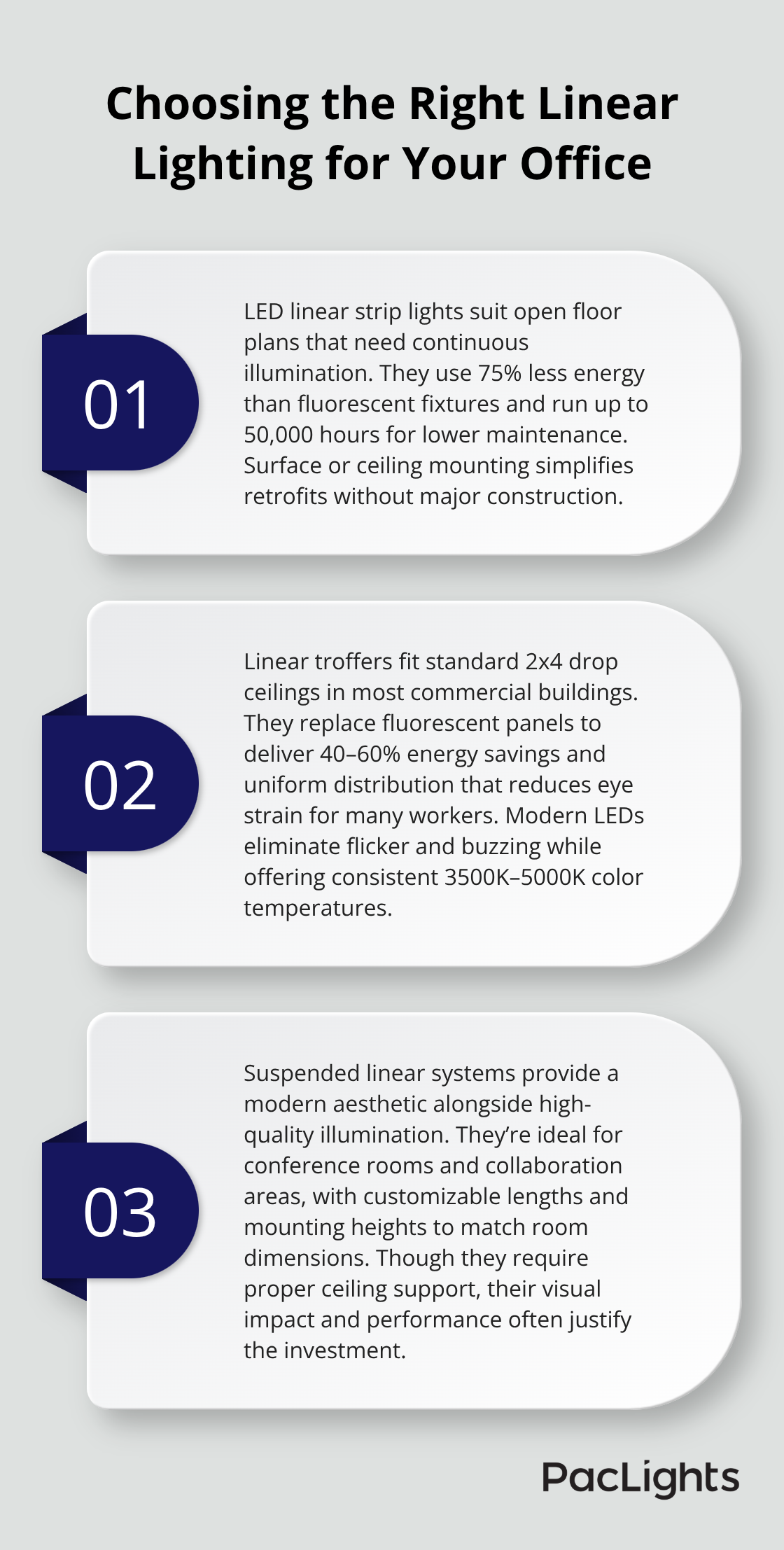
Office spaces need different linear lighting approaches based on ceiling types and installation requirements. LED linear strip lights work best for open floor plans where continuous illumination covers large areas. These fixtures consume 75% less energy than fluorescent alternatives and provide 50,000 hours of operation. Strip lights mount directly to ceilings or surfaces, which offers flexibility for retrofits without major construction work.
Linear Troffers for Standard Drop Ceilings
Linear troffer lights integrate seamlessly into standard 2×4 foot drop ceiling grids found in most commercial buildings. These fixtures replace outdated fluorescent panels and deliver 40-60% energy savings immediately. The key advantage lies in their uniform light distribution across desk surfaces, which reduces eye strain that affects 68% of office workers (according to the American Society of Interior Designers). Modern LED troffers eliminate the flickering and buzzing associated with older fluorescent systems while providing consistent color temperatures between 3500K and 5000K for optimal task performance.
Suspended Linear Systems for Modern Aesthetics
Linear pendant and suspended systems create architectural statements while delivering functional illumination. These fixtures work exceptionally well in conference rooms and collaborative spaces where both ambient and task lighting are needed. Suspended systems allow for customizable heights and lengths, with options ranging from 2 to 8 feet to match specific room dimensions. The installation requires proper ceiling support structures, but the visual impact and lighting performance justify the investment for companies that prioritize modern workplace design.
Smart Integration Options
Modern linear systems integrate with advanced controls that optimize energy use throughout the day. Daylight sensors automatically adjust brightness levels based on natural light availability, while motion controls activate fixtures only when spaces are occupied. These smart features can reduce energy consumption by an additional 25% beyond standard LED savings. The combination of efficient fixtures and intelligent controls creates responsive lighting environments that adapt to actual workplace needs rather than maintaining constant illumination levels.
Understanding these linear lighting options helps you select the right approach for your specific office requirements. The next step involves examining how these systems deliver measurable benefits that impact both operational costs and employee performance.
Why Linear Lighting Transforms Office Performance
Linear lighting systems deliver measurable business results that directly impact your bottom line. Companies that switch from fluorescent to LED linear fixtures see energy cost reductions of 40-60% within the first year, with annual savings that range from $3,000 to $5,000 for typical 10,000 square foot offices (according to the National Renewable Energy Laboratory). These systems consume up to 75% less energy while they provide 25,000 to 50,000 hours of operation, which means maintenance costs drop significantly. The financial benefits extend beyond energy savings when you factor in reduced replacement frequency and lower labor costs for fixture maintenance.
Uniform Distribution Eliminates Visual Discomfort
Linear fixtures create consistent light levels across entire work surfaces, which addresses the lighting dissatisfaction that affects 68% of office employees according to the American Society of Interior Designers. Modern linear systems with glare reduction technology decrease visual discomfort by 30% compared to standard LED panels, which directly reduces eye strain and headaches that plague computer-intensive work environments. The uniform distribution prevents the hot spots and shadows that traditional point-source lighting creates, which establishes comfortable conditions that support extended focus periods without visual fatigue.
Productivity Gains Through Optimized Lighting
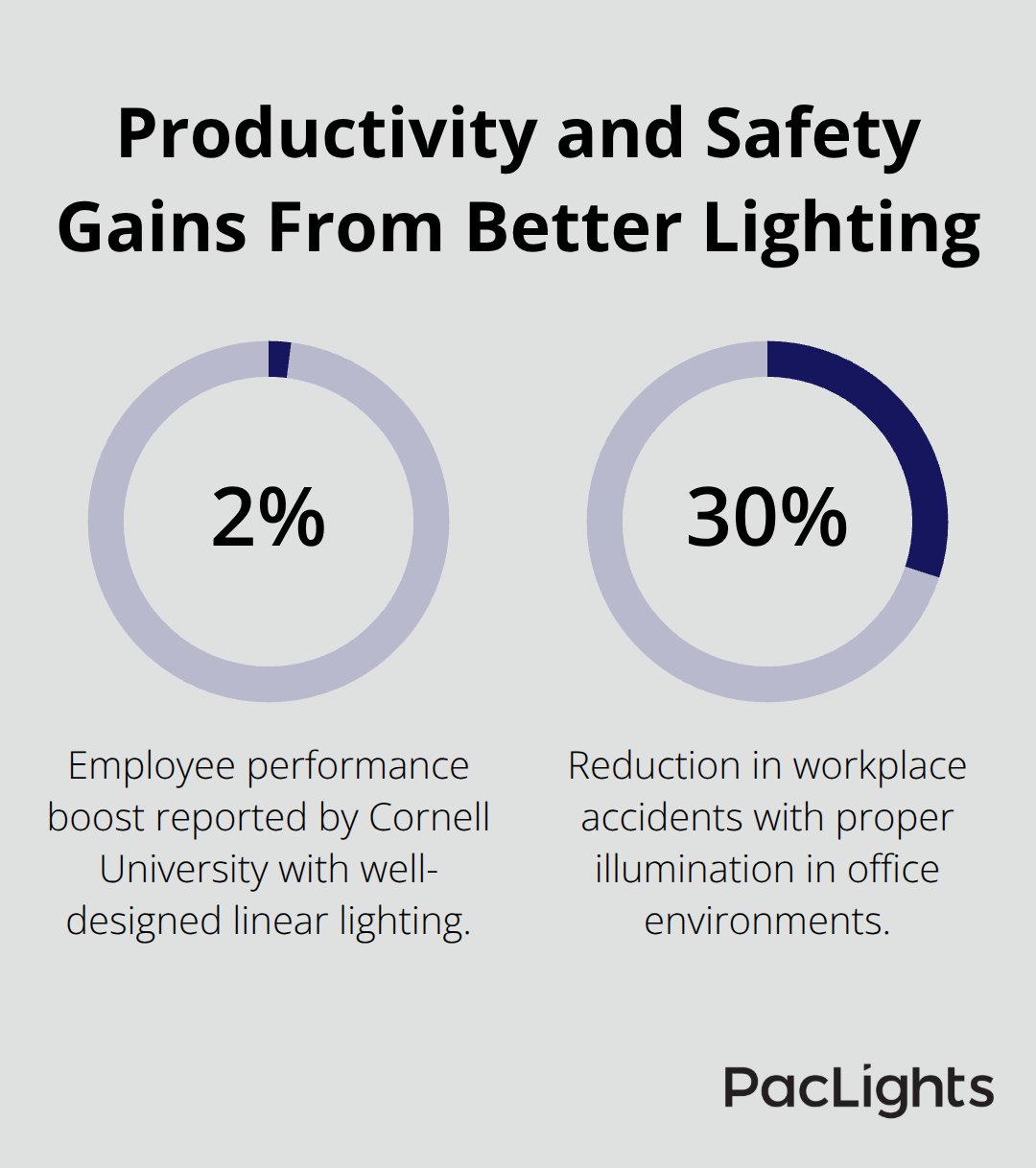
Well-designed linear lighting systems boost employee performance by 2% according to Cornell University research, while proper illumination reduces workplace accidents by up to 30%. The key lies in color temperature selection and control systems that adapt to daily work patterns.
Cool temperatures around 5000K enhance alertness during morning hours, while warmer 3500K settings support afternoon concentration. Smart controls with daylight harvesting can achieve additional 25% energy savings while they maintain optimal light levels that support cognitive function and reduce stress-related productivity losses.
Color Temperature Impact on Workplace Performance
The Journal of Environmental Psychology shows that blue-enriched light exposure in the morning can enhance alertness and performance throughout the day. Tunable linear systems that adjust color temperatures automatically help maintain circadian rhythms and improve sleep quality, which translates to better daytime productivity. High color rendering index values of 90 or above provide vibrant and true-to-life colors that prove essential for design-oriented workplaces where accurate color perception matters.
These performance benefits depend heavily on proper design choices and installation methods that maximize the potential of linear lighting systems.
How Do You Design Linear Lighting That Actually Works
Successful linear lighting design starts with color temperature selection for your specific work activities. Cool temperatures between 4000K and 5000K work best for detailed tasks and computer work, while warmer 3000K to 3500K temperatures support collaborative spaces and meeting rooms. The National Renewable Energy Laboratory found that proper color temperature selection can boost productivity by 5-10% when matched to task requirements. High color rendering index values of 90 or above prove essential for offices where color accuracy matters, such as design studios or marketing departments where visual precision impacts work quality.
Smart Controls That Reduce Energy Waste
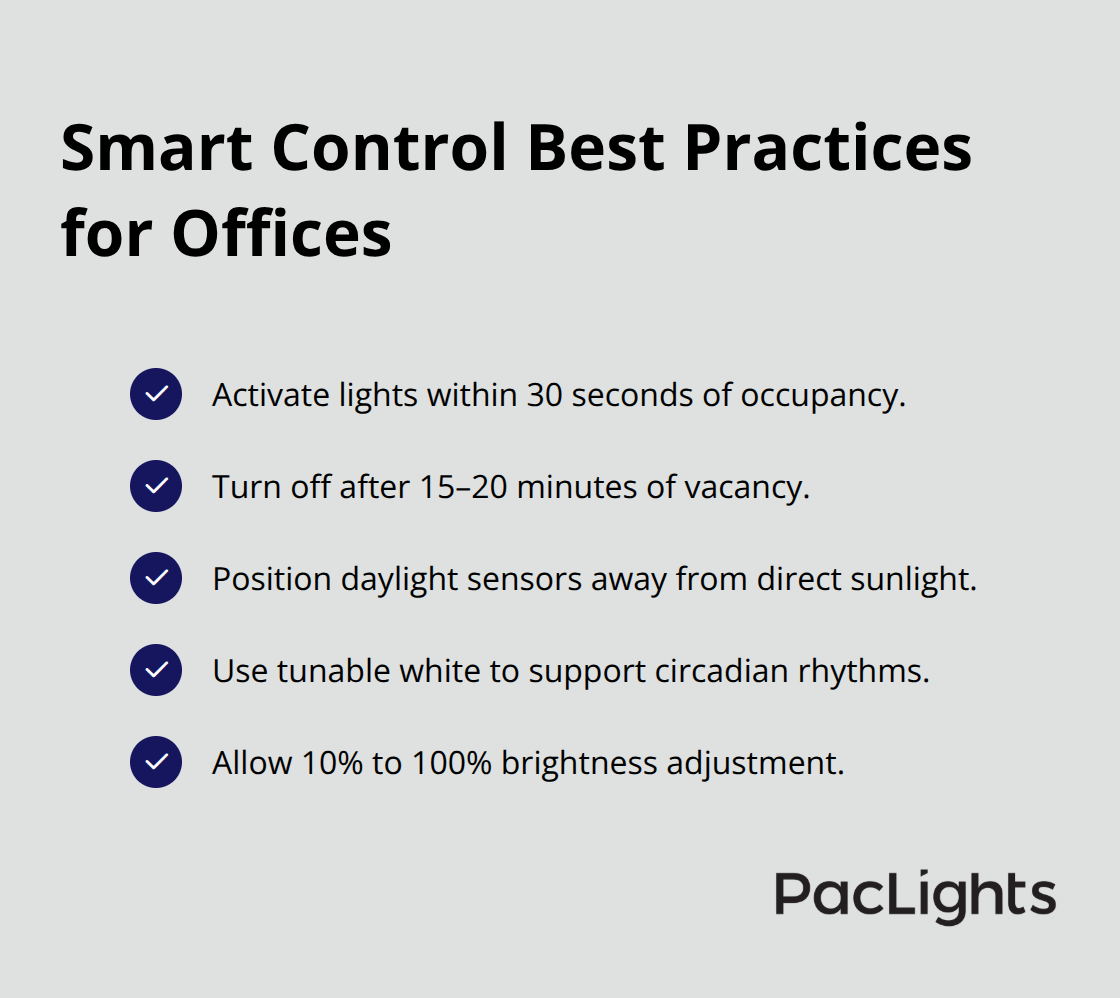
Daylight sensors and occupancy controls can cut energy consumption by 25% beyond standard LED savings (according to Department of Energy studies). Motion sensors should activate lights within 30 seconds of occupancy and turn off after 15-20 minutes of vacancy to balance energy savings with user comfort. Daylight sensors work most effectively when positioned to avoid direct sunlight while they accurately measure ambient light levels. Tunable white systems that automatically adjust color temperature throughout the day help maintain employee circadian rhythms while they reduce eye strain during extended computer work. Smart controls allow workers to adjust brightness levels between 10% and 100% capacity, which gives them control over their immediate work environment.
Fixture Placement That Prevents Problems
Linear fixture placement determines light uniformity across work surfaces. For general office illumination, fixtures should be spaced at distances equal to 1.5 times the mounting height with heights between 8 and 12 feet to achieve consistent light levels. Conference rooms require fixtures positioned directly over table surfaces at heights between 7 and 9 feet to minimize shadows during presentations. Suspended systems need adequate ceiling support structures capable of handling fixture weight plus any additional loads from integrated controls or sensors.
Electrical Planning for Maximum Flexibility
Electrical planning must account for individual fixture control requirements, with separate circuits for different zones to maximize energy savings and user flexibility. Each zone should connect to independent switches or controls that allow workers to adjust their immediate area without affecting adjacent spaces. Proper circuit design prevents overload conditions while it supports future expansion or reconfiguration needs that modern offices frequently require.
Final Thoughts
Office linear lighting delivers proven results that transform modern workspaces through measurable energy savings and productivity improvements. Companies that switch to LED linear systems achieve 40-60% energy cost reductions while employees experience better visual comfort and enhanced performance. The combination of uniform light distribution, smart controls, and proper color temperature selection creates work environments that support both business objectives and employee wellbeing.
The financial impact extends beyond immediate energy savings. Annual cost reductions of $3,000 to $5,000 for typical office spaces, combined with productivity gains of up to 2%, create compelling business cases for office linear lighting upgrades. Modern linear systems eliminate the visual discomfort that affects 68% of office workers while they reduce workplace accidents by 30% through improved illumination quality.
We at PacLights provide comprehensive linear lighting solutions with advanced controls and customizable options that meet diverse commercial needs. Our LED retrofit solutions upgrade existing systems while our lighting layout designs and ROI assessments help you make informed decisions about your workspace transformation. Contact us today to explore how linear lighting can transform your office environment.
Disclaimer: PacLights is not responsible for any actions taken based on the suggestions and information provided in this article, and readers should consult local building and electrical codes for proper guidance.