

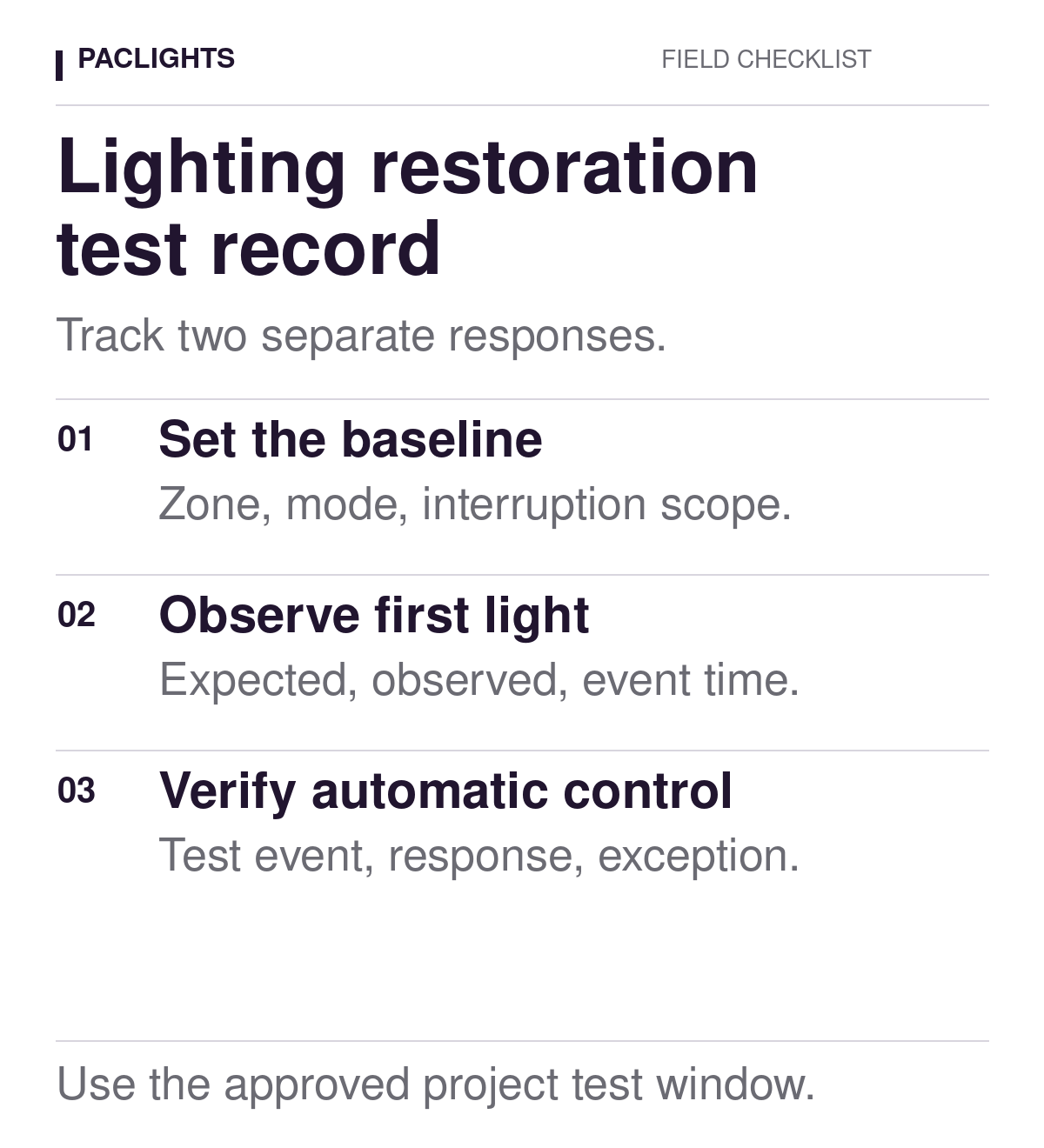
A lighting row can come back on after a power interruption while the controls serving that row are still recovering. A restoration test should record two observations separately: the initial light response when power returns, and the response to a normal control event after the zone is ready. Write the expected result for each observation from the approved sequence before the authorized test starts.
Define the zone and its expected response
Start with a zone where people can identify the fixture group and the controls that command it. Put the zone name, fixture or group identifiers, controller and sensor identifiers, and the revision of the approved sequence on the test record. Include the applicable equipment instructions and configuration revision where available. If a task area and an aisle are assigned to different groups, give each group its own row even when the fixtures are visually identical. The observer needs a reliable way to tell which fixtures they are evaluating.
Identify the installed option as well as the luminaire family. The PacLights FLHE linear high-bay product page lists optional occupancy, daylight harvesting and networked lighting controls. That product information helps identify what might be installed. The installed equipment instructions and approved project sequence are the sources for the actual behavior to verify. If neither defines the expected initial level or the conditions for automatic operation to resume, assign that question to the project reviewer before treating either response as an acceptance criterion.
Capture the pre-interruption state
Record the zone’s visible state and the conditions that explain it. Note the active operating mode, any scheduled scene or temporary override, the occupancy condition, and whether daylight is relevant to the test. Record the actual observed state of the named fixtures. If the approved procedure uses reported equipment status, capture that separately. A command shown in an interface and a light level observed on the floor are different pieces of evidence, and both can matter when the team reviews an unexpected result.
The approved test may require more than one starting condition. A zone observed in ordinary automatic operation answers a different question from the same zone observed with an active override. Use separate rows for those cases if both are required. For the override case, record which control initiated it, what the approved sequence says about its priority, and what should end it. The manual lighting override test guide provides a way to document those interactions before adding an interruption to the scenario.
Record what the authorized test interrupts
Use the approved interruption scope and have the designated personnel carry out the test. The observation record should identify which equipment the approved procedure covers and which related equipment is expected to remain available. For example, a procedure that covers a luminaire group while its supervisory equipment remains available represents a different condition from one that also covers the supervisory equipment. Label those cases clearly so a result from one scope is never treated as evidence for the other.
Agree in advance on the event that will serve as the time reference and who will record it. If two observers are needed, give them the same event labels and a common clock. The person observing the lights may be in a different location from the person confirming the status of the controller. Record where each observation came from and flag any time that was estimated. Use the approved procedure for the observation window and stopping conditions. If the approved scope or stopping conditions are unclear, resolve them with the responsible project personnel before beginning.
Watch the first light response and the return to control
At the restoration event, note what the named fixtures first do and when that response becomes visible. Include which fixtures responded and any differences within the group. If a later level change occurs, record that as a separate event. A first visible response is evidence about light output at that point in the test. It leaves open whether the zone responds to sensors, wall controls or schedules as specified. Give the initial response its own expected result, observed result and disposition.
At the applicable control checkpoint, use a normal event specified in the approved sequence. Record the event, the conditions under which it occurred, the observed output and the time associated with the response. Keep the evidence tied to the group under test. If a wall control commands an adjacent group as well, note that observed scope alongside the approved scope. If the window ends before an expected response can be verified, document the observation and the limit of the test, then assign a follow-up under the project process.
Choose automatic events that answer a specific question
For an occupancy-controlled zone, the approved test may call for observing an occupied or vacant transition. Identify which transition is in scope and how occupancy or vacancy was established. For a daylight-controlled group, note the relevant daylight condition and how the approved test calls for observing a response. In a space with variable daylight or regular traffic, record those conditions so a later reviewer can distinguish an environmental change from a control event. Mark an untested function as outside the run or pending, with the reason.
For a scheduled response, document the applicable schedule and the scheduled event the team expects to observe. An event that occurs during the test can have a different interpretation from a scene that was already active before the interruption. If the approved sequence calls for an override to persist, clear or release at a defined condition, record that condition and observe the resulting behavior. Avoid carrying an expectation from a different control arrangement into this test. Use the approved revision and installed settings for the exact group.
Assign a person to each observation before the run. For instance, the floor observer can record fixture marks and visible changes while a second observer records the controller event permitted by the procedure. Keep the records separate until the team lines up the event times. That makes missing evidence easier to spot before anyone signs off on the test.
Close out exceptions with enough detail to repeat the test
Consider an illustrative warehouse aisle where every fixture illuminates at restoration. The team’s separate occupancy event then produces the expected change in one portion of the aisle, while a second portion remains at its initial level. The record needs both observations, with the affected fixture IDs and the approved group definition. Reviewing group assignment, configured inputs and any active priority against the project documents is a more useful next step than attributing the difference to a particular component before it has been checked.
For each exception, preserve the original expected result, observed result, equipment configuration, event times, and observer notes. Distinguish a documented mismatch from an unresolved design requirement or an observation that could not be completed. Record who will resolve the issue and which conditions must be reproduced for a retest. If settings change in the meantime, write down the changed revision and preserve the original result so the comparison remains intelligible.
Keep the signed test record with the current zone and settings handover record. Before the next authorized test, put the zone, starting state, approved interruption scope, first-light expectation and automatic-control expectation on one review sheet. That gives the observer a practical basis for recording what came back and which functions still need verification.
Disclaimer: PacLights is not responsible for any actions taken based on the suggestions and information provided in this article, and readers should consult local building and electrical codes for proper guidance.