

Datacenter smart lighting systems have become a competitive advantage, not a luxury. At PacLights, we’ve seen firsthand how moving beyond basic dimming unlocks real operational gains-lower energy bills, faster maintenance, and reduced downtime.
The shift from static lighting to dynamic controls represents a fundamental change in how modern datacenters operate. This post walks through the evolution and shows you exactly what’s possible.
Why Datacenters Need Smart Lighting Systems
Datacenters spend 20 to 30 percent of total facility power on lighting alone. That’s not a minor line item-it’s a massive drain on operating budgets. For a mid-sized datacenter running 24/7, lighting can consume hundreds of thousands of dollars annually. Traditional lighting systems treat every fixture as an on-off switch, flooding aisles with full brightness whether a technician is present or not. This approach made sense decades ago, but it’s wasteful today. The problem compounds because datacenter lighting also generates heat, which forces cooling systems to work harder and longer. When you light an empty aisle at full intensity, you’re paying twice-once for the electricity and again in additional cooling costs.
The Real Cost of Static Lighting
Static lighting fails to adapt to actual usage patterns. Server aisles see traffic during maintenance windows and shift changes, but remain fully illuminated during quiet periods when only automated systems run. Equipment rooms experience similar cycles-intense activity for brief stretches, then hours of inactivity. A 2025 global market analysis valued the datacenter lighting market at approximately USD 478 million, with adoption accelerating at a 5.5 percent compound annual growth rate through 2033. This growth stems almost entirely from operators recognizing that energy costs and sustainability mandates make traditional lighting economically indefensible.
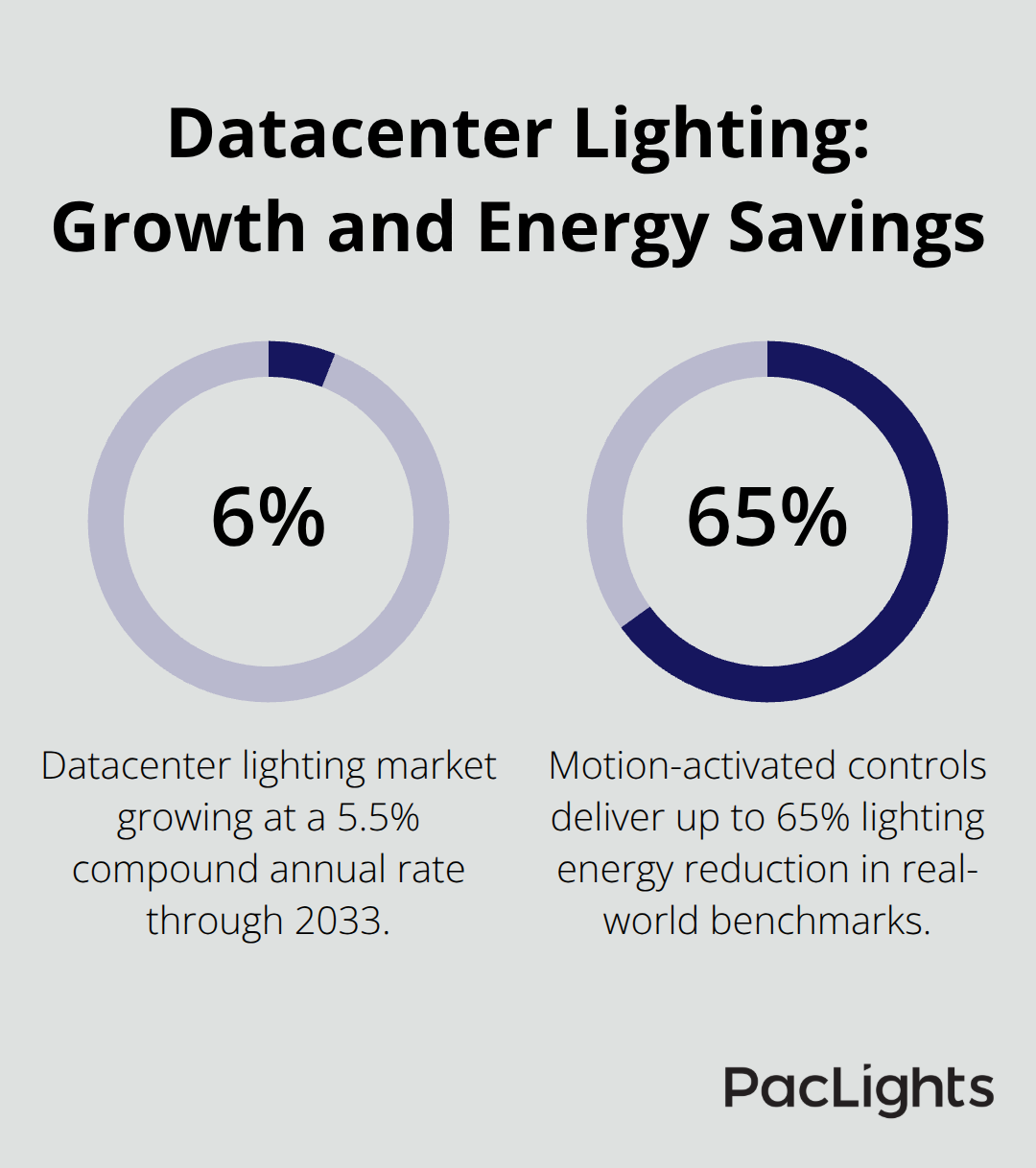
Network-connected lighting cuts lighting energy consumption by 30 to 65 percent through occupancy sensing, daylight harvesting, and scheduled dimming. Real-world benchmarks show reductions of up to 65 percent in similar environments with motion-activated controls. For datacenters, this translates to tens of thousands in annual savings without sacrificing visibility or safety.
Where Smart Controls Actually Save Money
Smart lighting systems reduce lighting load, which directly lowers cooling costs since fewer active fixtures generate less heat and reduce HVAC workload. Reducing lighting energy also enables demand response integration, delivering approximately 15 percent additional load reduction during grid peak events. Return on investment typically ranges from 3 to 5 years.
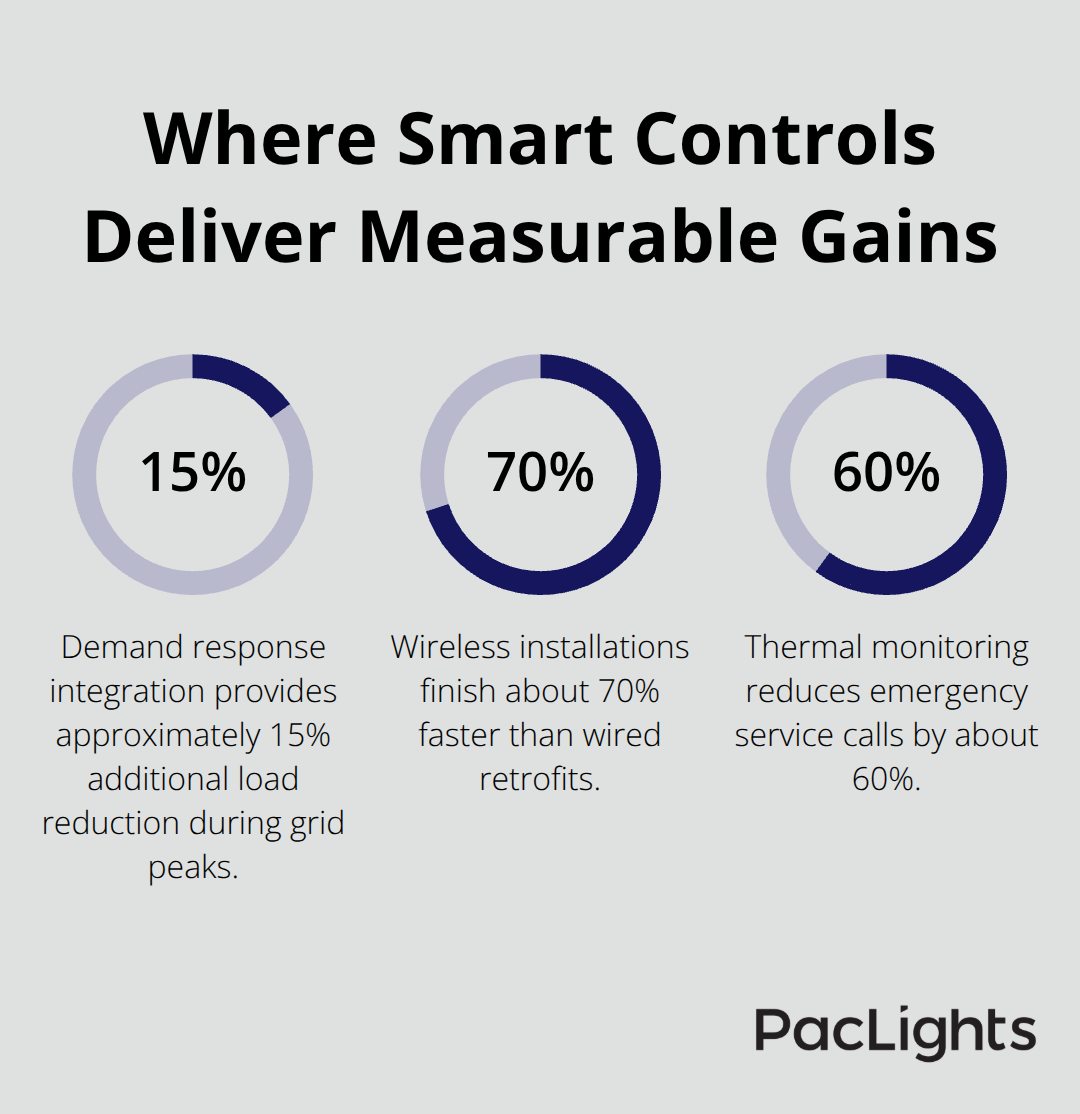
Wireless installations finish about 70 percent faster than wired retrofits, eliminating trenching and new electrical runs that drive up upfront costs. Thermal monitoring integrated with lighting detects fixture degradation early, reducing emergency service calls by about 60 percent. Energy efficiency standards like LEED and ASHRAE 90.1 increasingly push adoption of dynamic lighting in datacenters. Operators who delay smart lighting upgrades fall behind competitors who already capture these savings. The math is clear: smart controls pay for themselves while improving operational reliability and reducing carbon footprint simultaneously.
The Path Forward
Static systems cannot respond to changing datacenter demands. Motion sensors, occupancy controls, and networked systems represent the next evolution-one that transforms lighting from a fixed cost into a dynamic asset that adapts in real time.
From Basic Dimming to Advanced Dynamic Controls
How Dimming Systems Work and Their Limitations
Basic dimming systems represent the first step beyond on-off switching, but they expose a critical limitation: they require manual intervention. Phase-cut dimming and electronic low voltage dimming are the core methods used in datacenters, yet neither adapts automatically to actual usage patterns. A technician must manually adjust brightness, or a timer reduces lighting at preset hours regardless of whether anyone occupies the space. This approach saves energy compared to full-brightness static systems, but it squanders the real opportunity-datacenters operate on unpredictable schedules, and fixed timers cannot account for maintenance windows that shift or equipment failures that demand immediate attention.
Motion Sensors and Occupancy-Based Lighting
Occupancy sensors transform the equation entirely. When a technician enters a server aisle, motion detectors brighten fixtures to safe working levels in under one second, then dim or shut off when spaces empty. Daylight harvesting adds another dimension by automatically reducing electric lighting based on ambient daylight, with real-time adjustments for seasons and time of day. Combined, these technologies cut lighting energy by 30 to 65 percent according to real-world datacenter benchmarks. The critical difference lies in responsiveness: dynamic systems react to actual conditions rather than guessing at schedules or waiting for manual commands. Occupancy sensors eliminate the waste that plagues manual dimming-they light aisles only when technicians need them.
Networked Lighting Controls and Real-Time Optimization
Networked lighting controls represent the final evolution, transforming isolated fixtures into a coordinated system that reports status continuously to a central controller. Each luminaire communicates in real time, enabling granular energy analytics by zone, time of day, and fixture type. Wireless systems prove especially practical for retrofits since they eliminate trenching and new electrical runs, finishing installations about 70 percent faster than wired alternatives. Open standards like BACnet enable seamless integration with existing building management systems, though interoperability challenges affect roughly 62 percent of retrofit projects, making vendor selection critical.
Demand Response and Predictive Maintenance
Demand response integration adds another layer, delivering approximately 15 percent additional load reduction during grid peak events. Thermal monitoring integrated with networked systems detects fixture degradation early, reducing emergency service calls by about 60 percent. The payback period typically ranges from 3 to 5 years, with wireless deployments starting in high-traffic zones like server aisles and equipment rooms to validate ROI before facility-wide rollout. Advanced sensor technologies and AI-enabled controls now learn usage patterns, automatically adjusting lighting to match datacenter workflows while meeting energy code requirements under ASHRAE 90.1 and LEED standards.
Moving Toward Intelligent Facility Management
These networked systems form the foundation for what comes next: integration with broader facility operations. Real-time dashboards display consumption by zone, time of day, and fixture type, helping operators prioritize upgrades with the fastest returns. Reducing lighting load also lowers cooling costs, as fewer active fixtures generate less heat and reduce HVAC workload. The transition from manual dimming to dynamic, networked control positions datacenters to capture measurable gains in both energy efficiency and operational visibility-gains that compound when lighting systems connect with maintenance scheduling and performance monitoring across the entire facility.
How Smart Lighting Transforms Maintenance and Operations
Instant Illumination Accelerates Technician Response
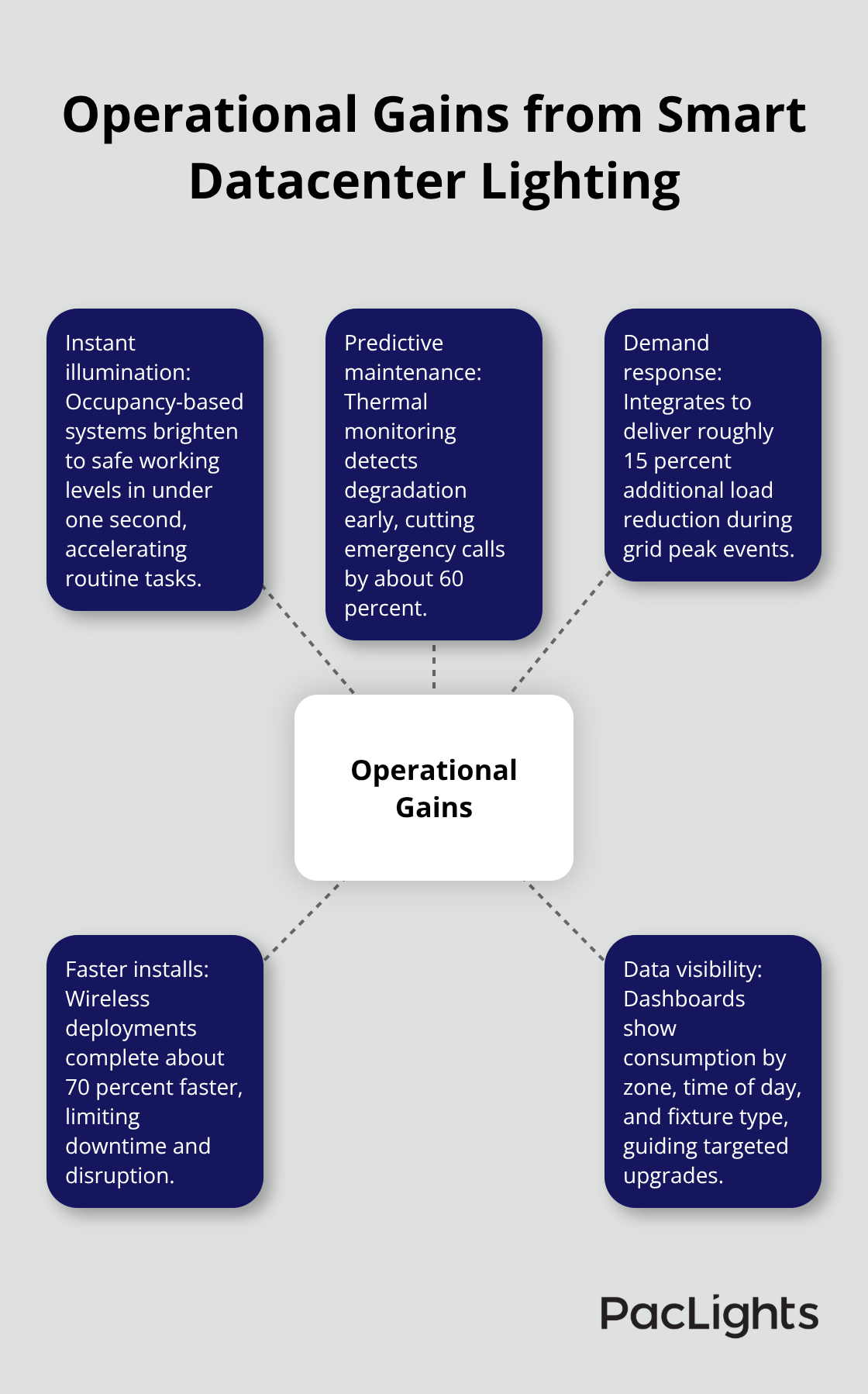
Technicians working in datacenters spend hours navigating equipment aisles, identifying cable routes, and performing hands-on maintenance. Poor lighting forces them to work slowly and carefully, increasing the time spent on routine tasks. Occupancy-based systems activate motion sensors as technicians enter an aisle, and fixtures brighten to safe working levels in under one second. The result is immediate, task-appropriate illumination without manual adjustment.
Maintenance windows that previously required coordinated lighting schedules now adapt automatically to actual technician movement.
Reduced glare on server displays and rack panels improves eye comfort during extended monitoring sessions and allows technicians to spot issues faster. Equipment rooms benefit even more dramatically because activity is concentrated and predictable. When a technician enters to investigate an alert or perform diagnostics, lights activate instantly. When they leave, fixtures dim or shut off within seconds. This responsiveness eliminates the frustration of manual controls and the safety risks of inadequate illumination.
Real-Time Dashboards Optimize Facility Operations
Real-time dashboards help facilities teams understand which zones experience the most traffic, enabling them to optimize sensor placement and dimming schedules based on actual usage patterns rather than assumptions. Operators can view consumption by zone, time of day, and fixture type, helping them prioritize upgrades with the fastest returns. This data-driven approach transforms lighting from a static infrastructure element into an operational tool that informs facility planning and resource allocation.
Predictive Maintenance Prevents Costly Downtime
Downtime in datacenters translates directly to lost revenue, making every minute of equipment unavailability expensive. Smart lighting systems reduce downtime through two mechanisms: faster technician response and predictive maintenance alerts. Thermal monitoring integrated with networked lighting detects fixture degradation early, reducing emergency service calls by approximately 60 percent. When a light fails or a sensor malfunctions, the system alerts facilities teams before the issue cascades into visibility problems that slow troubleshooting.
Demand response integration delivers roughly 15 percent additional load reduction during grid peak events, which stabilizes facility power and reduces the risk of cascading failures that darken entire aisles. The financial case is straightforward: wireless installations finish about 70 percent faster than wired retrofits, meaning datacenters deploy smart lighting without extended downtime or disruption to operations.
Rapid ROI Through Energy and Maintenance Savings
Return on investment typically ranges from 3 to 5 years, with energy savings alone accounting for tens of thousands annually in mid-sized facilities. Thermal monitoring alone justifies deployment by preventing emergency outages that would cost far more than the entire lighting system. Reducing lighting load also lowers cooling costs, as fewer active fixtures generate less heat and reduce HVAC workload. These combined benefits (energy reduction, maintenance prevention, and cooling efficiency) create a compelling financial case that accelerates adoption across modern datacenters.
Final Thoughts
Datacenter smart lighting systems deliver measurable returns within 3 to 5 years while reducing energy costs, accelerating maintenance response, and improving technician safety simultaneously. Occupancy sensors activate in under one second, thermal monitoring prevents costly failures before they occur, and real-time dashboards reveal exactly where energy waste happens. Wireless deployments finish 70 percent faster than wired alternatives, meaning operators implement smart lighting without extended downtime or operational disruption.
The financial case proves compelling across every metric. Reducing lighting load lowers cooling expenses since fewer active fixtures generate less heat and reduce HVAC workload, while demand response integration delivers an additional 15 percent load reduction during peak grid events. Technicians work faster when lights activate instantly, maintenance teams respond quicker when predictive alerts flag degradation before failures occur, and facilities managers make better decisions when dashboards show consumption by zone and time of day.
We at PacLights provide LED retrofit solutions and networked lighting controls designed specifically for industrial and commercial facilities, with optional motion sensors and daylight harvesting to maximize efficiency. Start with high-traffic zones like server aisles and equipment rooms, validate ROI, then expand across your facility-contact PacLights today to explore how datacenter smart lighting transforms your operations.
Disclaimer: PacLights is not responsible for any actions taken based on the suggestions and information provided in this article, and readers should consult local building and electrical codes for proper guidance.