

At PacLights, we understand the importance of proper lighting in commercial and industrial spaces. Calculating LED low bay lighting requirements is crucial for achieving optimal illumination and energy efficiency.
Our LED low bay lighting calculator simplifies this process, helping you determine the right number and type of fixtures for your specific needs. In this guide, we’ll walk you through the steps to accurately calculate your LED low bay lighting requirements.
What is LED Low Bay Lighting?
Defining Low Bay Lighting
LED low bay lighting transforms spaces with ceilings under 20 feet. These fixtures provide uniform, bright illumination across large areas without causing glare or hotspots. Low bay lights are optimized for mounting heights between 12 to 20 feet, ensuring efficient light distribution where traditional lighting might fall short.
The LED Advantage
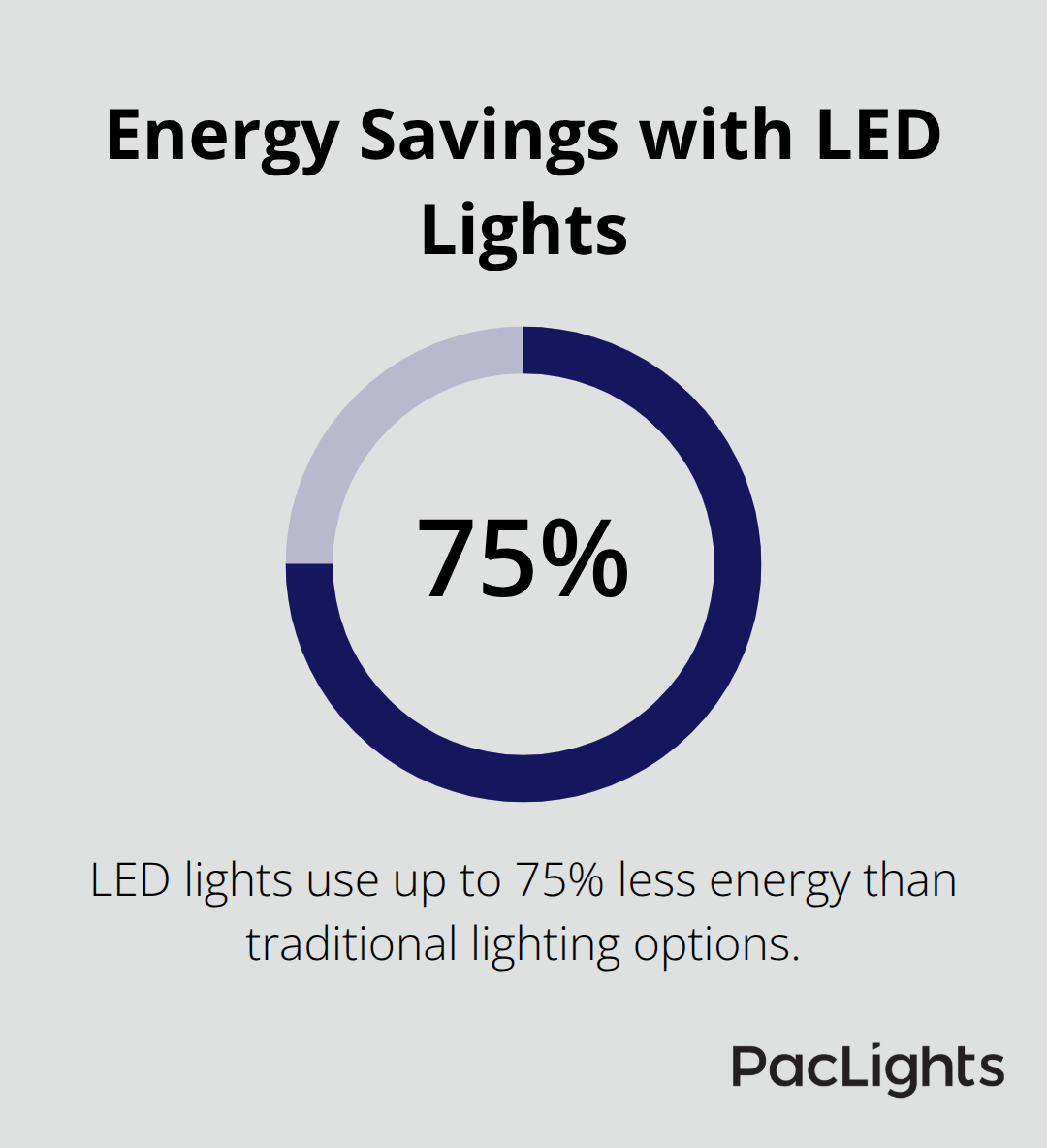
LED technology has revolutionized low bay lighting. These fixtures offer superior energy efficiency, often using up to 75% less energy than traditional options. The U.S. Department of Energy reports LEDs have a lifespan of 25,000 to 50,000 hours, which significantly reduces maintenance costs and downtime. The directional nature of LED light also means less wasted illumination, allowing for more precise lighting control.
Applications of Low Bay Lighting
Low bay LED lights excel in various settings:
- Retail Spaces: These lights enhance product visibility and create an inviting atmosphere.
- Warehouses and Manufacturing Facilities: They improve worker safety and productivity by eliminating shadows and providing consistent illumination.
- Schools and Offices: Quality LED lighting reduces eye strain and improves focus.
Auto repair shops have reported a 30% improvement in technicians’ ability to spot fine details during inspections after installing low bay LED fixtures. A local grocery store switched to LED low bays and saw a 40% reduction in energy costs while boosting sales in previously dimly lit areas.
Choosing the Right Color Temperature
Color temperature plays a vital role in low bay lighting selection:
- Workspaces: Cooler temperatures (4000K-5000K) promote alertness
- Retail or Hospitality: Warmer tones (2700K-3000K) create a more relaxed ambiance
The Color Rendering Index (CRI) is equally important; try to select fixtures with a CRI of 80 or higher to ensure colors appear true and vibrant under the lighting.
As we move forward, it’s important to consider the factors that affect LED low bay lighting requirements. Understanding these elements will help you make informed decisions when calculating your specific lighting needs.
Factors Influencing LED Low Bay Lighting Requirements
Ceiling Height and Space Configuration
The height of your ceiling directly affects the quantity and type of fixtures you need. Low bay lighting works best for ceilings between 12 to 20 feet. The exact placement depends on your space’s configuration. A 40×60 shop might require between 48,000 to 75,000 lumens (depending on the activities performed there).
Room obstructions like shelving or machinery can create shadows. Adjust your lighting plan to account for these elements. A strategic placement of fixtures around large equipment can reduce dark spots by up to 40% in manufacturing facilities.
Task-Specific Illumination Needs
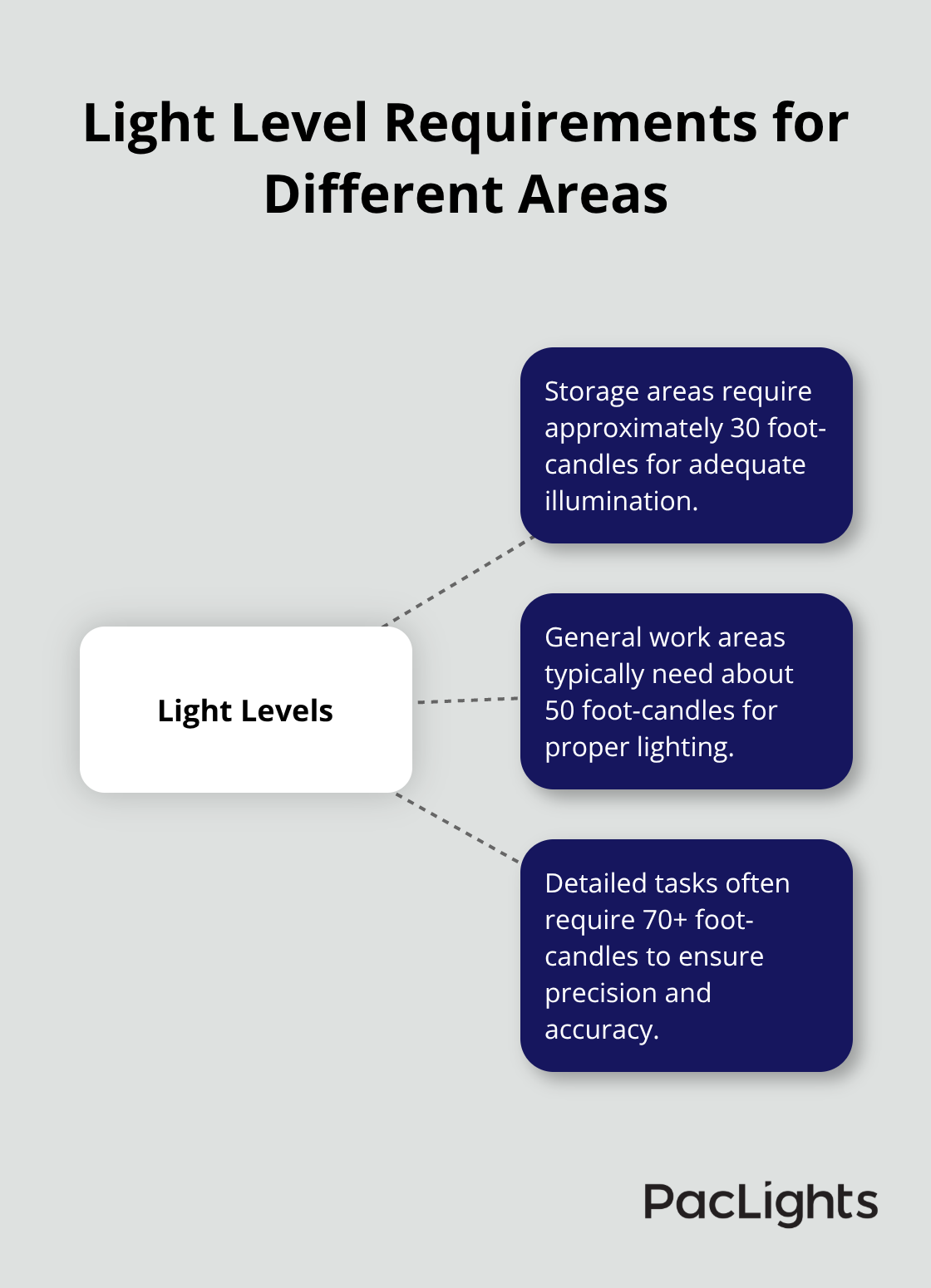
Different activities require varying levels of light. Try to achieve about 30 foot-candles for general storage areas. Active work areas often need 50 foot-candles, while detailed tasks may require 70+ foot-candles.
An increase in lighting levels from 30 to 70 foot-candles in inspection areas can result in a 25% improvement in defect detection (as observed in an auto repair shop). This demonstrates how task-specific lighting directly impacts productivity and quality.
Color Quality Considerations
Color temperature and Color Rendering Index (CRI) create the right atmosphere and ensure accurate color perception. Industrial spaces often prefer a color temperature between 4000K to 5000K, which mimics daylight and promotes alertness.
The CRI holds equal importance. While a CRI of 70 serves as the minimum for professional environments, fixtures with a CRI of 80 or higher ensure colors appear true and vibrant. This becomes particularly important in quality control areas or spaces where color accuracy is critical.
Energy Efficiency and Cost Considerations
LED low bay lights offer significant energy savings (up to 75% less energy consumption compared to traditional options). This translates to lower operational costs and a reduced carbon footprint. The long lifespan of LED fixtures (25,000 to 50,000 hours) further reduces maintenance expenses and downtime.
Lighting Controls and Flexibility
Modern LED low bay lighting systems often include advanced control options. These may include dimming capabilities, occupancy sensors, and daylight harvesting systems. Such features allow for dynamic adjustment of light levels based on actual needs, further optimizing energy use and enhancing user comfort.
Now that we’ve explored the key factors that influence LED low bay lighting requirements, let’s move on to the step-by-step process of calculating your specific lighting needs.
How to Calculate Your LED Low Bay Lighting Needs
Assess Your Space and Light Level Requirements
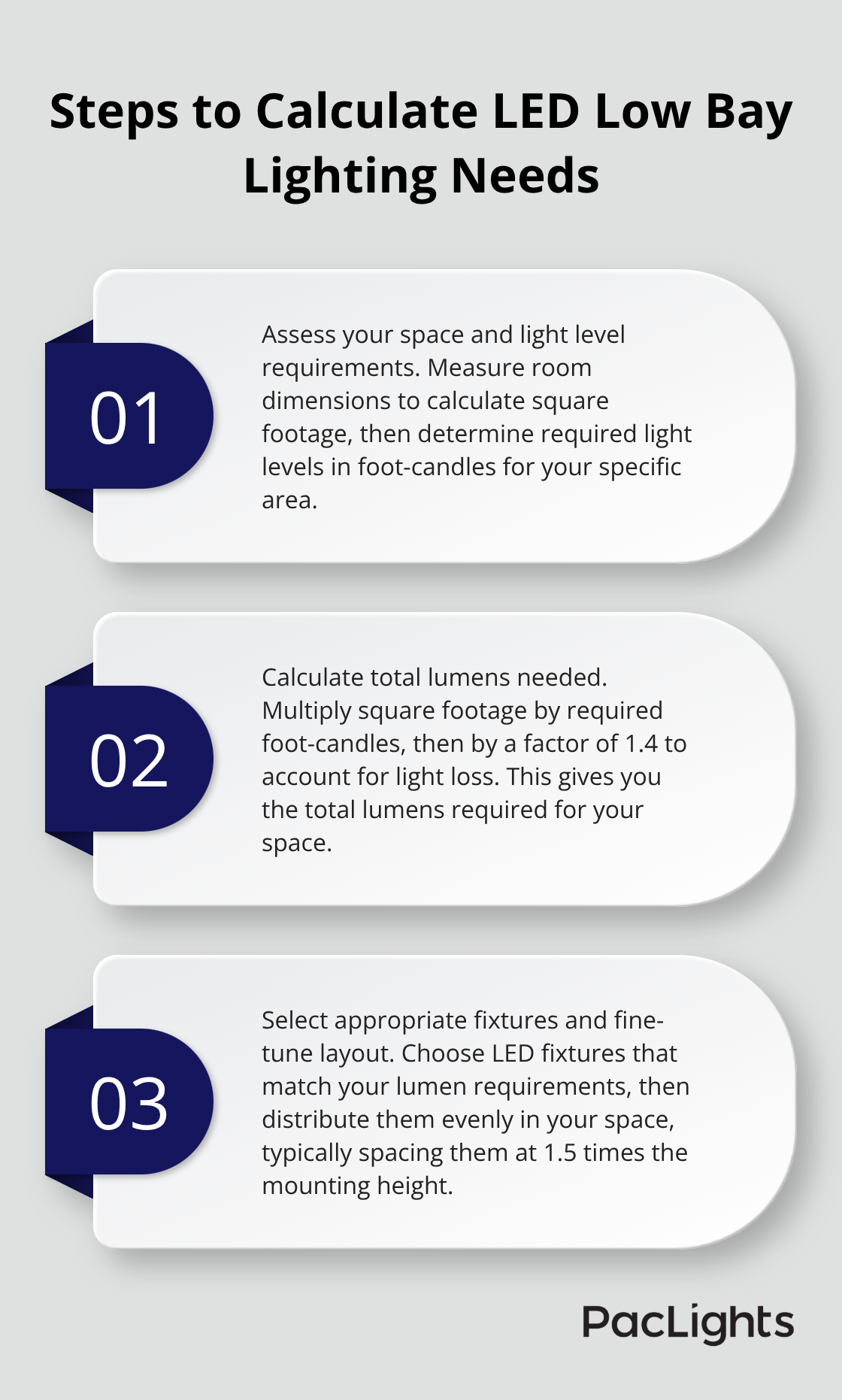
Start by measuring your room’s dimensions. Multiply the length by the width to get the total square footage. For example, a 40×60 shop has 2,400 square feet.
Next, determine the required light level for your space. This is typically measured in foot-candles (fc) or lumens per square foot. Here are some general guidelines:
- Storage areas: 30 fc
- General work areas: 50 fc
- Detailed tasks: 70+ fc
For our 40×60 shop example, let’s assume it’s a general work area requiring 50 fc.
Calculate Total Lumens Needed
To convert foot-candles to lumens, multiply the square footage by the required fc, then by a factor of 1.4 to account for light loss. For our example:
2,400 sq ft x 50 fc x 1.4 = 168,000 lumens
This is the total amount of light your space needs.
Select Appropriate Fixtures
Now, choose LED low bay fixtures that match your lumen requirements. Let’s say we find fixtures that produce 14,000 lumens each. To determine how many we need, divide the total lumens by the output per fixture:
168,000 / 14,000 = 12 fixtures
Fine-tune Your Layout
Consider the layout of your space. Distribute the fixtures evenly to avoid dark spots. A common guideline is to space fixtures at a distance equal to 1.5 times the mounting height for general lighting applications. For a 15-foot ceiling, try to achieve 15-22.5 feet between fixtures.
Account for Real-World Factors
Theoretical calculations don’t always translate perfectly to real-world scenarios. Factors like reflective surfaces, obstructions, and specific task areas can impact lighting effectiveness. It’s often wise to slightly overestimate your needs to ensure adequate illumination.
For instance, if your space has dark walls or lots of machinery, you might want to add an extra fixture or two to compensate for light absorption.
These steps provide a solid foundation for your LED low bay lighting plan. However, for complex spaces or when absolute precision is required, a lighting professional can provide valuable insights and optimize your lighting design.
Final Thoughts
Calculating LED low bay lighting requirements forms the foundation of an efficient lighting system for commercial and industrial spaces. Our LED low bay lighting calculator at PacLights helps determine the right number and type of fixtures for specific needs. Professional lighting design optimizes setups, accounting for unique space characteristics and potential obstructions.
LED low bay lighting installation offers significant benefits, including energy savings and reduced maintenance needs. Well-designed LED lighting improves visibility, enhances safety, and can boost productivity in work environments. Advanced features like dimming capabilities and occupancy sensors further enhance energy efficiency and user comfort.
PacLights offers a range of LED low bay lighting solutions tailored to diverse industrial needs (including optional daylight or motion control). We provide free lighting layout designs and ROI assessments to help make informed decisions about lighting upgrades. Our team stands ready to assist in creating a lighting system that meets immediate needs and provides long-term benefits.
Disclaimer: PacLights is not responsible for any actions taken based on the suggestions and information provided in this article, and readers should consult local building and electrical codes for proper guidance.