

When a power outage hits your facility, seconds matter. Emergency wall mounted lights are your first line of defense, keeping workers safe and operations moving during critical moments.
At PacLights, we’ve seen firsthand how the right emergency lighting solution cuts maintenance costs while meeting strict safety standards. This guide walks you through everything you need to know to protect your workspace.
Why Emergency Wall Mounted Lights Matter
Industrial facilities lose an average of $5,600 per minute during unplanned downtime, according to research from the Aberdeen Group. When power fails, emergency wall mounted lights become your operational lifeline, not just a compliance checkbox. Facilities managers need lighting solutions that work hard and cost less, which is exactly what modern emergency wall mounted fixtures deliver compared to outdated alternatives.
The Safety and Compliance Reality
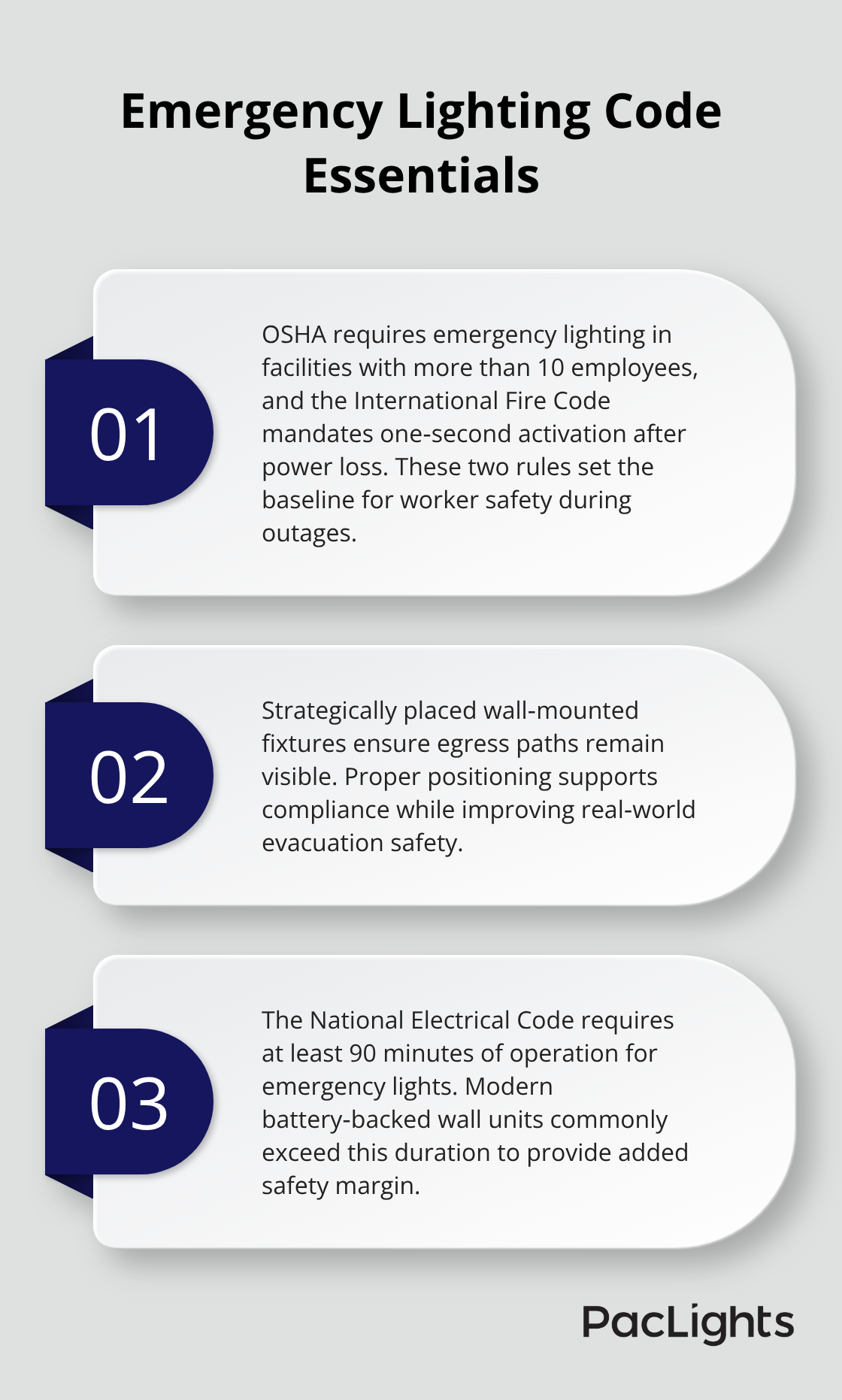
OSHA requires emergency lighting in facilities with more than 10 employees, and the International Fire Code mandates that emergency lights activate within one second of power loss. Wall mounted fixtures positioned strategically throughout your facility meet these requirements while providing practical visibility for evacuation routes. The National Electrical Code specifies that emergency lights must remain operational for a minimum of 90 minutes, and most modern battery-backed wall mounted units exceed this standard significantly.
Facilities that implement proper emergency lighting report fewer accident claims during outages. Warehouses and manufacturing plants with comprehensive emergency lighting systems experience fewer worker injuries during power events, which directly reduces insurance premiums and liability exposure.
Where LED Technology Saves Real Money
Traditional incandescent emergency lights consume 60-75 watts per fixture, while LED emergency wall mounted lights use just 8-12 watts. For a warehouse with 30 emergency fixtures running continuously, this difference translates to roughly $2,400 annually in electricity savings. LED units also last 25,000-50,000 hours compared to 2,000-3,000 hours for incandescent bulbs, meaning you replace fixtures far less frequently.
Maintenance labor costs drop substantially when technicians visit less often. Battery replacement cycles extend from every 4-5 years with older systems to 8-10 years with modern LED technology (a significant reduction in service interruptions). These operational savings compound quickly, making the higher upfront investment in quality LED emergency lighting recoup itself within 18-24 months for most industrial facilities.
Selecting the Right Solution for Your Facility
The next step involves evaluating your specific facility requirements, from brightness levels to battery runtime and environmental durability.
Where to Install Emergency Wall Mounted Lights for Maximum Protection
Placement strategy determines whether your emergency lighting actually protects workers or simply satisfies an inspector. In warehouses, emergency wall mounted lights perform best when positioned every 40-50 feet along main aisles and exit routes, according to guidelines from the National Fire Protection Association. Manufacturing plants with machinery require fixtures mounted 6-8 feet high on walls to avoid obstruction by equipment, while ground-level mounting works for open storage areas.
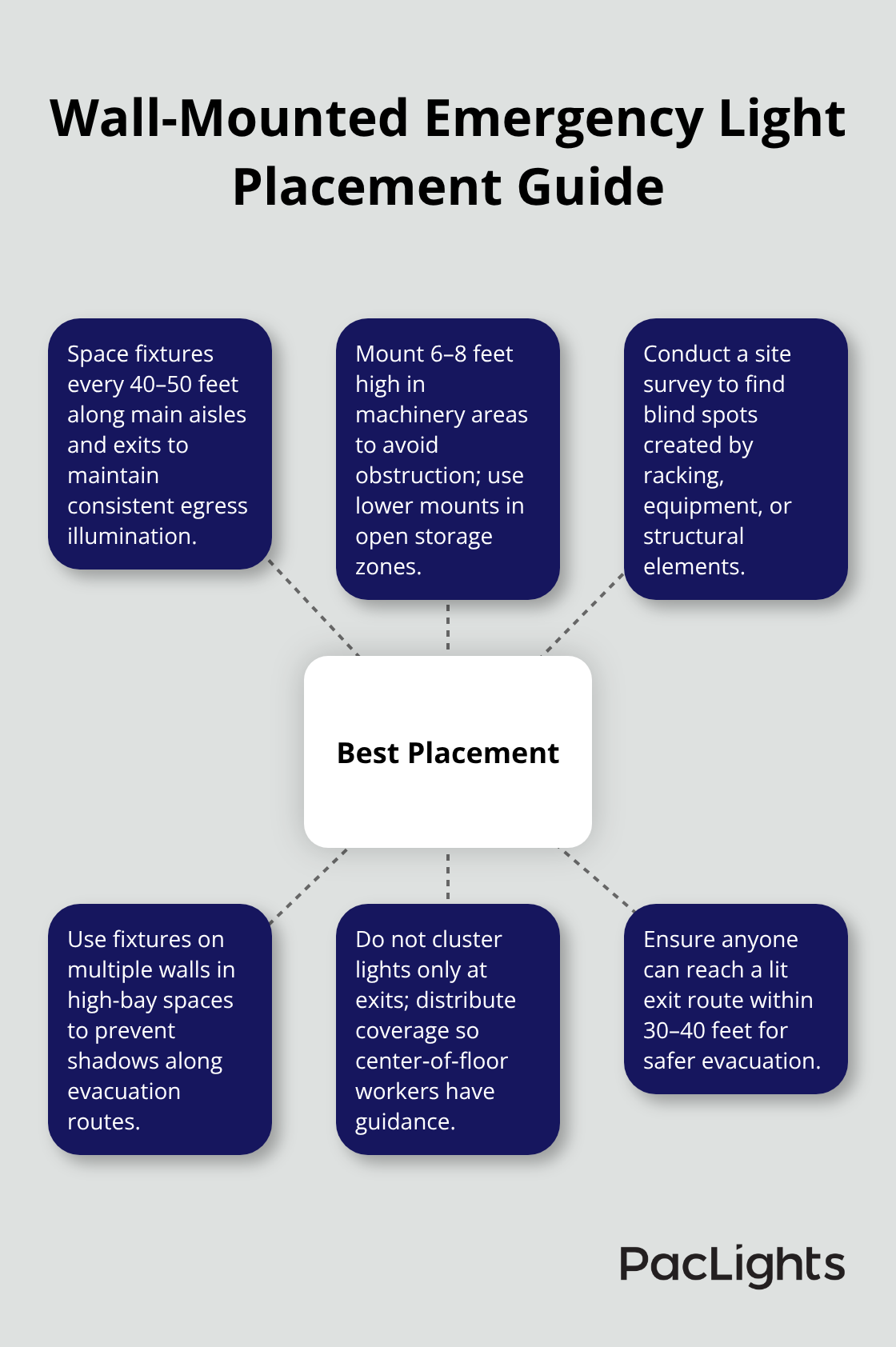
A site survey before installation identifies blind spots where machinery, racking, or structural elements block light paths. High-bay facilities need fixtures on multiple walls to prevent any evacuation route from falling into shadow. The worst placement mistake facilities make is installing all emergency lights near exits only-workers in the center of your warehouse will face complete darkness if you do this. Instead, distribute fixtures throughout your facility so that someone standing anywhere can reach a lit exit route within 30-40 feet.
Smart Integration with Daylight and Motion Controls
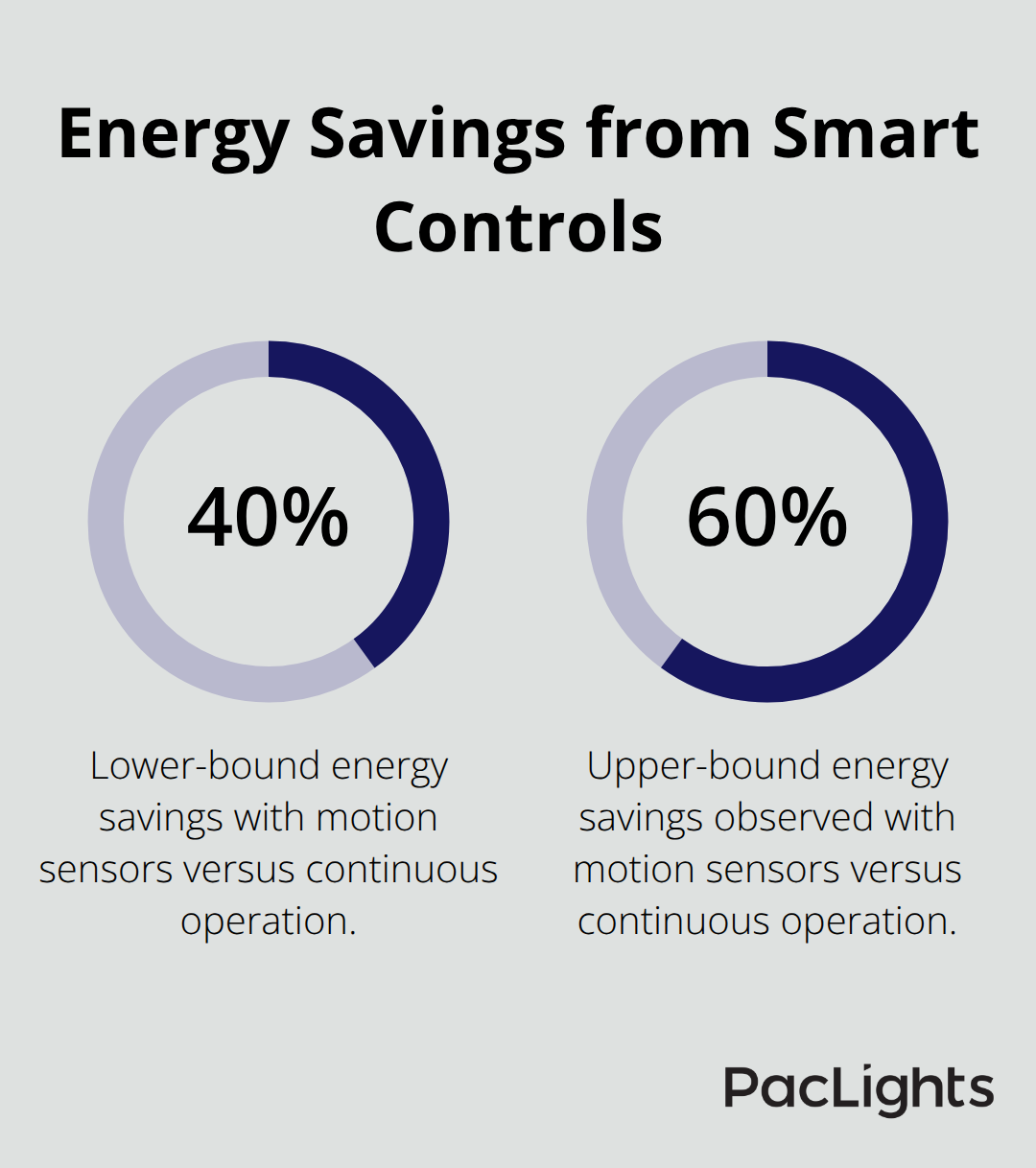
Emergency lights don’t need to run at full brightness constantly, and this is where modern controls save serious money. Motion sensors paired with emergency wall mounted lights reduce energy consumption by 40-60% compared to continuous operation, according to studies from the Illuminating Engineering Society. In manufacturing plants with shift work, motion sensors activate emergency lighting only when the facility is occupied, cutting unnecessary runtime during closed hours. Daylight harvesting controls adjust brightness based on natural light entering through windows and skylights, further reducing power draw during daylight hours.
Fixtures with integrated motion and daylight controls work seamlessly with your existing emergency systems without complex rewiring. The key is selecting controls that don’t compromise the one-second activation requirement mandated by the International Fire Code; cheap sensors introduce lag that defeats the safety purpose. Integration takes minimal effort during installation, and the payback appears immediately in reduced electricity bills.
Meeting Code Requirements Without Guesswork
Building codes vary by jurisdiction, but the International Fire Code, NFPA 101 Life Safety Code, and local amendments create a complex compliance landscape. Your facility needs emergency lights in stairwells, hallways, corridors, areas of refuge, and any location where workers must navigate during power loss. The International Building Code requires illumination of at least one foot-candle at floor level along emergency routes, and most modern LED wall mounted units deliver 2-5 foot-candles, exceeding minimums. Battery backup must sustain full brightness for 90 minutes minimum, though many industrial facilities install systems rated for 120-180 minutes for extra safety margin. A licensed electrical contractor familiar with your local codes will identify which fixtures require battery backup versus which can use standard wiring. This distinction matters because battery-backed fixtures cost more upfront but provide true emergency protection, while standard fixtures go dark immediately during outages. A code compliance review with your local building department before purchasing any emergency lighting system prevents costly mistakes or rework.
Evaluating Brightness and Coverage for Your Space
Different facility types demand different brightness levels and coverage patterns. A warehouse with 30-foot ceilings needs more powerful fixtures than a manufacturing plant with 12-foot ceilings to achieve adequate floor-level illumination. The foot-candle requirement of one at floor level sounds minimal, but achieving this uniformly across a large space requires careful fixture selection and spacing. Test your proposed layout with a lighting designer who can model how shadows from equipment and structural elements affect actual coverage. Most facilities underestimate how much brightness they need until they experience an actual outage and discover dark zones. Battery runtime also varies significantly-some facilities need 90 minutes while others with critical operations install systems rated for 3-4 hours. Your specific requirements depend on evacuation time, facility size, and whether you maintain backup generators that activate during extended outages.
Preparing for Installation and Compliance Verification
Once you’ve determined placement, brightness needs, and battery runtime requirements, the next step involves selecting fixtures that match your environmental conditions and budget constraints.
Selecting Fixtures That Match Your Real Conditions
Determining Brightness Requirements for Your Layout
Brightness requirements depend entirely on what your facility actually contains and how workers navigate it during emergencies. A warehouse with dense racking 12 feet high needs different fixture intensity than an open manufacturing floor, yet many facilities purchase emergency lights based on generic recommendations rather than their specific layout. The International Illuminating Engineering Society recommends one foot-candle minimum at floor level, but this assumes relatively uniform space without major obstructions. Your actual requirement depends on evacuation distance, equipment density, and whether workers must read signage during power loss.
Request a photometric study from your lighting supplier before purchasing any system-this involves modeling your facility layout with proposed fixture placement to verify actual floor-level illumination. Most industrial facilities discover during this process that their initial placement plan creates dark zones near machinery or between racking rows. A 10-watt LED emergency fixture might deliver adequate brightness in one location but fall short 20 feet away depending on ceiling height and reflectance. Testing with a light meter at proposed fixture locations costs roughly $500–$1,000 but prevents installing undersized systems that fail during actual emergencies. Oversizing fixtures also wastes money on unnecessary wattage and battery capacity, so precision matters.
Selecting Battery Runtime That Matches Your Operations
Battery runtime requirements separate facilities with casual needs from those with genuine safety priorities. The 90-minute code minimum suits facilities with quick evacuation procedures and backup generators activating within that window, but many industrial operations need 3–4 hours of sustained emergency lighting. Manufacturing plants with complex shutdown procedures, large facilities requiring extended evacuation time, or locations without backup power should specify 180-minute or longer runtime.
Battery cost increases significantly with runtime-a 180-minute system costs roughly 40–50% more than a 90-minute equivalent, according to pricing data from major industrial lighting suppliers. However, undersizing battery backup creates serious liability exposure if an outage occurs during a shift change when evacuation takes longer than expected.
Evaluating Environmental Durability and Material Selection
Environmental resistance determines whether fixtures survive your facility’s actual conditions without premature failure. Warehouses with high humidity, temperature fluctuations, or corrosive atmospheres require IP65-rated fixtures minimum, while hazardous locations demand NEMA 4X stainless steel construction. Standard fixtures with basic IP54 ratings fail quickly in these environments, forcing costly replacements within 3–5 years instead of the standard 10-year lifecycle.
Purchasing durable fixtures upfront costs more initially but eliminates expensive maintenance cycles and emergency repairs when lighting fails precisely when needed most. Emergency wall lights with customizable durability options allow you to match fixture specifications to your actual environmental demands rather than purchasing one-size-fits-all solutions.
Final Thoughts
Modern emergency wall mounted lights deliver measurable financial returns alongside genuine safety improvements. LED technology cuts energy consumption by 85% compared to incandescent systems, battery lifecycles extend from 4-5 years to 8-10 years, and maintenance visits drop dramatically. For a typical warehouse with 30 fixtures, these savings compound to roughly $2,400 annually in electricity alone, with additional reductions in labor and replacement costs.
Beyond cost reduction, emergency wall mounted lights protect your workforce during the moments that matter most. Facilities with comprehensive emergency lighting systems experience fewer worker injuries during power events, lower insurance premiums, and reduced liability exposure. Meeting OSHA requirements and the International Fire Code’s one-second activation mandate protects people working in your facility when power fails.
Conduct a photometric study to verify that your proposed fixture placement delivers adequate floor-level illumination throughout your facility, determine your actual battery runtime needs based on evacuation procedures rather than defaulting to the 90-minute code minimum, and select fixtures with environmental durability matching your specific conditions (whether that means IP65 ratings for humid warehouses or NFMA 4X stainless steel for corrosive atmospheres). Contact PacLights to discuss your emergency lighting needs with our team and receive a detailed assessment of potential savings and safety improvements for your operation.
Disclaimer: PacLights is not responsible for any actions taken based on the suggestions and information provided in this article, and readers should consult local building and electrical codes for proper guidance.