

Office lighting shapes how your team works and feels throughout the day. The right commercial downlights for offices can transform a space, cutting energy bills while keeping your workplace looking sharp.
At PacLights, we’ve seen firsthand how the balance between aesthetics and efficiency matters. This guide walks you through what you need to know to make the right choice.
Why Lighting Quality Directly Impacts Your Bottom Line
The Hidden Cost of Poor Office Lighting
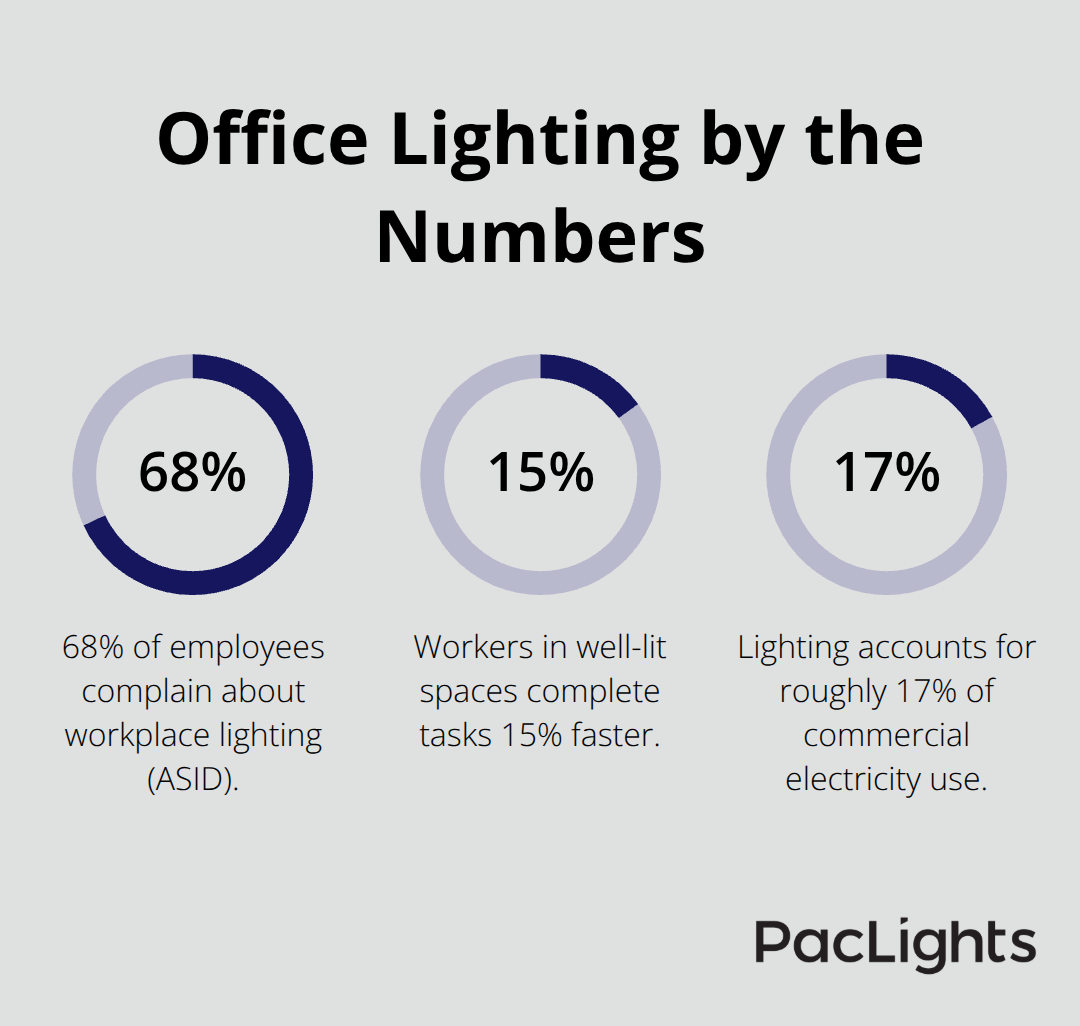
Poor office lighting costs money twice. First, it drains your energy budget through inefficient fixtures that waste power. Second, it tanks productivity and increases absenteeism, which hits harder than most facility managers realize. Research from the American Society of Interior Designers found that 68% of employees complain about lighting conditions in their workplace, and those complaints correlate directly with lower output and higher sick days.
When your team works under inadequate or flickering light, their circadian rhythms get disrupted, melatonin production suffers, and concentration drops. This isn’t theoretical-it’s measurable. A study published in the Journal of Environmental Psychology showed that workers in well-lit spaces completed tasks 15% faster than those in poorly lit environments.
Energy Waste in Commercial Buildings
The financial impact matters significantly. According to the U.S. Energy Information Administration, lighting accounts for roughly 17% of total electricity consumption in commercial buildings. For a typical office space, that translates to thousands of dollars annually in wasted energy costs from outdated downlights and poor fixture selection.
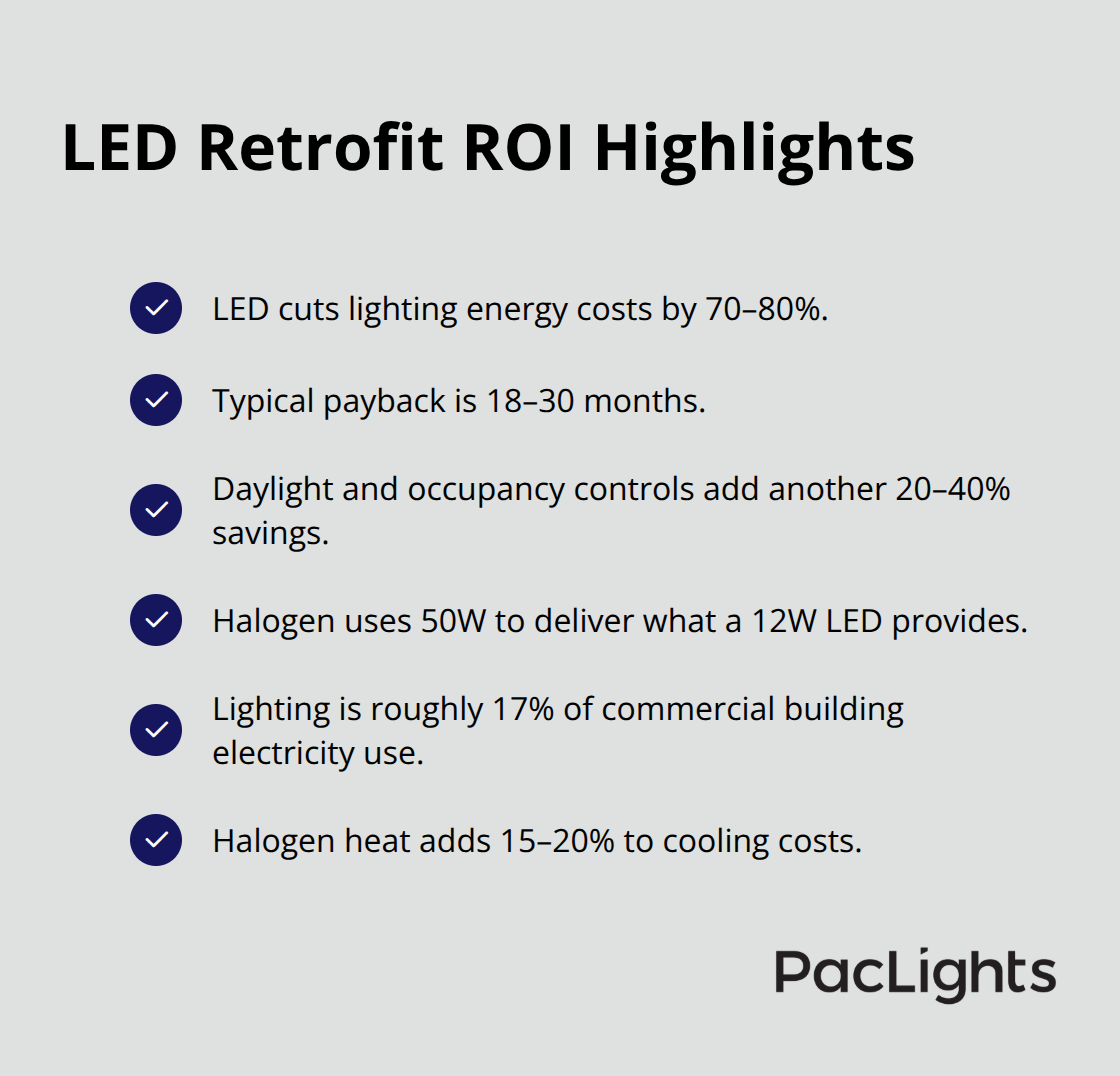
Traditional halogen downlights consume 3 to 4 times more energy than LED equivalents while generating excessive heat that forces air conditioning systems to work harder. LED downlights cut energy consumption dramatically-a retrofit from halogen to LED typically reduces lighting-related electricity costs by 70% to 80%.
The Real Numbers Behind LED Retrofits
The payback period matters here. A 50-fixture retrofit in a mid-sized office costs between $3,000 and $6,000 but recovers that investment in 18 to 30 months through energy savings alone. Beyond raw efficiency, the right downlights integrate daylight sensors and occupancy controls that automatically adjust brightness based on natural light and room usage.
This technology prevents the common mistake of running full lighting in spaces that receive adequate daylight or sit empty for portions of the day. Many offices operate without any automated controls, essentially leaving money on the table. The combination of efficient fixtures and smart controls creates the real win: lower energy bills, better employee performance, and a workspace that actually looks intentional rather than cheaply lit.
What Comes Next
Selecting the right downlight type requires understanding your current setup and what options exist for your specific office layout. The next section breaks down the different commercial downlight categories and how each one performs in different spaces.
Types of Commercial Downlights and Their Applications
Recessed Downlights for Suspended Ceilings
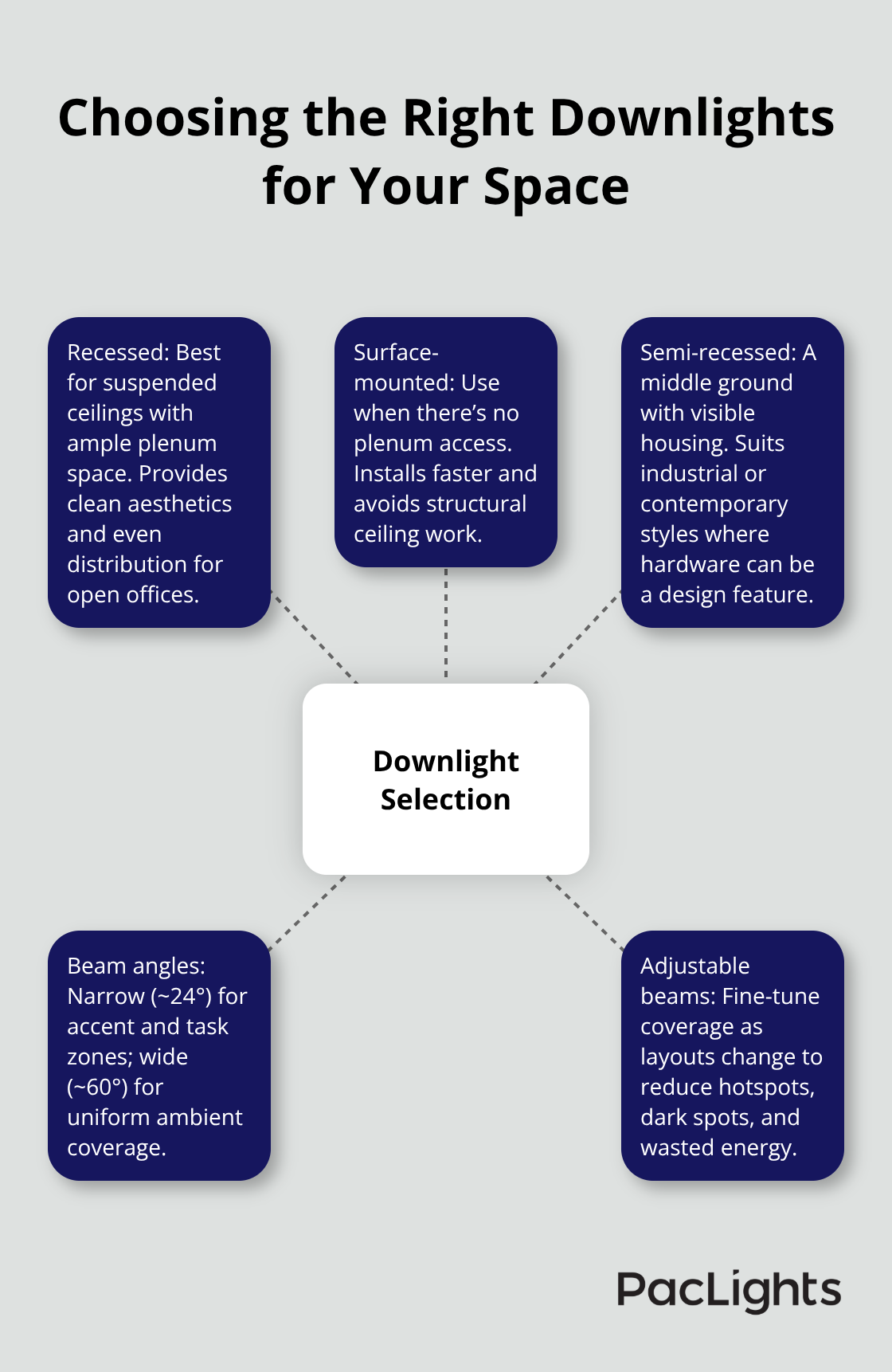
Recessed downlights work best in suspended ceiling systems where you have the clearance to mount fixtures above the ceiling plane. These sit flush with the ceiling, creating a clean aesthetic that most modern offices prefer. Installation requires access above the ceiling, so they perform smoothly in spaces built after the 1980s when suspended ceilings became standard. If your office has a drop ceiling with 12 inches or more of plenum space, recessed downlights offer your most straightforward option. The fixture sits hidden, and only the trim ring shows, which means your ceiling looks intentional rather than cluttered with visible hardware. Recessed fixtures also distribute light more evenly across larger areas compared to surface-mounted alternatives, making them ideal for open-plan offices where uniformity matters.
Surface-Mounted and Semi-Recessed Options
Surface-mounted and semi-recessed downlights solve the problem when you cannot access space above the ceiling or when your ceiling structure won’t support recessed installation. Surface-mounted fixtures attach directly to the ceiling surface, which makes them faster to install and requires no plenum space. Semi-recessed options sit partially into the ceiling while the housing remains visible below, offering a middle ground between aesthetics and installation simplicity. These alternatives work particularly well in older buildings with solid concrete ceilings or in spaces where retrofitting existing infrastructure would cost more than the lighting upgrade itself. The trade-off is visual impact-visible mounting hardware changes how the space feels, so these options suit industrial or contemporary office styles better than traditional corporate environments. Installation typically takes 30 to 40% less time than recessed alternatives, which matters when you need minimal disruption during a retrofit.
Beam Angles and Light Distribution
Beam angle selection determines how light spreads across your space and directly affects both aesthetics and energy efficiency. Fixed beam angles range from narrow spotlights at 24 degrees to wide floods at 60 degrees or more. Narrow beams concentrate light on specific areas and work well for accent lighting or task-focused spaces like conference rooms and individual workstations. Wide beam angles illuminate larger areas with softer coverage, which suits open offices and corridors where uniform brightness matters more than dramatic contrast. Adjustable beam angles give flexibility during installation, letting you fine-tune coverage without replacing fixtures if your office layout changes. The practical advantage is significant-poorly angled fixtures waste energy by lighting areas that don’t need it while leaving other spaces dim.
Calculating Coverage and Throw Distance
A 40-degree beam angle typically covers a 1.5-to-1 ratio between throw distance and coverage diameter, which means in a 9-foot ceiling, you get roughly a 6-foot diameter illumination circle. Calculate these ratios before purchase to prevent the common mistake of buying fixtures that either blast too narrow a beam or spread light so wide that brightness drops below usable levels. The right beam angle matches your ceiling height and the distance between fixtures, ensuring that light overlaps appropriately without creating dark spots or wasting energy on unoccupied areas. This calculation becomes especially important in open-plan offices where uneven lighting creates visual discomfort and forces employees to adjust their workspace positions to escape glare or shadows.
Selecting Fixtures for Your Specific Layout
Your office layout determines which downlight type and beam angle combination works best. Spaces with suspended ceilings and uniform layouts benefit from recessed fixtures with wide beam angles, while older buildings or areas with structural constraints require surface-mounted or semi-recessed alternatives. The next section examines how LED technology transforms these fixture types into energy-efficient solutions that cut operating costs while maintaining the visual quality your office needs.
Energy Efficiency and Cost Savings with LED Downlights
How LED Outperforms Halogen on Every Financial Metric
LED downlights outperform halogen fixtures across every metric that matters financially. A halogen downlight consumes 50 watts while producing the same light output as a 12-watt LED equivalent, meaning you waste 38 watts on every fixture running during business hours. In an office with 60 downlights operating 10 hours daily, that difference amounts to 13,800 kilowatt-hours annually-roughly $1,656 in wasted electricity at average U.S. commercial rates of $0.12 per kilowatt-hour.
Halogen fixtures also generate intense heat that forces air conditioning systems to work overtime during cooling seasons, adding another 15 to 20 percent to climate control costs. The Department of Energy reports that LED adoption reduces total lighting energy consumption by 75 percent compared to halogen systems. That statistic undersells the real advantage: halogen’s heat burden means your facility pays twice-once for the wasted light energy and again for the extra cooling required to counteract it. LED downlights eliminate this penalty entirely, delivering cooler ceilings and lower thermostat strain.
ROI Analysis and Payback Periods for Office Retrofits
The payback calculation proves compelling enough that postponing an LED retrofit becomes indefensible. A 50-fixture retrofit from halogen to LED typically costs between $3,000 and $6,000 depending on fixture quality and whether you handle installation yourself or hire professionals. That investment recovers in 18 to 30 months through energy savings alone, after which every year delivers pure savings.
Most commercial office leases extend five to ten years, meaning an LED retrofit completes its payback and generates three to eight years of additional profit before lease expiration. The real advantage arrives when you integrate daylight sensors and occupancy controls into your LED fixtures. These systems automatically dim lights when natural sunlight floods the space or turn fixtures off in unoccupied rooms, cutting energy consumption by another 20 to 40 percent beyond the baseline LED advantage.
Advanced Controls That Multiply Your Savings
A mid-sized office with windows on two sides and variable occupancy patterns typically realizes these additional savings within weeks rather than months. Networked lighting controls allow you to monitor energy use in real time across your facility, identify problem areas where fixtures run unnecessarily, and adjust settings remotely without visiting each fixture individually.
PacLights offers LED retrofit solutions with optional daylight and motion control features, plus advanced networked lighting controls to further optimize energy use. These systems track actual usage patterns rather than relying on guesswork, helping you maximize ROI performance and identify where your facility wastes the most energy. The combination of efficient fixtures and smart controls creates measurable results: lower energy bills, better employee performance, and a workspace that operates at peak efficiency.
Final Thoughts
Selecting commercial downlights for offices requires you to balance visual quality, installation constraints, and operating costs. Your ceiling type determines whether recessed, surface-mounted, or semi-recessed fixtures work best, while your space layout and occupancy patterns dictate beam angles and control strategies. The financial case for LED conversion proves straightforward: switching from halogen to LED cuts lighting energy costs by 70 to 80 percent while eliminating the heat burden that inflates air conditioning expenses.
A typical 50-fixture retrofit pays for itself in 18 to 30 months, then generates pure savings for the remainder of your lease term. Adding daylight sensors and occupancy controls accelerates payback by another 20 to 40 percent, turning a good investment into an exceptional one. Workers in well-lit spaces complete tasks 15 percent faster and report fewer complaints about their environment, so proper lighting transforms how your team performs.
The practical next step involves assessing your current setup and identifying which fixtures need replacement first. Try prioritizing areas with the longest operating hours and highest occupancy density, as these spaces generate the fastest ROI. PacLights provides free lighting layout designs and ROI assessments to help you understand exactly what your facility needs and what financial returns you can expect from specific upgrades.
Disclaimer: PacLights is not responsible for any actions taken based on the suggestions and information provided in this article, and readers should consult local building and electrical codes for proper guidance.