

Kitchen lighting affects everything from food safety to your bottom line. Wrap lights in kitchen areas deliver even illumination without shadows, reduce contamination risks, and handle humidity and heat better than traditional fixtures.
At PacLights, we’ve seen commercial kitchens cut energy costs by 40% or more after switching to LED wrap lights. This guide covers why wrap lights work, how they save money, and what installation looks like for your space.
Why Wrap Lights Transform Kitchen Visibility
Wrap lights solve a problem that plagues most kitchens: uneven illumination that creates shadows exactly where you need clarity. When a prep cook works a cutting board or plates a dish, shadows from their own body or from poorly positioned fixtures make the work harder and slower. Wrap lights mount close to work surfaces and distribute light evenly across the entire area, eliminating those dead zones. According to the Illuminating Engineering Society, food prep zones need 500 to 1,000 lux to support precise work, and a properly positioned 4-foot wrap fixture delivers approximately 4,200 lumens at 4000K, which provides the uniform brightness needed for knife work, ingredient measurement, and accurate color assessment. The even distribution directly impacts food safety and staff productivity. A 4000K color temperature mimics daylight, so your team can accurately judge the color and texture of ingredients without uncertainty about whether something is cooked through or properly prepared.
Sealed housings eliminate sanitation problems
Wrap fixtures with sealed housings and smooth surfaces resist grease buildup far better than traditional fixtures with crevices or exposed components. In a kitchen running 12 to 16 hours daily, grease accumulation dulls output and creates sanitation problems. NSF-certified wrap lights meet food environment standards and simplify your cleaning routine because bacteria and residue have nowhere to hide. Vapor-tight designs with IP65 or higher protection ratings handle steam, splashes, and washdown procedures without degradation. These fixtures tolerate the harsh reality of commercial kitchens, where moisture and heat remain constant challenges. A sealed design means fewer maintenance headaches and consistent light output over months of operation.
Long lifespan reduces replacement frequency
LED wrap lights operate for approximately 50,000 hours compared to roughly 3,000 hours for incandescent bulbs, according to the U.S. Department of Energy. That’s a 16-fold difference in lifespan. In a kitchen environment, where fixtures experience frequent switching, temperature fluctuations, and humidity exposure, this durability matters enormously. LED modules emit significantly less heat than traditional lighting, which reduces strain on the fixture itself and keeps your kitchen cooler during service. The instant-on, flicker-free performance eliminates warm-up delays and improves staff efficiency because lights reach full brightness immediately. When you combine long lifespan with sealed construction and heat resistance, wrap lights become the most reliable choice for food prep areas where lighting failures disrupt operations and create safety risks.
What this means for your energy bill
The financial case for wrap lights strengthens when you examine energy consumption and maintenance costs over time. LED wrap fixtures use at least 75% less energy than incandescent lighting, and ENERGY STAR certified options use roughly 90% less energy than incandescent bulbs while lasting about 15 times longer. In kitchens operating 12 to 16 hours daily, LED wrap lighting can reduce monthly energy consumption from roughly 2,800 kWh to about 700 kWh per prep area. Installation costs typically range from $1,200 to $2,400 per fixture, with a payback period of about 5 to 8 weeks. These numbers shift the conversation from “Can we afford wrap lights?” to “How quickly can we install them?” Understanding your current energy spend and operational hours helps you calculate your specific ROI, which is why many lighting suppliers offer free assessments to map your kitchen layout and project your savings.
How Much Money Do Wrap Lights Actually Save
Electricity Costs Drop Fast
LED wrap fixtures cut electricity consumption so dramatically that the numbers stop sounding theoretical once you apply them to your kitchen’s actual operating hours. The U.S. Department of Energy reports that LED wrap lighting uses at least 75% less energy than incandescent alternatives, and ENERGY STAR certified fixtures push that to roughly 90% less. In a kitchen running 12 to 16 hours daily, this translates to real dollars. A single prep area consuming approximately 2,800 kWh monthly with traditional incandescent lighting drops to about 700 kWh after switching to LED wrap fixtures. At an average commercial electricity rate of $0.12 per kilowatt-hour, that reduction saves $252 per month per fixture. Over one year, a single wrap light saves your operation roughly $3,024 in electricity alone.
Installation Pays for Itself in Weeks
Installation costs typically range from $1,200 to $2,400 per fixture, meaning your payback period sits between 5 to 8 weeks. After that window closes, every month of operation produces pure savings that flows directly to your bottom line. Most commercial kitchens install multiple wrap fixtures across prep stations, islands, and work zones, which multiplies these savings across the entire operation. The speed of payback removes financial hesitation from the upgrade decision.
Maintenance Labor Vanishes
LED modules deliver approximately 50,000 hours of lifespan compared to roughly 3,000 hours for incandescent bulbs, according to the U.S. Department of Energy. That 16-fold difference means your staff spends far less time on ladder replacements and fixture troubleshooting. Traditional incandescent bulbs in a 12-hour-daily kitchen need replacement roughly every 8 months, while LED wrap fixtures operate for approximately 16 years before requiring module replacement. Labor costs for bulb changes, fixture repairs, and downtime during lighting failures simply vanish. Sealed LED housings resist grease buildup better than traditional fixtures, which means your cleaning staff spends less time on fixture maintenance and more time on food-prep tasks.
The Complete Financial Picture
The combination of reduced electricity, eliminated replacement cycles, and lower maintenance labor creates a financial advantage that extends far beyond the initial installation cost. A kitchen with four prep stations equipped with wrap lights can expect annual savings exceeding $12,000 in electricity costs alone, plus additional savings from reduced labor and maintenance. These savings compound year after year, with no additional investment required. Understanding your specific kitchen layout, operating hours, and current lighting setup allows you to calculate your exact ROI. Lighting suppliers can provide free assessments and layout designs to help you project your savings based on your operation’s actual dimensions and schedule.
Installation and Customization Options for Kitchen Lighting
Matching Your Ceiling Type to Installation Method
Your ceiling type determines how quickly and cost-effectively your electrician can install wrap lights. Suspended drop ceilings, common in older facilities, offer the easiest installation path because wrap fixtures mount directly to the grid without structural modifications. This approach typically takes 2 to 4 hours per fixture and costs $1,200 to $2,400 including labor. Concrete or structural ceilings in newer builds demand anchor bolts or surface-mounted brackets, which adds complexity but remains straightforward for experienced electricians. Open joist systems provide maximum flexibility for positioning fixtures exactly where you need them, though wiring runs become more visible unless you plan conduit routing during the design phase.
Electrical Capacity and Circuit Planning
Before your electrician arrives, verify your existing circuit capacity because wrap lights draw significantly less power than traditional incandescent fixtures. A single LED wrap fixture typically draws 40 to 60 watts compared to 400+ watts for equivalent incandescent output, so retrofitting existing circuits becomes feasible in most kitchens. Your current 120V circuits often handle multiple new installations without panel upgrades. This electrical efficiency removes a major barrier to upgrading older facilities that lack spare capacity in their electrical infrastructure.
Positioning Fixtures for Maximum Light Coverage
Position fixtures 24 to 36 inches above work surfaces, centered over prep stations and islands where shadows cause the most problems. Spacing matters enormously: for countertops longer than six feet, install multiple fixtures spaced 24 to 30 inches apart to eliminate dim patches that compromise food safety and staff efficiency. Perpendicular mounting relative to your longest counter dimension spreads light evenly across the full prep surface rather than creating bright and dark zones. Test your layout by comparing prepared dishes under the new lighting to your kitchen’s existing reference standards before finalizing fixture positions.
Dimming Controls Reduce Energy Waste
Dimmable LED fixtures allow you to reduce brightness during plating work to minimize eye strain while maintaining full output during knife work and ingredient assessment. Motion sensors paired with dimming controls cut energy waste during off-peak hours or when prep stations sit idle between service periods. Install motion sensors above your busiest prep areas and set dimming thresholds that trigger 30 to 50 percent brightness reduction after 15 minutes of inactivity. This approach cuts energy consumption by an additional 15 to 25 percent beyond the baseline LED efficiency, accelerating your payback timeline from 5 to 8 weeks down to 4 to 6 weeks depending on your operating schedule.
Smart Controls and Color Temperature Adjustment
Smart lighting controls integrate with your existing kitchen management systems through standard 120V connections, allowing you to create preset scenes for different operational phases: full brightness during morning prep, reduced brightness during plating service, and minimal illumination during closing procedures. Many facilities program motion sensors to trigger full brightness when staff approaches a prep station, then gradually dim after 10 minutes without activity.
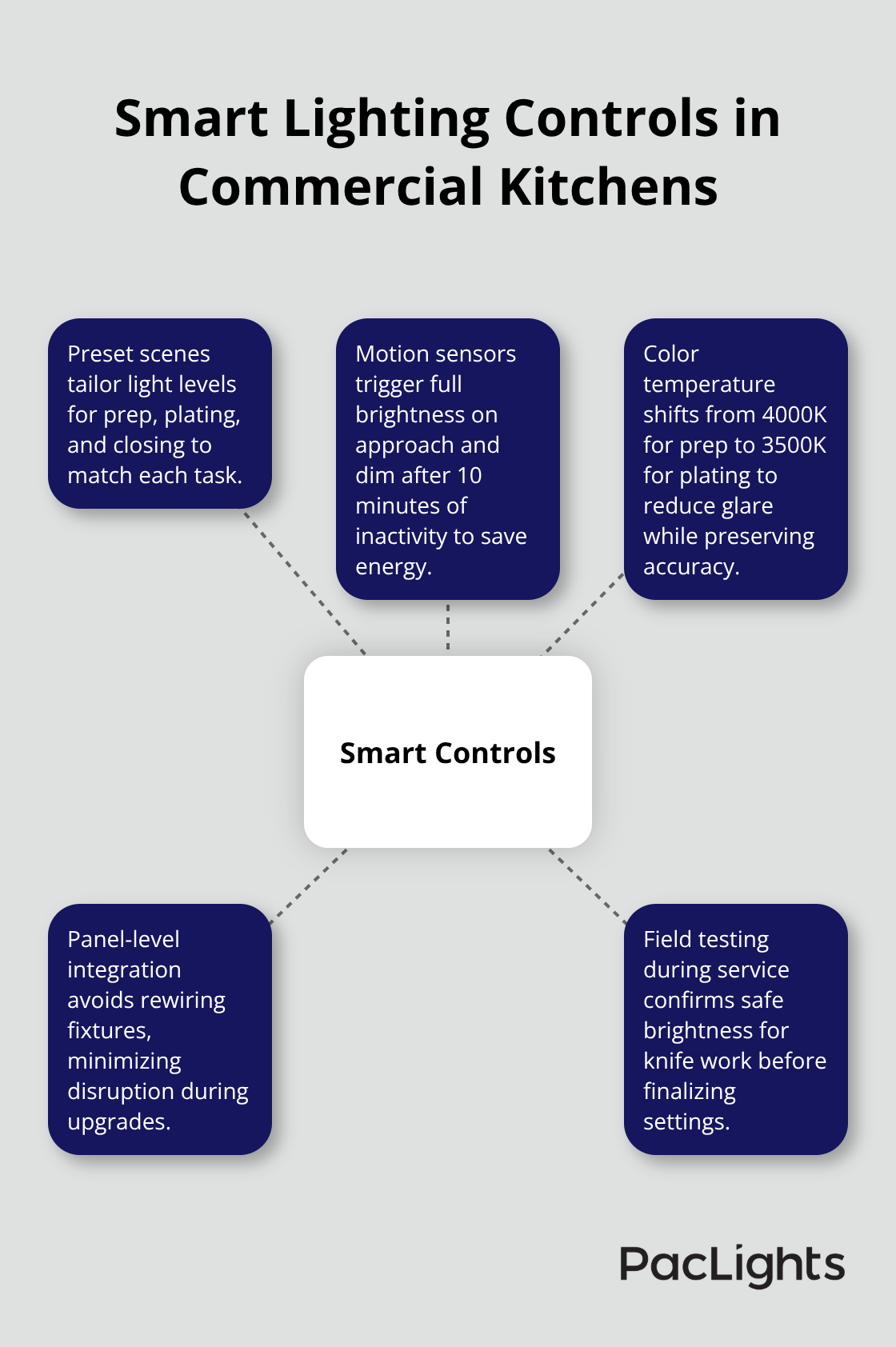
Color temperature control, available on higher-end wrap fixtures, lets you shift from 4000K neutral daylight during food preparation to slightly warmer 3500K tones during plating to reduce glare without sacrificing color accuracy. Integration happens at the control panel level rather than requiring rewiring of individual fixtures, so your existing electrical infrastructure handles the upgrade with minimal modification. Test your dimming settings during actual service periods to confirm that reduced brightness levels still support safe, accurate knife work and ingredient handling before finalizing your control programming.
Final Thoughts
Wrap lights in kitchen areas deliver measurable benefits that affect both daily operations and your financial performance. The combination of even illumination, sealed hygienic design, and long-lasting LED technology creates an environment where your staff works faster and safer while your energy bills shrink month after month. A single prep station equipped with wrap lights saves approximately $3,024 annually in electricity costs alone, with installation paying for itself in 5 to 8 weeks.
Your team no longer works around shadows that force repositioning or squinting at ingredient colors, and sealed fixtures mean less time spent on maintenance and more time spent on food preparation. LED modules rated for 50,000 hours of operation reduce the constant cycle of bulb replacements that interrupts service and frustrates staff. Smooth, sealed housings resist grease buildup and simplify sanitation routines, supporting NSF compliance and reducing contamination risks while motion sensors and dimming controls optimize energy use based on actual kitchen activity.
We at PacLights understand that kitchen lighting decisions involve balancing performance, durability, and cost. Contact our team for a free lighting assessment to identify the exact fixtures and control options that match your operation’s needs and budget, and we’ll project your specific ROI based on your kitchen layout and operating hours.
Disclaimer: PacLights is not responsible for any actions taken based on the suggestions and information provided in this article, and readers should consult local building and electrical codes for proper guidance.