

Wrap lights are one of the most misunderstood fixtures in commercial lighting design. Most facilities install them without considering spacing, layout, or how they’ll actually perform in their specific environment.
At PacLights, we’ve seen countless installations fail because the basics weren’t right. This wrap lights design guide walks you through the exact calculations, placement strategies, and performance metrics that separate a well-lit space from one with dark spots and wasted energy.
What Wrap Lights Actually Do
Wrap lights are linear fixtures that mount flush against ceiling surfaces and deliver uniform illumination across wide areas with minimal visual obstruction. Unlike traditional recessed downlights that create pools of light, wrap lights distribute brightness in a broad, even pattern that fills entire rooms or corridors. The fixture itself is typically a long rectangular housing, ranging from 2 to 4 feet in commercial applications, with LED arrays behind a diffuser that spreads light across the mounting surface and outward into the space. Inside, reflectors and optical engineering control beam spread, preventing the harsh shadows and uneven coverage that plague older fluorescent wraps or poorly spaced downlights.
Where Wrap Lights Perform Best
Wrap lights excel in environments where uniform light distribution matters more than directional control. Offices, corridors, retail spaces, and light manufacturing areas benefit most from their broad output because workers need consistent visibility across entire work surfaces without glare or dark zones. Commercial models deliver between 1,700 and 6,300 lumens depending on size and wattage, with the larger 4-foot by 6-inch commercial wraps reaching approximately 6,300 lumens at just 45 watts. This efficiency, often exceeding 140 lumens per watt, means fewer fixtures cover larger areas compared to traditional downlight arrays. Residential applications also use wrap lights in kitchens and bathrooms, where residential models deliver around 2,800 to 4,700 lumens in compact 24-inch and 46-inch formats. The key advantage is coverage per fixture-a single wrap light replaces multiple smaller fixtures, reducing installation labor and maintenance points.
Control and Energy Performance
Wrap lights integrate seamlessly with daylight and motion control systems because their broad, even output responds predictably to dimming and switching. A facility using motion sensors in low-traffic corridors can dim wrap lights to 20 or 30 percent during unoccupied periods, cutting energy consumption without creating dead zones. Color temperature options spanning 3000K through 5000K let you match the light quality to the task-warmer tones for retail environments where merchandise appeal matters, cooler tones for inspection areas where color accuracy is critical. Most wrap lights operate on standard 120-volt residential circuits or 277-volt commercial systems, making retrofits straightforward in existing buildings. The durable construction, typically rated for IP65 or better, handles moisture and dust in industrial settings far better than traditional ceiling fixtures.
Installation and Customization
Installation uses standard mounting hardware and wiring practices, which means electricians familiar with basic fixture replacement can handle the work without specialized training. Wrap lights come in multiple configurations-the NuDeco Wrap offers 46-inch by 6-inch and 46-inch by 10-inch formats with Black or Brushed Nickel finishes, while commercial and residential variants provide flexibility for different spaces. Some models include a Night Light option that delivers secondary, low-level illumination without requiring an extra fixture. At PacLights, we offer wrap lights as part of our comprehensive indoor fixture lineup, tailored to meet the specific performance and aesthetic requirements of your facility.
Understanding how wrap lights perform in your space requires more than just selecting a fixture-it demands careful attention to spacing, placement, and how light actually distributes across your work areas.
How to Space Wrap Lights for Even Coverage
Spacing wrap lights correctly separates a well-lit facility from one with visible dark bands running across the ceiling. Most installers treat wrap light spacing as a fixed distance when it actually depends on your room dimensions, ceiling height, and the specific fixture’s light distribution. Commercial wrap lights with wider beam spreads (typically around 110 to 120 degrees) require different spacing than narrower distributions. A 4-foot by 6-inch commercial wrap delivering 6,300 lumens at 45 watts covers more ground than a 2-foot by 6-inch model producing 1,700 lumens, so you cannot apply the same spacing rule to both.
Calculating Spacing Based on Room Length
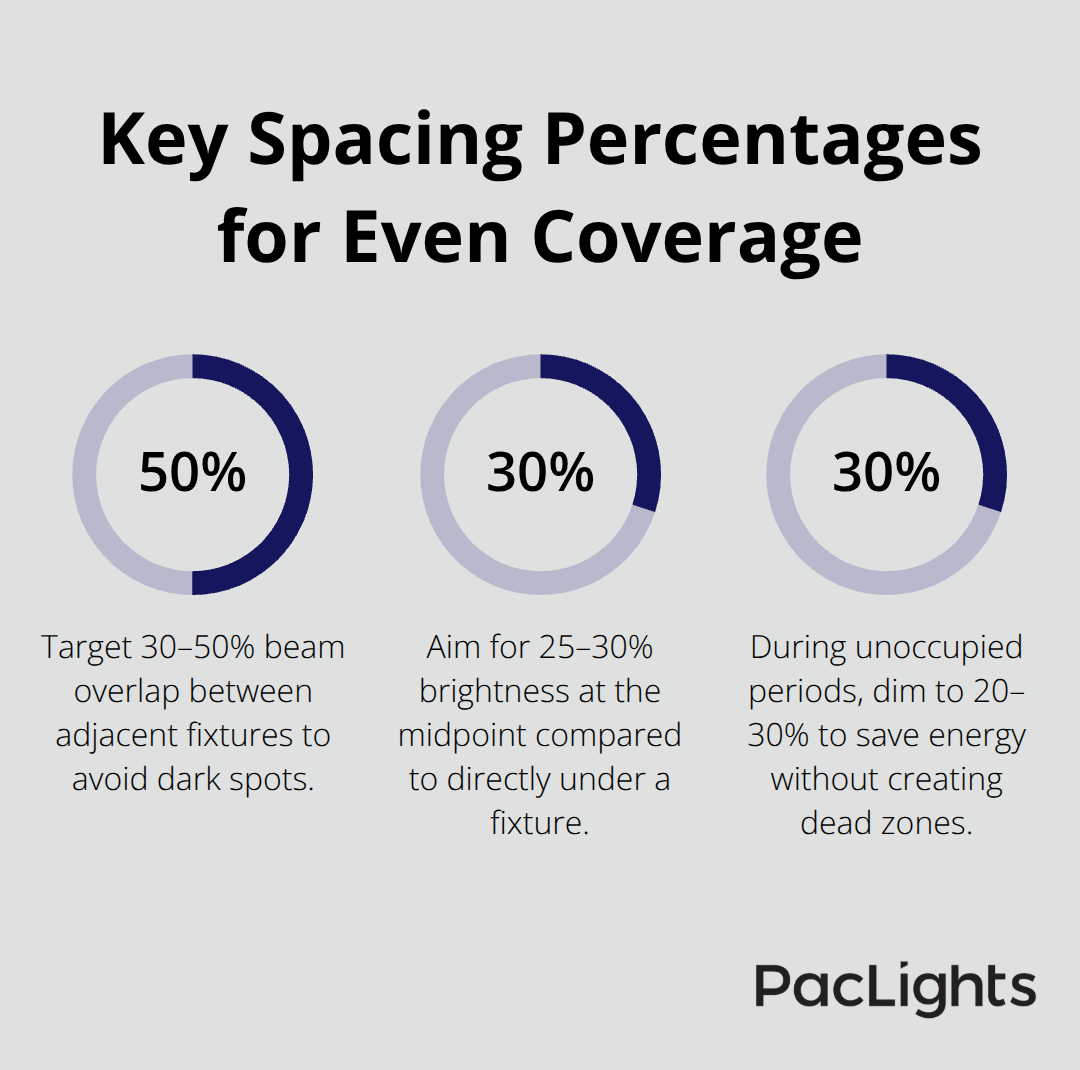
Start by measuring your room length and width, then divide the longer dimension by the number of fixtures you plan to install. If your corridor stretches 60 feet long and you want to avoid visible gaps, install fixtures every 12 to 15 feet rather than spacing them 20 feet apart, which creates noticeable dark zones at the midpoint between fixtures. The goal is achieving 30 to 50 percent beam overlap between adjacent fixtures-this eliminates dark spots without creating excessive brightness that wastes energy. To verify your spacing works, perform a mock installation with two fixtures and use a light meter to measure illumination at the point between them. That midpoint reading should fall between 25 and 30 percent of the brightness directly under a fixture for general commercial spaces.
If your measurement drops below 20 percent, move the fixtures closer together or upgrade to a higher-lumen model.
How Room Shape and Reflectance Affect Coverage
Room shape and ceiling reflectance matter more than most designers realize. A narrow hallway with dark walls reflects far less light than an open office with white ceilings, meaning you need either closer spacing or higher-lumen fixtures in the hallway to achieve the same perceived brightness. Residential applications in kitchens and bathrooms often require tighter spacing because work surfaces demand higher, more consistent illumination than commercial corridors. A 24-inch residential wrap delivering 2,800 lumens works well in a 10-foot-wide kitchen when spaced 8 to 10 feet apart along the length, but spacing those same fixtures 15 feet apart creates dark zones over countertops.
Spacing Larger Commercial Fixtures
For larger commercial spaces, aligning lights in rows or clusters provides broader coverage, allowing spacing up to 18 to 20 feet in some applications while maintaining uniformity. Always round your spacing calculation up rather than down, because fixtures come in fixed counts and purchasing one extra fixture costs far less than retrofitting to fix dark spots after installation. Document your final spacing plan on a ceiling layout drawing before ordering fixtures or scheduling installation. This drawing becomes your installation guide and prevents on-site improvisation that leads to uneven light distribution.
Verifying Your Layout Plan
Your spacing strategy determines whether your facility receives consistent illumination or develops problem areas that require expensive corrections later. The specific lumen output of your chosen wrap light model, combined with your room’s reflectance properties and desired illumination levels, all influence the final spacing distances that work for your space. Getting this calculation right before installation prevents costly mistakes and ensures your wrap lights perform as intended across the entire facility.
How Much Light Do You Really Need
Wrap lights deliver vastly different brightness levels depending on size and wattage, and selecting the wrong output creates either wasted energy or inadequate illumination. A 2-foot by 6-inch commercial wrap produces around 1,700 lumens at 12 watts, suitable only for small offices or hallway sections. The 4-foot by 6-inch commercial wrap reaches 6,300 lumens at 45 watts, covering expansive retail floors or manufacturing areas. Residential models split the difference, with 24-inch variants delivering approximately 2,800 lumens at 34 watts and 46-inch models producing roughly 4,700 lumens at 55 watts.
Efficiency and Lumen Output
Commercial wraps achieve up to 149 lumens per watt, meaning a single fixture replaces three or four traditional downlights while consuming less power. Most facilities overbuy lumen output because designers assume brighter always means better, then waste thousands annually on unnecessary energy consumption. Your actual illumination target depends on the task: general office work requires 300 to 500 lux, retail merchandise displays demand 500 to 1,000 lux, and inspection areas need 1,000 to 2,000 lux. Measure your current lighting levels with an inexpensive smartphone app or a proper lux meter, then select wrap light output that meets your specific requirement without excess.
Color Temperature and Perceived Brightness
Color temperature selection influences perceived brightness as much as actual lumen output-a 4000K neutral white fixture feels brighter than a 3000K warm white model at identical lumen levels. Cooler temperatures work better in technical spaces while warmer tones suit retail environments where merchandise appeal matters more than color accuracy.
Motion Sensors and Daylight Controls
Wrap lights with motion sensors and daylight harvesting controls reduce energy consumption by 30 to 50 percent in spaces with variable occupancy. Install photocells to dim fixtures during daylight hours, preventing the common mistake of running full brightness when windows already provide adequate illumination. Motion sensors work exceptionally well in corridors, storage areas, and restrooms where occupancy fluctuates throughout the day-set sensors to maintain 30 percent brightness during unoccupied periods, then ramp to full output when movement is detected.
Dimming wrap lights to 50 percent brightness reduces energy draw to roughly 60 percent of full power because LED drivers operate efficiently across the dimming range, unlike older fluorescent systems that wasted energy at reduced levels. A facility with 20 wrap lights running 12 hours daily at full brightness consumes approximately 5,400 kilowatt-hours annually; adding motion controls and daylight harvesting cuts that to roughly 2,700 kilowatt-hours, saving approximately $350 to $500 per year depending on local electricity rates.
Advanced Lighting Control Systems
Networked lighting controls track occupancy patterns and adjust brightness automatically across entire zones, optimizing energy use beyond what simple motion sensors achieve. This approach requires proper installation by qualified electricians to avoid control conflicts and ensure seamless operation. Most commercial facilities recoup control system costs within three to five years through energy savings alone, then enjoy continuous reductions afterward.
Wrapping Up
Wrap light design succeeds when spacing, fixture selection, and control systems work together as a unified strategy rather than isolated decisions. The calculations and placement methods in this wrap lights design guide eliminate guesswork and prevent the dark spots, wasted energy, and installation mistakes that plague poorly planned facilities. Your spacing depends on room dimensions and fixture output, not arbitrary distances, and your lumen selection must match actual task requirements rather than assumptions about brightness.
A ceiling layout drawing documents fixture placement, spacing distances, and lumen output before installation begins, preventing costly on-site improvisation and giving your electrician clear guidance for the work ahead. Measure your current illumination levels, identify your specific lighting requirements by task, and select wrap light models that deliver exactly what you need without excess capacity. This approach transforms wrap light installation from a guessing game into a data-driven process that produces predictable results.
We at PacLights provide free lighting layout designs and ROI assessments to help you implement this wrap lights design guide for your facility’s specific requirements. Contact our team for a professional layout assessment that ensures your wrap lights perform efficiently and deliver the uniform illumination your space demands.
Disclaimer: PacLights is not responsible for any actions taken based on the suggestions and information provided in this article, and readers should consult local building and electrical codes for proper guidance.