

Harsh industrial environments demand lighting solutions that won’t fail when you need them most. Vapor tight LED fixtures are built specifically for these conditions, sealing out moisture, dust, and corrosive elements that destroy standard lights.
At PacLights, we’ve seen firsthand how the right fixtures transform facility operations and cut maintenance costs dramatically. This guide walks you through everything you need to know about selecting, installing, and maintaining these workhorses.
What Makes Vapor Tight LED Fixtures Different
Construction and Sealing Technology
Vapor tight LED fixtures are hermetically sealed lighting units that operate reliably in environments where moisture, dust, chemicals, and corrosive elements destroy conventional lighting. Reinforced polycarbonate or acrylic housings with gasketed seals and multipoint LED arrays create a barrier against contaminants while delivering consistent illumination.
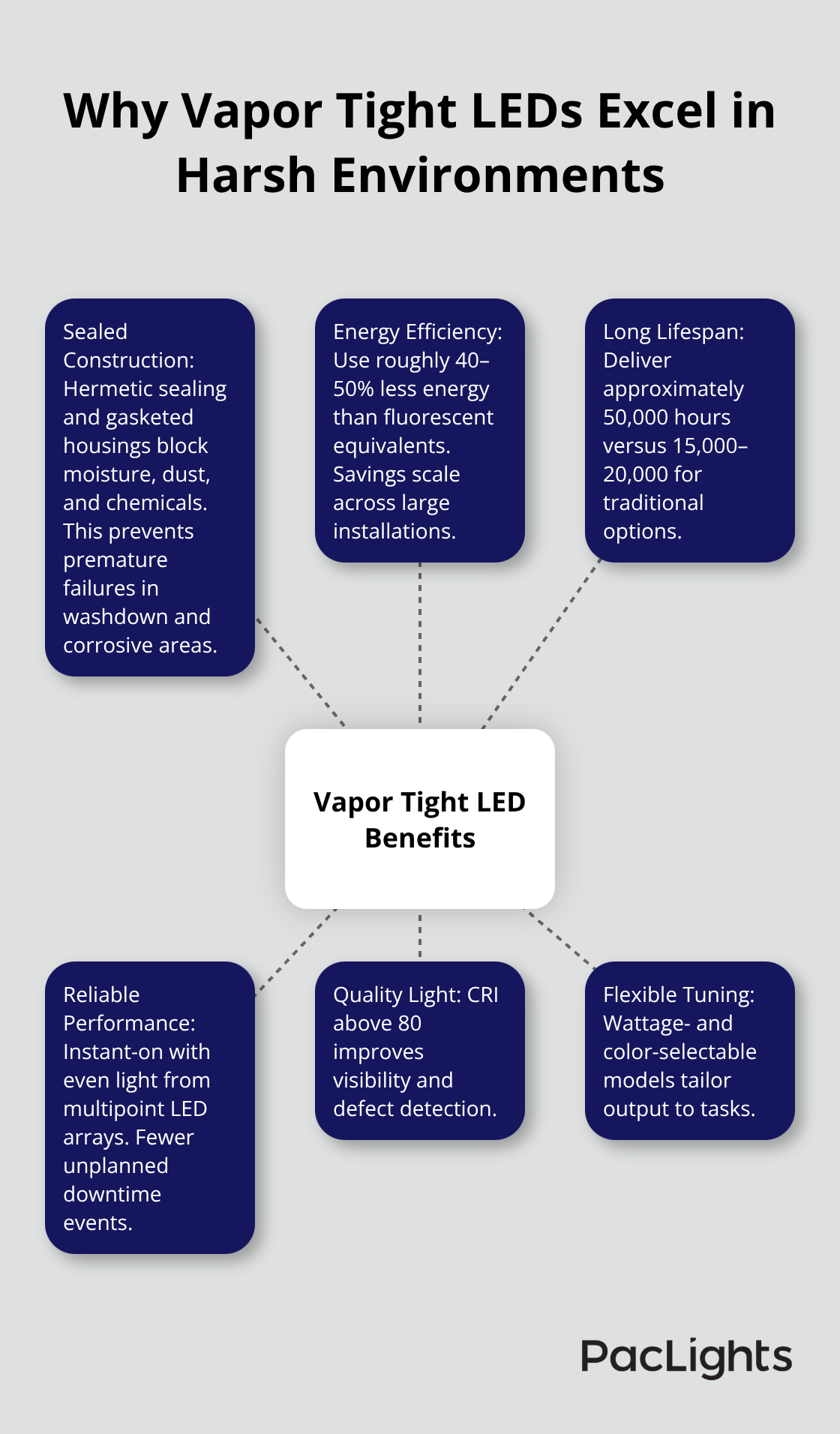
IP65 and IP66 ratings indicate dust-tight sealing plus protection against water jets, with IP66 offering extra defense in extreme environments. These fixtures typically deliver between 900 and 27,400 lumens depending on size and wattage configuration, with options ranging from 2-foot compact units at 15–30W to 8-foot high bays at 38–90W. Color temperatures span 3000K to 5000K, and many models offer selectable wattage and color temperature in a single fixture, allowing precise tuning for specific tasks without purchasing multiple units.
Energy and Lifespan Advantages
LED vapor tight units consume roughly 40–50% less energy than fluorescent equivalents while delivering approximately 50,000 hours of lifespan compared to 15,000–20,000 hours for traditional options. This translates directly to lower utility bills and dramatically reduced maintenance frequency. For a 24/7 operation running 8-foot fixtures at 75W, switching from fluorescent to LED vapor tight saves around 3,650 kilowatt-hours annually per fixture. In food processing plants, cold storage facilities, car washes, pharmaceutical warehouses, and wastewater treatment plants, these fixtures eliminate the constant lamp replacement cycles that plague older technology.
Specialized Certifications and Protection
NSF-certified models meet food safety requirements without compromise in hygienic environments. The sealed design protects internal components from washdowns and chemical exposure, preventing driver failures and contamination that force premature replacement. Installation requires hardwired connection to 120–277V circuits with proper conduit routing and grounding per NEC Article 410, but once secured, these fixtures operate with minimal intervention. Vapor tight LEDs cut total cost of ownership by 35–50% over a ten-year period when compared to fluorescent vapor tight systems.
Selecting the Right Configuration for Your Space
The range of available configurations means you can match fixtures precisely to your facility’s demands. Wattage-selectable options allow you to adjust brightness without swapping units, while color-selectable variants (3500K, 4000K, 5000K) adapt to different task requirements. High bay styles accommodate higher mounting points while maintaining vapor-tight integrity, and NSF-certified options serve processing and packaging environments where hygiene standards matter. Understanding your space’s actual washdown intensity and chemical exposure level determines whether IP65 or IP66 protection suits your needs-room labels alone won’t tell you enough.
Installation and maintenance practices directly impact how well these fixtures perform in your specific environment, which is why proper setup from the start matters far more than most facility managers realize.
How Much Can Vapor Tight LED Fixtures Actually Save You
Energy Savings That Compound Across Your Facility
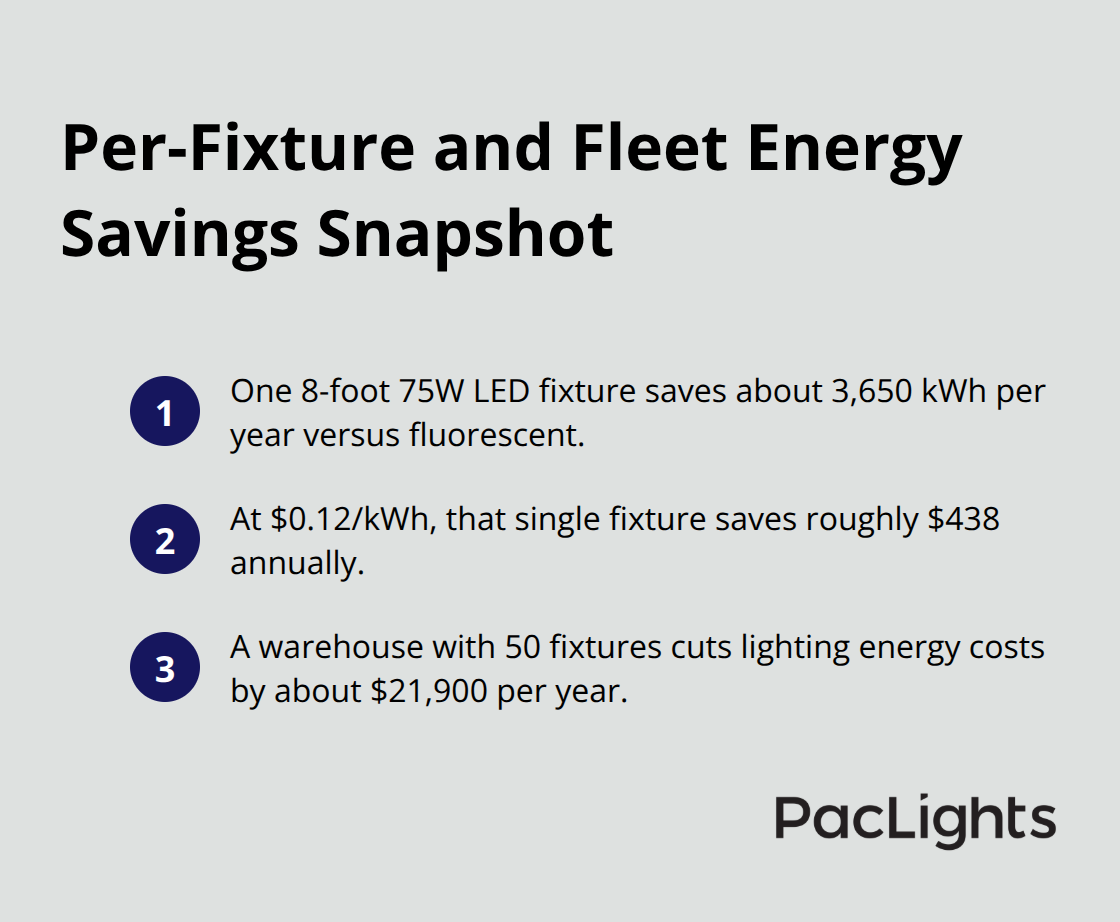
LED vapor tight units consume roughly 40–50% less energy than fluorescent equivalents, and this difference compounds quickly across large installations. A 24/7 operation running 8-foot fixtures at 75W saves approximately 3,650 kilowatt-hours annually per fixture when switching from fluorescent to LED vapor tight. At an average industrial electricity rate of $0.12 per kilowatt-hour, that single fixture generates $438 in annual savings. A warehouse with 50 fixtures cuts its lighting energy costs by $21,900 yearly.
Over a ten-year period, vapor tight LED systems reduce total cost of ownership by 35–50% compared to fluorescent vapor tight alternatives, even accounting for higher upfront purchase prices.
Maintenance Labor Disappears When You Switch to LED
The lifespan difference accelerates savings dramatically. LED vapor tight fixtures deliver approximately 50,000 hours of operation versus 15,000–20,000 hours for traditional options. In a 24/7 facility, an LED fixture runs roughly five years before requiring replacement, while fluorescent units need replacement every 18–24 months. Maintenance labor costs drop almost entirely, which matters intensely in food processing plants, cold storage facilities, and pharmaceutical warehouses where technician time costs $50–$100 per hour. One facility replacing 100 fluorescent vapor tight fixtures with LED units eliminates roughly 40–60 maintenance visits annually, translating to $2,000–$6,000 in labor savings per year alone.
Reliability Prevents Costly Production Shutdowns
The sealed design protects internal components from washdowns and chemical exposure, preventing driver failures that force premature replacement and production shutdowns. NSF-certified models serve processing and packaging environments where contamination creates regulatory violations and product loss, making reliability worth far more than fixture cost. Facilities avoid the constant lamp replacement cycles that plague older technology, which translates to fewer unplanned downtime events and more predictable operational budgets.
Light Quality Improves Worker Safety and Productivity
The multipoint LED array inside these fixtures delivers even light distribution that appears brighter than equivalent lumen fluorescent fixtures, improving visibility in dark corners and overhead areas where shadows accumulate. Color rendering index above 80 on most models allows workers to identify product defects, safety hazards, and color-critical tasks without eye strain. Wattage-selectable options let you adjust brightness without swapping units, and color-selectable variants spanning 3500K, 4000K, and 5000K adapt to different task requirements without purchasing multiple fixture types. A facility can install one fixture model and configure each location to its actual lighting needs, reducing inventory complexity and installation time.
Instant Performance Eliminates Dangerous Warm-Up Delays
Instant-on performance means vapor tight LEDs reach full brightness immediately, unlike older technologies with warm-up periods that create dangerous conditions during power restoration. These performance characteristics combine to lower accident rates and reduce employee complaints about inadequate or inconsistent lighting. Facilities that upgrade their vapor tight systems report measurable improvements in operational efficiency, though the real advantage emerges when you examine what happens during installation and the first weeks of operation-which is where most facility managers discover whether their fixtures truly match their environment’s demands.
Getting Vapor Tight LED Fixtures Right From Installation Through Year Five
Installation Steps That Prevent Early Failures
Proper installation determines whether vapor tight LED fixtures deliver their promised 50,000-hour lifespan and cost savings or fail prematurely in your harsh environment. Turn off power at the main breaker before touching any wiring, mount the fixture securely to prevent vibration-induced loosening, and verify that all gaskets sit flush in their grooves before final closure. The hardwired connection to 120–277V circuits requires routing conduit through weatherproof boxes and connecting wiring to the internal terminal block per NEC Article 410. Technicians must complete grounding steps and seal all penetrations after connection, as skipping these tasks invites moisture infiltration that kills drivers within months.
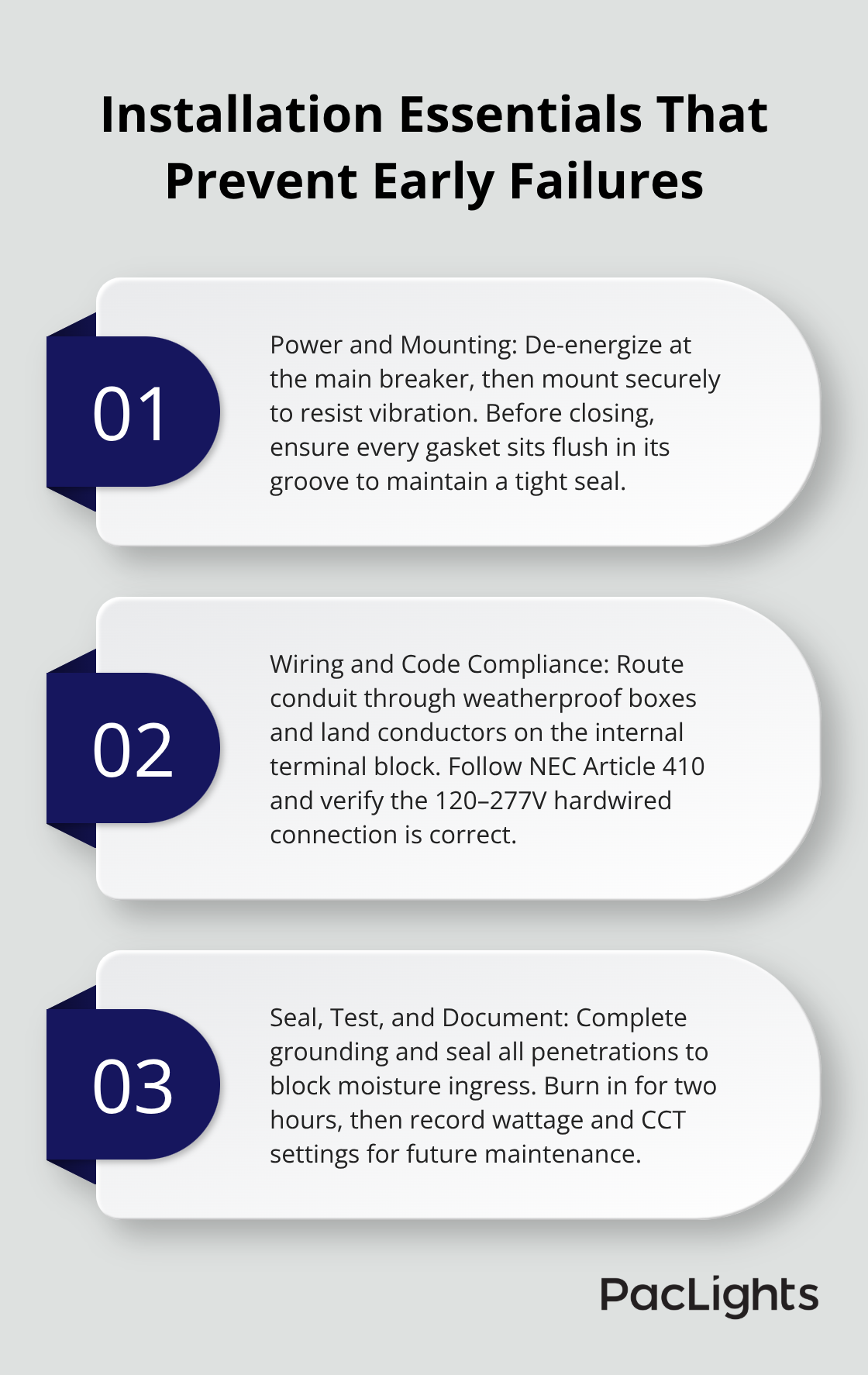
After installation completes, test the fixture under operating conditions for at least two hours before declaring the job finished, then document the exact wattage and color temperature settings you selected so maintenance staff knows what configuration you installed.
Circuit Planning and Fixture Spacing
Circuit planning matters more than most facilities realize when calculating how many fixtures one electrical run can support. A 20-amp circuit at 120V handles roughly 50–60 fixtures running at 40W each, while 277V circuits support 115–140 fixtures at the same wattage. Space 4-foot fixtures between 8–12 feet apart, and 8-foot fixtures between 10–16 feet, though your specific space layout and lumen requirements may demand tighter or wider spacing. This documentation prevents future technicians from accidentally changing settings during routine service calls and helps you track which circuits power which fixture zones.
Maintenance Schedules for Long-Term Performance
Maintenance schedules for vapor tight LEDs differ fundamentally from fluorescent systems because you protect against environmental degradation rather than lamp burnout. Clean the polycarbonate lens every six months in dusty environments and every three months in food processing or pharmaceutical facilities where washdown residue accumulates, using only soft cloths and mild soap to avoid scratching the lens material. Inspect gasket integrity annually by looking for visible cracks, hardening, or compression set that reduces sealing effectiveness; replace gaskets if they show any deterioration since a compromised seal allows moisture penetration that kills the driver within months.
Monitoring and Replacement Protocols
Check that all mounting bolts remain tight twice yearly in facilities with vibration from machinery, as loosening allows water and dust ingress around the fixture body. The sealed design means internal component failures happen without warning, so monitor for any dimming, color shift, or intermittent operation and replace the entire fixture immediately rather than attempting repairs. Most vapor tight LED fixtures carry 5–7 year warranties, but actual field life extends to 50,000 hours only when you maintain proper environmental sealing and avoid voltage fluctuations exceeding ±10% of nominal supply voltage. A facility running 24/7 operations should budget for fixture replacement every five years as a baseline, then adjust upward if your environment proves less harsh than expected.
Final Thoughts
Vapor tight LED fixtures have transformed from niche industrial products into standard practice across facilities that demand reliability in harsh conditions. The combination of 50,000-hour lifespan, 40–50% energy savings versus fluorescent systems, and sealed construction that eliminates maintenance cycles creates a compelling financial case that extends far beyond initial purchase price. Facilities operating 24/7 see payback periods of three to five years, with total cost of ownership dropping 35–50% over a decade compared to traditional vapor tight lighting.
Industry adoption accelerates as facility managers recognize that upfront costs disappear quickly against eliminated maintenance labor, reduced energy consumption, and prevented production shutdowns from lighting failures. Food processing plants, pharmaceutical warehouses, cold storage facilities, and car washes increasingly standardize on LED vapor tight systems because the sealed design protects against washdowns and chemical exposure without compromise. NSF-certified models serve hygiene-critical environments where contamination creates regulatory violations, while wattage-selectable and color-selectable options reduce inventory complexity and installation time.
Selecting the right vapor tight LED fixtures requires matching IP ratings to your actual environment rather than relying on room labels, choosing appropriate wattage and color temperature for specific tasks, and completing proper installation with correct gasket sealing and grounding per NEC Article 410. Circuit planning, fixture spacing, and maintenance schedules determine whether your system delivers promised performance or fails prematurely. We at PacLights provide free lighting layout designs and ROI assessments to help you select vapor tight LED fixtures tailored to your facility’s specific demands, so you capture the full financial and operational benefits these systems deliver.
Disclaimer: PacLights is not responsible for any actions taken based on the suggestions and information provided in this article, and readers should consult local building and electrical codes for proper guidance.