

Equipment failures in industrial settings often trace back to one overlooked factor: poor sealing. Moisture, corrosion, and vibration work together to degrade components, and vapor tight strips durability becomes the difference between equipment that lasts years and equipment that fails months into operation.
At PacLights, we’ve seen firsthand how the right sealing solution protects facilities from costly downtime. This guide covers what makes vapor tight strips withstand harsh conditions and how to maximize their lifespan.
What Makes Vapor Tight Strips Survive Corrosion and Vibration
Housing Materials That Resist Chemical Attack
Vapor tight strips survive harsh environments because they’re engineered with three critical components working together: the housing material, the sealing system, and the internal component protection. The housing in most vapor tight strips uses polycarbonate or fiberglass-reinforced polyester, with fiberglass standing as the superior choice in corrosive environments. Polycarbonate offers decent moisture resistance but fails quickly when exposed to oils and solvents found in manufacturing facilities and chemical plants. Fiberglass-reinforced polyester resists both moisture and chemical attack, making it the material to specify for facilities handling corrosive substances.
Sealing Systems That Block Moisture and Vapors
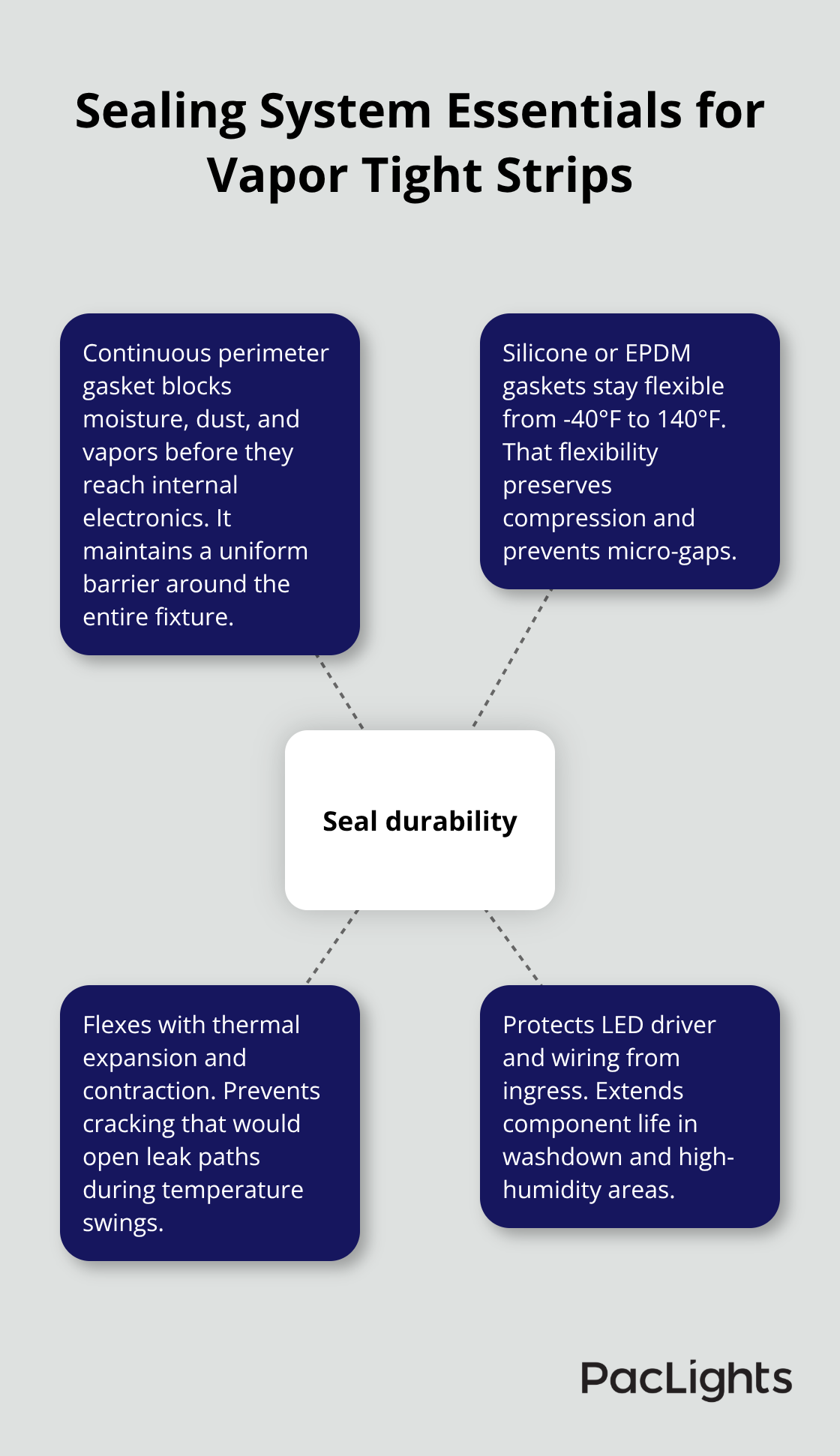
The perimeter gasket is where the real durability happens. Continuous gaskets around the entire fixture seal out moisture, dust, and vapors before they reach the LED driver and wiring. These gaskets are typically made from silicone or EPDM rubber, which maintain flexibility across temperature swings from -40°F to 140°F. When temperature shifts occur, materials expand and contract at different rates. A rigid gasket cracks under this stress, but a flexible gasket accommodates the movement and keeps the seal intact.
IP65 and IP66 ratings define this protection level according to IEC 60529 standards. IP65 means the fixture resists water jets from any direction and dust cannot enter in quantities that interfere with operation. IP66 goes further, handling direct washdowns and temporary submersion up to 10 minutes. For food processing plants or car washes where high-pressure cleaning happens regularly, IP66 is non-negotiable.
LED Drivers That Withstand Vibration and Impact
Vibration resistance comes from the fixture’s internal design and mounting system. Most vapor tight strips use shock-resistant LED drivers rated for IK10 protection, which means they withstand direct impacts of up to 20 joules without component failure. The housing itself is reinforced with ribs and support structures that prevent flexing during equipment operation. Stainless steel mounting brackets and corrosion-resistant hardware eliminate another failure point.
Facilities that switch from fluorescent fixtures to LED vapor tight strips immediately notice reduced maintenance calls because vibration no longer causes ballast failures or flickering. Fluorescent ballasts are electromagnetic devices that vibrate sympathetically with machinery, shortening their lifespan to 3,000-5,000 hours in high-vibration areas. LED drivers are solid-state components without moving parts, so they ignore vibration.
Condensation Control and Long-Term Reliability
The sealed construction also protects against condensation, which forms when warm air inside the fixture meets cold surfaces during temperature swings. Anti-condensation vents or pressure-equalization features in quality vapor tight strips allow air exchange while blocking moisture. Without this feature, water droplets accumulate inside the lens, reducing light output and eventually corroding internal connections.
Choosing fixtures with these specific features rather than generic sealed enclosures makes the difference between equipment lasting 50,000 hours and equipment failing prematurely. The combination of material selection, gasket design, vibration-resistant drivers, and condensation control creates a system that performs reliably in the most demanding industrial settings. Understanding how these components work together helps facility managers identify which vapor tight strips will actually survive their specific environment-a critical step before evaluating performance in real-world conditions.
How Vapor Tight Strips Perform Under Real Industrial Stress
Materials That Survive Chemical and Moisture Exposure
Vapor tight strips face their true test in environments where corrosion and vibration operate simultaneously. Food processing facilities experience both high-humidity conditions and constant equipment vibration from conveyors and machinery. Chemical plants expose fixtures to airborne vapors that corrode standard aluminum housings within months. Car washes subject lighting to salt spray, high-pressure washdowns, and thermal shock from temperature swings exceeding 50 degrees in a single day.
Fiberglass-reinforced polyester housings outperform polycarbonate in these environments because they resist both moisture and chemical solvents. A manufacturing facility handling petroleum-based coolants cannot use polycarbonate fixtures; the material degrades within 18 months as oils penetrate the housing and compromise seals. Fiberglass housings remain chemically inert. Stainless steel mounting hardware matters equally-standard steel brackets rust in humid environments, creating corrosion pathways that eventually reach internal wiring. Facilities that specify NEMA 4X ratings for corrosion resistance or fiberglass construction report 40–50% fewer maintenance calls compared to those using standard sealed enclosures.
Vibration Tolerance in High-Impact Operations
Vibration tolerance separates reliable installations from chronic problem sites. Woodworking shops with large table saws and sanders produce continuous vibration that destroys fluorescent ballasts within 6,000 operating hours, but LED vapor tight strips with solid-state drivers routinely exceed 50,000 hours in the same environment. A beverage bottling line operates at frequencies between 10–60 Hz, vibration ranges where electromagnetic ballasts resonate and fail prematurely.
IK10-rated vapor tight fixtures absorb these impacts without component degradation because shock-resistant drivers and reinforced housings distribute impact forces across the entire assembly rather than concentrating stress on single connection points. The cost difference is substantial-a 4-foot LED vapor tight strip costs $150–250 installed, while replacing damaged fluorescent fixtures across a 10,000-square-foot facility costs $3,000–5,000 annually.
Temperature Swings and Condensation Control
Cold storage facilities present a different durability challenge: temperature gradients between -20°F inside and 70°F outside create condensation inside poorly sealed fixtures within weeks. Quality vapor tight strips with pressure-equalization vents prevent this by allowing air exchange while blocking moisture. Without this feature, internal corrosion begins immediately.
Facilities switching from fluorescent to LED vapor tight strips in cold storage report zero condensation failures, whereas fluorescent installations required lens replacement every 12–18 months due to internal fogging. Material selection, internal protection design, and vibration resistance work together to create systems that survive where standard fixtures fail within months. These performance advantages translate directly into maintenance schedules and replacement cycles-understanding how your facility’s specific environment stresses lighting fixtures helps identify which vapor tight strips will actually protect your operation.
Keeping Vapor Tight Strips Working at Peak Performance
Inspection Schedules That Catch Problems Early
Vapor tight strips demand far less maintenance than fluorescent systems, but neglecting them accelerates corrosion and seal degradation. Facilities in corrosive environments should conduct quarterly inspections, while standard industrial settings need semi-annual checks. Start each inspection by examining the gasket perimeter for cracks, discoloration, or separation from the housing. A gasket that has pulled away from the fixture edge allows moisture to seep behind it, compromising the seal within weeks. Check mounting hardware for rust or white corrosion deposits, which indicate that stainless steel fasteners were not used or that galvanic corrosion has begun where dissimilar metals contact. Inspect the lens for internal fogging or water droplets, a sign that pressure-equalization vents are blocked or failing.
Cleaning Procedures That Preserve Fixture Integrity
Clean lens surfaces monthly in facilities with heavy dust or chemical airborne particles, as accumulated grime reduces light output by 15–25% and traps moisture against the lens surface. Use a soft cloth with mild soap and water for polycarbonate housings, but switch to fiberglass-safe cleaners for fiberglass-reinforced polyester fixtures exposed to oils or solvents. Never use abrasive pads or harsh chemicals that degrade gasket materials or lens coatings. This simple maintenance routine prevents the buildup that accelerates corrosion and extends the interval between major repairs.
Repair Versus Replacement Decisions
Replacement becomes necessary when gaskets no longer compress fully when tightened, when corrosion penetrates the housing material itself, or when internal components show visible damage after impact. A fixture with a compromised gasket but intact housing and working LED driver costs $60–120 to repair through gasket replacement, whereas a new fixture costs $150–300. However, if corrosion has spread to the mounting bracket or housing shows cracks, replacement is the only reliable option because repair costs approach 70% of new fixture pricing and the underlying material damage will continue degrading. In high-vibration environments, inspect mounting brackets and fasteners every six months because vibration can loosen connections even with corrosion-resistant hardware.
Documentation and Predictive Maintenance
Document each inspection with photos and notes about gasket condition, corrosion presence, and any repairs performed. This record helps predict failure patterns specific to your environment and justifies equipment replacement budgets when fixtures reach end-of-life after 50,000 operating hours. Facilities that establish quarterly inspection routines and address gasket or fastener issues immediately report 40–50% fewer emergency maintenance calls compared to those relying on reactive repairs. The investment in systematic inspection pays dividends through reduced downtime and extended fixture lifespan.
Final Thoughts
Vapor tight strips durability depends on three factors working together: material selection, engineering design, and maintenance discipline. Facilities that specify fiberglass-reinforced polyester housings with continuous gaskets and IK10-rated drivers eliminate the corrosion and vibration failures that plague standard sealed enclosures. A manufacturing facility switching from fluorescent fixtures to LED vapor tight strips reduces maintenance calls by 40–50% annually while extending equipment lifespan from 12,000–15,000 hours to 50,000 hours or more.
The financial case proves equally compelling. A single vapor tight strip costs $150–250 installed, but chronic maintenance in corrosive or high-vibration environments reaches $3,000–5,000 annually across a typical facility. Over a 10-year period, the difference between reactive repairs and preventive fixture selection amounts to tens of thousands of dollars, with payback occurring within 18–24 months through reduced downtime and eliminated emergency service calls.
Matching fixture specifications to your environment determines long-term reliability. Food processing plants and car washes need IP66 ratings and fiberglass construction; woodworking shops and beverage lines need IK10 vibration protection; chemical facilities need NEMA 4X corrosion resistance. We at PacLights offer customizable vapor tight and vapor proof lighting solutions tailored to your specific durability requirements, plus free lighting layout designs and ROI assessments to validate your investment.
Disclaimer: PacLights is not responsible for any actions taken based on the suggestions and information provided in this article, and readers should consult local building and electrical codes for proper guidance.