

Large spaces demand lighting that works as hard as the facilities themselves. Industrial cylinder pendant lights deliver the brightness and reliability needed to keep warehouses, manufacturing floors, and commercial buildings operating at full capacity.
At PacLights, we’ve seen firsthand how the right lighting solution cuts energy costs while improving safety and visibility across sprawling work environments. This guide covers what makes these fixtures the practical choice for industrial operations.
Why Industrial Cylinder Pendants Outperform Other Fixtures
Uniform Light Distribution Across Large Areas
Industrial cylinder pendant lights excel at covering large floor areas with uniform brightness because their cylindrical form distributes light efficiently across extended spaces without creating dead zones or excessive shadows. A warehouse averaging 30 foot-candles of illumination-the standard recommended by the Illuminating Engineering Society for general industrial work-requires careful fixture spacing to prevent costly under-illumination or energy waste.
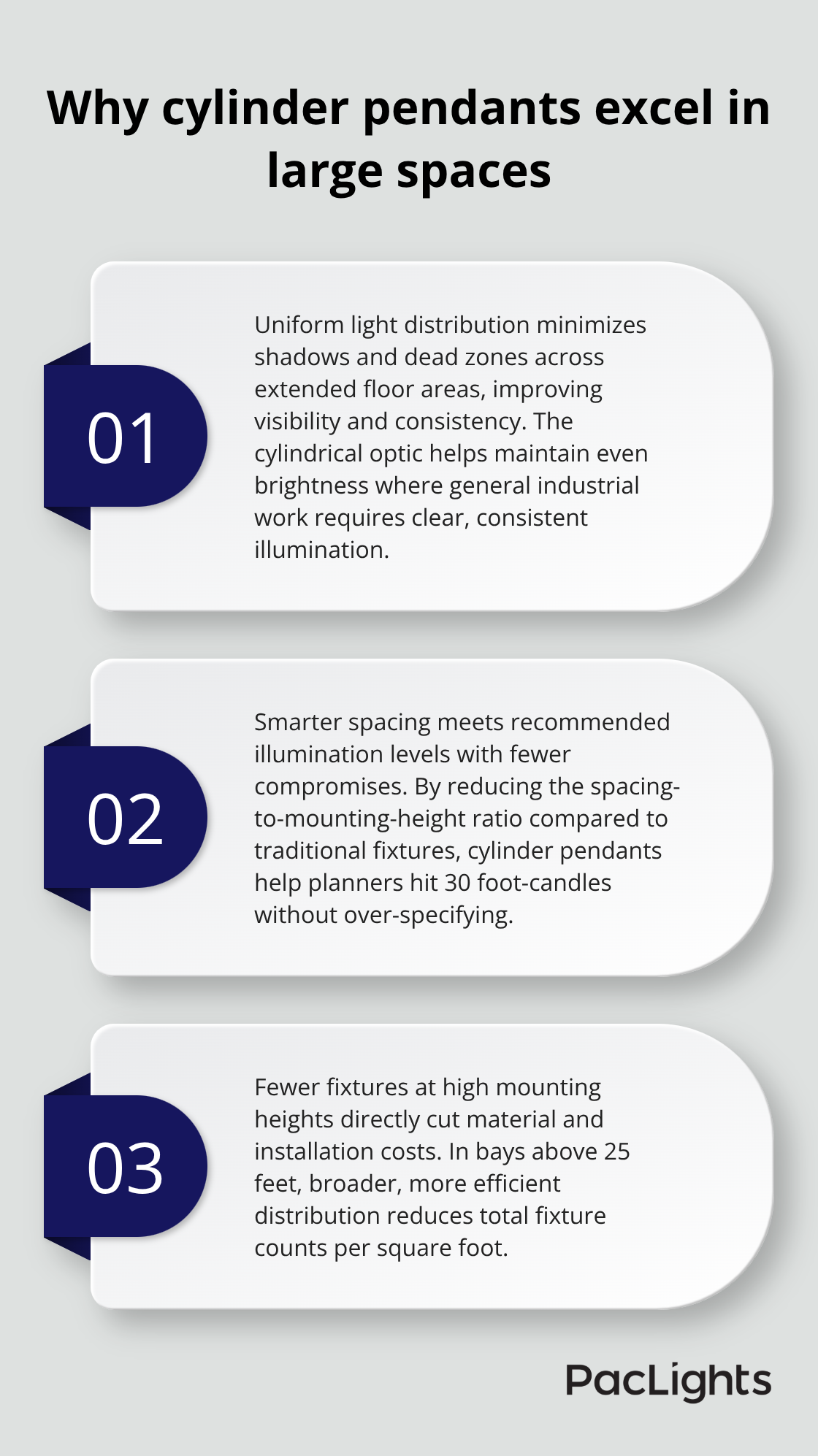
Cylinder pendants outperform other commercial fixtures through precise optical design: their form factor allows light to spread consistently in multiple directions, reducing the spacing-to-mounting-height ratio needed compared to traditional fixtures. For high-bay spaces with mounting heights above 25 feet, this efficiency translates to fewer fixtures required per square foot, directly lowering material and installation costs.
Energy Savings That Impact Your Bottom Line
LED industrial lighting delivers over 50 percent energy savings compared to fluorescent or HID alternatives, and cylinder pendants amplify this advantage when paired with smart controls like daylight harvesting and occupancy sensors that automatically dim or switch off lights when spaces sit empty. The long operational life of LED cylinder fixtures reduces maintenance downtime and replacement frequency across extensive installations-a critical factor when lighting failures disrupt production schedules or compromise worker safety. Cost-effectiveness extends beyond energy consumption; when you calculate total cost of ownership over a five to ten year period, the combination of lower energy bills, reduced maintenance labor, and fewer replacement cycles makes industrial cylinder pendants the practical choice over alternatives that demand frequent bulb changes or consume significantly more power.
Built to Withstand Demanding Conditions
Durability in harsh environments separates industrial-grade cylinder pendants from standard commercial fixtures. These units feature robust construction materials and industrial-grade mounting kits designed to withstand vibration, temperature fluctuations, and demanding work conditions found in manufacturing facilities and distribution centers. Vandal-resistant designs protect fixtures in tough environments where equipment movement and high activity levels pose damage risks. Many cylinder pendants carry IP ratings such as IP69K, indicating suitability for wet locations and washdown areas common in food processing or automotive manufacturing.
The real test of any industrial lighting solution comes when you apply it to actual work environments. Warehouses, manufacturing floors, and retail spaces each present unique challenges that cylinder pendants address with proven performance.
Design Features and Installation Considerations
Robust Construction Materials That Resist Corrosion
Industrial cylinder pendant lights succeed in demanding environments because manufacturers engineer them with materials and construction methods that withstand constant vibration, temperature swings, and physical stress. Steel and aluminum construction with powder-coated finishes resist corrosion in humid warehouses and chemical-exposed manufacturing floors, while stainless steel options handle the most aggressive washdown conditions in food processing or automotive plants. The finish quality matters significantly: a quality powder coat applied to properly prepared metal surfaces lasts 10-15 years in harsh indoor conditions without degradation, whereas cheaper finishes chip and corrode within 2-3 years, forcing expensive replacements.
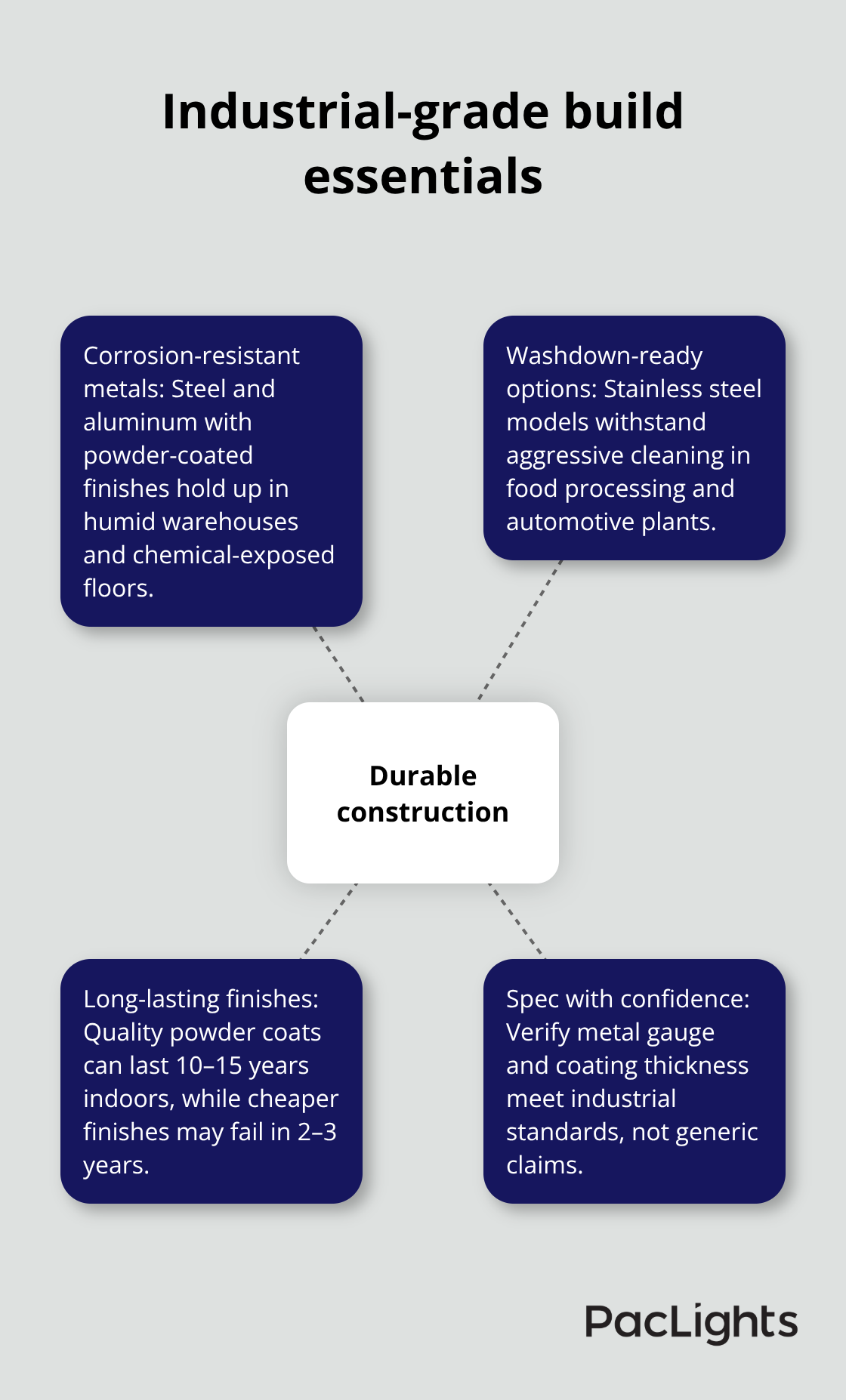
When selecting fixtures, verify the gauge of the metal housing and confirm the coating thickness meets industrial standards rather than accepting generic durability claims.
Flexible Mounting Options for Varying Ceiling Heights
Mounting flexibility determines whether your facility can actually install cylinder pendants across varying ceiling heights and conditions. Industrial-grade mounting kits accommodate high vaulted ceilings above 25 feet and sloped ceilings common in older warehouses, with tilting canopy or sloped canopy options keeping fixtures aligned even when roof angles shift. Standard pendant suspension works for flat ceilings, but facilities with mixed ceiling heights need adjustable kits that accept different drop lengths without requiring custom fabrication or multiple fixture types.
Energy Efficiency Through Proper Spacing and Layout
Proper fixture spacing based on your specific mounting height prevents overcrowding that wastes energy and creates uneven lighting patterns. High-bay spaces typically require a spacing-to-mounting-height ratio of 1.0 or less, meaning fixtures spaced no farther apart than your mounting height; low-bay spaces below 25 feet can accommodate slightly looser spacing. Conduct a lighting audit before installation to measure current illumination levels and calculate exact fixture counts needed for your space dimensions, ceiling height, and work type. This assessment reveals opportunities to optimize your layout and avoid costly over-specification.
Maintenance Access and Service Considerations
Maintenance access matters significantly when planning your installation strategy. Position fixtures so maintenance crews can safely reach them for occasional cleaning and lamp inspection, and select models with accessible wiring compartments that don’t require complete fixture removal for basic service. These practical decisions during the design phase reduce downtime and labor costs throughout the fixture’s operational life. With the right construction materials and installation approach in place, your facility is ready to evaluate how cylinder pendants perform across specific work environments.
Real-World Applications Where Cylinder Pendants Deliver Results
Warehouses: Eliminating Dark Zones and Safety Hazards
Warehouses operating around the clock depend on consistent illumination to maintain safety and productivity across thousands of square feet. Industrial cylinder pendants excel in these environments because their uniform light distribution eliminates the dark corners and shadows that create safety hazards and slow operations. A typical warehouse measuring 100 feet by 200 feet with 30-foot ceilings needs roughly 60 to 80 cylinder pendants spaced at 25-foot intervals to achieve the 30 foot-candles standard recommended by the Illuminating Engineering Society for general warehouse work. The math matters here: improper spacing either wastes energy through over-specification or leaves blind spots where workers struggle to read labels and identify hazards. Distribution centers handling time-sensitive shipments particularly benefit from the reduced maintenance downtime LED cylinder fixtures provide compared to traditional high-intensity discharge lamps that require frequent ballast replacements and burn out unpredictably.
Manufacturing Floors: Withstanding Vibration and Temperature Stress
Manufacturing floors present harsher conditions where vibration from heavy machinery and temperature swings from production processes test fixture durability constantly. Cylinder pendants with proper industrial-grade mounting withstand these conditions without loosening or misaligning, maintaining consistent light distribution week after week. Production environments where precision work demands high visual clarity benefit from selecting fixtures with a color rendering index above 80 and color temperatures between 4000K and 5000K (which improve contrast and reduce eye strain during detailed assembly or quality inspection tasks).
Retail Spaces: Balancing Aesthetics with Function
Retail and commercial buildings use cylinder pendants differently, prioritizing aesthetic appeal alongside function. A showroom with 20-foot ceilings might use smaller cylinder pendants in clusters to create visual interest while maintaining 50 to 75 foot-candles across merchandise displays. Retail applications demand flexibility: smart controls with dimming capabilities allow staff to adjust light levels for different times of day and product presentations without installing additional fixtures. The energy impact compounds quickly in retail spaces open 12 to 16 hours daily. LED cylinder pendants with daylight harvesting sensors can reduce energy consumption by 30 to 40 percent in spaces with significant window exposure, offsetting artificial light output when natural daylight suffices.
Commercial Buildings: Layering Light for Comfort and Design
Commercial office buildings increasingly specify cylinder pendants for lobbies and conference areas where durability meets design expectations. The practical advantage comes from selecting fixtures that accommodate both downlighting and uplighting options, allowing designers to layer illumination that reduces glare on screens while maintaining ambient brightness for general visibility.
Final Thoughts
Industrial cylinder pendant lights outperform traditional high-intensity discharge lamps and standard commercial pendants across three measurable dimensions: uniform light distribution that eliminates dark zones, energy savings exceeding 50 percent when paired with daylight harvesting and occupancy sensors, and industrial-grade construction that withstands vibration and harsh washdown conditions without frequent maintenance cycles. The total cost of ownership over five to ten years favors cylinder pendants significantly, as HID fixtures require unpredictable ballast replacements that disrupt production schedules, while cheaper commercial options lack the robust construction and IP ratings needed for demanding environments. Your facility gains measurable improvements in safety, visibility, and operational costs when you select fixtures engineered for industrial performance rather than standard commercial applications.
Start your selection process with a lighting audit that measures your current illumination levels and calculates exact fixture requirements based on ceiling height and work type. Verify that fixtures feature industrial-grade construction with quality powder-coated finishes, confirm mounting options accommodate your ceiling heights, and check that color temperature and CRI ratings match your specific tasks.
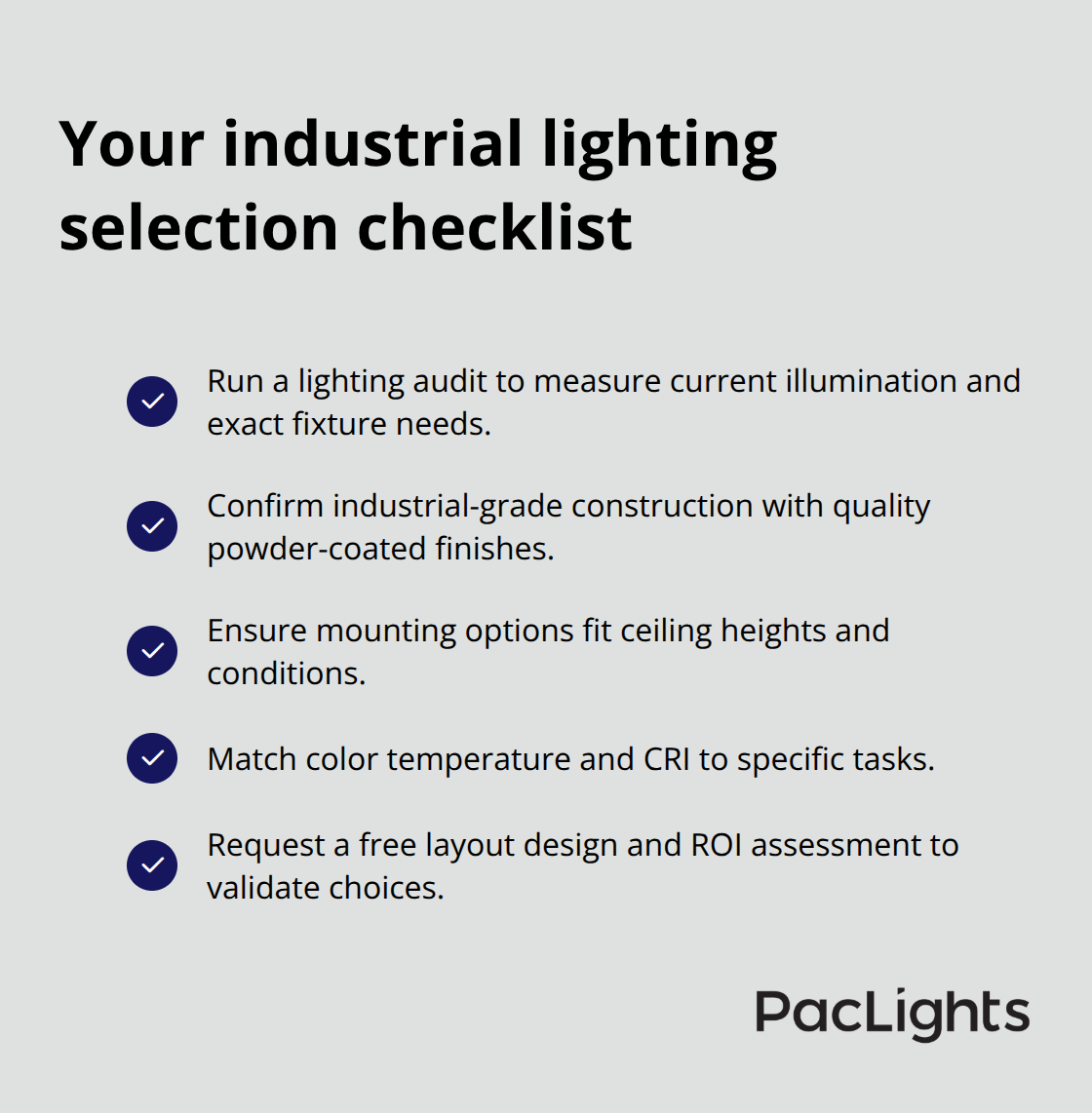
We at PacLights offer free lighting layout designs and ROI assessments to help you make informed decisions tailored to your facility’s unique needs.
Disclaimer: PacLights is not responsible for any actions taken based on the suggestions and information provided in this article, and readers should consult local building and electrical codes for proper guidance.