

Server room lighting controls have a direct impact on your data center’s energy bills, equipment lifespan, and operational safety. Most facilities still rely on manual switches, which wastes energy and creates blind spots in critical environments.
At PacLights, we’ve seen firsthand how networked lighting management transforms server room operations. Modern control systems deliver real-time visibility, automated efficiency, and measurable cost savings that manual setups simply cannot match.
The Real Cost of Server Room Lighting
Lighting in server rooms consumes 20 to 30 percent of total facility power, making it one of your largest controllable energy expenses. If your facility spends $50,000 annually on lighting energy, that figure alone justifies immediate attention. The US International Energy Agency reported that data centers consumed 183 TWh in 2024, roughly 4 percent of total US electricity usage, and lighting represents a significant portion of that consumption. Most server rooms are over-lit at 400 to 500 lux when 200 to 300 lux suffices for safe operation, meaning you’re paying for illumination you don’t need. A typical 24/7 server room running a 500W fluorescent system consumes around 4,380 kWh annually. Switching to LED fixtures drops that to roughly 440 kWh per year, saving approximately $527 at standard rates of $0.12 per kilowatt-hour. That’s real money, and it compounds over time.
Temperature and Equipment Reliability
Lighting heat directly drives cooling costs, which account for 30 to 50 percent of total facility energy consumption. Every watt your lights generate becomes a watt your cooling system must remove, inflating both your power bill and your carbon footprint simultaneously. LED fixtures emit significantly less heat than fluorescent or incandescent sources, so reducing lighting power by 40 to 50 percent via LED conversion can lower cooling load by 5 to 10 percent, delivering additional savings of roughly $8,000 to $15,000 annually for mid-sized operations. This cooling benefit is not marginal; it’s a direct multiplier on your energy savings. Overheated equipment fails faster, and failure in a server room means downtime that costs far more than any lighting investment. Better thermal management through efficient lighting extends equipment lifespan and reduces unexpected failures.
Safety, Visibility, and Maintenance Speed
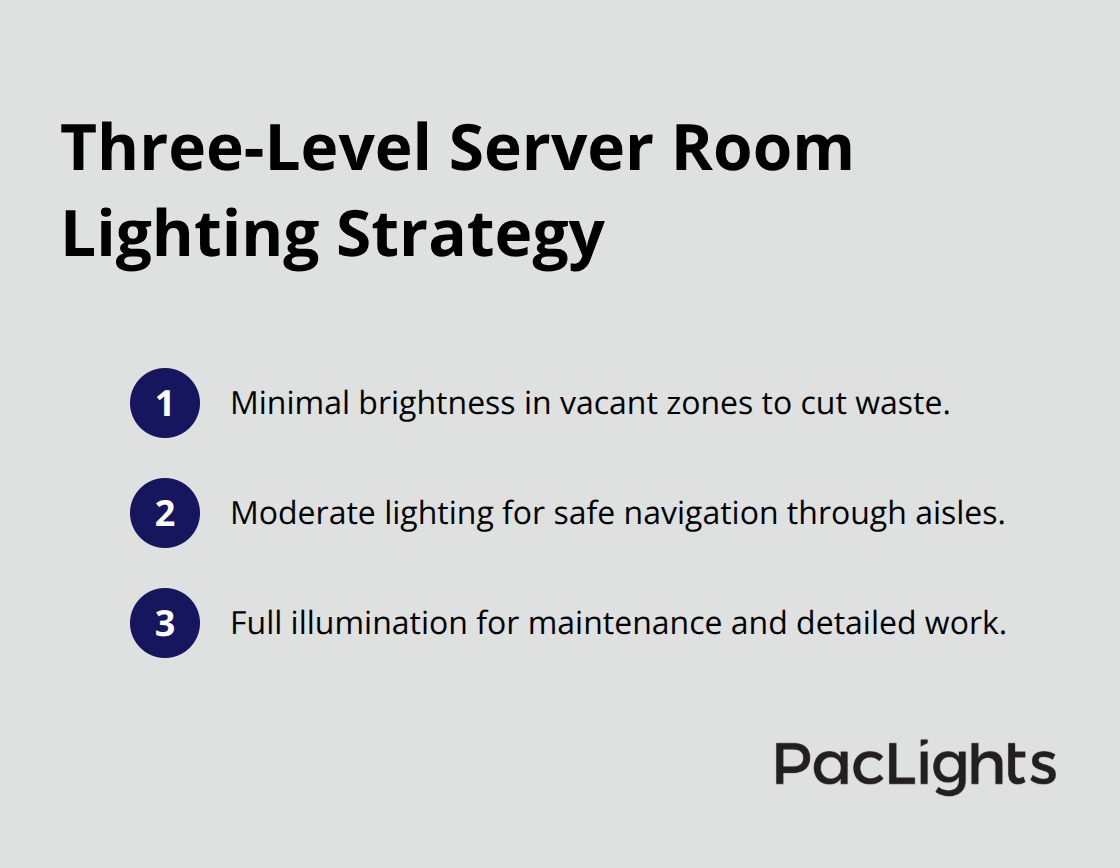
Manual switch-based lighting creates dark zones and inconsistent visibility across aisles, slowing troubleshooting and increasing technician errors during critical repairs. Proper aisle lighting at 500 lux in work areas supports cable connections, equipment labeling, and rapid fault identification. Networked lighting systems detect equipment failures 20 to 30 days earlier than manual inspections, reducing emergency dispatches by about 60 percent and preventing cascading outages. Visibility also matters for security and compliance; NFPA 101 emergency lighting requirements mandate illuminated exit paths and minimum lighting levels during power outages. A three-level lighting strategy-minimal brightness in vacant zones, moderate for safe navigation, and full illumination for maintenance work-meets code while cutting waste. Better visibility reduces mean time to repair, keeps technicians safer, and prevents the costly mistakes that happen in poorly lit environments.
These cost and safety realities set the stage for a fundamental shift in how you manage server room lighting. The transition from manual switches to automated controls addresses each of these pain points directly, transforming lighting from a fixed expense into a variable cost that shrinks as your systems become smarter.
Manual Switches Waste Energy and Hide Operational Problems
Traditional switch-based lighting management forces technicians to manually turn fixtures on and off, a system that wastes enormous amounts of energy and creates operational blind spots. Most server rooms stay lit 24/7 because switching everything off manually is impractical, even when aisles sit empty for hours. A facility with rarely visited zones might run lights continuously when motion sensors could cut runtime from 8,760 hours annually to roughly 2,000 hours-a reduction of about 77 percent. Motion sensors cost between $50 and $150 per unit and cut lighting energy by 20 to 35 percent simply by turning fixtures off when nobody is present. Dimmable fixtures let you adjust brightness during different operational phases, cutting energy waste during low-activity periods while maintaining safety. Without these controls, technicians have no visibility into which areas consume the most power, where over-lighting exists, or when equipment needs maintenance. Manual systems also fail to coordinate with cooling systems, missing the opportunity to reduce HVAC load when lighting heat drops. The result is predictable: energy waste compounds, maintenance becomes reactive rather than preventive, and equipment failures happen without warning.
How Networked Systems Separate Control from Hardware
Networked lighting systems separate physical fixtures from operational management, enabling instant adjustments across thousands of luminaires without rewiring a single cable. Each fixture becomes a networked node with edge microcontrollers and sensors that monitor occupancy, daylight, and local conditions in real time. A centralized software platform aggregates data from all fixtures and integrates with building management systems via DALI, Modbus, or BACnet protocols, creating a unified energy dashboard with remote access to policies and troubleshooting.
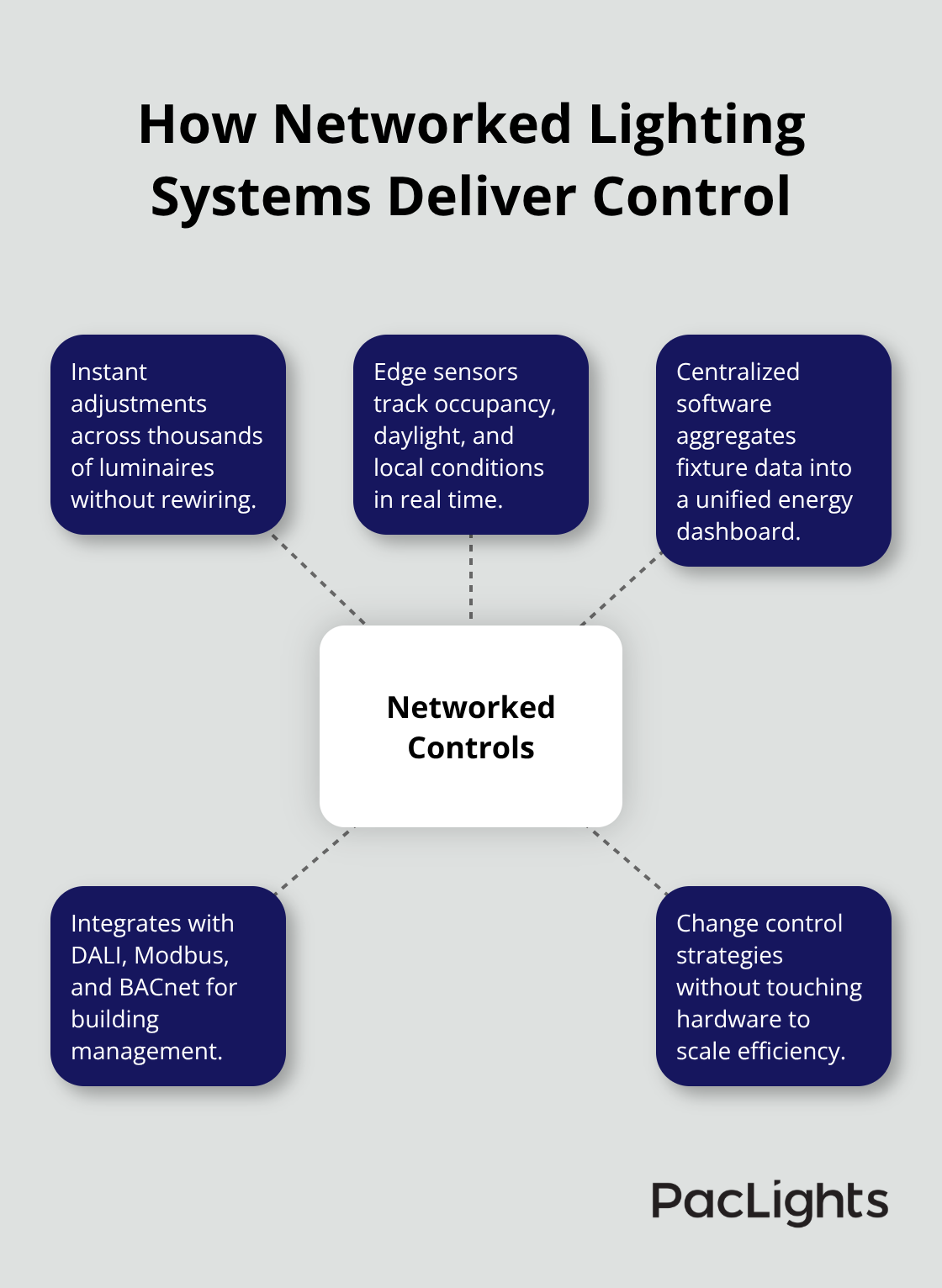
This separation means you can change control strategies without touching hardware, scaling efficiency across your entire facility in minutes rather than weeks.
Real-Time Data Reveals Energy Hotspots
Real-time luminaire-level energy monitoring highlights hotspots, typically server aisles and 24/7 equipment rooms, guiding targeted optimizations where they matter most. Occupancy-based dimming responds in seconds, and daylight harvesting adjusts automatically when ambient light suffices, eliminating manual oversight. Predictive maintenance alerts flag thermal issues, sensor faults, and fixture degradation 20 to 30 days earlier than manual checks, reducing emergency dispatches by roughly 60 percent. You see exactly where energy flows and where waste accumulates, transforming lighting from a black box into a measurable operational asset.
Measurable Savings and Rapid Payback
Typical energy savings with centralized controls range from 30 to 65 percent, with many deployments achieving around 50 percent reductions. A Malaysian facility with 300 motion-sensor luminaires cut on-site maintenance visits by 80 percent, translating directly to lower labor costs and faster response times. Installing networked controls in a mid-sized data center typically costs $8,000 to $20,000, with payback occurring in 2 to 3 years from energy savings alone, often much faster when combined with LED retrofits. These numbers show that networked management is not a luxury-it’s a financial decision that pays for itself while improving reliability and safety.
The shift from manual switches to networked controls addresses the core inefficiencies that plague traditional server room lighting. Once you understand how much energy and labor manual systems waste, the case for automation becomes undeniable. The next step is understanding how to integrate these networked systems with your existing infrastructure and what protocols work best for your facility’s specific needs.
How Networked Controls Transform Server Room Visibility
Real-Time Data Reveals What Manual Systems Hide
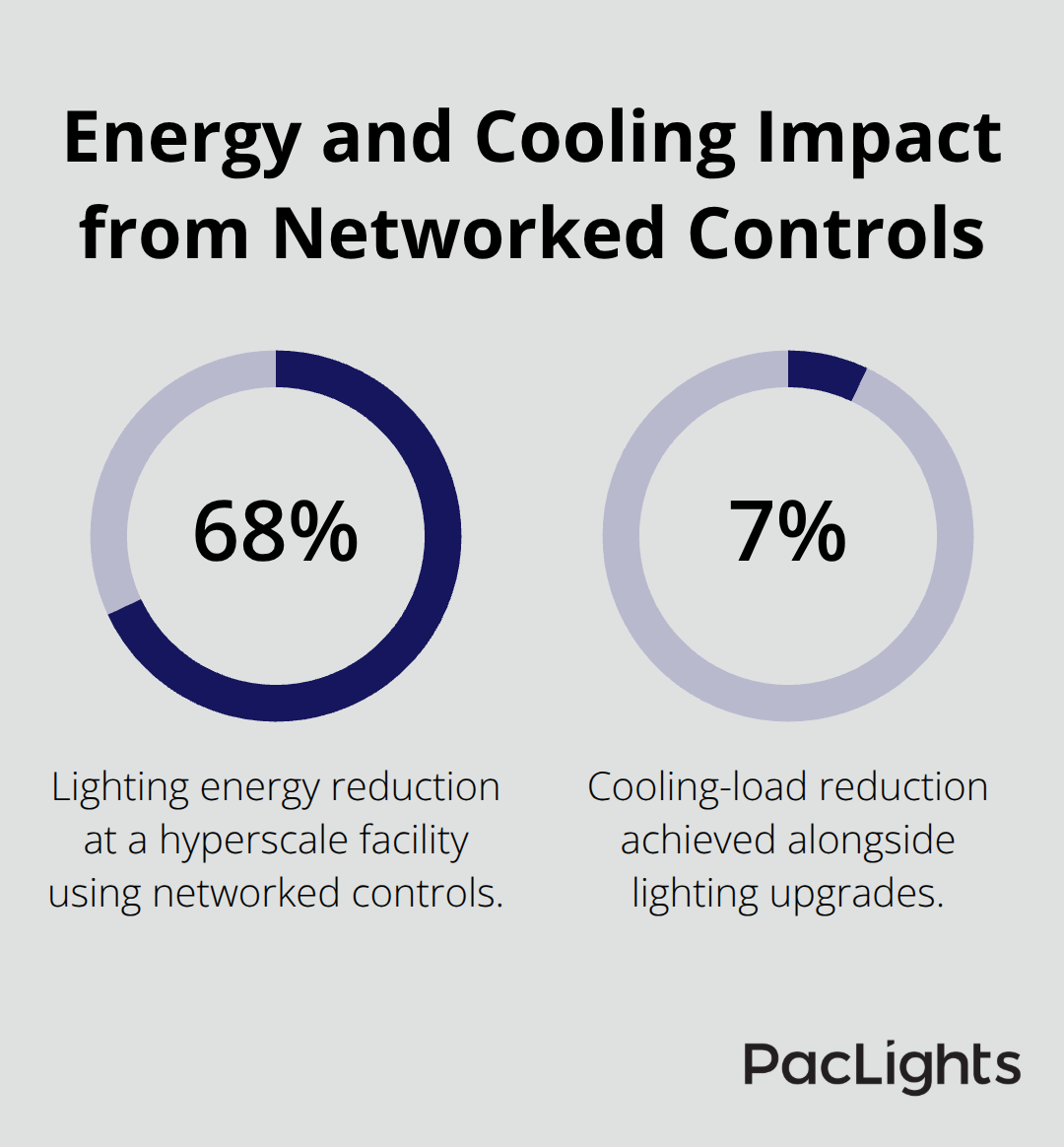
Networked lighting management puts operational data into your hands immediately. Instead of guessing which zones consume the most energy or when equipment needs attention, you monitor every fixture’s performance from a centralized dashboard. Each luminaire reports occupancy, daylight levels, power consumption, and sensor health continuously, creating a complete picture of your lighting ecosystem in real time. A hyperscale facility in Southeast Asia achieved a 68 percent reduction in lighting energy and a 7 percent cooling-load reduction by implementing networked controls, with payback occurring around 20 months and annual savings reaching roughly $220,000. Those results stem directly from seeing exactly where energy flows and responding instantly.
Remote Management and Instant Adjustments
Remote management lets you adjust brightness, occupancy thresholds, and scheduling from anywhere without dispatching technicians to racks. Zone-level adjustments happen in seconds. Occupancy-based dimming responds faster than motion sensors alone, and daylight harvesting adapts automatically when natural light suffices, eliminating manual oversight entirely. Integration with building management systems via DALI, Modbus, or BACnet protocols creates a unified energy dashboard where lighting data flows directly into your facility’s central control platform. This integration matters because lighting and cooling interact constantly; reducing lighting heat by 40 to 50 percent lowers cooling demand by 5 to 10 percent, and networked controls coordinate both systems automatically. You see HVAC load drop as lighting efficiency improves, reinforcing the financial case for investment.
Predictive Maintenance Prevents Failures
Predictive maintenance alerts flag thermal issues and sensor degradation 20 to 30 days before failures occur, preventing emergency calls and unplanned downtime. Networked systems detect equipment failures far earlier than manual inspections, reducing emergency dispatches by roughly 60 percent. Real-time luminaire-level monitoring highlights energy hotspots in server aisles and 24/7 equipment rooms, guiding targeted optimizations where they deliver the highest return. A Malaysian facility with 300 motion-sensor luminaires cut on-site maintenance visits by 80 percent, translating directly to lower labor costs and faster response times.
Financial Payback and Energy Savings
The financial payback accelerates when you combine networked controls with LED retrofits and occupancy sensors. A facility spending $50,000 annually on lighting energy can recover $20,000 to $30,000 in the first year through networked management alone, with installation costs typically ranging from $8,000 to $20,000 for mid-sized data centers. That’s payback in 2 to 3 years, often faster when LED power reductions compound the savings. Typical energy savings with centralized controls range from 30 to 65 percent, with many deployments achieving around 50 percent reductions. This combination of energy savings, labor reduction, and prevented downtime creates a financial case that justifies the investment immediately.
Scalability Without Rewiring
Cloud-based networked controls enable remote management across thousands of fixtures, supporting scalable server-room management as your facility expands. Modular lighting designs prevent expansion bottlenecks and can speed deployment timelines by 30 to 40 percent during growth. The separation of physical lighting infrastructure from operational management enables rapid scaling of control policies across thousands of fixtures without rewiring, supporting demand-response events and seasonal adjustments. This scalability means your lighting infrastructure grows with your business without constant redesign.
Final Thoughts
The transition from manual switches to networked server room lighting controls transforms how data centers operate and compete financially. Facilities combining LED fixtures with networked controls achieve 30 to 65 percent reductions in lighting energy consumption, with many deployments reaching 50 percent. A mid-sized data center spending $50,000 annually on lighting recovers $20,000 to $30,000 in the first year, and installation costs of $8,000 to $20,000 yield payback within 2 to 3 years. When cooling benefits compound the savings-reducing lighting heat by 40 to 50 percent lowers cooling load by 5 to 10 percent-the financial case strengthens dramatically.
Networked controls eliminate operational blind spots that manual systems perpetuate. Predictive maintenance alerts flag equipment degradation 20 to 30 days before failures occur, reducing emergency dispatches by roughly 60 percent, while real-time monitoring reveals energy hotspots and maintenance needs instantly. A Malaysian facility cut on-site maintenance visits by 80 percent after implementing motion-sensor luminaires, freeing technicians for higher-value work and accelerating response times across the facility.
We at PacLights offer free lighting layout designs and ROI assessments tailored to your facility’s specific needs, helping you quantify potential savings before committing to upgrades. Our energy-efficient fixtures, LED retrofit solutions, and advanced networked lighting controls work together to transform your server room into an optimized, data-driven operation. Contact us to plan your upgrade and see exactly how much you can save.
Disclaimer: PacLights is not responsible for any actions taken based on the suggestions and information provided in this article, and readers should consult local building and electrical codes for proper guidance.