

Choosing the wrong luminaire for a hazardous location can cost you thousands in compliance fines and put your team at serious risk. At PacLights, we’ve seen facilities struggle because they didn’t understand the specific requirements for their environment.
This guide walks you through hazardous location luminaire selection step by step. You’ll learn what classifications mean, which standards apply to your situation, and how to pick fixtures that actually work.
Understanding Hazardous Location Classifications
Class and Division Ratings Explained
OSHA defines hazardous locations as areas where fire or explosion hazards may exist due to flammable gases, vapors, combustible dust, or ignitable fibers. The NEC classifies these environments into three distinct classes, each with two divisions that determine how strictly you must specify your luminaires. Class I covers flammable gases and vapors found in petroleum refineries, gasoline storage areas, and LNG plants. Class II addresses combustible dust in grain elevators, flour mills, and facilities handling magnesium or aluminum powders. Class III involves ignitable fibers near machinery in textile mills, cotton gins, and sawdust operations.
Division 1 means the hazardous material is present during normal operations, while Division 2 means it exists but remains contained and controlled. This distinction matters because Division 1 requires far more robust equipment ratings than Division 2. Within Class I, you’ll encounter Groups A through D based on the specific substance: Acetylene, Hydrogen, Ethylene, and Propane respectively. Class II uses Groups E, F, and G for Metal Dusts, Carbonaceous Dusts, and Non-Conductive Dusts like flour and wood.
The Cost of Misclassification
Getting the class, division, and group wrong is expensive. Non-compliance leads to fines, mandatory replacements, and potential lawsuits. If you’re uncertain about your facility’s classification, consult your OSHA representative for an on-site determination rather than guessing.
Temperature Ratings Stop Fires Before They Start
Every luminaire in a hazardous location has a maximum surface temperature rating denoted by T-codes that must never exceed the Temperature Classification of the substances present. The NEC specifies six temperature classes: T1 allows surfaces up to 450°C, T2 up to 300°C, T3 up to 200°C, T4 up to 135°C, T5 up to 100°C, and T6 up to 85°C. A luminaire rated T4 cannot be used in an environment requiring T6 protection, even if everything else matches.
This single detail prevents ignition from surface heat contact with flammable materials. LED luminaires typically run cooler than traditional HID or incandescent fixtures, which gives you more flexibility in temperature-sensitive areas. When selecting fixtures, try matching the T-code to your specific environment’s requirements-don’t default to the lowest temperature rating available unless your hazard assessment actually requires it, as this unnecessarily limits your options and increases costs.
Match Your Fixture to What’s Actually in Your Space
Your facility likely contains one or more hazardous substances, and each demands a specific luminaire rating. An oil refinery with propane vapors needs Class I, Division 1 or 2 fixtures rated for Group D. A grain storage facility with flour dust needs Class II, Division 1 or 2 fixtures rated for Group G. The protection concept built into the luminaire-whether it’s flameproof enclosure design, increased safety measures, or type N construction-must align with your hazard class.
All electrical components, conduits, and switches should meet the highest-rated fixture standard in your area to stay compliant. If you’re unsure whether a storage area might become hazardous in the future, specify hazardous location lighting now rather than retrofitting later. The cost difference is minimal, but the compliance risk of using standard lighting in a space that later becomes classified as hazardous is substantial. Understanding your exact hazard profile sets the foundation for selecting the right certifications and standards that apply to your installation.
Key Compliance Standards and Certifications
UL 844: The North American Baseline
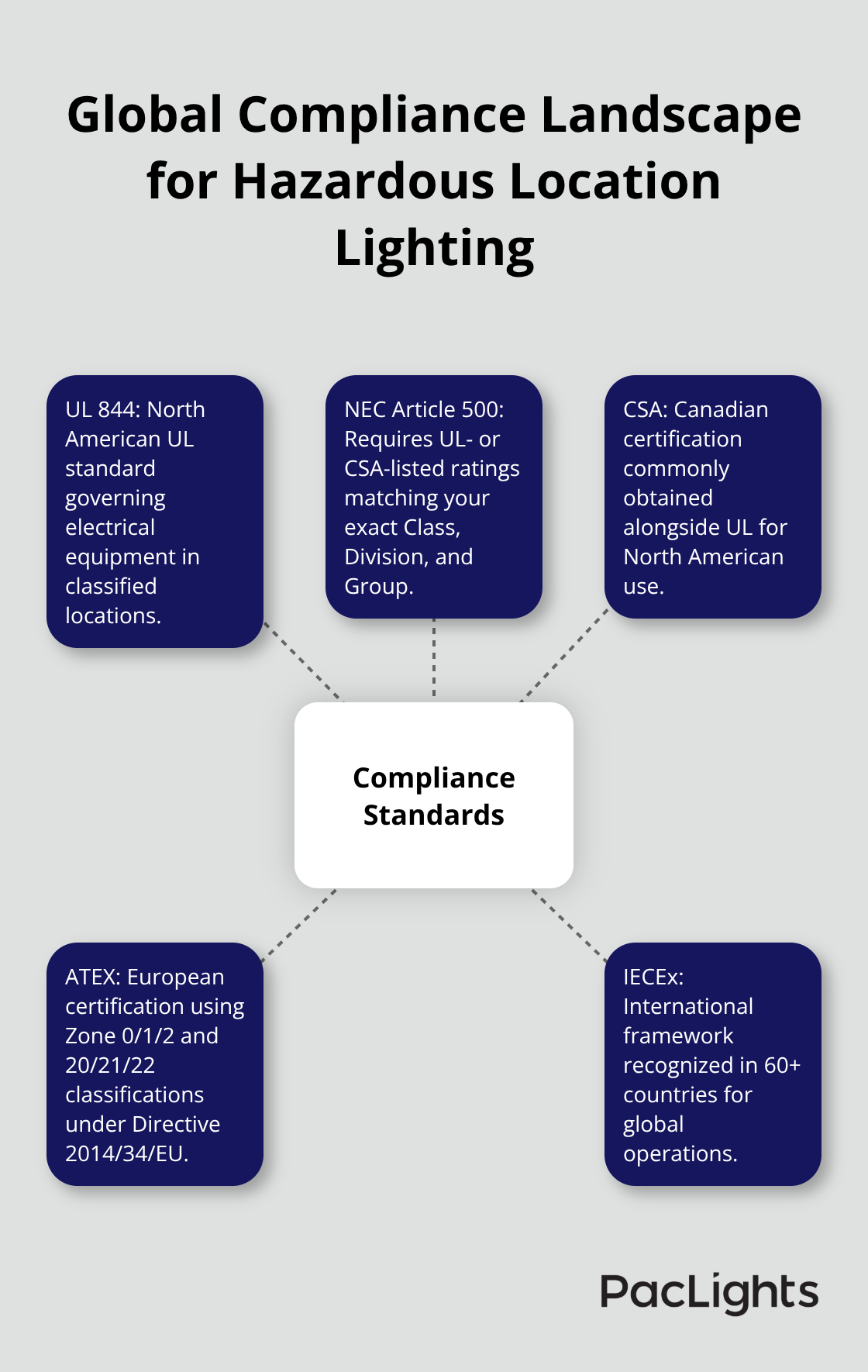
UL 844 is the standard you must verify first when sourcing hazardous location luminaires in North America. This UL standard covers electrical equipment for use in hazardous classified locations and sets the benchmark that manufacturers must meet before their fixtures can legally be sold in the United States. CSA (Canadian Standards Association) requires equivalent certification for Canadian facilities, and most manufacturers obtain both UL and CSA approval simultaneously to serve both markets. When you receive a luminaire specification sheet, check whether it carries both UL 844 and CSA certification marks-if either is missing, that fixture cannot be legally installed in your facility regardless of other features.
NEC Article 500 and Your Specific Classification
NEC Article 500 does not create its own certification; instead, it references UL standards and requires that all electrical equipment in hazardous locations meet UL-listed or CSA-certified ratings that match your specific Class, Division, and Group. Your luminaire’s label must display the exact Class and Division rating your hazard assessment determined, not a broader rating that happens to include your classification. Many facilities accept equipment rated for Class I, Division 1 when their space only requires Class I, Division 2-while this technically works, you pay premium prices for unnecessary robustness.
International Standards: ATEX, IECEx, and Beyond
Outside North America, the standards shift significantly and compliance becomes regional. Europe enforces ATEX (Atmosphères Explosibles) certification under Directive 2014/34/EU, which uses a Zone classification system (Zone 0, 1, or 2 for gases; Zone 20, 21, or 22 for dust) rather than the NEC’s Class and Division approach. IECEx provides a global certification framework recognized in over 60 countries, making it valuable if your organization operates internationally or plans expansion.
The temperature classification system remains consistent across standards-T1 through T6-but the documentation requirements and marking conventions differ between ATEX and NEC specifications.
Managing Multiple Regional Requirements
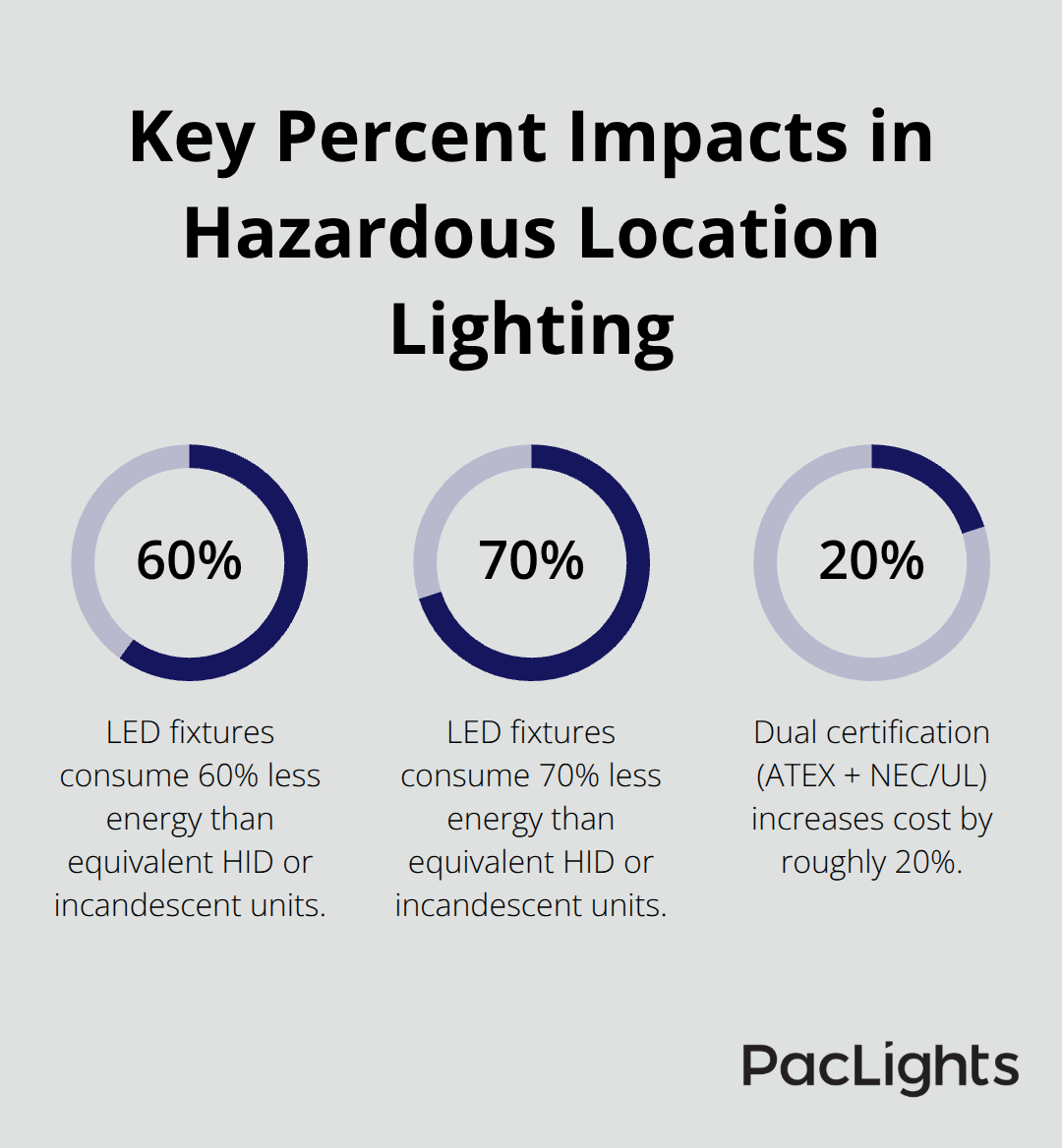
If your facility imports equipment or has international operations, specify that suppliers provide dual certification (both ATEX and NEC/UL) where possible, though this increases cost by roughly 15–20 percent. HSE (Health and Safety Executive) guidance in the UK requires ATEX compliance but also references BS EN 60079 series standards for detailed equipment selection. For facilities operating in multiple regions, identify the most stringent standard applicable and specify that baseline across all locations rather than maintaining different luminaire inventories by region.
Verification and Documentation Matter
Always request the actual certification documentation from your supplier-not just the product brochure-and verify the certificate number matches the luminaire model you’re purchasing, as counterfeit certifications and mislabeled equipment remain persistent problems in industrial supply chains. Once you confirm your standards and certifications align with your hazard classification, the next critical step involves matching the actual fixture type and construction materials to your specific environmental conditions.
Selecting the Right Hazardous Location Luminaire
Match Fixture Type to Your Space
Once you’ve confirmed your Class, Division, Group, and temperature requirements, you must select the specific fixture type that performs in your environment. High bay luminaires work for warehouse spaces with ceilings above 20 feet, while linear fixtures suit hallways and tunnels where space constraints matter. LED area lights handle outdoor petrochemical facilities, whereas jelly jar lights excel in damp, vapor-prone environments because their sealed construction prevents moisture infiltration that corrodes standard housings. The mistake most facilities make involves selecting based on initial cost rather than environmental stress factors.
Evaluate Material Construction and Durability
A $300 fixture rated for Class I, Division 2 may cost half the price of a robust option, but if your space experiences temperature swings, vibration, or salt-air corrosion, that cheaper unit fails within two years while a properly specified fixture lasts 50,000 to 100,000 hours. Material selection determines durability far more than wattage or lumen output. Aluminum housings resist general corrosion but fail quickly in chemical plants where acid vapors are present; stainless steel or epoxy-coated steel handles those environments. Tempered glass lenses withstand mechanical impact better than plastic, though they cost more upfront.
Account for Light Output and Environmental Factors
IP ratings tell you the enclosure’s dust and water protection level. CIBSE SLL Lighting Guide 1 recommends 50 lux for walkways, 100 lux for external equipment, and 150–300 lux for plant items depending on task complexity. You must verify that your selected fixture delivers adequate lumens after dust accumulation reduces light output over time. Environmental conditions (vibration, extreme temperatures, corrosion, water, dirt) require luminaires with robust industrial design and certified hazardous-location ratings.
Optimize Control Options and Energy Efficiency
LED fixtures consume 60–70 percent less energy than equivalent HID or incandescent units while producing less heat, which matters in confined spaces where thermal buildup becomes a hazard. Motion sensors and daylight harvesting controls reduce consumption further, though they add 10–15 percent to fixture cost. Universal drivers operate across wide voltage and temperature ranges, which simplifies inventory management across multiple facility locations and reduces spare-parts complexity. Fixtures with modular designs allow lens or driver replacement without replacing the entire housing, and this flexibility cuts maintenance costs substantially when repairs become necessary in hazardous locations where downtime carries safety and compliance consequences.
Final Thoughts
Hazardous location luminaire selection requires matching three critical factors: your facility’s Class, Division, and Group classification; the temperature rating your substances demand; and the fixture type that withstands your specific environmental stressors. Skip any of these steps and you face fines, forced replacements, and safety risks that no cost savings justify. Your OSHA representative can confirm your hazard assessment on-site, eliminating guesswork and protecting your operation from costly misclassification.
Material construction determines how long your fixtures actually last in harsh conditions. Stainless steel or epoxy-coated housings resist chemical corrosion better than bare aluminum, while tempered glass lenses survive mechanical impact where plastic fails. LED fixtures run cooler than HID units, which gives you flexibility in temperature-sensitive spaces and reduces thermal hazards in confined areas where heat buildup becomes a safety concern.
Energy efficiency delivers real savings over time, with LED luminaires consuming 60 to 70 percent less energy than traditional options while lasting 50,000 to 100,000 hours. Motion sensors and daylight harvesting controls cut consumption further, universal drivers simplify inventory across multiple locations, and modular designs allow component replacement without replacing entire housings. We at PacLights provide hazardous location lighting solutions tailored to your exact Class, Division, and environmental requirements, along with free lighting layout designs and ROI assessments to help you make informed decisions.
Disclaimer: PacLights is not responsible for any actions taken based on the suggestions and information provided in this article, and readers should consult local building and electrical codes for proper guidance.