

Floodlight lights are powerful illumination solutions that serve a variety of purposes. From enhancing security to creating stunning architectural displays, these versatile fixtures have become indispensable in many settings.
At PacLights, we’ve seen firsthand how the right floodlight can transform spaces and improve functionality. In this post, we’ll explore the world of floodlights, their applications, and how to choose the perfect one for your needs.
What Are Floodlight Lights?
Definition and Purpose
Floodlight lights are powerful illumination devices that cast a wide, bright beam of light over a large area. These fixtures play a vital role in various outdoor applications, from security enhancement to sports field illumination.
The Luminous Power of Floodlights
Floodlights pack a punch when it comes to brightness. They typically produce between 700 and 20,000 lumens (depending on their intended use). To put this in perspective, a standard 60-watt incandescent bulb generates about 800 lumens. This high lumen output makes floodlights perfect for lighting up expansive spaces where visibility is paramount.
Types of Floodlights
The market offers several types of floodlights:
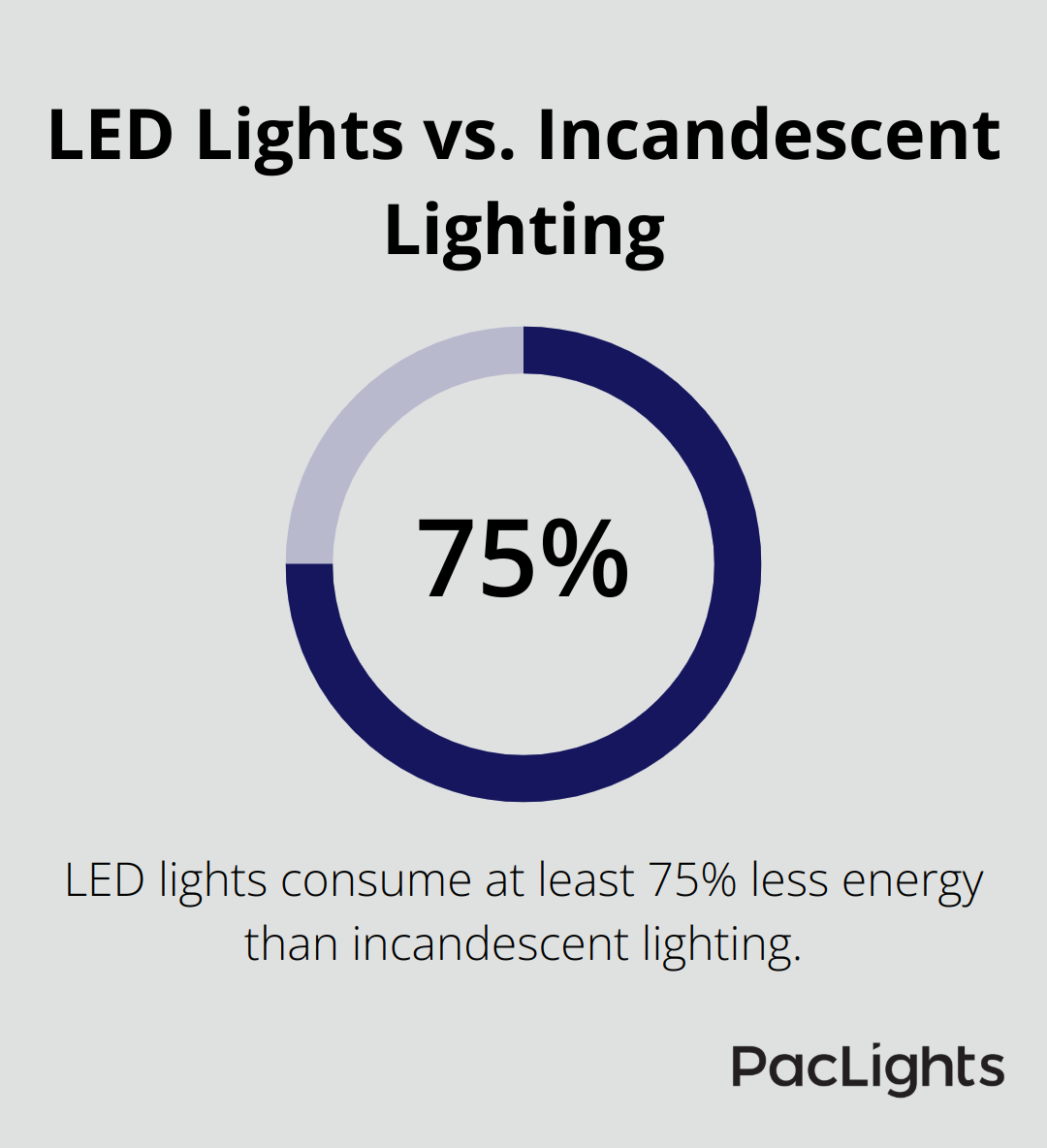
- LED Floodlights: These have surged in popularity due to their energy efficiency and longevity. The U.S. Department of Energy reports that LED lights consume at least 75% less energy and last 25 times longer than incandescent lighting.
- Halogen Floodlights: Known for their bright, white light, these fixtures consume more energy and have a shorter lifespan compared to LEDs.
- Metal Halide Floodlights: Often used in large outdoor areas like stadiums due to their high lumen output, these lights require a warm-up period before reaching full brightness.
Key Components
Understanding the components of floodlights helps in making an informed decision when selecting one:
- Housing: This protects the internal components from the elements. Try to find fixtures with an IP65 rating or higher to ensure they’re dust-tight and protected against water jets.
- Reflector: This directs the light output. Wide-beam reflectors typically cover angles of 60 to 120 degrees, while narrow-beam options range from 15 to 30 degrees. Your choice depends on the specific area you need to illuminate.
- Light Source: LED chips have become the standard due to their efficiency and long life. Some advanced LED floodlights even offer color temperature adjustability, allowing you to switch between warm (2700K-3000K) and cool (5000K-6500K) light depending on the application.
As we move forward, it’s important to consider how these different types and components of floodlights apply to various real-world scenarios. Let’s explore the diverse applications of floodlight lights and how they transform outdoor spaces.
Where Can Floodlights Be Used?
Enhancing Security with Floodlights
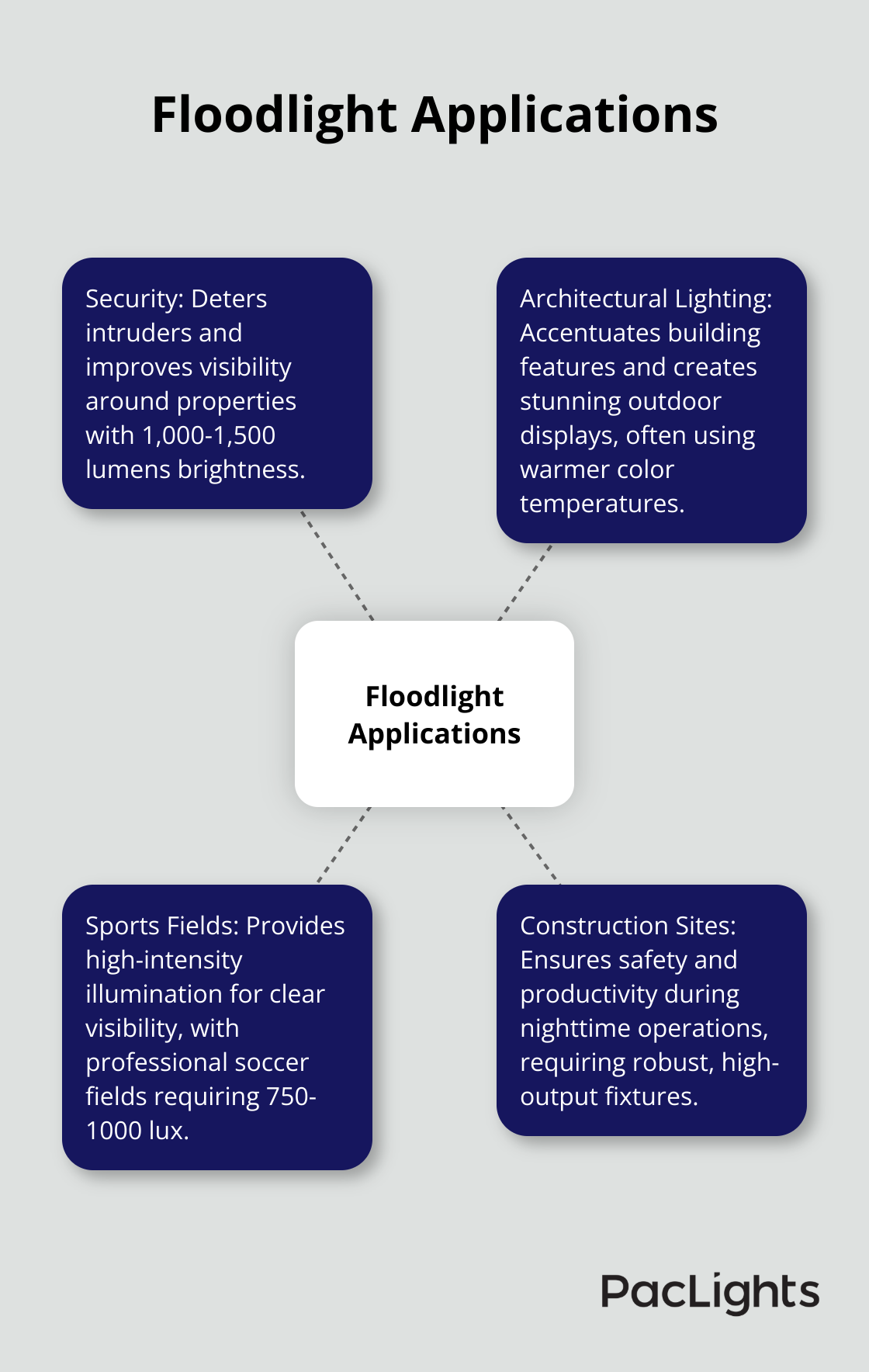
Outdoor security stands as a primary application for floodlights. The Illuminating Engineering Society recommends a brightness of 1,000-1,500 lumens for security lights. This level of illumination deters potential intruders and improves visibility around properties. For optimal coverage, the U.S. Department of Energy advises spacing floodlights no more than 50-60 feet apart and mounting them approximately 10 feet above the ground, angled downwards at about 22 degrees.
Security floodlights benefit from motion sensors or timers to conserve energy. These features lead to significant savings while maintaining effective security. For example, the replacement of a 300-watt halogen floodlight with a 100-watt LED equivalent can save up to $200 annually on electricity costs.
Transforming Landscapes with Architectural Lighting
Floodlights transform architectural and landscape lighting. They accentuate building features, illuminate pathways, and create stunning outdoor displays. For these applications, warmer color temperatures (between 2700K and 3000K) often create a more inviting ambiance.
Architectural lighting design benefits from different beam angles for specific features. Narrow beams (15-30 degrees) highlight architectural details, while wider beams (60-120 degrees) wash walls or illuminate larger areas.
Illuminating Sports Fields and Stadiums
Sports field and stadium lighting requires high-intensity illumination to ensure clear visibility for players and spectators. In these settings, metal halide or LED floodlights with color temperatures between 5000K and 6500K maximize visibility.
The lighting requirements for sports fields vary depending on the sport and level of play. Professional soccer fields typically require illumination levels of 750-1000 lux, while amateur fields may only need 200-300 lux. Specific lighting standards for each sport ensure proper illumination.
Powering Construction and Industrial Sites
Construction and industrial sites rely on floodlights for safety and productivity during nighttime operations. These environments demand robust, high-output fixtures that withstand harsh conditions.
These applications require floodlights with high IP ratings (IP65 or higher) to ensure protection against dust and water. LED floodlights suit these environments due to their durability and energy efficiency. They also generate less heat than traditional lighting options, reducing the risk of accidents in potentially hazardous areas.
Portable floodlight towers offer flexibility for construction or industrial sites. These towers move and adjust easily as work progresses, ensuring optimal illumination throughout the project.
The versatility of floodlights extends beyond these applications. Their powerful illumination capabilities make them suitable for various outdoor settings, from parking lots to emergency response scenarios. The next section will explore how to choose the right floodlight for your specific needs, considering factors such as brightness, beam angle, and energy efficiency.
How to Select the Perfect Floodlight
Brightness and Beam Angle
The selection of an ideal floodlight requires careful consideration of several key factors. Brightness, measured in lumens, plays a vital role. For security purposes, try to achieve 700 to 1300 lumens for residential properties and up to 20,000 lumens for larger areas. For ambient outdoor lighting, 400-800 lumens often prove sufficient.
Beam angle is another important aspect. Narrow beams (15-30 degrees) excel at highlighting specific features, while wider beams (60-120 degrees) illuminate larger areas effectively. Your selection depends on the specific application and the area you need to light up.
Color Temperature
Color temperature significantly impacts the mood and functionality of your lighting. For security applications, cooler temperatures between 5000K-6500K maximize visibility. In contrast, warmer temperatures (2700K-3000K) create a more inviting atmosphere for residential settings.
Energy Efficiency: The LED Advantage
LED floodlights have transformed outdoor lighting. LEDs consume at least 75% less energy than incandescent lights and last 25 times longer. This translates to significant cost savings over time. The replacement of a 300-watt halogen floodlight with a 100-watt LED equivalent can save up to $200 annually on electricity costs.
LED floodlights offer superior durability and performance. With a lifespan of up to 50,000 hours, they reduce maintenance costs and the need for frequent replacements. They also prove more environmentally friendly, as they contain no toxic materials and reduce carbon footprints due to their energy efficiency.
Smart Features for Enhanced Control
Modern floodlights often come equipped with smart features that enhance their functionality and efficiency. Motion sensors prove particularly useful for security applications, as they activate the light only when they detect movement. This saves energy and adds an element of surprise for potential intruders.
Timers and dusk-to-dawn sensors automate the lighting process, ensuring your floodlights operate only when needed. Some advanced models even offer smartphone connectivity, which allows you to control your lights remotely or set custom schedules.
Durability and Weather Resistance
For outdoor applications, durability proves paramount. Look for floodlights with an IP65 rating or higher, which guarantees protection against dust and water jets. This ensures your lights will withstand various weather conditions and continue to perform reliably.
Regular maintenance ensures optimal performance. Clean your floodlight fixtures at least twice a year to maintain light output and heat dissipation. Annual inspections of wiring connections are also essential (particularly after severe weather) to check for signs of corrosion.

Final Thoughts
Floodlight lights have become essential tools for outdoor illumination across various applications. These powerful devices transform spaces, enhance safety, and contribute to energy savings in ways few other lighting solutions can match. We at PacLights anticipate future advancements in LED efficiency, smart controls, and customization options that will further revolutionize the industry.
PacLights offers a range of floodlight solutions designed to meet diverse needs, from residential security to large-scale industrial applications. Our energy-efficient LED floodlights reduce costs and minimize environmental impact while providing reliable illumination for any outdoor setting. We provide free lighting layout designs and ROI assessments to help customers make informed decisions about their lighting solutions.
As lighting technology evolves, floodlight lights will continue to shape our nighttime environments. Choosing the right floodlight solution means investing in safety, efficiency, and visual appeal. Let PacLights guide you towards the perfect floodlight solution for your unique lighting needs.
Disclaimer: PacLights is not responsible for any actions taken based on the suggestions and information provided in this article, and readers should consult local building and electrical codes for proper guidance.