

Flood lights are powerful illumination solutions, and the 250-watt variant is a popular choice for many applications. At PacLights, we often field questions about these versatile fixtures.
In this post, we’ll explore the characteristics, efficiency, and cost considerations of 250W flood lights. We’ll also showcase our own flood light solutions and explain why they might be the perfect fit for your lighting needs.
Understanding 250 Watt Flood Lights
Definition and Basic Characteristics
250 watt flood lights are powerful outdoor lighting fixtures that illuminate large areas with intense, broad beams of light. These fixtures typically produce between 20,000 to 25,000 lumens, making them suitable for applications where high visibility is essential. They feature weatherproof housings (often with an IP65 or higher rating) to withstand harsh outdoor conditions.
Light Distribution and Coverage
The light distribution pattern of a 250W flood light can cover areas up to 10,000 square feet, depending on the specific model and mounting height. This impressive coverage makes these fixtures versatile for various outdoor lighting needs.
Common Applications
250W flood lights serve as workhorses in the lighting world. Their applications include:
- Sports facilities
- Parking lots
- Construction sites
- Industrial yards
A single 250W flood light can effectively illuminate a small tennis court or provide ample light for nighttime construction work. In commercial settings, these lights often enhance security and visibility when installed on building exteriors.
Wattage Comparison
250W flood lights strike a balance between power and efficiency. They outperform 100W or 150W options, which might suffice for smaller areas or accent lighting. However, they consume less energy than 400W or 1000W flood lights, which are typically reserved for very large spaces or high-intensity applications like stadium lighting.
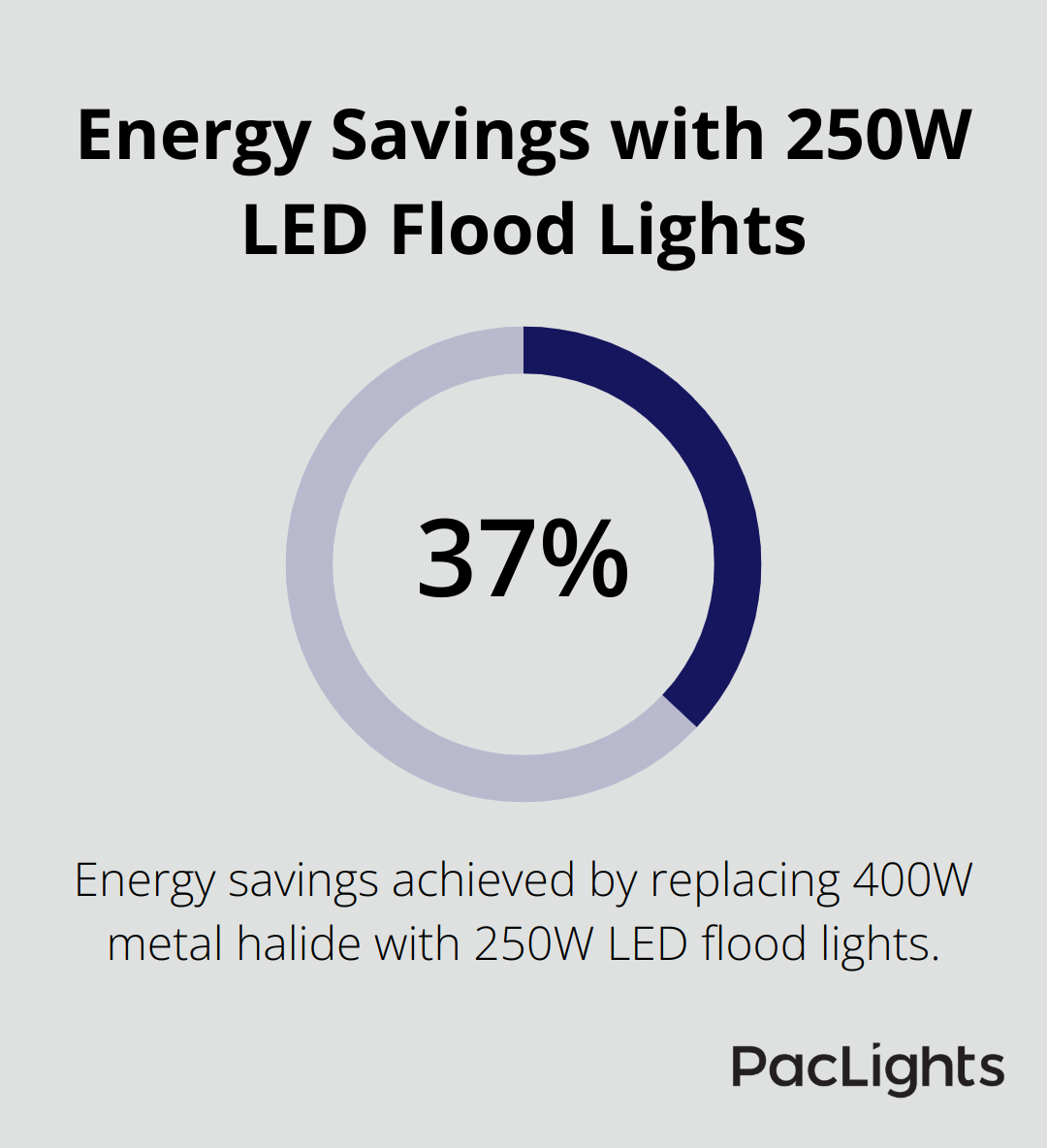
A 250W flood light can replace a 400W metal halide fixture while providing similar or better illumination. This replacement can lead to energy savings of up to 37% (according to data from the Department of Energy).
Choosing the Right Wattage
When considering flood lights for a project, it’s important to conduct a thorough site analysis to determine the most appropriate wattage for specific needs. Factors to consider include:
- Area size
- Desired light intensity
- Mounting height
- Energy efficiency goals
The next section will explore the energy efficiency and cost considerations of 250W flood lights in more detail, helping you make an informed decision for your lighting needs.
Are 250W Flood Lights Cost-Effective?
Energy Consumption and Operating Costs
A 250W flood light uses about 250 kilowatt-hours (kWh) of electricity per 1000 hours of operation. At an average U.S. electricity rate of $0.14 per kWh, this equals approximately $35 in energy costs for 1000 hours of use. For facilities that run these lights for 12 hours daily, the annual energy cost for a single 250W flood light can exceed $150.
LED Alternatives: A More Efficient Option
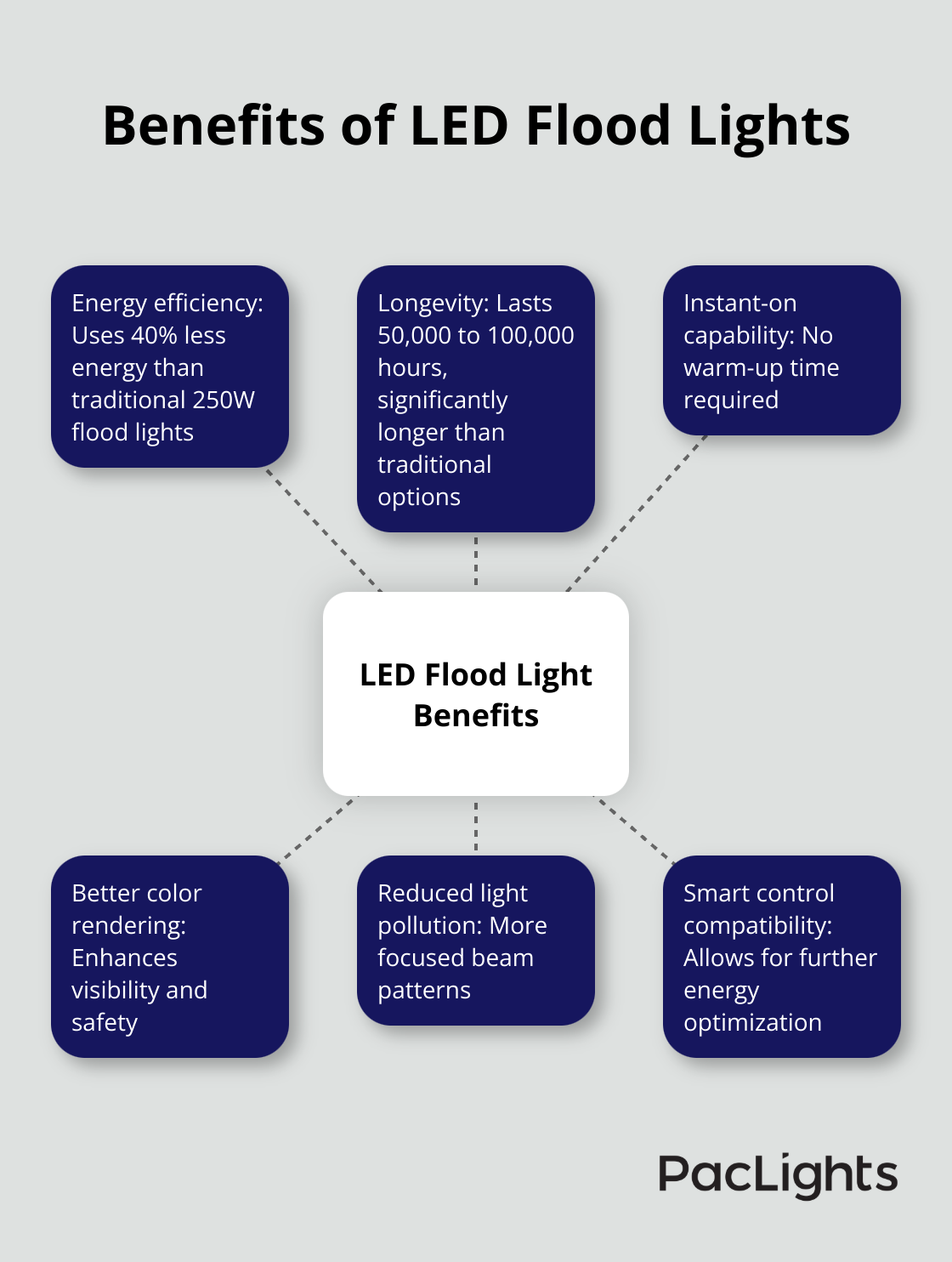
LED technology offers significant benefits over traditional flood light options. An LED flood light equivalent to a 250W metal halide typically uses only 100-150W while providing comparable or superior illumination. This reduction in energy use directly results in lower operating costs.
A 150W LED flood light operating for 1000 hours would use only 150 kWh, costing about $21. This represents a 40% reduction in energy costs compared to its 250W counterpart.
Long-Term Savings and ROI
The initial cost of LED flood lights often exceeds traditional options. However, the long-term savings potential is substantial. LED fixtures last significantly longer (50,000 to 100,000 hours) compared to metal halide lamps (10,000 to 20,000 hours).
Consider this scenario: A facility replaces ten 250W metal halide flood lights with equivalent LED fixtures. Assuming 12 hours of daily operation and an electricity rate of $0.14/kWh, the annual energy savings could exceed $1,500. When you factor in reduced maintenance costs due to less frequent replacements, the return on investment (ROI) period for LED flood lights often falls between 2 to 4 years.
Additional Benefits of LED Flood Lights
LED flood lights offer several advantages beyond energy savings:
- Instant-on capability (no warm-up time)
- Better color rendering (enhancing visibility and safety)
- Reduced light pollution (due to more focused beam patterns)
- Compatibility with smart controls (for further energy optimization)
Making the Right Choice
While 250W flood lights remain viable for certain applications, the shift towards LED alternatives is evident. The combination of energy efficiency, longevity, and additional features makes LED flood lights an increasingly attractive choice for most outdoor lighting needs.
A thorough analysis of your specific requirements and long-term operational costs will help you determine the most economical choice for your project. Many lighting companies (including PacLights) offer detailed ROI assessments to assist in this decision-making process.
In the next section, we’ll explore specific flood light solutions and their key features to help you find the perfect fit for your lighting needs.
What Makes High-Quality Flood Lights Stand Out?
Advanced LED Technology
Modern flood lights utilize cutting-edge LED technology, offering superior light output with reduced energy consumption. For instance, a 150W LED flood light produces illumination equivalent to a traditional 250W metal halide fixture while using 40% less energy. This translates to significant cost savings over the fixture’s lifetime.
Durability and Longevity
High-quality flood lights are built to withstand harsh outdoor conditions. With IP65 or higher ratings, these fixtures protect against dust and water ingress, ensuring reliable performance in various weather conditions. The robust construction of top-tier flood lights contributes to their extended lifespan, which can exceed 50,000 hours of operation.
Versatile Mounting Options
Every installation is unique. That’s why the best flood lights come with flexible mounting options, including knuckle mounts, trunnion mounts, and slip fitter attachments. This versatility allows for easy installation in various settings, from parking lots to sports fields.
Smart Control Capabilities
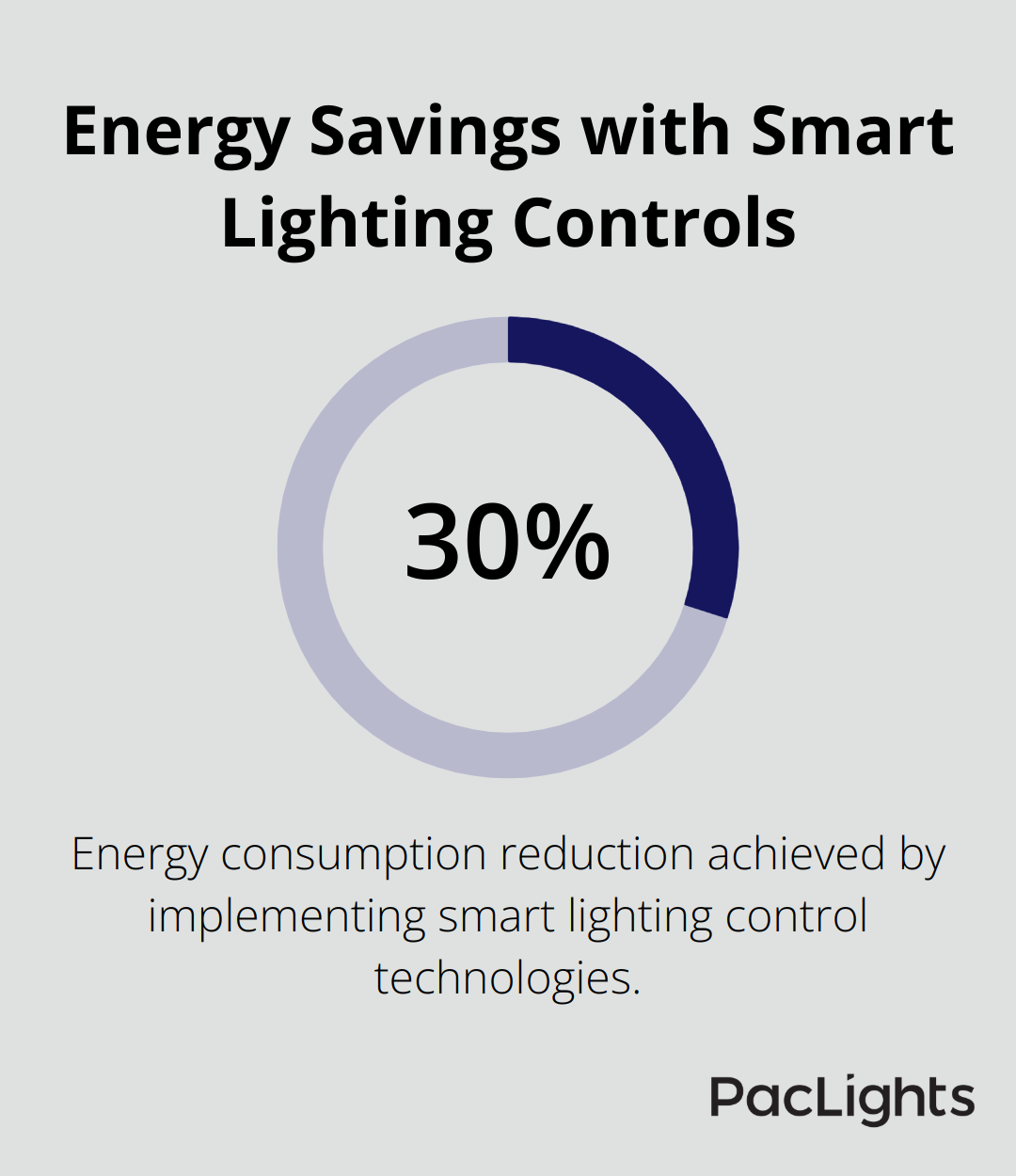
Many modern flood light models are compatible with advanced lighting controls. These smart features include motion sensors, daylight harvesting, and networked control systems. The implementation of these technologies can reduce energy consumption by up to 30% (according to data from the U.S. Department of Energy).
Color Temperature Options
High-quality flood lights are available in multiple color temperatures, typically ranging from 3000K to 5000K. This allows customers to choose the most appropriate light quality for their specific application. Warmer tones (3000K-4000K) are often preferred for residential areas, while cooler temperatures (4000K-5000K) are commonly used in commercial and industrial settings for enhanced visibility.
Final Thoughts
250-watt flood lights provide powerful illumination for outdoor applications. However, LED alternatives offer superior energy efficiency, longevity, and cost-effectiveness. PacLights’ LED flood lights match or exceed the output of traditional 250W fixtures while consuming less energy, resulting in significant cost savings and reduced maintenance.
We offer free lighting layout designs and ROI assessments to help you make informed decisions about your flood lighting needs. Our products feature optional smart controls for further energy optimization, suitable for various applications (including sports fields, parking lots, and industrial facilities).
Contact our team to learn more about our flood light solutions and find the perfect lighting for your specific requirements. We will guide you through the selection process and answer any questions about flood light wattages and performance.
Disclaimer: PacLights is not responsible for any actions taken based on the suggestions and information provided in this article, and readers should consult local building and electrical codes for proper guidance.