

At PacLights, we’re often asked about the benefits of vapor tight high bay LED lights. These specialized fixtures are designed to withstand harsh environments while providing superior illumination.
In this Q&A, we’ll explore what makes vapor tight high bay LEDs unique, their advantages, and how to choose the right one for your needs.
What Are Vapor Tight High Bay LED Lights?
Sealed for Protection
Vapor tight high bay LED lights are specialized lighting fixtures that withstand harsh environments while providing powerful illumination from elevated positions. These fixtures combine the robust protection of vapor tight enclosures with the high-output capabilities of high bay lighting.
The defining feature of vapor tight high bay LED lights is their sealed construction. This design prevents the ingress of moisture, dust, and other contaminants that could compromise the fixture’s performance or safety. The National Electrical Manufacturers Association (NEMA) rates these fixtures based on their level of protection, with many achieving IP65 or higher ratings.
Built for Height and Power
High bay lights typically install at heights of 20 feet or more, making them ideal for large, open spaces. Vapor tight high bay LEDs take this concept further by offering lumen outputs that can exceed 30,000 lumens, ensuring adequate illumination even in challenging conditions.
Applications in Demanding Environments
These fixtures find their home in a variety of industrial and commercial settings where standard lighting would quickly fail. Some common applications include:

- Food Processing Plants: The water-resistant nature of vapor tight fixtures makes them perfect for areas that require frequent washdowns.
- Chemical Manufacturing Facilities: These lights withstand corrosive atmospheres that would damage standard fixtures.
- Cold Storage Warehouses: Vapor tight high bay LEDs perform reliably despite temperature fluctuations that could cause condensation in lesser fixtures.
Outdoor Versatility
The versatility of vapor tight high bay LED lights extends to outdoor applications as well. Sports facilities and outdoor warehouses use these fixtures to maintain visibility regardless of weather conditions. Their durability makes them a low-maintenance solution for areas that are difficult or dangerous to access frequently.
As we move into the next section, we’ll explore the numerous benefits these robust lighting solutions offer, from energy efficiency to improved safety in hazardous locations.
Why Vapor Tight High Bay LEDs Outshine Traditional Lighting
Dramatic Energy Savings
Vapor tight high bay LEDs slash energy costs dramatically. The U.S. Department of Energy reports that LED lighting reduces energy consumption by up to 75% compared to traditional lighting solutions. Large industrial spaces benefit significantly from this efficiency. A warehouse that replaces 100 400-watt metal halide fixtures with 150-watt LED equivalents can save over $10,000 annually on energy costs alone.

Unmatched Longevity in Harsh Conditions
The sealed construction of vapor tight high bay LEDs provides exceptional durability. Quality LED fixtures operate for 50,000 hours or more, while traditional high-intensity discharge (HID) lamps last only 10,000 to 24,000 hours. This extended lifespan proves particularly valuable in environments where frequent maintenance disrupts operations or poses dangers. A food processing plant operating 24/7 could run these lights for over five years before replacement (minimizing production interruptions).
Enhanced Illumination for Improved Productivity
Vapor tight high bay LEDs don’t just last longer; they provide superior light quality. Unlike fluorescent or HID lamps that flicker or shift color over time, LEDs maintain consistent color temperature and brightness throughout their lifespan. This stability proves crucial in environments where color accuracy matters, such as textile manufacturing or quality control areas. Moreover, the directional nature of LED light allows better control over light distribution, reducing glare and dark spots that can cause eye strain and decrease productivity.
Tailored Solutions for Specific Environments
When selecting vapor tight high bay LEDs, consider the specific needs of your environment. Factors such as color temperature, beam angle, and lumen output should match the tasks performed in the space. Cooler color temperatures (5000K-6500K) are often preferred in industrial settings for their similarity to daylight, which can help maintain worker alertness during long shifts.
Safety Features for Hazardous Locations
Vapor tight high bay LEDs offer enhanced safety features, making them ideal for hazardous locations. Their sealed design prevents the ingress of flammable gases or dust, reducing the risk of explosions. Many models come with additional certifications for use in specific hazardous environments, providing peace of mind in potentially dangerous settings.
The next chapter will guide you through the process of choosing the right vapor tight high bay LED light for your specific needs, ensuring you maximize the benefits of this advanced lighting technology.
How to Select the Perfect Vapor Tight High Bay LED
Selecting the right vapor tight high bay LED light is essential for optimal performance and longevity in challenging environments. This chapter explores key factors to consider when making your selection.
Lumen Output and Efficiency
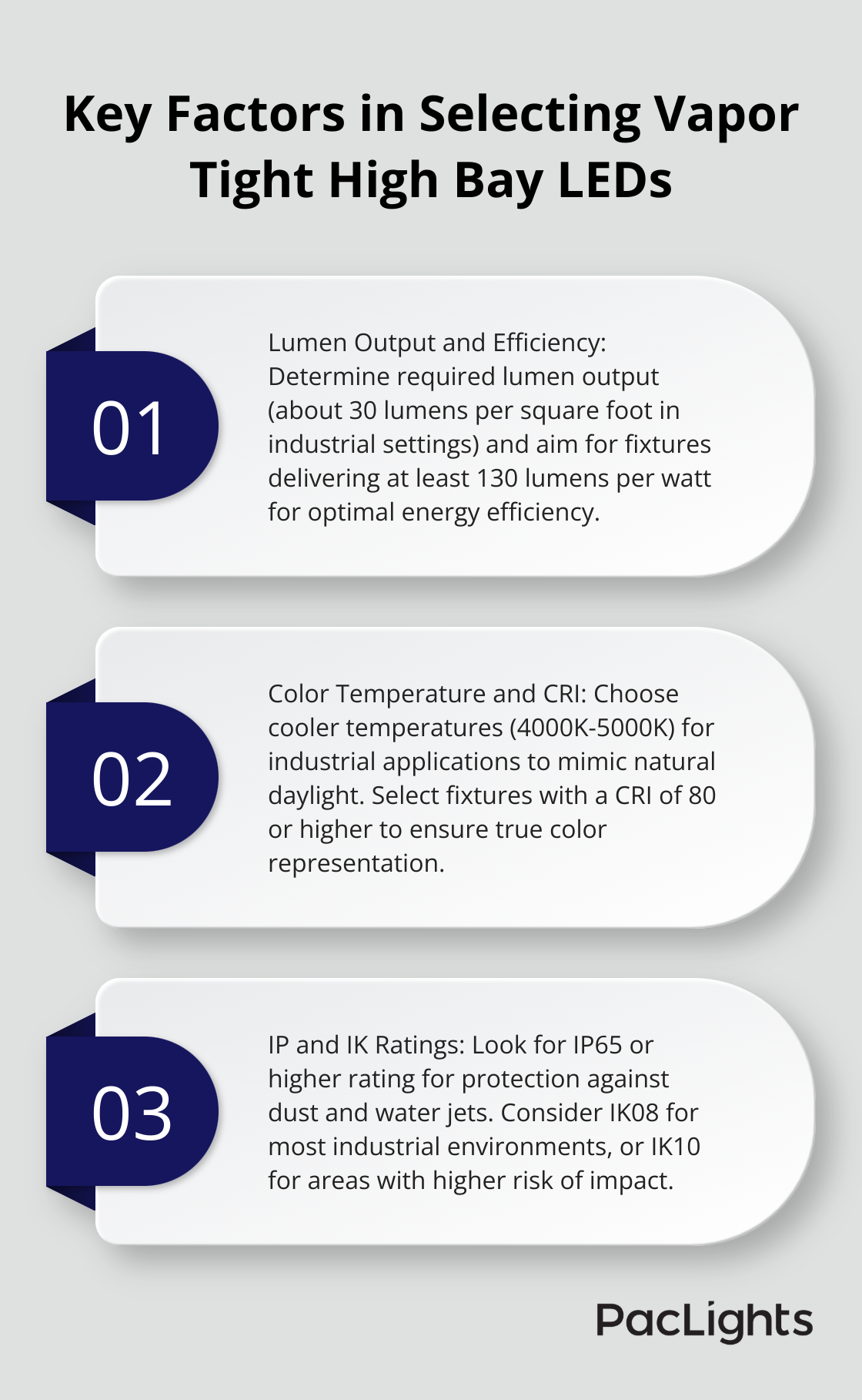
The first step involves determining the required lumen output for your space. A general guideline suggests 30 lumens per square foot in industrial settings. However, this can vary based on ceiling height and specific tasks performed in the area. (For instance, a 10,000 square foot warehouse with 30-foot ceilings might require fixtures totaling 300,000 lumens.)
Efficacy, measured in lumens per watt, is equally important. Try to find fixtures that deliver at least 130 lumens per watt to ensure optimal energy efficiency. This level of efficiency can lead to significant cost savings over time, especially in large industrial spaces that operate 24/7.
Color Temperature and CRI
Color temperature affects both aesthetics and functionality. Most industrial applications prefer cooler temperatures between 4000K and 5000K. These mimic natural daylight, which helps maintain worker alertness and accuracy in detail-oriented tasks.
The Color Rendering Index (CRI) is another important factor, especially in environments where color accuracy is vital. Try to select fixtures with a CRI of 80 or higher to ensure colors appear true to life under your lighting. This is particularly important in quality control areas or facilities dealing with colored products.
Beam Angle and Light Distribution
The beam angle of your fixtures will determine how light is distributed throughout your space. Narrow beam angles (15-30 degrees) work best for high ceilings and focused task lighting, while wider angles (60-120 degrees) provide more even illumination across larger areas.
Consider the layout of your space and the tasks performed when selecting beam angles. A combination of different angles might prove necessary to achieve optimal coverage and minimize shadowing.
IP and IK Ratings
Understanding IP (Ingress Protection) and IK (Impact Protection) ratings is vital when selecting vapor tight fixtures. For most industrial applications, an IP65 rating or higher ensures protection against dust and water jets from any direction.
The IK rating indicates impact resistance. An IK08 rating suits most industrial environments, providing protection against impacts up to 5 joules. However, in areas with a higher risk of impact, fixtures with IK10 ratings offer maximum durability.
Customization and Future-Proofing
When selecting your vapor tight high bay LEDs, consider fixtures that offer customization options. Adjustable wattage and lumen output can provide flexibility as your lighting needs change over time. Some manufacturers offer fixtures with field-adjustable settings, allowing you to fine-tune performance without replacing the entire unit.
Additionally, look for fixtures compatible with advanced control systems. The ability to integrate with occupancy sensors, daylight harvesting, and networked control systems can lead to even greater energy savings and operational efficiency.
Final Thoughts
Vapor tight high bay LED lights revolutionize industrial and commercial lighting. These fixtures provide powerful illumination and protection against harsh environments, making them perfect for food processing plants, chemical facilities, and cold storage warehouses. Their sealed construction ensures reliability even when exposed to moisture, dust, and other contaminants.
Vapor tight high bay LEDs offer significant advantages beyond durability. They reduce energy consumption by up to 75% compared to traditional lighting, resulting in substantial cost savings for businesses. With a lifespan exceeding 50,000 hours, these fixtures minimize maintenance disruptions and replacement expenses (which is particularly valuable in 24/7 operations).
PacLights offers high-quality vapor tight high bay LED solutions that meet diverse industrial and commercial needs. Our fixtures combine advanced technology with durable design, providing energy-efficient illumination tailored to specific requirements. We help businesses optimize their lighting for maximum efficiency and performance through customization options and advanced control systems.
Disclaimer: PacLights is not responsible for any actions taken based on the suggestions and information provided in this article, and readers should consult local building and electrical codes for proper guidance.