

Tennis court LED lighting is revolutionizing the way players experience the game.
At PacLights, we’ve seen firsthand how this technology enhances visibility, reduces energy costs, and improves overall court conditions.
In this Q&A, we’ll explore the key aspects of LED lighting for tennis courts and how it’s changing the game for players of all levels.
What Are Tennis Court LED Lights?
The Basics of Tennis Court LED Lighting
Tennis court LED lights are advanced illumination systems designed for outdoor and indoor tennis courts. These lights use Light Emitting Diodes (LEDs) to produce bright, uniform light across the entire playing surface.
Key Components of LED Lighting Systems
A typical tennis court LED lighting system consists of several essential parts. The core of the system is the LED fixture, which contains multiple high-powered LED chips. These fixtures mount on tall poles (ranging from 20 to 66 feet in height), depending on court size and play level.
The fixtures include specialized optics that direct light precisely where needed, which minimizes light spill and maximizes efficiency. Many modern systems also feature smart controls for remote operation, scheduling, and dimming capabilities.
LED Lights vs. Traditional Options
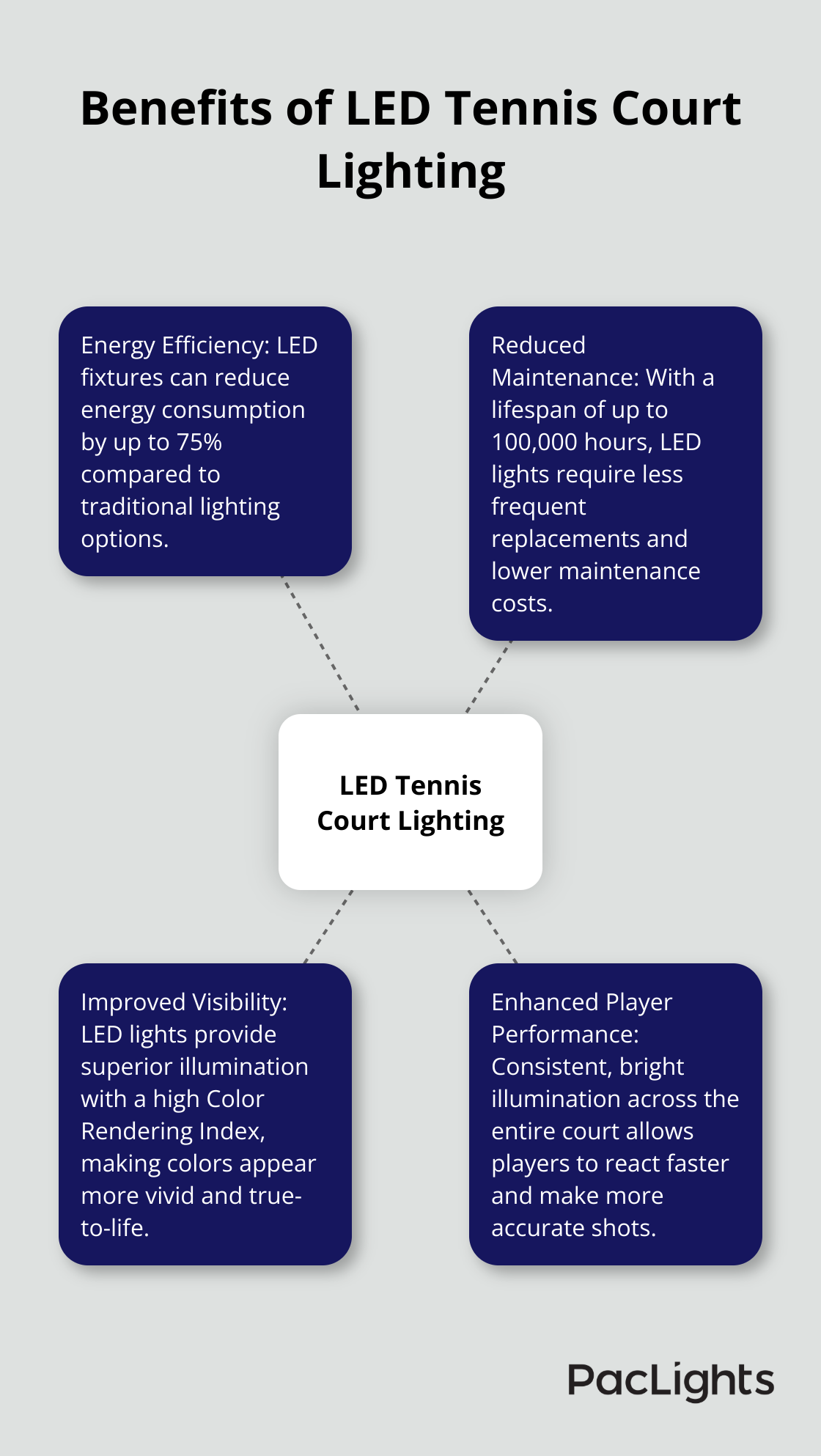
LED lights offer significant advantages over traditional metal halide or halogen lamps for tennis courts. Their superior energy efficiency stands out as a primary benefit. LED fixtures can reduce energy consumption by up to 75% compared to older lighting technologies. This reduction translates to substantial cost savings over time.

For instance, operating 35,000 watts of LED lighting on a tennis court costs about $4.20 per day, compared to $8.40 for the same wattage of metal halide lights. Over a year, this difference can amount to thousands of dollars in savings.
Longevity and Reduced Maintenance
LED lights boast an impressive lifespan, often lasting up to 100,000 hours or more. This duration significantly exceeds traditional lighting options, which typically require replacement after 15,000 to 20,000 hours of use. The extended lifespan of LEDs results in less frequent replacements and lower maintenance costs for court operators.
Improved Playing Experience
For players, LED lights provide superior illumination quality. They offer a high Color Rendering Index (CRI) of 80 or above, which means colors appear more vivid and true-to-life under these lights. This enhanced color accuracy makes it easier for players to track the ball and see court lines clearly.
LED lights also turn on instantly, eliminating the warm-up time required by metal halide lamps. This feature proves particularly useful for evening matches or tournaments where quick lighting adjustments may become necessary.
As we move forward, let’s explore how these LED lighting systems specifically enhance the tennis court experience and improve gameplay for players of all levels.
How LED Lighting Transforms Tennis Court Play
Crystal-Clear Visibility
LED lights provide superior illumination that enhances every aspect of play. With a color rendering index (CRI) of 80 or higher, these lights make colors pop, allowing players to track the ball with unprecedented clarity. The United States Tennis Association (USTA) recommends a minimum illumination level of 125 foot-candles for professional courts, which LED systems easily achieve and maintain consistently throughout matches.
Glare-Free Play
One of the most significant improvements LED lighting brings to tennis courts is the reduction of glare and shadows. Traditional lighting often creates hot spots and dark areas, which disorient players. LED fixtures, with their precise optics and uniform light distribution, eliminate these issues. Players report better depth perception and fewer missed shots due to lighting inconsistencies.
Dramatic Energy Savings
The energy efficiency of LED lighting translates to substantial cost savings for tennis facilities. A typical LED system can reduce energy consumption by up to 75% compared to metal halide lights. For example, a tennis court that previously used 1000-watt metal halide fixtures might now only require 400-watt LED fixtures to achieve the same (or better) illumination. This reduction can lead to thousands of dollars in savings annually on electricity bills.
Minimal Maintenance, Maximum Uptime
LED lights’ longevity is a game-changer for court maintenance. With a lifespan of up to 100,000 hours, LED fixtures can last over a decade with regular use. This extended lifespan means fewer replacements and less downtime for courts. Facility managers report significant reductions in maintenance costs and increased court availability, as there’s no need for frequent bulb changes or system downtime.
Enhanced Player Performance
The superior lighting quality of LEDs directly impacts player performance. Consistent, bright illumination across the entire court (without dark spots or glare) allows players to react faster and make more accurate shots. This improved visibility can lead to longer rallies, more exciting matches, and potentially even reduced injury rates due to better visual acuity.
The transformation LED lighting brings to tennis courts extends beyond just improved visibility. It impacts energy costs, maintenance schedules, and even the quality of play itself. As we explore the best practices for implementing LED lighting on tennis courts in the next section, we’ll see how proper design and installation can maximize these benefits for players and facility managers alike.
How to Optimize LED Lighting for Tennis Courts
Light Distribution and Uniformity
Uniform light distribution is essential for optimal play. The International Tennis Federation (ITF) recommends a uniformity ratio of at least 0.7 for competitive play. This means the minimum light level on the court should not fall below 70% of the maximum level. To achieve this, a combination of narrow and wide beam angles (ranging from 60° to 120°) is used, depending on the court’s dimensions and pole heights.
A standard doubles court (78 feet by 36 feet) typically requires 8 to 12 LED fixtures mounted on 4 to 6 poles. These poles are placed at the corners and midpoints of the court’s long sides. This arrangement ensures even coverage and minimizes shadows, especially during doubles play.
Light Levels for Different Play Levels
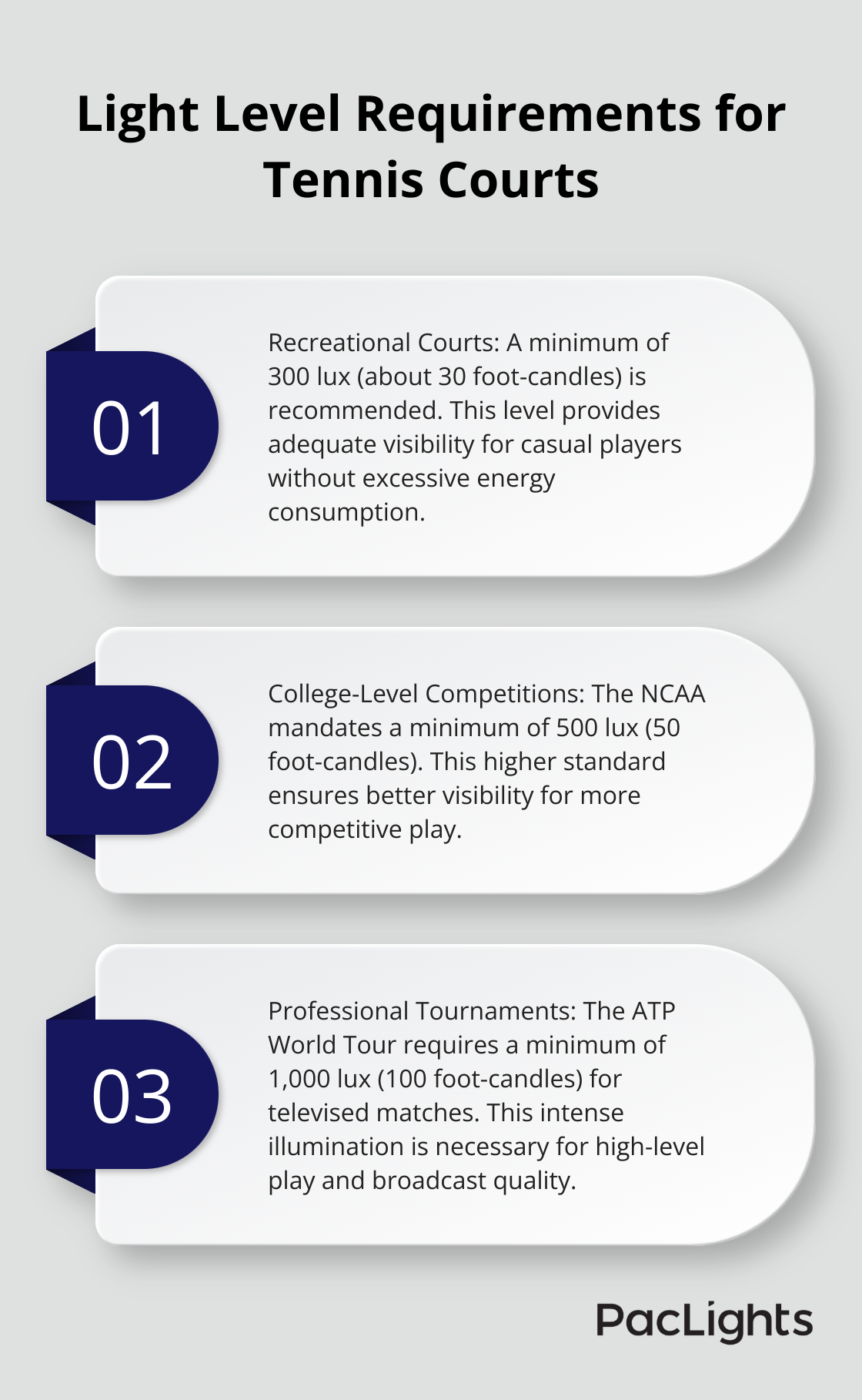
Light levels vary significantly based on the level of play. For recreational courts, a minimum of 300 lux (about 30 foot-candles) is recommended. This level provides adequate visibility for casual players without excessive energy consumption.
College-level competitions require higher standards. The NCAA mandates a minimum of 500 lux (50 foot-candles). Professional tournaments demand even more intense illumination. The ATP World Tour, for instance, requires a minimum of 1,000 lux (100 foot-candles) for televised matches.
Many facilities opt for higher light levels to enhance player experience and accommodate potential future upgrades in play level.
Fixture Placement and Positioning
Proper fixture placement minimizes glare and ensures even illumination. LED fixtures are typically mounted at heights between 20 and 66 feet, depending on the court’s size and surrounding environment.
The setback distance (the horizontal distance between the pole and the court’s sideline) is a key consideration. For most installations, a setback of 10 to 20 feet is recommended. This distance helps reduce glare for players while still providing optimal court coverage.
Aiming angles are equally important. Fixtures are usually tilted between 15° and 30° from vertical. This angle directs light onto the court while minimizing spill light and sky glow (which can be a concern for neighboring properties).
Color Temperature and CRI Considerations
The color temperature of LED lights significantly impacts visibility and player comfort. For tennis courts, a color temperature between 4000K and 6000K is recommended. This range closely mimics natural daylight, providing excellent visibility without causing eye strain during extended play.
Color Rendering Index (CRI) is another important factor. A high CRI ensures colors appear vivid and true-to-life under artificial lighting. LED fixtures with a CRI of at least 80 are advised for tennis courts. This level allows players to clearly distinguish between different colored court surfaces, lines, and the ball itself.
Some facilities now explore tunable LED systems, which allow adjustment of color temperature. This feature can be particularly useful for multi-use courts or facilities that host both daytime and nighttime events.
Final Thoughts
LED lighting has revolutionized tennis courts, offering superior illumination, energy efficiency, and longevity. Players enjoy enhanced visibility and performance, while facility operators benefit from energy savings and lower maintenance costs. As technology advances, we expect exciting developments in tennis court LED lighting, including smart systems with remote control and scheduling capabilities.
Professional lighting design and installation are essential to maximize the benefits of LED lighting for tennis courts. Proper fixture placement, light distribution, and color temperature selection ensure compliance with international standards and provide the best playing experience. At PacLights, we offer tailored tennis court LED lighting solutions to meet the unique needs of each facility.
LED technology will continue to evolve, offering even greater benefits for players and facilities. Tennis courts can provide optimal playing conditions while managing resources efficiently by embracing these advancements and working with experienced lighting professionals. The future of tennis court lighting looks bright, promising improved gameplay and sustainability for years to come.
Disclaimer: PacLights is not responsible for any actions taken based on the suggestions and information provided in this article, and readers should consult local building and electrical codes for proper guidance.