

High bay emergency lighting is a critical safety feature in industrial and commercial settings. These systems provide essential illumination during power outages, ensuring safe evacuation and continued operations in emergencies.
At PacLights, we understand the importance of selecting the right high bay emergency lighting for your facility. This guide will help you navigate the key factors to consider when choosing these vital safety systems.
What is High Bay Emergency Lighting?
Definition and Purpose
High bay emergency lighting is a specialized illumination system designed for large, open spaces with high ceilings. These systems provide essential light during power outages or emergencies in industrial and commercial settings. They maintain safety and operational continuity in warehouses, factories, and large retail spaces.
The Vital Role in Safety
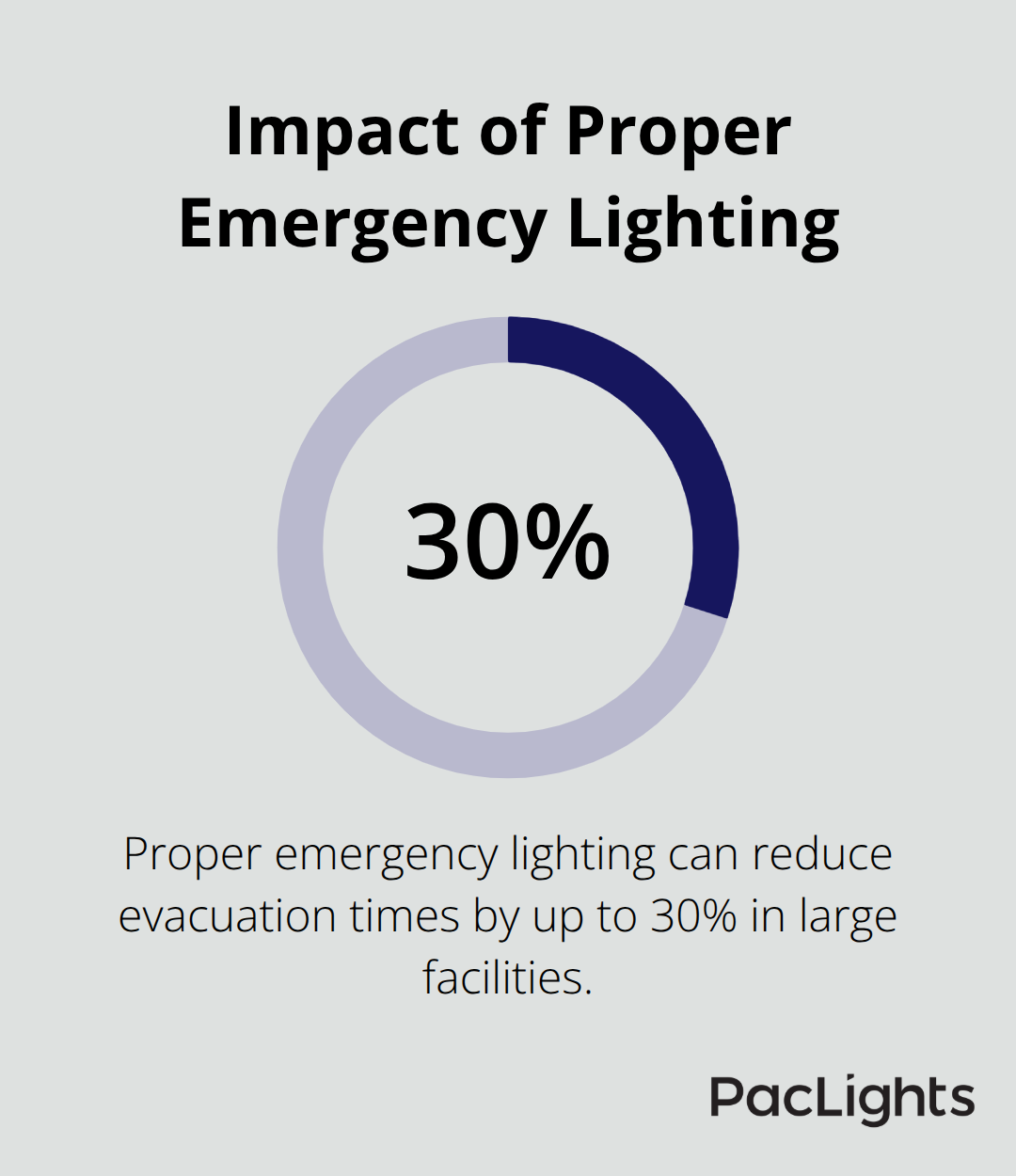
In unexpected power failures, high bay emergency lighting acts as a lifeline. It guides occupants to safety, prevents accidents, and allows critical operations to continue or shut down safely. The National Fire Protection Association (NFPA) reports that proper emergency lighting can reduce evacuation times by up to 30% in large facilities (a significant factor when every second counts in emergencies).
Regulatory Compliance
Selecting the right high bay emergency lighting involves more than just brightness-it requires meeting strict regulatory requirements. The Occupational Safety and Health Administration (OSHA) mandates that emergency lighting must provide a minimum illumination of 1 foot-candle (10.8 lux) along exits and escape routes for at least 90 minutes after a power failure.
The International Building Code (IBC) also requires emergency lighting in various locations, including:
- Exit access corridors
- Exit stairs
- Assembly spaces
Facility managers must ensure their emergency lighting systems meet these standards to avoid hefty fines and protect lives.
Customizing Solutions
The choice of high bay emergency lighting depends on the specific needs of your facility. Several factors influence the most effective lighting solution:
- Ceiling height
- Floor space
- Potential obstacles
For example, a warehouse with 40-foot ceilings needs high-output LED fixtures that can penetrate through tall shelving units. In contrast, a manufacturing plant with lower ceilings might require a different configuration to ensure even light distribution across work areas.
Understanding these key aspects of high bay emergency lighting equips you to make informed decisions that enhance safety and compliance in your facility. The next section will explore the specific factors to consider when selecting the best high bay emergency lighting for your needs.
Key Factors in High Bay Emergency Lighting Selection
Illumination Power and Coverage
The effectiveness of emergency lighting hinges on its ability to provide adequate visibility during power outages. The Illuminating Engineering Society (IES) recommends high bay emergency lighting maintain a minimum of 1 foot-candle (10.8 lux) along egress paths. For optimal safety in industrial settings, we suggest 3-5 foot-candles (32-54 lux) in critical areas.
Coverage area plays an equally important role. A study by the National Institute of Standards and Technology (NIST) revealed that uniform light distribution can reduce evacuation times by up to 18%. When selecting fixtures, consider their beam angle and mounting height. A 120-degree beam angle often suits 30-foot ceilings, while taller spaces may require wider angles or multiple fixtures.
Battery Performance
Batteries form the core of any emergency lighting system. The National Fire Protection Association (NFPA) requires emergency lighting to operate for at least 90 minutes after a power failure. In industrial settings where evacuation might take longer, systems with 120-180 minute runtimes offer additional safety.
Charging time also matters. Modern lithium-ion batteries fully charge in 24 hours, compared to 48-72 hours for older lead-acid batteries. This faster charging ensures your system readies sooner after an emergency event.
Durability and Environmental Adaptability
Industrial environments demand robust lighting solutions. Look for fixtures with high IP (Ingress Protection) ratings. An IP65 rating offers complete dust protection and resistance to low-pressure water jets.
Temperature tolerance also plays a key role. In extreme environments (such as cold storage facilities or hot manufacturing plants), choose fixtures rated for operation between -20°C to 50°C (-4°F to 122°F).
Ease of Installation and Maintenance
In industrial settings, time equals money. Select emergency lighting systems that offer tool-less entry for battery replacement and easy mounting options. Some modern systems feature self-diagnostic capabilities, automatically performing monthly and annual tests required by NFPA standards. This can significantly reduce maintenance time and ensure system readiness.
Energy Efficiency and Long-Term Costs
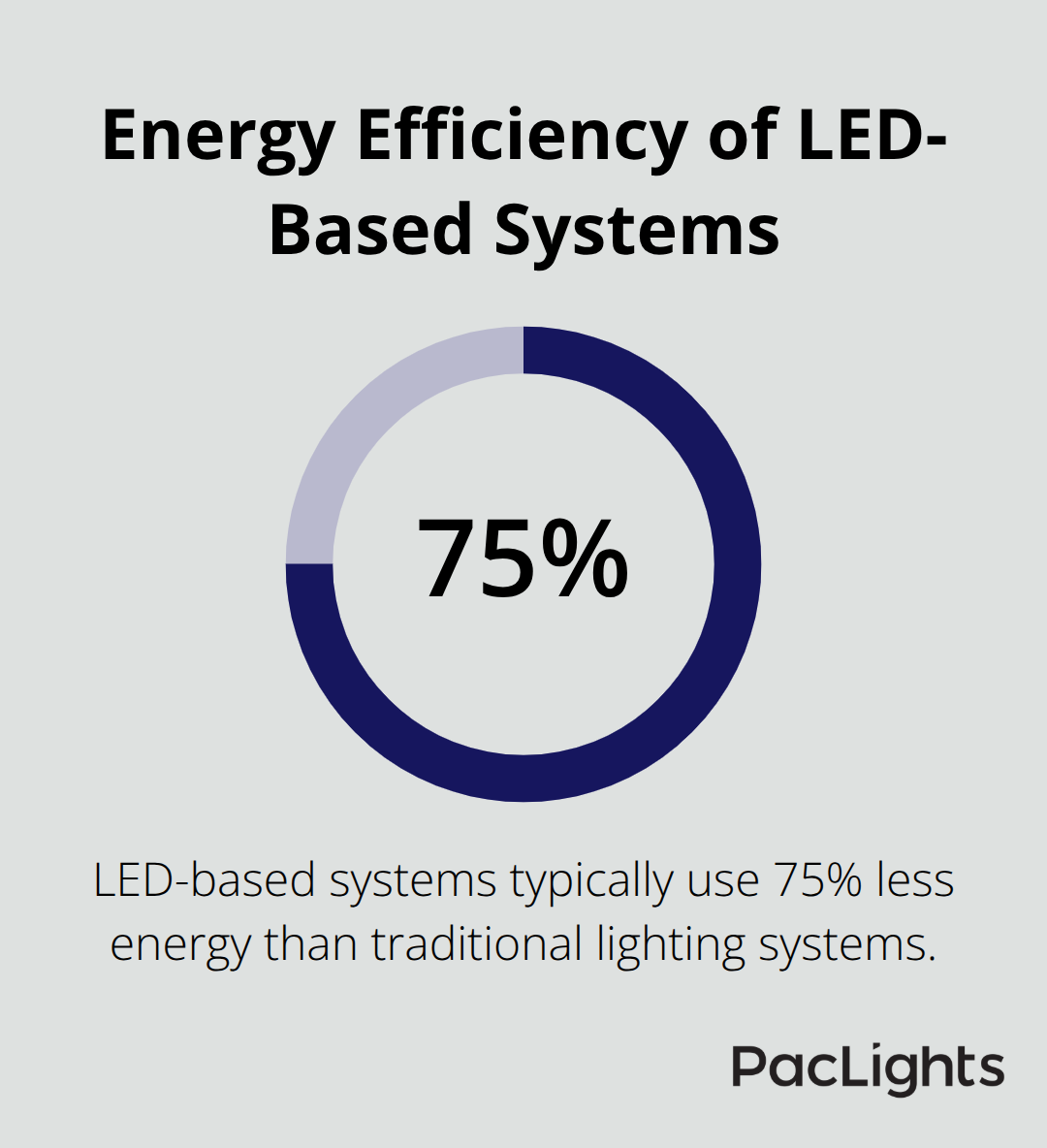
While initial costs matter, the long-term operational expenses of your emergency lighting system can add up. LED-based systems typically use 75% less energy than traditional lighting, according to the U.S. Department of Energy. This translates to substantial savings over the system’s lifespan.
Moreover, LED emergency lights often last 50,000 hours or more, reducing replacement frequency and associated labor costs. When calculating the total cost of ownership, factor in these long-term savings alongside the initial investment.
With these key factors in mind, let’s explore how PacLights’ high bay emergency lighting solutions address these critical aspects and provide reliable safety illumination for diverse industrial needs.
What Sets High Bay Emergency Lighting Apart?

Unmatched Longevity and Efficiency
High bay emergency lighting with LED technology offers a lifespan exceeding 50,000 hours (equivalent to 5.7 years of continuous operation). This longevity significantly reduces replacement frequency and associated costs. The U.S. Department of Energy reports that LED lighting can cut energy consumption by up to 75% compared to traditional systems. This efficiency not only lowers operational costs but also minimizes environmental impact.
Versatile Mounting and Installation
Top-tier high bay emergency lighting fixtures come with multiple mounting options, including pendant, surface, and chain mounting. This flexibility allows for optimal placement in various ceiling types and heights, ensuring comprehensive coverage. Many fixtures are designed for quick installation, with some models featuring tool-less entry for easy maintenance and battery replacement.
Smart Energy Management
Advanced high bay emergency lighting incorporates control systems for energy optimization. These include occupancy sensors and daylight harvesting capabilities, which can further reduce energy consumption by up to 30% (according to a study by the Lawrence Berkeley National Laboratory). Some models also feature self-diagnostic systems that automatically perform monthly and annual tests as required by NFPA standards, saving valuable maintenance time and ensuring system readiness.
Tailored Solutions for Every Industry
The best high bay emergency lighting offers customizable solutions to meet specific industrial needs. For instance, fixtures for cold storage facilities can operate in temperatures as low as -20°C (-4°F), while those for high-temperature environments can withstand up to 50°C (122°F). Options with varying lumen outputs and beam angles suit different ceiling heights and space configurations.
Rigorous Safety Compliance
High-quality high bay emergency lighting solutions meet or exceed industry safety standards. These fixtures comply with NFPA 101 and OSHA requirements, providing a minimum illumination of 1 foot-candle (10.8 lux) along egress paths for at least 90 minutes after power failure. Many models exceed these standards, offering up to 180 minutes of emergency operation for enhanced safety in complex industrial environments.
Final Thoughts
High bay emergency lighting selection impacts safety, compliance, and efficiency in industrial settings. Quality systems enhance employee safety, reduce accident risks during outages, and meet regulatory requirements. Advanced LED-based solutions offer long-term cost savings through lower energy consumption and maintenance needs.
We at PacLights understand the diverse needs of facilities for high bay emergency lighting. Our range of solutions meets varied requirements, offering energy-efficient options that reduce costs and environmental impact. PacLights provides reliable, durable, and versatile lighting products that ensure optimal illumination in emergencies.
PacLights high bay emergency lighting solutions invest in your facility’s safety and efficiency. Our commitment to quality and innovation means you can trust our products to perform when it matters most. PacLights keeps your operations running smoothly and your people safe in any situation.
Disclaimer: PacLights is not responsible for any actions taken based on the suggestions and information provided in this article, and readers should consult local building and electrical codes for proper guidance.