

Server rooms demand lighting that works as hard as the equipment inside them. At PacLights, we’ve seen firsthand how the right server room lighting controls reduce energy waste, protect sensitive hardware, and streamline facility management.
Most data centers still rely on outdated lighting systems that waste power and complicate operations. Modern control solutions change that equation entirely.
Why Advanced Controls Matter in Server Rooms
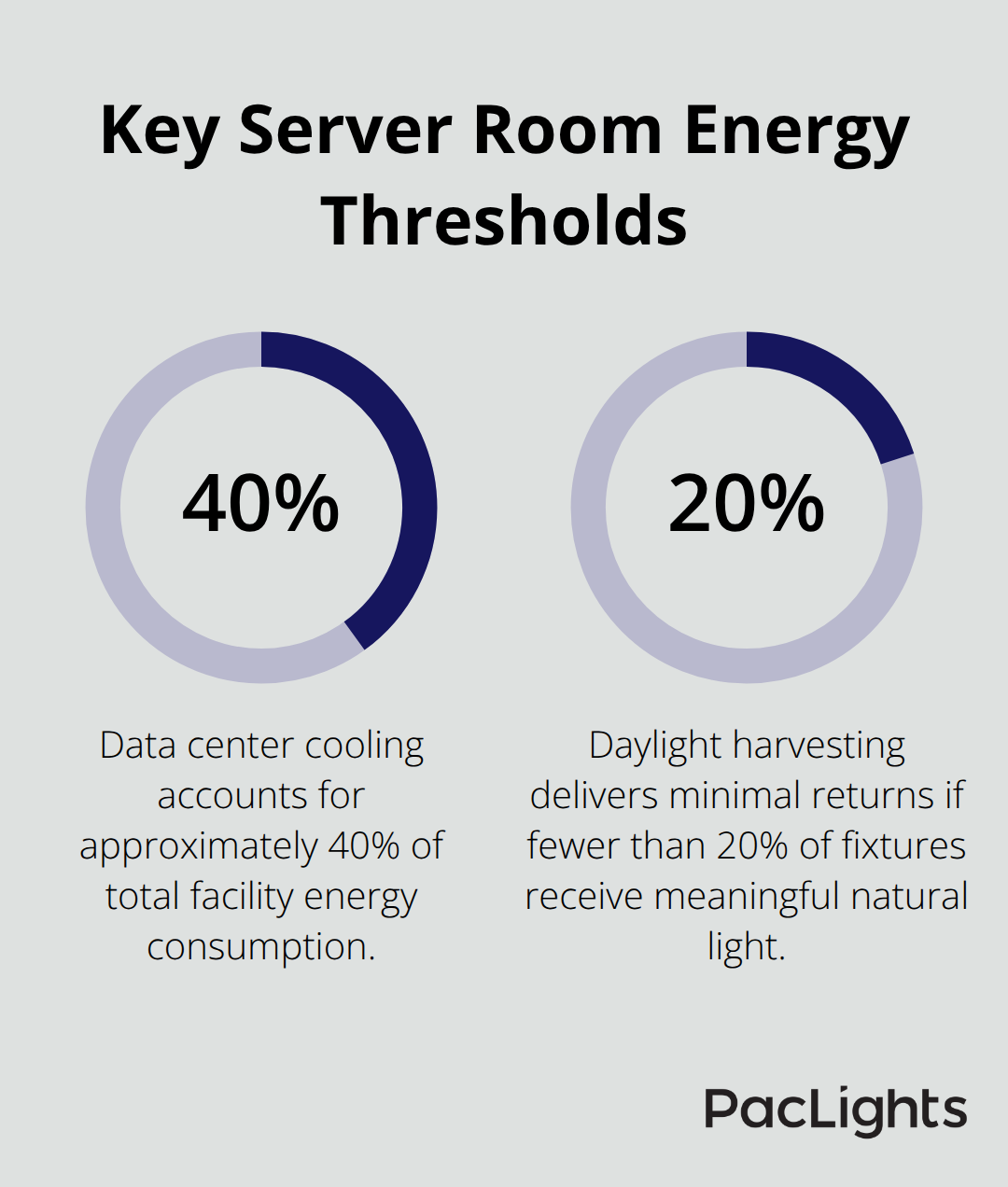
Server rooms generate significant heat, and lighting contributes more to that thermal load than most facility managers realize. Traditional fixed-output lighting systems dump constant energy into spaces that need cooling, forcing HVAC systems to work harder and driving up operational costs. The U.S. Department of Energy reports that data center cooling accounts for approximately 40% of total facility energy consumption. When lighting runs at full brightness regardless of occupancy or time of day, you pay twice-once for the unnecessary light and again to remove the heat it generates.
How Lighting Affects Temperature and Equipment
Advanced lighting controls reduce waste by adjusting output based on actual needs, which directly lowers both energy bills and equipment stress. Server room temperatures that rise even one degree above optimal ranges cause equipment reliability to drop measurably. Precision controls prevent temperature spikes by eliminating excess heat from lighting, protecting your hardware investment and extending component lifespan.
The Real Cost of Constant Full-Brightness Operation
Data centers spend between $0.10 and $0.15 per kilowatt-hour on average, according to industry benchmarks. A typical server room with 20 high-bay fixtures running 24/7 at full capacity consumes roughly 48 kilowatts daily, costing $1,440 to $2,160 monthly. Motion sensors and occupancy-based controls cut this consumption by 30% to 50% simply because technicians don’t occupy server rooms continuously. Networked lighting management platforms go further, enabling daylight harvesting in facilities with windows and automated dimming schedules aligned with actual maintenance windows. The payback period for advanced controls typically ranges from 18 to 36 months, after which you realize pure operational savings.
Security and Access Integration
Security and access management benefit equally from modern controls. Motion sensors alert facility staff to unauthorized movement, and networked systems log lighting activation patterns tied to badge access data, creating an audit trail that traditional systems cannot provide. This integration strengthens your security posture without additional hardware investment. Control systems that track occupancy patterns (combined with access logs) reveal operational inefficiencies and potential vulnerabilities simultaneously.
With energy costs and security concerns addressed, the next step involves selecting the right control technologies for your specific infrastructure.
Types of Lighting Control Systems for Server Rooms
Motion Sensors and Occupancy-Based Controls
Motion sensors and occupancy-based controls form the foundation of practical server room lighting management because technicians spend limited time inside these spaces. A typical data center technician spends roughly 2 to 4 hours per day in server rooms, yet traditional systems light these spaces 24 hours daily. Motion sensors detect actual presence and dim or shut off fixtures within minutes of the last detected movement, cutting wasted energy significantly. The payback calculation becomes straightforward: if your 20-fixture setup costs $2,160 monthly to operate at full capacity, a 40% reduction from occupancy controls saves $864 monthly or $10,368 annually. Most facilities recover sensor installation costs within 18 months.
Motion sensor performance depends heavily on proper placement and sensitivity calibration. Dead zones where technicians work without triggering sensors waste the entire investment, so site surveys before installation matter more than the sensors themselves. Technicians who move slowly or remain stationary for extended periods may not maintain continuous sensor activation, requiring you to adjust sensitivity thresholds during commissioning.
Daylight Harvesting and Automated Dimming
Daylight harvesting and automated dimming systems address a different inefficiency that occupancy controls miss. Server rooms with windows or skylights receive natural light that traditional fixed systems ignore, forcing you to pay for artificial lighting that competes with free daylight. Automated dimming systems measure ambient light levels and reduce fixture output proportionally, cutting energy consumption by an additional 15% to 30% in facilities with significant window exposure. This approach works particularly well in hybrid server environments where some zones receive natural light while others remain interior spaces.
Networked Lighting Management Platforms
Networked lighting management platforms consolidate motion sensors, dimming controls, and daylight harvesting into unified systems that integrate with your building management infrastructure. These platforms log lighting activation patterns, track energy consumption in real time, and identify anomalies that signal equipment problems or security breaches. Integration with access control systems creates comprehensive audit trails: you see exactly when technicians entered specific zones and how long they remained, matching this data against lighting activation records. This combination reveals whether personnel work efficiently or spend excessive time troubleshooting problems.
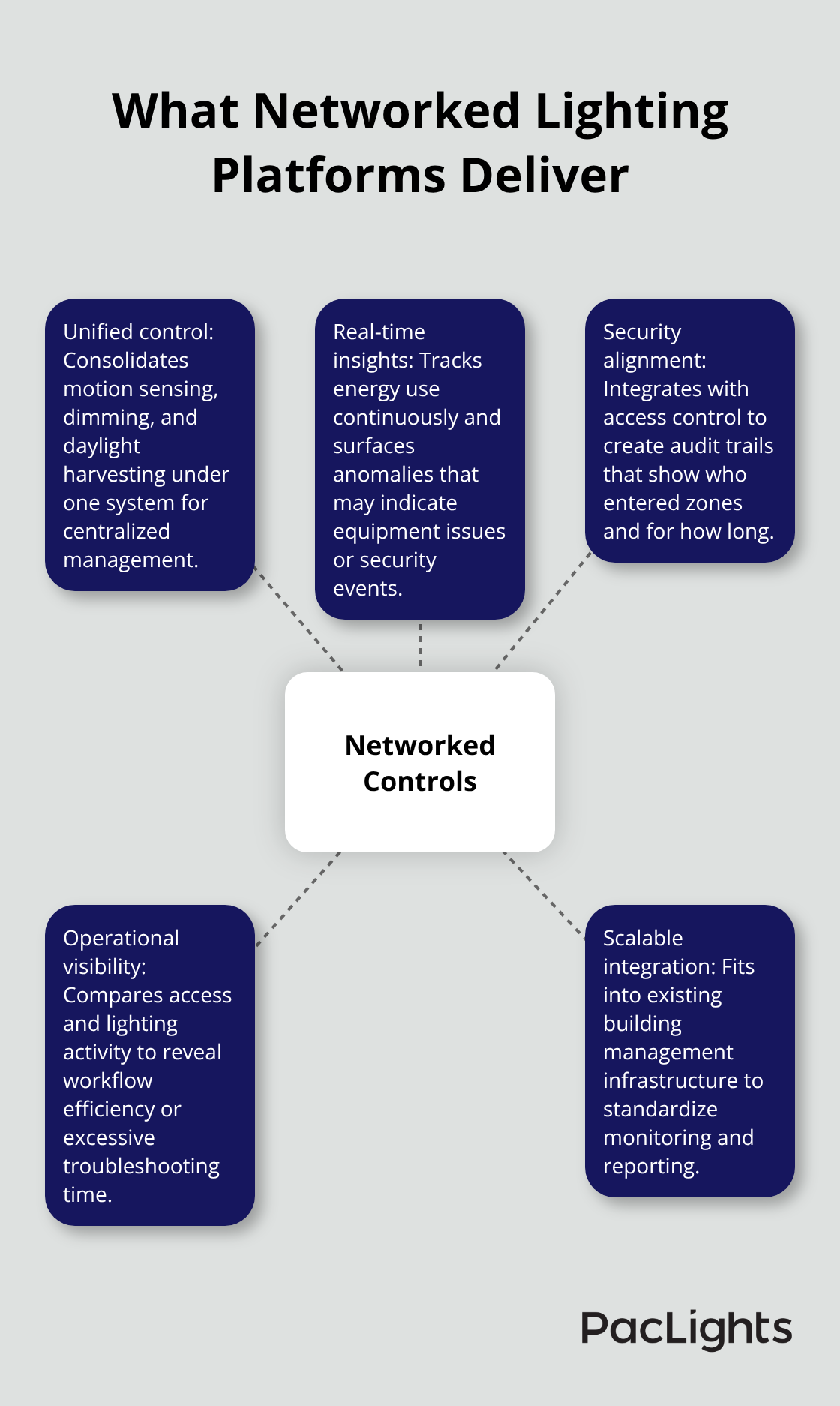
The upfront cost of networked platforms runs higher than standalone sensors, typically $8,000 to $15,000 for a mid-sized facility, but the operational intelligence justifies the investment within 24 to 36 months when you factor in energy savings, reduced HVAC strain, and improved security monitoring. Lighting fixtures with optional motion and daylight controls plus advanced networked lighting control capabilities provide the visibility that isolated sensors cannot deliver.
With control technologies identified, your next priority involves assessing your current infrastructure and determining which systems align with your facility’s specific requirements and operational constraints.
Implementation Best Practices for Server Room Lighting
Assess Your Current Infrastructure and Needs
Implementing lighting controls in a server room requires a methodical approach that starts with honest assessment of what you currently have and what your space actually demands. Many facilities rush to install motion sensors or networked platforms without first understanding their existing infrastructure, fixture types, and occupancy patterns, which leads to undersized systems that fail to deliver promised savings or oversized installations that waste capital. Start by documenting your current lighting setup: count fixtures, note wattage ratings, identify circuit configurations, and measure how long technicians actually spend in each zone during a typical week. This data reveals whether occupancy-based controls will work effectively or whether your facility operates with continuous staffing that makes motion sensors less valuable.
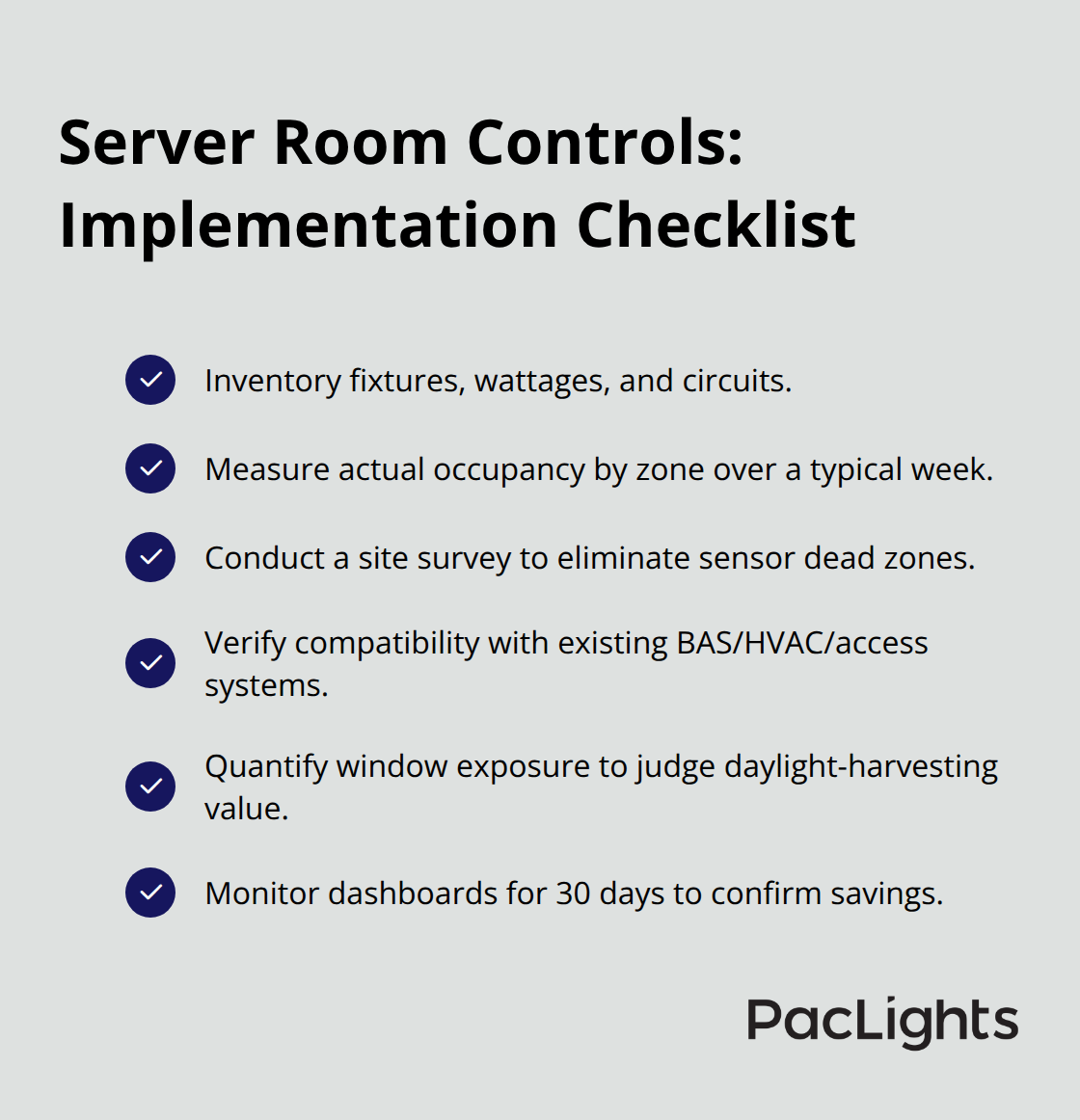
Next, assess your facility’s physical characteristics. Server rooms with windows benefit dramatically from daylight harvesting systems, while interior spaces without natural light gain minimal value from this technology. Check whether your facility already has networked building management systems in place. If your HVAC, access control, and security systems already communicate through a central platform, adding lighting controls to that network costs significantly less than integrating isolated sensor systems later. If your facility lacks networked infrastructure, standalone motion sensors and simple timers often deliver better returns than expensive platforms that require network installation.
Select Compatible Control Technologies
Selecting control technologies that match your infrastructure prevents costly mistakes and ensures your investment performs as promised. Prioritize compatibility with your existing systems before evaluating advanced features. If your facility runs a Building Automation System from a specific vendor, verify that any lighting control platform integrates with that system before purchase. Many mid-market facilities discover too late that their new lighting controls cannot communicate with existing HVAC or access systems, forcing expensive workarounds.
When evaluating sensor-based systems, request site surveys from installers to identify dead zones where technicians work without triggering motion detection. Poor sensor placement wastes the entire investment, so this step determines whether you achieve the promised 30% to 50% energy reductions or fall short. For daylight harvesting systems, measure window exposure and calculate the percentage of your facility that receives meaningful natural light. If fewer than 20% of your fixtures have access to natural light, daylight harvesting delivers minimal returns.
Monitor Performance and ROI
Monitoring your control system’s performance after installation separates facilities that achieve projected savings from those that install expensive equipment and never verify results. Request real-time energy consumption dashboards from your control system vendor, and compare actual kilowatt-hour consumption against baseline measurements taken before installation. Most facilities should see energy reductions within the first 30 days if systems are configured correctly.
Track occupancy patterns for at least 90 days to identify whether technician behavior matches your initial assumptions. If motion sensors activate far more frequently than expected, your facility may have higher occupancy than you initially assessed, which changes the ROI calculation. Calculate actual payback periods using real data: if your 20-fixture installation cost $12,000 and you achieve $800 monthly savings instead of the projected $1,200, your payback extends from 15 months to 18 months, which still justifies the investment but changes your budget planning.
Review security audit logs quarterly to identify unauthorized access patterns or equipment failures signaled by unusual lighting activation sequences. This practice reveals whether your control system performs its dual role of energy management and security monitoring effectively.
Final Thoughts
Server room lighting controls deliver measurable returns that extend far beyond energy savings. The systems we’ve covered reduce operational costs by 30% to 50%, lower equipment stress through better temperature management, and create security audit trails that traditional lighting cannot provide. These benefits compound over time as your facility operates more efficiently month after month, turning a one-time investment into sustained competitive advantage.
Long-term success requires treating lighting controls as infrastructure investments rather than cost-cutting measures. Facilities that monitor performance data, adjust sensor sensitivity based on actual occupancy patterns, and integrate controls with existing building systems achieve payback periods of 18 to 36 months consistently. After that threshold, every dollar saved flows directly to your bottom line, while unauthorized access detection and occupancy pattern logging strengthen your facility’s protection posture without requiring separate security hardware.
Your facility’s specific needs determine which control technologies deliver the best results. Motion sensors work exceptionally well in spaces with limited occupancy, daylight harvesting adds value where natural light reaches fixtures, and networked platforms provide comprehensive visibility across your entire operation. Visit PacLights to explore how server room lighting controls can transform your facility’s operations and discover which control approach fits your requirements and budget.
Disclaimer: PacLights is not responsible for any actions taken based on the suggestions and information provided in this article, and readers should consult local building and electrical codes for proper guidance.