

Warehouse lighting problems cost businesses thousands annually in wasted energy and preventable accidents. Most facilities still rely on outdated fixtures that drain budgets while leaving dark corners where workers struggle to operate safely.
At PacLights, we’ve seen firsthand how strategic warehouse lighting ideas transform operations. The right lighting setup cuts energy costs, boosts productivity, and pays for itself faster than most facility managers expect.
The Real Cost of Warehouse Lighting Failures
Safety Risks from Inadequate Illumination
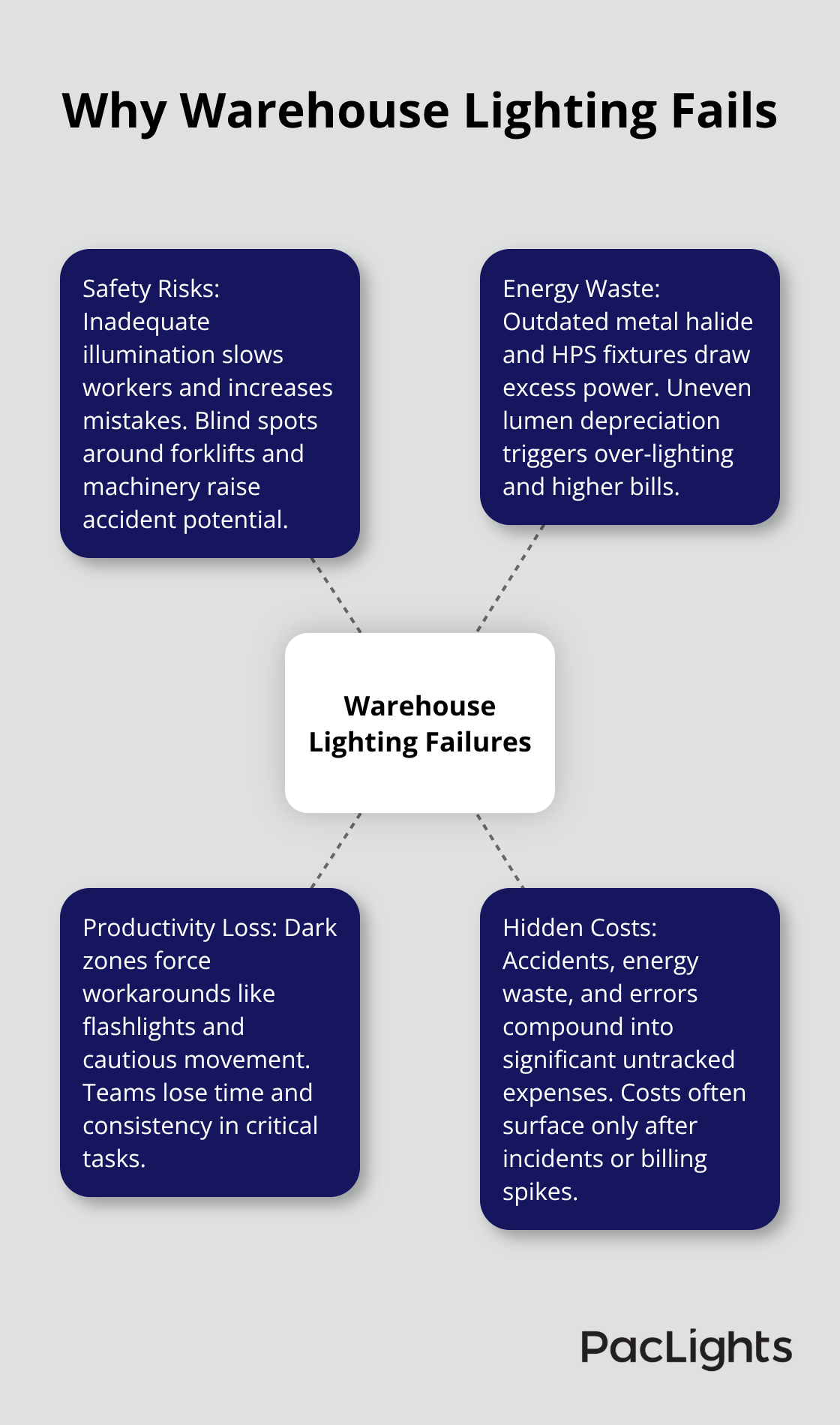
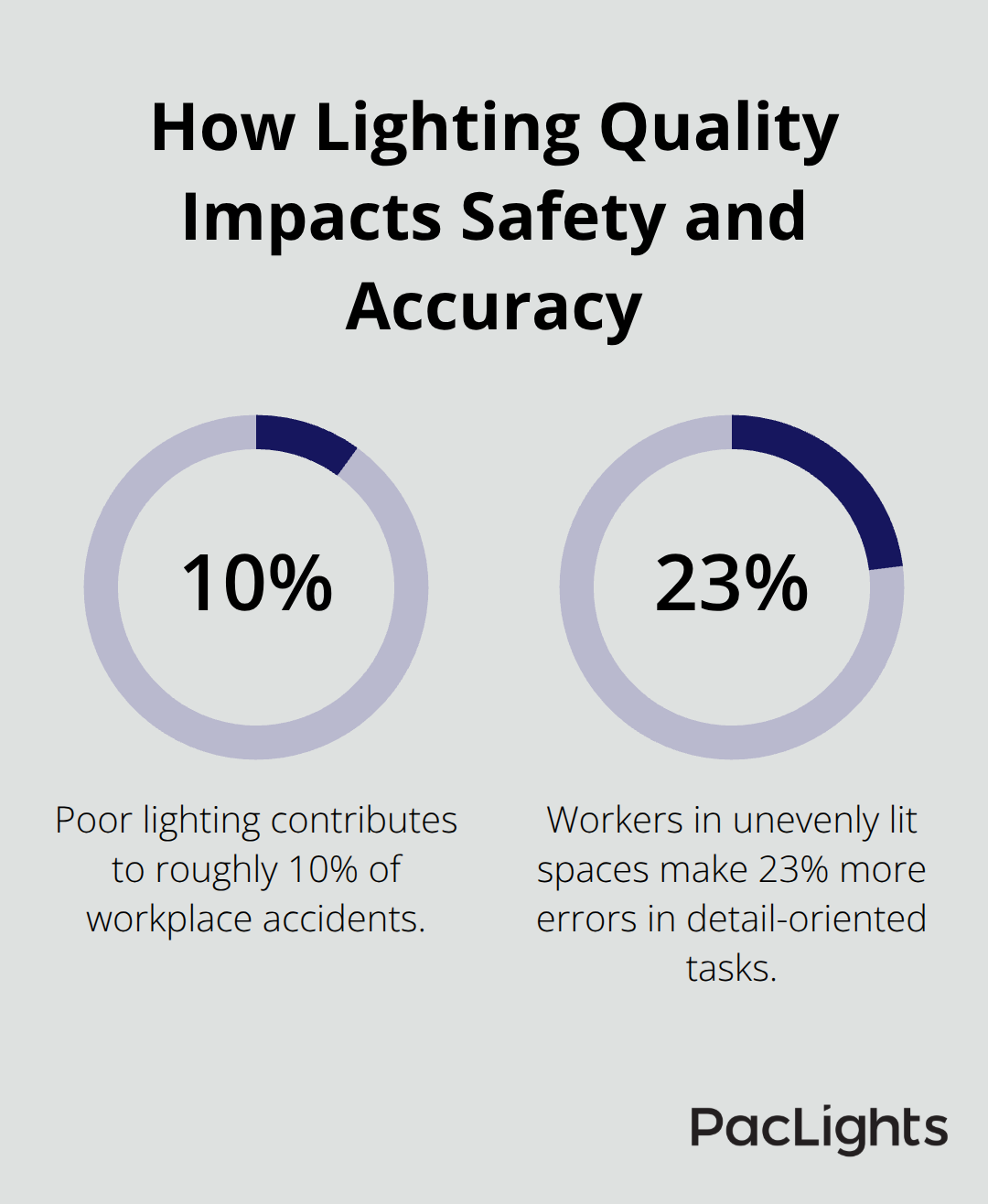
Inadequate lighting in warehouses isn’t just an inconvenience-it’s a financial and safety liability that compounds daily. The Occupational Safety and Health Administration reports that poor lighting contributes to roughly 10% of workplace accidents, and warehouses rank among the highest-risk environments. When workers can’t see clearly, they move slower, make mistakes, and face genuine danger around forklifts and heavy machinery. Dark zones exist in nearly every warehouse, typically concentrated near loading docks, inventory aisles, and overhead storage areas. These problem areas force workers into inefficient workarounds-they use flashlights, move cautiously, or skip inspections entirely.
The productivity loss alone can reach 15-20% in poorly lit sections, which translates to thousands in lost output monthly for mid-sized operations.
Energy Waste from Outdated Fixture Systems
Outdated lighting systems drain energy at alarming rates because older fixtures like metal halide and high-pressure sodium lamps consume 40-50% more electricity than modern LED alternatives while delivering inferior light quality. A typical warehouse running 24/7 operations with 50,000 square feet of outdated high bay fixtures wastes $8,000-$12,000 annually on excess energy costs. The problem intensifies when these aging systems fail unevenly-some fixtures dim over time, which creates inconsistent illumination that forces facility managers to over-light certain areas to compensate. This reactive approach burns even more energy and accelerates equipment degradation.
Productivity Loss from Poor Light Distribution
Poor light distribution damages operations because it forces workers into constant adaptation, shifting between bright spots and shadowy corners, which causes eye strain and fatigue. Studies show workers in unevenly lit spaces experience 23% more errors in detail-oriented tasks like inventory counting or quality checks. The combination of safety risks, energy waste, and productivity loss means most warehouses operate with a hidden cost that never appears on a single line item-until a serious accident occurs or energy bills spike unexpectedly.
These three problems demand solutions that address all of them simultaneously, which is why high-performance lighting systems deliver results that facility managers can measure immediately.
What Actually Works for Warehouse Lighting Performance
LED High Bay Fixtures Deliver Consistent Illumination
LED high bay fixtures solve the core problem that outdated systems create-they produce consistent, bright illumination across large floor areas while consuming a fraction of the energy. A 50,000 square foot warehouse switching from metal halide to LED high bays typically reduces energy consumption by 40-50%, which translates to $8,000-$12,000 in annual savings for 24/7 operations. The light quality matters equally. LED fixtures produce 90+ color rendering index, meaning workers see inventory, safety markings, and machinery hazards with clarity that older lamps simply cannot match. Installation takes days rather than weeks, and the fixtures last 50,000+ hours compared to 15,000 hours for metal halide lamps, which reduces replacement costs dramatically over a decade.
Motion Sensors and Daylight Controls Cut Energy Further
Motion sensors and daylight harvesting controls represent the next efficiency layer, and they work best when paired with LED fixtures. Motion sensors cut energy use by 20-35% in warehouses with variable occupancy patterns-loading docks, break rooms, and storage areas that don’t need constant illumination. Daylight harvesting automatically reduces artificial lighting when natural light enters through skylights or windows, which saves an additional 10-15% on facilities with good window access. A warehouse manager at a mid-sized distribution center reported reducing monthly energy costs by $2,400 after implementing networked controls on top of LED retrofits, with payback occurring in less than three years.
Advanced Networked Controls Optimize Operations in Real Time
Advanced networked lighting controls allow facility managers to adjust brightness across zones, schedule dimming during low-activity periods, and track energy consumption in real time through a dashboard. These systems provide data that reveals exactly which areas consume the most energy, enabling precise optimization rather than guesswork. The real advantage of combining LED fixtures with smart controls is that each technology amplifies the other. LED fixtures are efficient, but adding motion sensors and networked controls makes them efficient in a way that matches actual warehouse operations. A facility running full brightness 24/7 wastes money on illumination when few workers occupy the space during night shifts. Smart controls eliminate that waste while maintaining safety in active zones.
Integrated Systems Deliver Measurable Results
PacLights offers high bay fixtures with optional daylight and motion controls built in, plus advanced networked lighting control systems that integrate across multiple fixture types. This means a warehouse can implement one cohesive system rather than patching together incompatible components. The combination delivers measurable results-energy savings, improved safety visibility, and faster payback than LED fixtures alone. These performance gains create the foundation for understanding exactly how much money a warehouse can recover from a lighting upgrade, which is where real-world ROI becomes clear.
How Much Money Does a Warehouse Actually Save from LED Lighting
Energy Savings That Justify the Investment
LED retrofits deliver predictable financial returns that most facility managers underestimate until they see the actual numbers. A 50,000 square foot warehouse operating 24/7 with outdated metal halide or high-pressure sodium fixtures spends $8,000–$12,000 annually on excess energy costs compared to LED high bays. Switching to LED cuts that waste entirely while improving light quality, which means the energy savings alone justify the retrofit investment within 3–5 years for most facilities.
The U.S. Department of Energy reports that LED high bay upgrades reduce energy consumption by 40–50%, and when paired with motion sensors and daylight controls, facilities achieve additional 20–35% reductions in lighting energy use. A distribution center manager upgraded 200 fixtures across 80,000 square feet and recovered $18,000 in annual energy savings, with the entire project paying for itself in 2.8 years.
Reduced Maintenance and Replacement Costs
LED retrofits eliminate the expense of constantly replacing failed fixtures. Metal halide lamps last 15,000 hours and require replacement every 2–3 years in 24/7 operations, while LED fixtures exceed 50,000 hours, which means replacement intervals stretch to 5–7 years or longer. This reduction in maintenance cycles saves labor costs, minimizes downtime, and cuts material expenses substantially over a decade.
Facility managers stop budgeting for frequent lamp replacements and focus resources elsewhere. The longer lifespan of LED fixtures (compared to older technologies) transforms lighting from a recurring expense into a one-time investment that compounds savings year after year.
Safety Improvements Create Hidden Financial Value
Worker safety improvements create measurable financial value that spreadsheets often miss entirely. Warehouses with poor lighting experience more accidents, which drives up workers compensation insurance premiums, increases liability exposure, and creates productivity losses when workers operate cautiously in dim areas. The National Safety Council indicates that inadequate lighting contributes to roughly 10% of workplace accidents, meaning a facility with 50 annual incidents might prevent 5 of them through proper lighting upgrades.
Each prevented accident saves $40,000–$60,000 in direct costs plus indirect expenses like lost productivity and retraining. Better visibility from LED fixtures reduces near-misses and equipment damage, which further protects the bottom line.
Advanced Controls Accelerate Payback Periods
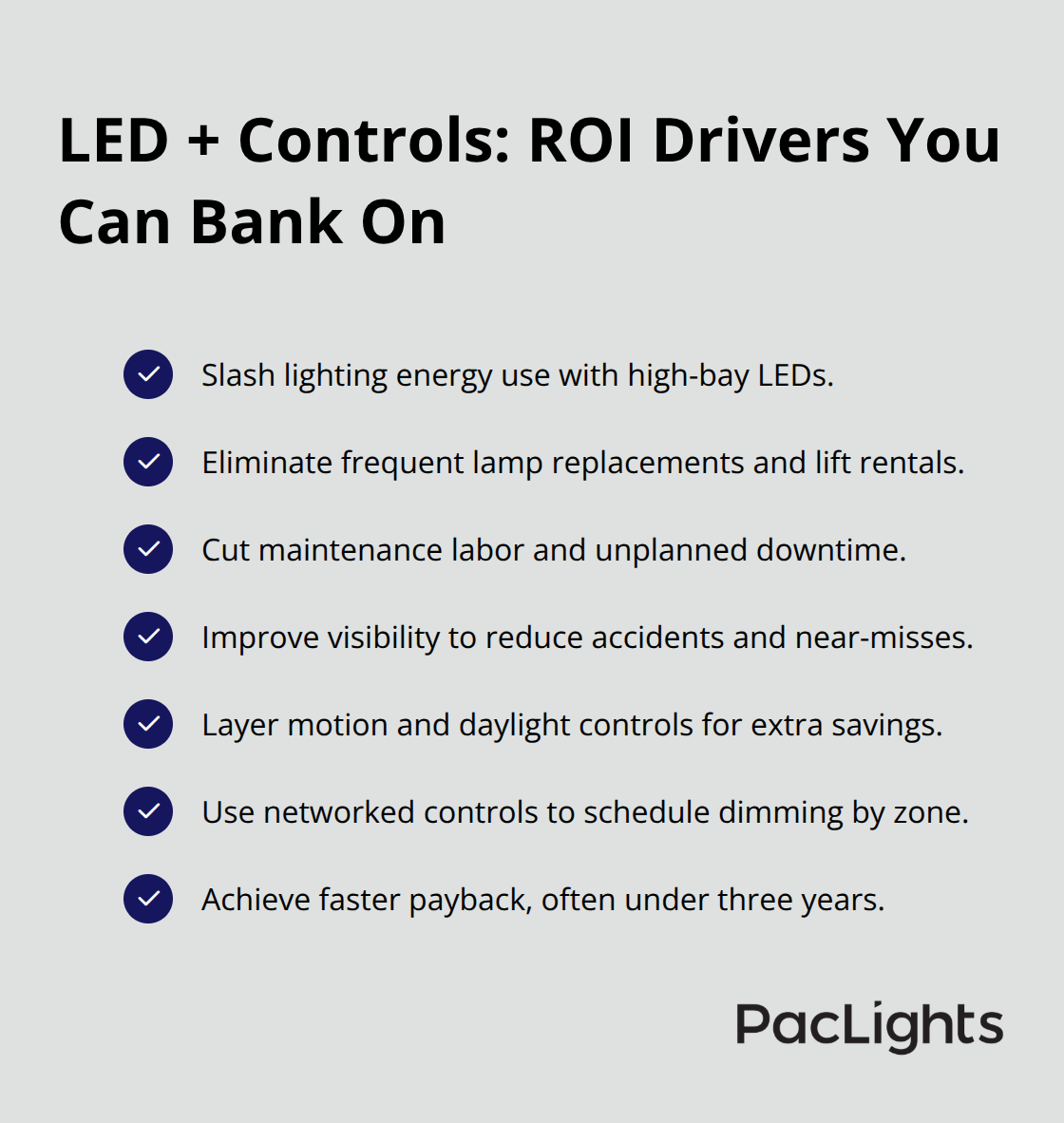
Advanced networked controls accelerate payback further by enabling precise optimization that LED fixtures alone cannot achieve. A warehouse manager can schedule dimming during low-occupancy night shifts, automatically reduce brightness when daylight enters through windows, and adjust specific zones based on actual usage patterns. This layered approach turns a solid LED investment into an exceptional one, with total payback periods dropping below three years for most mid-sized facilities and below two years for larger operations with significant energy consumption.
The data from networked controls reveals exactly which areas consume the most energy, allowing facility managers to fine-tune operations rather than rely on guesswork. Motion sensors and daylight harvesting work together to eliminate waste in spaces that don’t require constant full brightness, while maintaining safety in active zones where workers need clear visibility.
Final Thoughts
Warehouse lighting ideas deliver measurable returns that extend far beyond energy bills. The combination of LED high bays, motion sensors, daylight controls, and networked systems addresses safety risks, eliminates energy waste, and restores productivity in ways that older fixtures simply cannot match. A facility manager who implements these solutions typically recovers the investment within three years while preventing accidents, reducing maintenance cycles, and creating a safer environment for workers.
A lighting assessment reveals exactly where problems exist and which solutions deliver the highest ROI for your specific operation. This assessment identifies dark zones, measures current energy consumption, and calculates potential savings based on your facility’s size, occupancy patterns, and operating hours (transforming guesswork into strategy). The data allows you to prioritize upgrades that matter most to your bottom line.
Long-term benefits compound year after year as LED fixtures last five to seven years or longer, eliminating the constant replacement cycle of outdated systems. Advanced controls continue optimizing energy use as your facility evolves, adjusting to seasonal changes and shifting operational demands. Contact PacLights to schedule your free lighting assessment and see exactly what your warehouse can save.
Disclaimer: PacLights is not responsible for any actions taken based on the suggestions and information provided in this article, and readers should consult local building and electrical codes for proper guidance.