

Warehouse lighting design tips often get overlooked, yet they directly impact your bottom line. Poor lighting costs you money through wasted energy and lost productivity, while putting workers at risk.
At PacLights, we’ve seen firsthand how strategic lighting transforms warehouse operations. This guide shows you exactly how to audit your space, upgrade your fixtures, and implement controls that work.
Why Warehouse Lighting Directly Impacts Your Safety Record and Bottom Line
Poor Lighting Costs You Money and Puts Workers at Risk
Poor warehouse lighting doesn’t just create an uncomfortable work environment-it actively drains your budget and puts workers in danger. Inadequate visibility leads to higher accident rates around forklifts, loading docks, and tall racking systems. The Occupational Safety and Health Administration documents that poor lighting contributes to workplace injuries that cost warehouses thousands in workers’ compensation claims, lost productivity, and potential legal liability. A well-lit warehouse reduces mispicks because product labels and barcodes become clearly visible, which directly lowers order errors and return costs. Workers in brightly lit environments stay alert longer and make fewer mistakes, meaning your throughput increases without pushing staff harder.
Energy Costs Demand Immediate Attention
Energy costs tell the same story as safety. Traditional fluorescent and HID fixtures consume massive amounts of electricity-often 70% more than modern LED alternatives. If your warehouse still runs on older lighting technology, you overspend on utilities every single month. Switching to LED cuts electricity costs by more than 70% while delivering the brightness your operations need. Industry expectations show payback periods of 12–24 months for LED upgrades, making the financial case straightforward.
Compliance Standards Govern Your Lighting Choices
Warehouse operations fall under OSHA safety standards that mandate adequate illumination levels depending on your work areas. Loading bays and storage rooms require at least 80 lux, while general warehouse work demands 160 lux. Detailed picking or food preparation tasks require 240–400 lux depending on the specific work. Failing to meet these standards exposes you to citations and fines. Energy efficiency standards are also tightening across many regions, which now incentivize LED upgrades through rebate programs that lower your retrofit costs significantly. Modern LED fixtures include options for motion sensors and daylight controls, which help you meet sustainability goals while reducing operational expenses. The combination of regulatory compliance, worker safety, and energy efficiency makes strategic lighting design a business decision, not a nice-to-have feature.
What Comes Next in Your Lighting Strategy
Understanding why lighting matters sets the foundation for action. The real challenge lies in determining what your specific warehouse actually needs-and that starts with a thorough assessment of your current system.
What Fixture Types and Light Levels Actually Work for Your Warehouse
Match Lux Levels to Your Specific Tasks
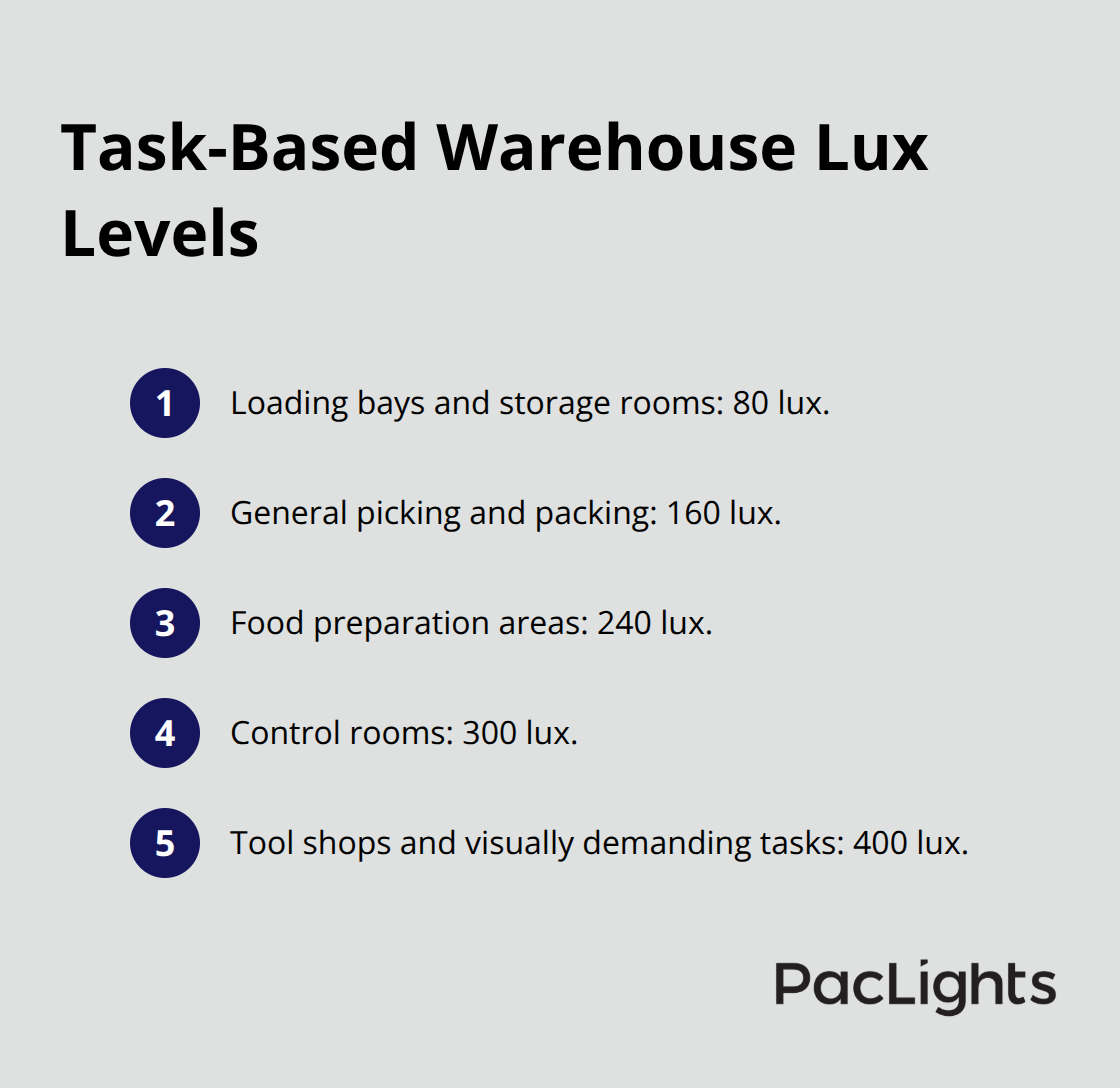
The Illuminating Engineering Society sets clear standards that separate safe operations from risky ones. Loading bays and storage rooms function safely at 80 lux, general warehouse picking and packing require 160 lux, food preparation areas demand 240 lux, control rooms need 300 lux, and visually demanding tasks like tool shops reach 400 lux. These numbers matter because undershooting them costs you in accidents and errors, while overshooting wastes energy on unnecessary brightness. Start by mapping your warehouse into zones and assigning each one its task category, then calculate the lumens you actually need.
For a 1,000 square foot space with a 10-foot ceiling and 10-foot fixture spacing, you need approximately 32,000 lumens total. At 15 feet ceiling height with 14-foot spacing, that jumps to 35,000 lumens. At 25 feet, you’re looking at 39,000 lumens, and at 35 feet, 42,000 lumens. These numbers guide your fixture selection and prevent the guesswork that leads to expensive retrofits down the line.
Select the Right Fixture Type for Your Ceiling Height
Fixture type determines whether light reaches the right places or gets wasted in shadows. For warehouses under 15 feet, 80-watt LED fixtures work well, but you’ll need 100–105 watts at 15–25 feet, 240 watts at 45 feet, and 320 watts at 50 feet. High bays excel in tall facilities because they concentrate light downward over wide areas, eliminating the dark corners that plague older systems. Narrow beam angles around 60 degrees work for shelving because they prevent light from being blocked by inventory, while open aisles benefit from wide beams between 90–120 degrees to cover larger zones uniformly. Color temperature around 5000K improves detail visibility and keeps workers alert, outperforming warmer tones that dampen focus.
Implement Controls That Cut Energy Waste
Control systems separate high-performing warehouses from mediocre ones. Motion sensors automatically shut off lights in unused areas, cutting energy consumption during low-activity periods. Daylight-responsive dimming reduces artificial lighting when natural light streams through windows or skylights, lowering utility bills without sacrificing visibility. Smart controls let you schedule lighting by shift, dim fixtures during slow periods, and adjust zones independently rather than running everything at full power all day. Implementing these controls typically pays for itself within 12–24 months through energy savings alone, making the upfront investment straightforward to justify to your finance team.
Plan Your Fixture Layout to Eliminate Dark Spots
The way you position fixtures across your warehouse floor determines whether workers see clearly or navigate shadows. Centralize fixture placement along aisles to maximize coverage and consistency across the workspace. Try wide-beam light (90–120 degrees) for open areas between shelves and corridors; for shelves themselves, use narrow (60 degrees) or long-beam (120 degrees) patterns to prevent inventory from blocking illumination. Avoid placing fixtures directly above shelves, which creates shadows underneath and forces workers to strain their eyes. A mix of fixture types and strategic positioning ensures uniform coverage without over-illumination or dark corners that slow operations.
The right fixtures and controls form the foundation of an efficient warehouse, but success also depends on how you actually transition from your current system to a better one.
How to Transition From Your Old System to LED Without Disrupting Operations
Conduct a Lighting Audit to Establish Your Baseline
Start your retrofit with a systematic lighting audit that identifies exactly where you waste energy and where visibility falls short. Walk through each warehouse zone with a light meter and document current lux levels against the task requirements you mapped earlier-80 lux for storage, 160 for general picking, 240 for food prep, 300 for control rooms, and 400 for detailed work. Photograph dark corners and problem areas where workers struggle to read labels or navigate safely.
Check your current fixture types and wattages, then calculate total lumens across the space using industry standards: roughly 10 lumens per square foot for large items and 30 lumens per square foot for small items. Compare these numbers against your actual needs. Most warehouses running fluorescent or HID systems discover they overspend by 40–60% on energy while still maintaining inadequate visibility in critical zones. Document your findings in a spreadsheet that lists each fixture location, current wattage, condition, and lux reading. This data becomes your baseline for calculating ROI and justifying the upgrade to decision-makers.
Choose Between One-for-One Replacement and Phased Upgrades
Retrofit approaches matter more than you might think. One-for-one replacement lets you swap fluorescent fixtures with similar form factors, which minimizes downtime and installation disruption. This method works well for warehouses that cannot afford extended shutdowns, though it sometimes leaves existing infrastructure underutilized.
A phased upgrade approach spreads capital expenditure over time while letting you prioritize zones with the highest safety and productivity impact first-typically loading docks and main aisles where accidents cost the most. Start there, measure results, then expand to secondary zones. LED conversion cuts electricity costs by more than 70% compared with legacy systems, and payback periods typically run 12–24 months according to industry expectations.
Deploy Motion Sensors and Daylight Controls
Motion sensors automatically turn off lights in unused areas during low-activity periods, which cuts energy consumption dramatically. Daylight-responsive dimming reduces artificial lighting when natural light streams through windows, lowering utility bills without sacrificing visibility.
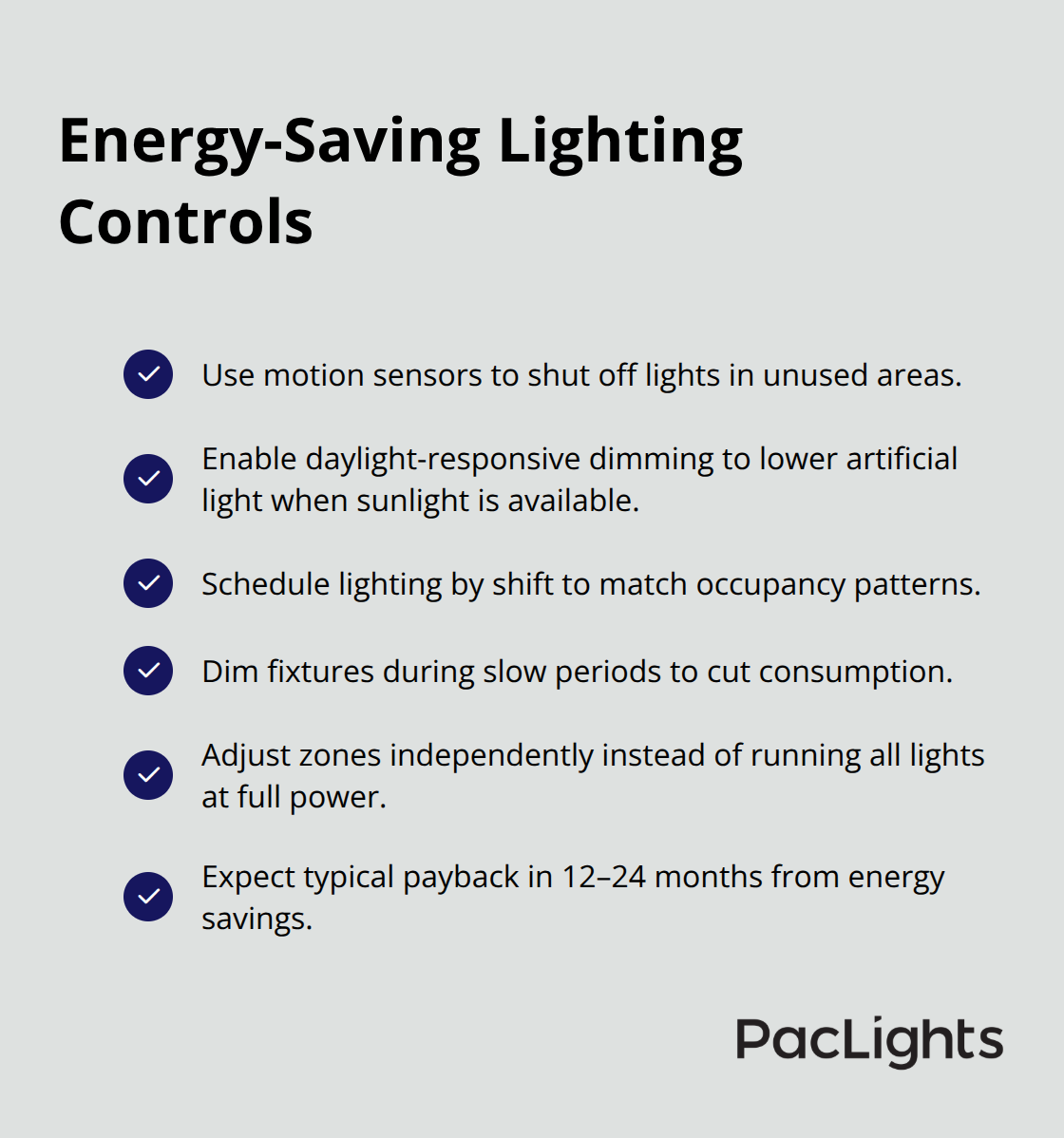
Smart controls let you schedule lighting by shift, dim fixtures during slow periods, and adjust zones independently rather than running everything at full power all day. These systems (when properly configured) transform energy consumption patterns and extend fixture lifespans through reduced operating hours. Implementing these controls typically pays for itself within 12–24 months through energy savings alone, making the upfront investment straightforward to justify to your finance team.
Quantify Your Financial Case Before Committing
LED retrofit investments require clear financial justification. Calculate your current annual energy costs by multiplying your total fixture wattage by operating hours and your local electricity rate. Then project savings by applying the 70% reduction that LED systems deliver.
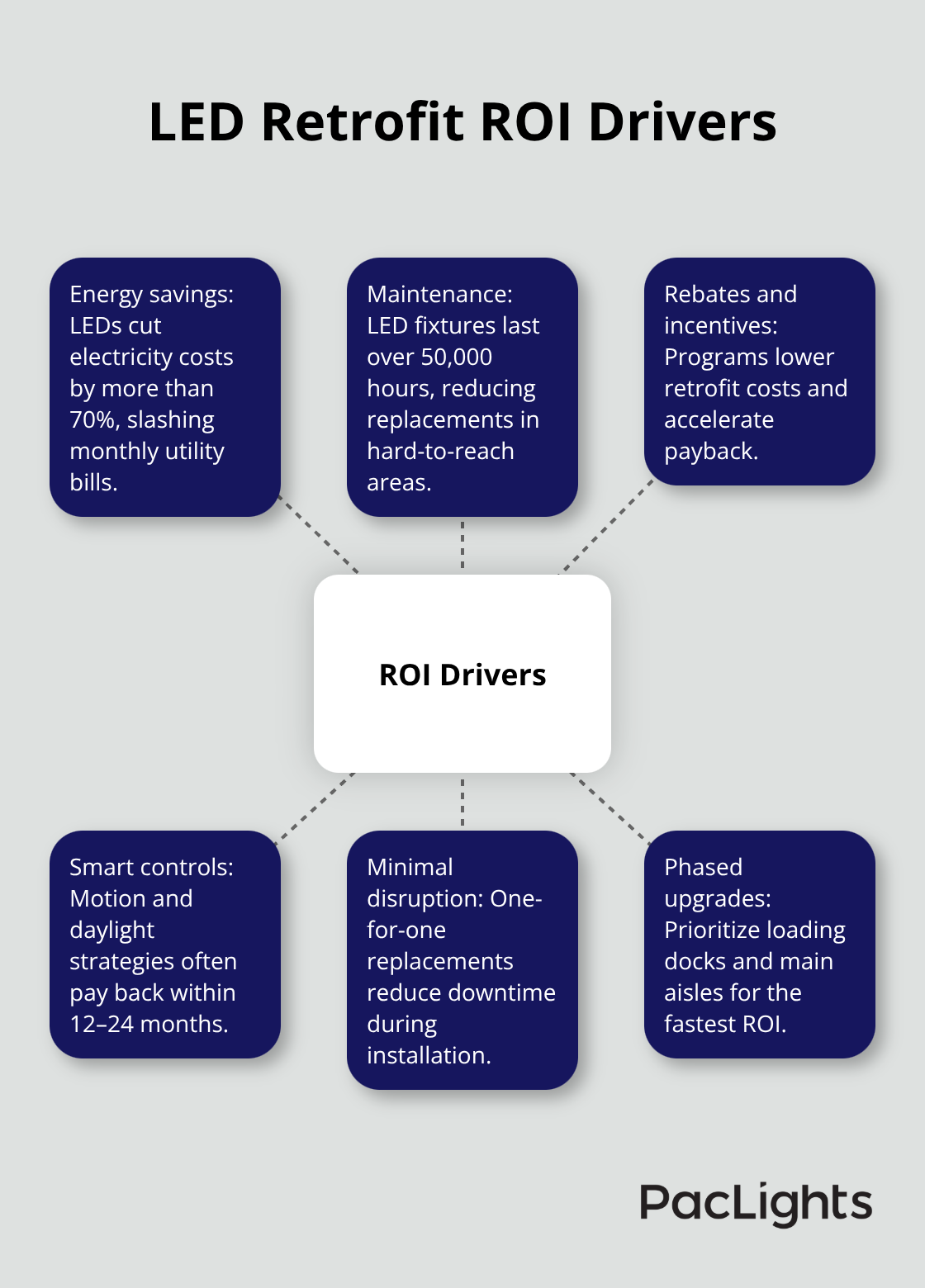
Factor in maintenance cost reductions-LED fixtures last over 50,000 hours compared with fluorescent tubes that require frequent replacement in hard-to-reach warehouse locations.
ROI assessments help you understand payback timelines and total savings over a five-to-ten-year period. Many lighting suppliers offer free layout designs and ROI calculations that model your specific warehouse conditions (ceiling height, fixture spacing, task requirements) to project realistic savings. These assessments remove guesswork from the decision and give your finance team the numbers they need to approve the project.
Final Thoughts
Strategic warehouse lighting design tips work because they address three interconnected problems at once: worker safety, operational costs, and productivity. The warehouses that perform best treat lighting as a system that directly influences their bottom line, not as an afterthought. Start by mapping lux levels to each zone, select fixtures that match your ceiling height, and implement controls that automatically adjust lighting based on occupancy and daylight.
Long-term benefits compound over time. LED fixtures last over 50,000 hours, which means fewer maintenance calls to hard-to-reach locations and lower replacement costs year after year. Energy savings of 70% or more translate directly to reduced utility bills month after month, while fewer accidents and mispicks mean lower workers’ compensation claims and fewer costly order errors. A well-designed lighting system pays for itself within 12–24 months, then continues generating savings for a decade or longer.
The transition from your current system doesn’t require shutting down operations. One-for-one replacements minimize disruption, while phased upgrades let you prioritize high-impact zones first (loading docks and main aisles typically deliver the fastest ROI). Your next step is conducting that lighting audit, documenting your baseline, and calculating what improvements will actually save your operation-contact us at PacLights to discuss tailored fixture solutions for your warehouse.
Disclaimer: PacLights is not responsible for any actions taken based on the suggestions and information provided in this article, and readers should consult local building and electrical codes for proper guidance.