

Warehouse lighting retrofits deliver real savings that hit your bottom line immediately. Energy bills drop by 50–75% when you switch to LED technology, and many facilities recover their investment within three years.
At PacLights, we’ve helped industrial facilities cut lighting costs while improving visibility and worker safety. This guide walks you through the financial case, planning steps, and implementation strategies that actually work.
Why Warehouse Lighting Retrofits Make Financial Sense
Energy Cost Reductions from LED Technology
LED warehouse retrofits cut energy consumption by 50–75%, which translates directly to lower utility bills every month. A 100,000-watt system reduced to 30,000 watts at an electricity rate of $0.12 per kilowatt-hour saves roughly $33,600 annually. Since lighting accounts for up to 40% of a building’s total electricity usage, this improvement hits hard on your operating expenses. The payback period typically falls between 18 months and three years, depending on your facility’s operating hours, local electricity rates, and available rebates. Many warehouses recover their investment in under two years, which means the retrofit essentially pays for itself before you’ve finished the first full cycle of LED fixture replacement.
Tax Credits and Rebates Available for Upgrades
Federal tax incentives and utility rebates can cover 60–100% of your upgrade costs. The federal 179D tax deduction offers up to $1.88 per square foot for qualifying LED upgrades as of 2023. Most utility companies run programs like Ameren BizSavers that provide substantial rebates for high bay fixtures-the 2023 average rebate was $127 per fixture. Some programs offer bonus incentives that push savings even higher, especially for interior lighting upgrades.
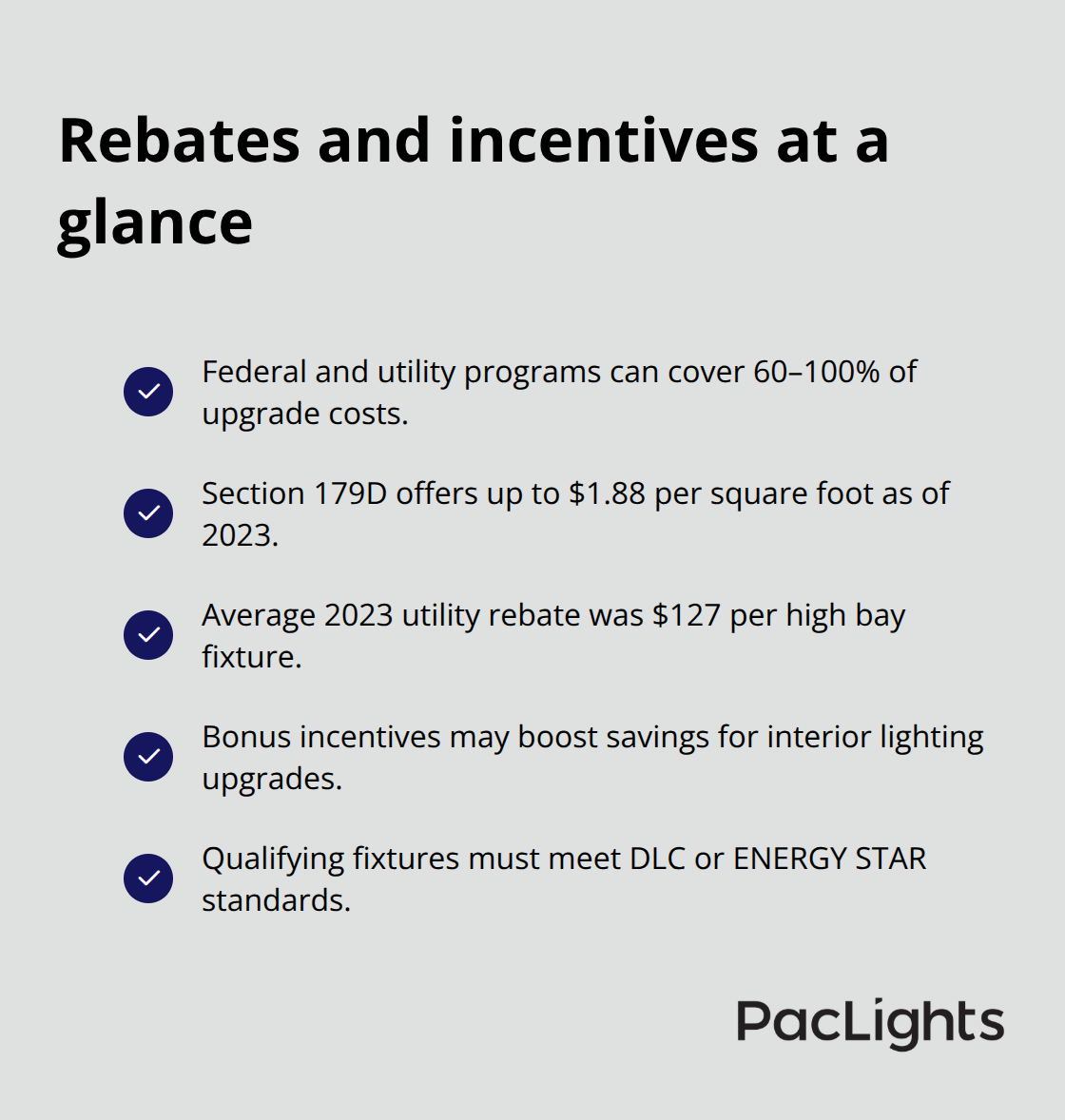
To qualify, your fixtures must meet DesignLights Consortium or ENERGY STAR standards.
Pre-approval through your local utility is critical before ordering, as post-installation inspection windows are strict. A facility that spent $55,000 on a retrofit received $42,000 in rebates and savings, reducing the net cost dramatically. Incentive levels vary significantly by region and change annually, so contacting your utility provider today prevents leaving money on the table.
Long-Term ROI and Payback Periods
Energy savings represent only part of the financial case. LED fixtures last 50,000–100,000 hours (roughly 5–11 years) compared to traditional metal halide or fluorescent bulbs that require replacement every 1–3 years. This means far fewer maintenance calls, less labor time, and reduced downtime. Total cost of ownership over a decade favors LED by a substantial margin because you avoid constantly replacing failed fixtures or paying technicians to climb into high bays. The long lifespan also improves facility reliability-your warehouse stays lit during critical picking periods without unexpected outages.
When you factor energy savings, rebates, and eliminated maintenance costs together, the financial case becomes undeniable. The next step involves assessing your current system and determining which fixture types deliver the strongest returns for your specific warehouse layout and operating schedule.
Planning Your Warehouse Lighting Retrofit Project
Assess Your Current System and Energy Usage
Start by tallying exactly what you have now. Walk your warehouse and count every fixture type, note the wattage on each one, and record ceiling heights across different zones. Most facilities run a mix of 400-watt metal halide high bays, 1000-watt systems in older sections, and fluorescent troffers in offices. Document your current monthly electricity bill and identify the rate you pay per kilowatt-hour from your utility statement. This baseline determines your actual savings potential. A 100,000-watt system running 4,000 hours annually at $0.12 per kilowatt-hour costs $48,000 yearly. Switching to 30,000 watts cuts that to $14,400, delivering $33,600 in annual savings.
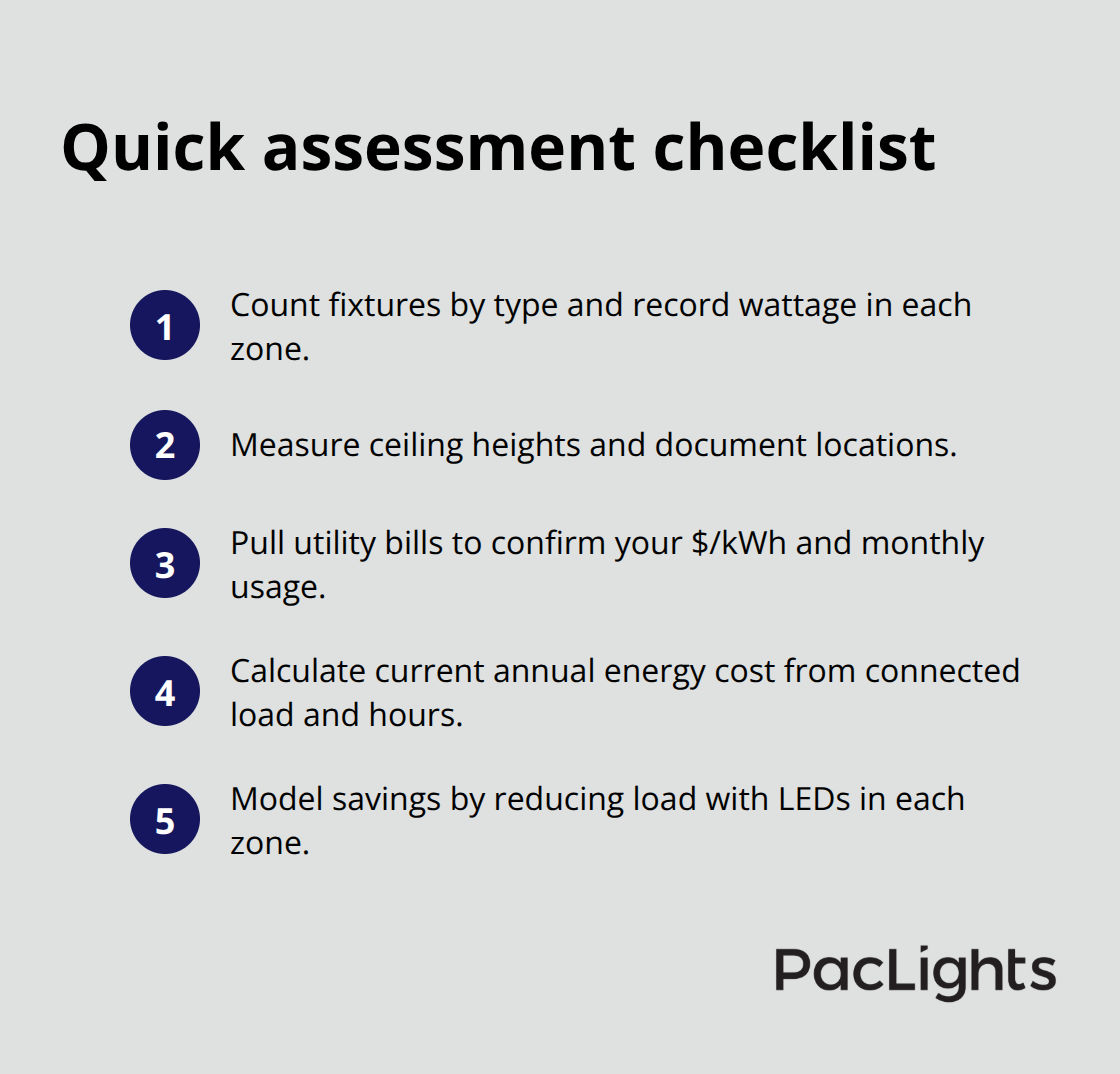
Without this data, you’re guessing at ROI instead of calculating it.
Next, determine your facility’s burn hours. Warehouses operating 16 hours daily have different economics than those running 24/7. Higher burn hours accelerate payback because energy savings compound faster. Contact your utility provider now for pre-approval on rebates, since the 2023 average rebate of $127 per high bay fixture requires specifications that meet DesignLights Consortium standards before you order anything.
Select the Right Fixtures for Your Warehouse Zones
Fixture selection depends entirely on your warehouse layout and task requirements. High bay fixtures work for open floor spaces with 15 to 25-foot ceilings, delivering 60–70% energy savings versus 400-watt metal halide while maintaining superior light quality. Linear high bays suit aisles and racking areas where you need directional light. LED tubes replace fluorescent troffers in offices and low-ceiling zones at 40–60% energy savings, costing $15–$35 per tube. Wall packs handle exterior and dock areas, cutting energy use by 50–65% compared to older HPS fixtures.
The mistake most facilities make is treating the entire warehouse the same. Different zones need different fixtures. Racking aisles need focused beam patterns to prevent glare on product labels. Dock areas need bright, even light for safety during loading. Office spaces tolerate slightly warmer color temperatures than picking areas.
Leverage Professional Design and Layout Planning
A photometric study translates your space dimensions into specific fixture counts and placement. This prevents both under-lighting that slows picking accuracy and over-lighting that wastes energy. Professional lighting design shows exactly which fixtures work best for your facility, eliminating the guesswork entirely. The design process accounts for your ceiling type, existing mounting points, and operational priorities so installation becomes straightforward and your energy savings match projections. With the right fixture specifications and layout confirmed, you’re ready to move forward with implementation details that minimize disruption to your operations.
Implementing Your Retrofit: Key Steps and Best Practices
Schedule Installation Around Your Operations
Timing your installation determines whether your retrofit becomes a smooth transition or a costly operational disruption. The most practical approach schedules work during your lowest-activity periods-weekends, holidays, or seasonal slowdowns when warehouse traffic drops. If you run a 24/7 operation, phase the retrofit section by section rather than attempting a facility-wide blackout. Install fixtures in one zone at a time, keeping adjacent areas fully operational. This approach takes longer but preserves productivity and prevents your entire picking operation from halting because half your lighting is offline.
Coordinate with your installation team at least four weeks ahead to lock in scheduling and confirm crew availability. A turnkey retrofit partner handles the logistics of material staging, fixture delivery sequencing, and crew coordination, which eliminates the complexity of managing multiple vendors and timelines yourself. During installation, verify that emergency lighting and exit signage remain functional throughout the project-fire code violations during retrofits create liability and can delay completion if inspectors flag non-compliance.
Integrate Motion Sensors and Daylight Harvesting
Smart lighting controls multiply your retrofit’s financial impact far beyond fixture efficiency alone. Motion sensors and daylight harvesting can reduce energy consumption by an additional 25–40% beyond what LED fixtures deliver on their own, transforming your retrofit from a 60% energy cut into a 75% reduction.
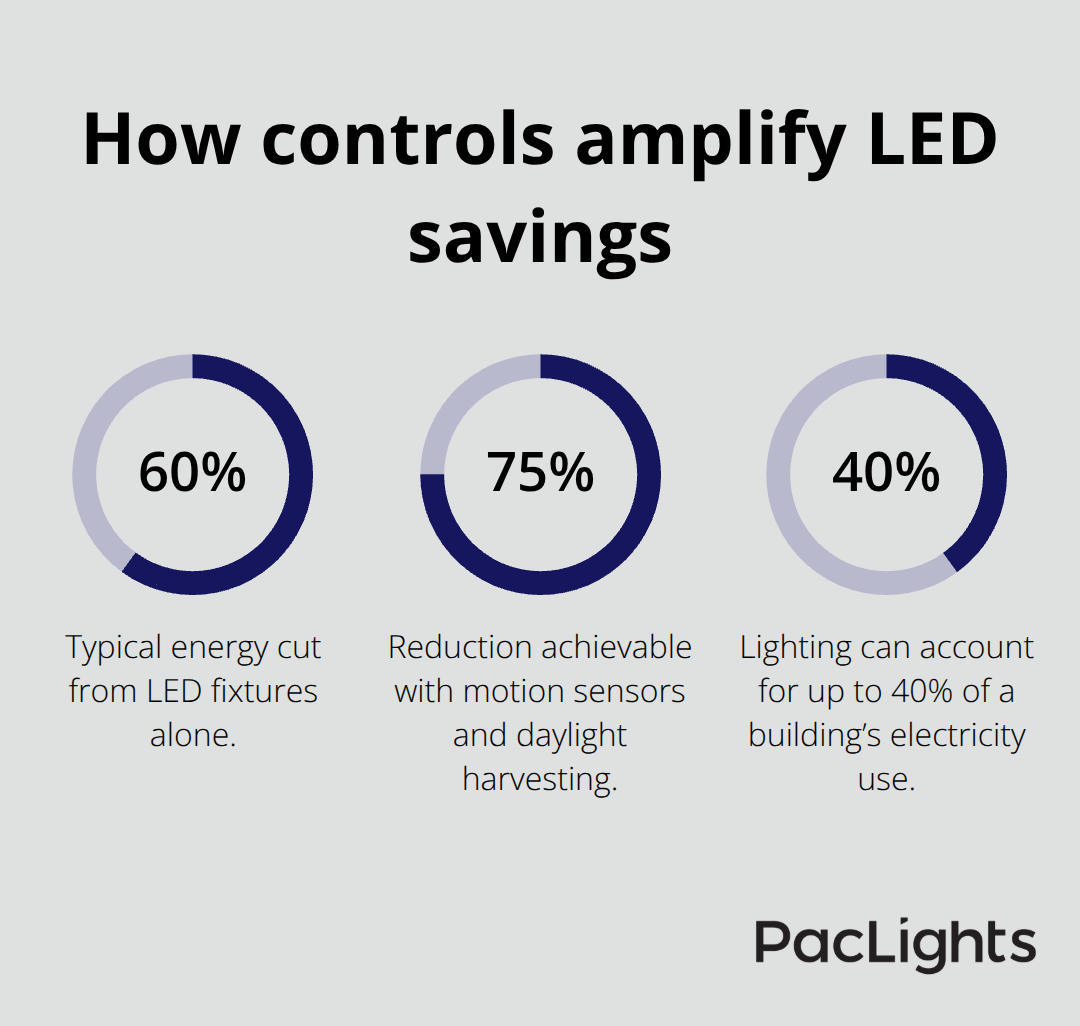
Install occupancy sensors in low-traffic zones like storage areas and offices where lights run unnecessarily during off-peak hours.
Daylight harvesting dimming systems work best in zones with windows or skylights-the sensors detect natural light and dial back artificial output automatically. This combination of fixture upgrades and control technology creates compounding savings that extend well beyond the first year of operation.
Deploy Networked Lighting Controls for Real-Time Optimization
Networked lighting controls integrate all your fixtures into a centralized system that provides real-time visibility into energy consumption, maintenance alerts when fixtures fail, and the ability to adjust brightness schedules as your warehouse operations change. The integration process requires coordination with your building management system during installation, but the payoff justifies the planning effort-facilities tracking consumption data through networked controls typically identify additional efficiency opportunities worth thousands in annual savings.
Networked lighting controls built into fixture specifications ensure you capture this optimization from day one rather than retrofitting controls later as an afterthought. This approach ensures your system performs at peak efficiency immediately after installation.
Final Thoughts
A warehouse lighting retrofit delivers measurable financial results that extend far beyond the first year. Your facility cuts energy costs by 50–75%, recovers the investment within three years, and eliminates the constant maintenance burden of aging fixtures. The combination of LED efficiency, available rebates covering 60–100% of upgrade costs, and reduced labor for relamping creates a financial case that’s hard to ignore.
The path forward starts with a clear assessment of your current system. Document your fixture types, wattages, and operating hours, then contact your utility provider for pre-approval on rebates before ordering anything. Work with lighting professionals to design a layout tailored to your warehouse zones rather than applying a one-size-fits-all approach, since different areas need different fixtures and control strategies to maximize both energy savings and operational performance.
Implementation requires careful scheduling to protect your picking operations and productivity. Phase the retrofit strategically, integrate motion sensors and daylight harvesting to amplify savings beyond fixture efficiency alone, and deploy networked controls that provide real-time visibility into consumption and maintenance needs. Contact PacLights today to start your warehouse lighting retrofit planning and lock in the financial gains waiting in your current lighting system.
Disclaimer: PacLights is not responsible for any actions taken based on the suggestions and information provided in this article, and readers should consult local building and electrical codes for proper guidance.