

Commercial downlights consume far more energy than most facility managers realize. A single halogen downlight can draw 50 watts, while an LED alternative uses just 8 watts for the same brightness.
At PacLights, we’ve seen businesses cut their lighting costs by 60% or more through LED conversion. This guide shows you exactly how much you’ll save and how to make the switch.
LED Downlights vs Traditional Halogen and Incandescent Options
Energy Consumption Differences and Wattage Comparisons
The wattage difference between traditional downlights and LEDs is staggering. A 50-watt halogen downlight produces the same brightness as an 8-watt LED, according to real-world comparisons we see across commercial retrofits. Incandescent downlights waste even more energy, converting only 10% of their input into light while the rest becomes waste heat. LEDs reverse this equation: roughly 80% of energy becomes light and just 20% becomes heat.
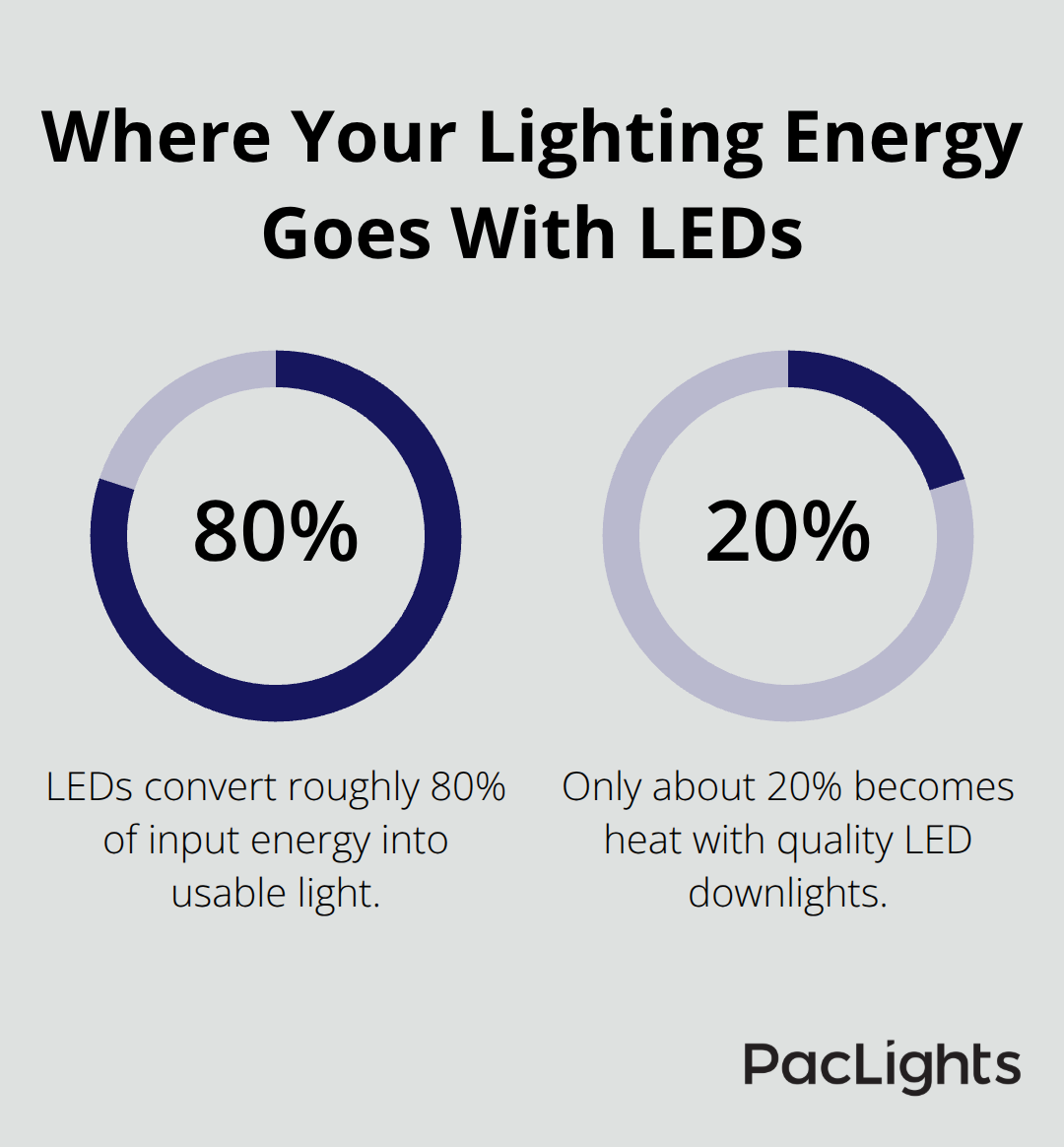
This efficiency gap creates massive cost differences. A typical 10,000 square foot office space using halogen downlights spends between $4,500 and $8,500 annually on lighting electricity alone, per data from the Department of Consumer and Regulatory Affairs. Switching those fixtures to LEDs cuts energy costs by 65% to 80% depending on your current setup. For a facility manager, this translates to thousands of dollars in annual savings before considering any other benefits.
Lifespan and Replacement Frequency
LED downlights last 50,000 to 100,000 hours compared to halogen’s 4,000 hours and incandescent’s 2,000 to 4,000 hours. In a commercial space operating 12 hours daily, a halogen bulb needs replacement every year, while an LED lasts over a decade. This dramatic difference eliminates the constant cycle of ladder work, safety risks, and labor costs that drain maintenance budgets.
You stop paying technicians to climb into ceilings and stop stockpiling replacement bulbs. The extended lifespan also means fewer service interruptions and more predictable operating expenses. Maintenance teams redirect their time and resources toward higher-value facility work instead of chasing burned-out fixtures.
Heat Generation and Cooling Load Reduction
Halogen and incandescent downlights dump enormous amounts of heat into your ceiling cavity, forcing your HVAC system to work harder to cool the space. LEDs generate minimal heat, which directly reduces your air conditioning load. This secondary benefit often goes unnoticed but compounds your savings significantly.
A commercial facility can see additional 10% to 15% reductions in total energy costs beyond the direct lighting savings once you account for reduced cooling demands. This makes LED conversion especially valuable in climates with long cooling seasons or facilities with high occupancy density. These compounding savings create the financial foundation for understanding your actual return on investment.
Real Cost Savings From Switching to LED Downlights
Calculate Your Annual Energy Savings
The financial case for LED downlights rests on concrete numbers, not promises. Start with your current annual lighting spend. If your 10,000 square foot facility pays $4,500 to $8,500 yearly for lighting electricity according to the Department of Consumer and Regulatory Affairs, a 65% to 80% reduction means you’ll save $2,925 to $6,800 annually. That calculation alone justifies the retrofit. To get your specific number, multiply your current lighting kilowatt-hours by your local electricity rate, then apply the 65% to 80% savings range.
A 50-watt halogen downlight costs roughly $15 to $25 per year in electricity, while an 8-watt LED costs $2 to $4 for identical brightness. Over five years, that single fixture saves you $55 to $115 in energy alone. Multiply that across hundreds of downlights in a typical commercial space and the cumulative savings become substantial.
Payback Period and ROI Timeline
Most facilities see payback within 18 to 36 months once you factor in both energy savings and eliminated replacement labor. The secondary savings matter as much as the energy reduction. You stop buying replacement bulbs at $8 to $15 each, eliminating the ongoing inventory costs. More importantly, you eliminate the labor expense of technicians replacing burned-out fixtures.
At $50 to $100 per service call, replacing a halogen bulb every year costs $500 to $1,000 per fixture over a decade. An LED lasts 50,000 to 100,000 hours, meaning in a space operating 12 hours daily, you might replace it once in 15 years instead of 15 times. The labor savings alone often account for 20% to 30% of your total financial benefit.
Maintenance and Labor Cost Reductions
Reduced cooling demands from lower heat output save another 10% to 15% on overall energy costs in many climates. This secondary benefit compounds your savings significantly.
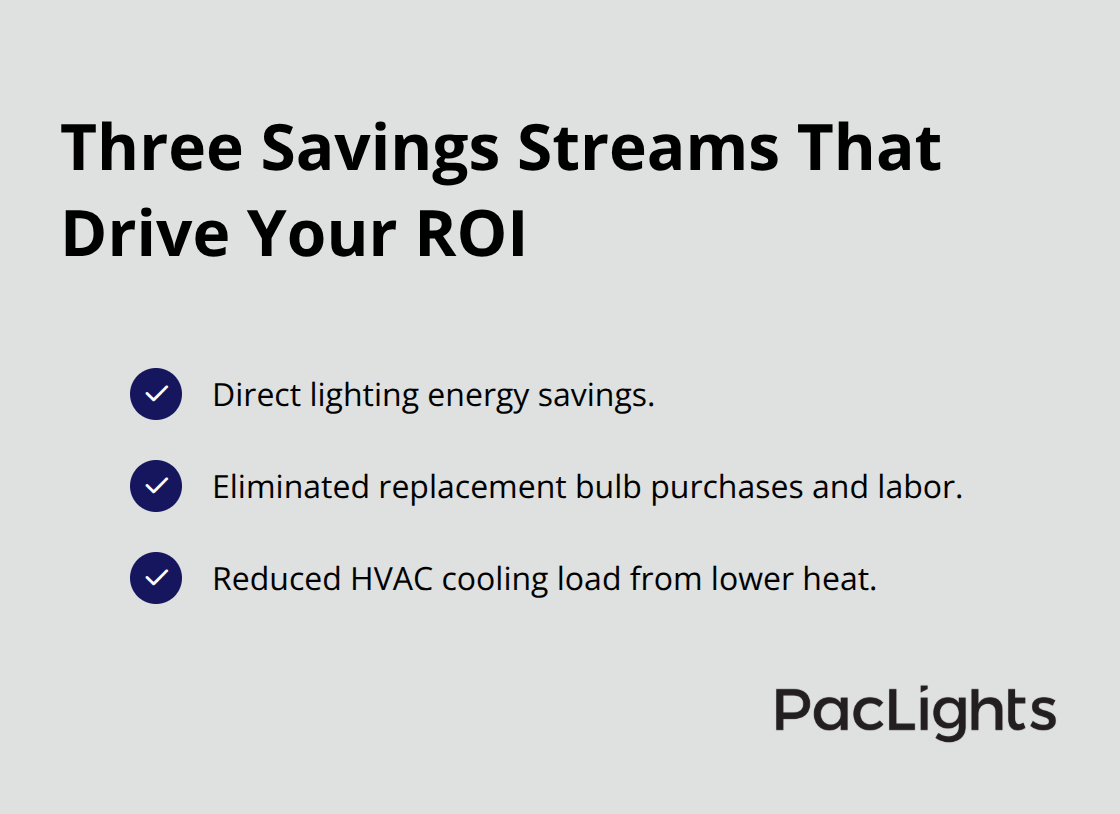
Add these three streams together-direct lighting savings, eliminated replacement labor, and reduced HVAC load-and your actual ROI frequently exceeds initial projections (energy savings, maintenance labor, and cooling efficiency gains all work in your favor).
A free ROI assessment quantifies your payback timeline based on your facility’s specific operating hours, current fixture count, and local electricity rates. PacLights offers free ROI assessments that help you understand exactly what your retrofit will cost and when you’ll break even. These assessments remove guesswork from the decision-making process and show you the true financial impact before you commit to any retrofit project.
Optimizing Downlight Performance for Maximum Efficiency
Right-Sizing Fixtures for Your Space
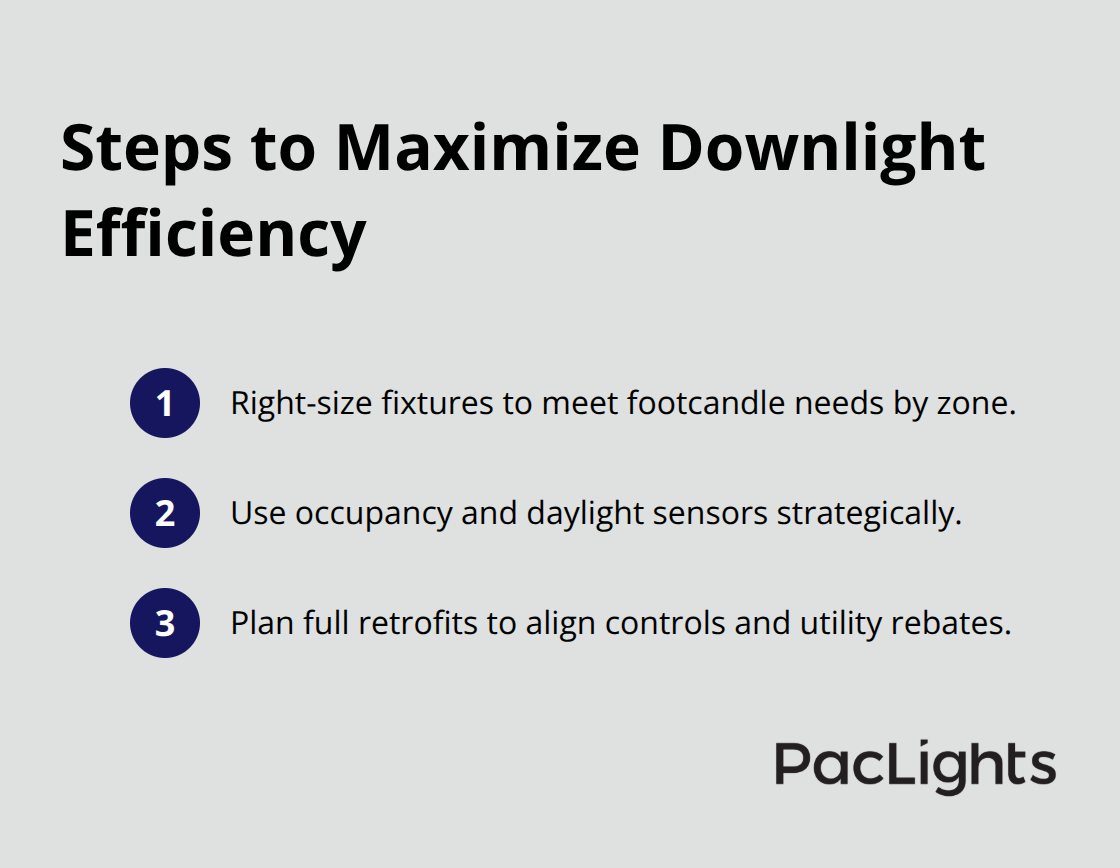
Wattage selection matters far more than most facility managers understand. When designing downlight layouts, professionals size fixtures based on footcandle requirements for each zone, not arbitrary placement. A kitchen or detailed workspace needs 30 to 50 footcandles, while a hallway or storage area functions well at 10 to 20 footcandles. An 18-watt LED downlight in a space where a 12-watt fixture delivers adequate brightness wastes energy and money.
Start with a professional lighting layout that calculates lumens per square foot for your specific space. This prevents the common mistake of over-lighting, which adds unnecessary fixture costs and ongoing energy waste. Spacing matters equally-fixtures spaced too far apart create dark spots that force you to add more downlights, while proper spacing at 8 to 10 feet apart delivers even illumination with fewer total fixtures. A well-designed layout reduces your fixture count by 15% to 25% compared to poorly planned installations, which compounds your savings across the entire retrofit project.
Installing Controls That Cut Energy Use
Occupancy sensors automatically shut lights off in unused conference rooms, storage areas, and restrooms, cutting energy use by 20% to 30% in spaces with variable occupancy. Daylight harvesting sensors dim or turn off downlights when natural light provides adequate illumination, delivering another 10% to 15% in savings for perimeter zones. The real advantage comes from pairing these controls with quality LED drivers that eliminate flicker and maintain consistent brightness during dimming.
Cheap drivers cause visible flicker that irritates staff and wastes energy through inefficient dimming. Quality drivers protect your investment and maximize the efficiency gains that controls provide. Occupancy and daylight sensors work best when paired with reliable driver technology that responds smoothly to sensor input without compromising light quality.
Planning Systematic Retrofit Projects
Retrofit projects work best when completed systematically rather than piecemeal. Replacing all fixtures at once allows you to install coordinated controls across the entire space, maximizing sensor effectiveness and simplifying maintenance. A full retrofit also qualifies you for utility rebate programs-Con Edison offers rebates for LED lighting and controls upgrades, while NYSERDA’s programs cover energy studies and implementation support.
These incentives often offset 20% to 30% of your retrofit costs, accelerating your payback timeline significantly. Free ROI assessments and lighting layout designs factor in your local utility rebates, showing you the true net cost before you commit to any project. Professional assessments remove guesswork from the decision-making process and help you understand exactly what your retrofit will cost and when you’ll break even.
Final Thoughts
The financial case for LED downlights stands on concrete numbers: you’ll cut your lighting costs by 65% to 80% while eliminating the constant cycle of replacements and maintenance that drain your budget. A typical 10,000 square foot facility saves $2,925 to $6,800 annually on electricity alone, with payback arriving within 18 to 36 months once you factor in eliminated labor costs and reduced cooling demands. These results reflect what we see across commercial downlights energy savings projects every day.
LED conversion reduces your facility’s carbon footprint significantly through lower energy consumption, which means fewer greenhouse gas emissions and less waste entering landfills from constantly replacing burned-out bulbs. Utility rebate programs from Con Edison, NYSERDA, and other providers offset 20% to 30% of your retrofit costs, making the investment far more accessible than most facility managers realize. A free ROI assessment shows you exactly what your retrofit will cost and when you’ll break even based on your facility’s specific operating hours and local electricity rates.
Contact PacLights to schedule your assessment and start capturing the savings your facility deserves. Our team provides the fixtures, controls, and expertise to transform your lighting system into an energy-efficient operation. We offer free lighting layout designs and ROI assessments that account for your local utility incentives, helping you understand the true financial impact before committing to any project.
Disclaimer: PacLights is not responsible for any actions taken based on the suggestions and information provided in this article, and readers should consult local building and electrical codes for proper guidance.