

Poor lighting in warehouse loading areas costs money and creates safety risks. We at PacLights know that warehouse canopy lighting directly impacts how efficiently your team works and how well you protect your facility.
The right system pays for itself through lower energy bills and fewer accidents. This guide shows you exactly what to look for when upgrading your loading zone.
Why Warehouse Canopy Lighting Matters
Safety hazards demand immediate attention
Poor warehouse canopy lighting creates immediate safety hazards that ripple through your operation. OSHA standards require a minimum of 10 foot-candles for loading platforms and active storage areas, yet many facilities fall short of this baseline, leaving workers vulnerable to falls, dropped loads, and vehicle accidents. When your team cannot see clearly, they move slower and make mistakes. Workplace lighting research shows that inadequate illumination directly correlates with injury rates, and loading zones rank among the highest-risk areas in any warehouse. Proper canopy lighting eliminates dark spots under the structure, reduces shadows around dock edges, and ensures consistent visibility across the entire work surface. This is not about comfort-it is about preventing accidents that cost money, disrupt operations, and damage your facility’s safety record.
Energy consumption drains your budget
A typical warehouse with 20 canopy lights running 12 hours daily consumes roughly 13,000 kWh annually with traditional HID fixtures, translating to approximately $1,600 in energy costs per year at standard utility rates. LED canopy upgrades cut this consumption by 50–75%, meaning you save over $800 annually on a modest installation. A 150W LED canopy delivers more than 20,000 lumens-matching a 400W metal halide fixture-while using less than half the power. The payback period typically ranges from 1–3 years, and many utility rebates shorten that to under one year. After the system pays for itself, you operate on nearly free electricity for the remaining 10–15 years of the fixture’s lifespan.
Visibility strengthens security operations
Bright, uniform canopy lighting deters theft and vandalism by eliminating hiding spots and creating clear sightlines for security cameras. High CRI LED fixtures render colors accurately, which means your security system captures better footage and identifies details more reliably. Loading dock theft represents a significant loss category for warehouses-poor lighting makes it easier for unauthorized personnel to move goods undetected. Uniform illumination also eliminates blind spots where intruders operate. When your canopy is bright enough to cast sharp shadows, people know they are being watched.
These three factors-safety compliance, operational cost, and loss prevention-form the foundation for upgrading your canopy system. The next section examines the specific features that separate effective canopy lighting from outdated alternatives.
Key Features of Modern Canopy Lighting Systems
Long lifespan eliminates constant maintenance
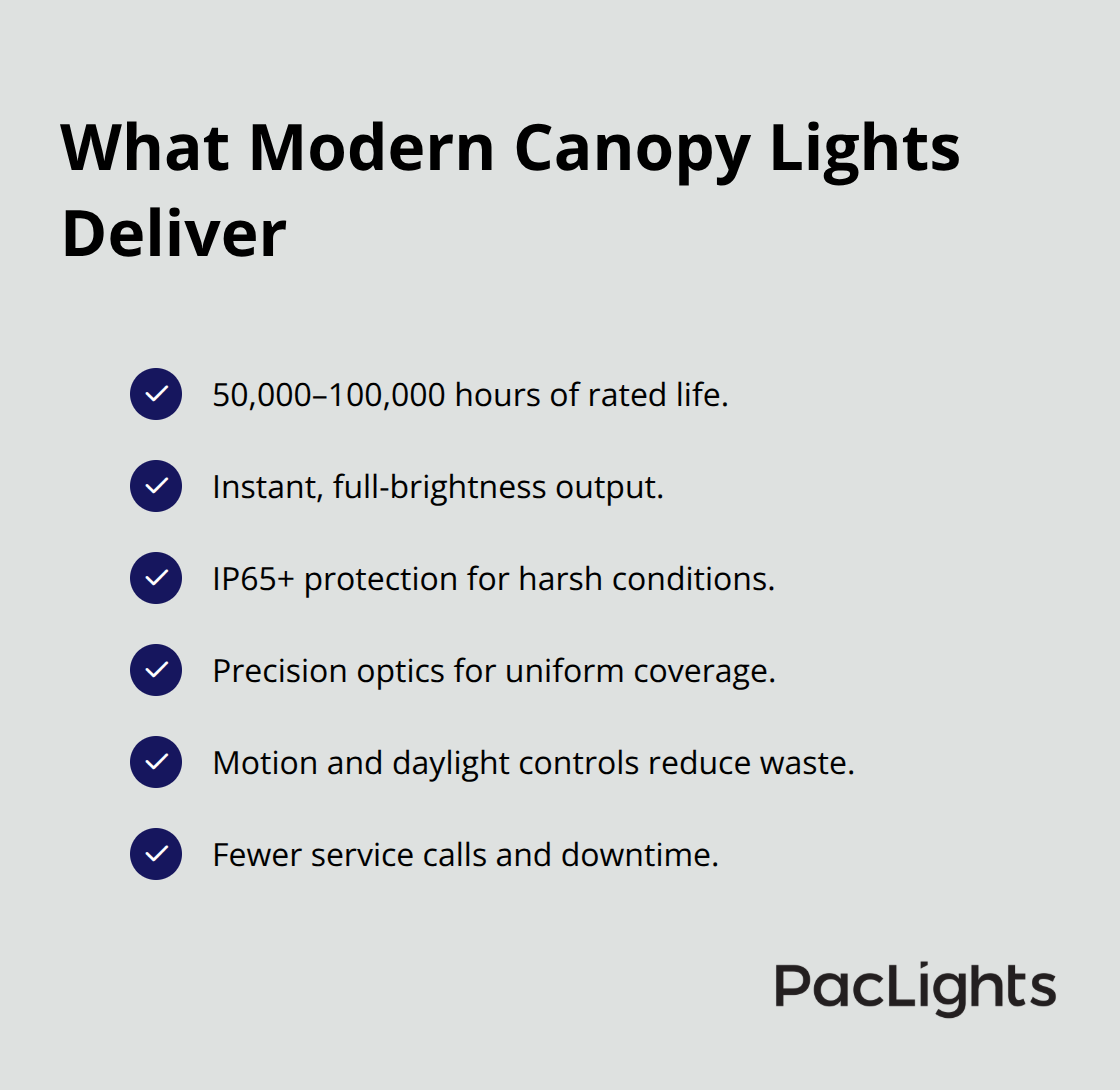
LED canopy fixtures operate for 50,000 to 100,000 hours, which means your loading area stays bright for over 11 years at 12 hours daily without a single bulb replacement. Metal halide systems burn out around 15,000 hours and require frequent restrike cycles that leave your dock dark during peak activity. A 150W LED canopy produces over 20,000 lumens instantly at full brightness with zero warm-up delay, while older HID fixtures waste time reaching peak output. This performance difference matters most when your team needs visibility right now, not five minutes from now.
Weather resistance and precision optics deliver uniform coverage
Outdoor canopy fixtures rated IP65 or higher resist dust, water jets, and temperature swings from -40°F to 130°F without corrosion or performance loss. Precision optics in modern LED designs eliminate the dark spots that plague older canopy systems, delivering uniform coverage across your entire loading surface. This combination of long life, instant output, and weather resistance means fewer service calls, less downtime, and predictable performance year-round.
Motion sensors and daylight controls cut energy waste
When your loading dock sits idle during off-peak hours, motion-activated systems dim fixtures to 10–30% output, then ramp to full brightness the instant activity resumes. This adaptive approach saves an additional 30–50% beyond the baseline LED efficiency, which already cuts consumption by 50–75% compared to traditional fixtures. Daylight photocells shut down canopy lights automatically at sunrise, preventing waste from running bright fixtures during daylight hours. For a facility with 20 canopy lights, this combination stretches annual savings beyond $1,200 while maintaining the safety and visibility your team needs during actual work periods.
Optional daylight and motion control options integrate seamlessly into your existing infrastructure, allowing you to optimize energy use without rewiring or major installation complexity. These controls transform your canopy from a static system into an intelligent one that responds to real conditions. The next section walks you through the specific steps to assess your loading area and calculate exactly what your facility needs.
How to Size Your Loading Area and Calculate Lumen Requirements
Measure your canopy dimensions and mounting height
Start with your canopy dimensions and the exact mounting height of your current or planned fixtures. Most warehouse loading docks range from 12 to 20 feet in height, and this single measurement determines whether you need one powerful fixture or multiple units spread across the space. Measure the length and width of your loading surface, then note any obstructions like dock shelters, equipment, or structural columns that block light distribution. A 40-by-60-foot loading dock with 15-foot mounting height needs a fundamentally different approach than a 20-by-30-foot covered area at 12 feet. Take photographs of your current setup and note problem areas where shadows persist or visibility drops.
Establish your target foot-candle level
OSHA requires a minimum of 10 foot-candles for loading platforms, but practical warehouse operations demand 30–40 foot-candles to prevent the eye strain and mistakes that slow your team. This baseline data prevents you from oversizing your system and wasting money on unnecessary lumens, or undersizing and creating the dark spots that cause accidents. Many facilities install fixtures without this assessment and end up with uneven coverage or excessive glare that defeats the purpose.
Calculate total lumen output needed
Multiply your loading area square footage by your target foot-candles, then convert to lumens using the standard that 10 lux equals approximately 1 foot-candle. A 2,400-square-foot loading dock targeting 35 foot-candles requires roughly 84,000 lumens total output. A single 150W LED canopy delivers over 20,000 lumens, so you would need four to five fixtures to achieve uniform coverage.
Compare LED savings against your current system
A 400W metal halide produces similar output but costs roughly 2.7 times more to operate annually. At $0.12 per kilowatt-hour, switching those five 400W fixtures to 150W LEDs saves approximately $1,100 per year on energy alone. Most warehouse operators see full payback within 18–24 months, after which the system operates nearly free for the remaining 8–12 years of fixture life.
Use professional layout design to eliminate guesswork
Professional photometric layout designs calculate exact lumen placement and spacing for your specific loading area. This approach eliminates guesswork and ensures you order the right fixtures the first time rather than discovering coverage gaps after installation.
Final Thoughts
Warehouse canopy lighting directly impacts three critical areas of your operation: worker safety, operating costs, and loss prevention. A facility running 20 traditional HID canopy fixtures spends roughly $1,600 annually on energy alone, while LED alternatives cut that bill by over $800 per year. OSHA compliance requires 10 foot-candles minimum on loading platforms, but achieving 30–40 foot-candles prevents the eye strain and mistakes that slow your team, and bright, uniform coverage eliminates the dark zones where theft and vandalism occur undetected.
Modern LED canopy systems deliver 50,000 to 100,000 hours of lifespan, meaning your loading dock stays bright for over 11 years without bulb replacement. Motion sensors and daylight controls add another 30–50% in energy savings beyond the baseline LED efficiency. The payback period typically falls between 18–24 months, after which your system operates at minimal cost for the remainder of its life.
Start with your loading area dimensions and current mounting height, then establish your target foot-candle level based on OSHA standards and your team’s actual work demands. We at PacLights offer free lighting layout designs and ROI assessments to help you evaluate your specific warehouse canopy lighting needs and discover exactly how much you can save. Contact our team to receive a customized analysis and retrofit solutions that upgrade your existing infrastructure without major rewiring.
Disclaimer: PacLights is not responsible for any actions taken based on the suggestions and information provided in this article, and readers should consult local building and electrical codes for proper guidance.