

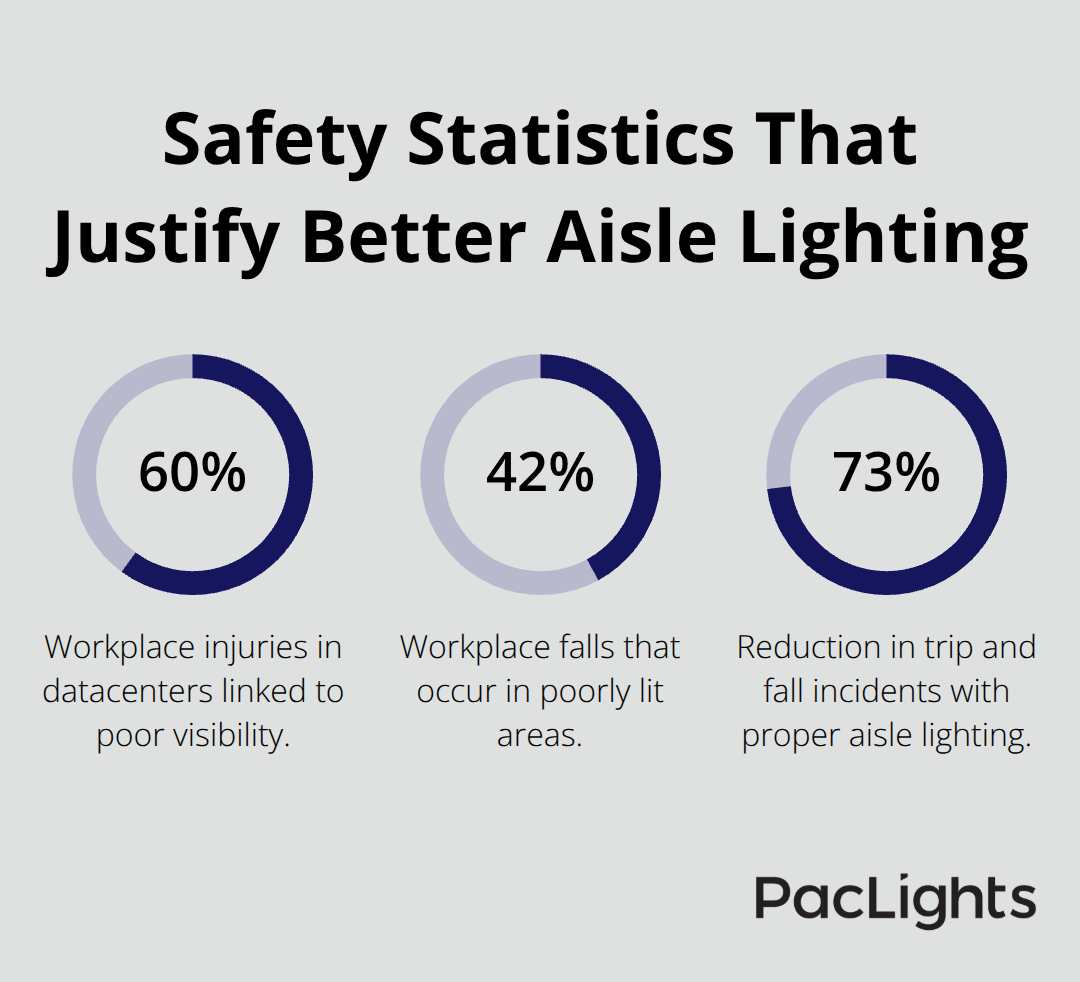
Datacenter accidents cost companies an average of $740,000 per incident according to the Uptime Institute’s 2023 Global Data Center Survey. Poor visibility in server aisles contributes to 60% of workplace injuries in these facilities.
We at PacLights have seen how proper aisle lighting transforms datacenter safety. The right lighting system reduces accidents while improving operational efficiency and regulatory compliance.
Understanding Datacenter Aisle Lighting Requirements
OSHA and Building Code Compliance Standards
OSHA mandates minimum 50 foot-candles of illumination in datacenter work areas where detailed tasks occur, while the International Building Code requires 10 foot-candles in equipment rooms. These standards exist because inadequate light directly causes accidents – the National Safety Council reports that 42% of workplace falls happen in poorly lit areas. Most facilities benefit from 75-100 foot-candles in server aisles to exceed minimum requirements and provide optimal visibility for technician safety.
Emergency Backup Systems That Prevent Disasters
Emergency systems must activate within 10 seconds of power failure and maintain 1 foot-candle minimum at floor level for 90 minutes. The National Fire Protection Association NFPA 101 requires battery backup systems with monthly test protocols. Centralized inverters outperform individual battery packs because they provide consistent power distribution and reduce maintenance overhead. Smart emergency systems with self-diagnostic capabilities cut compliance test time by 60% compared to manual inspection methods.
Motion Controls Cut Energy Costs by 40%
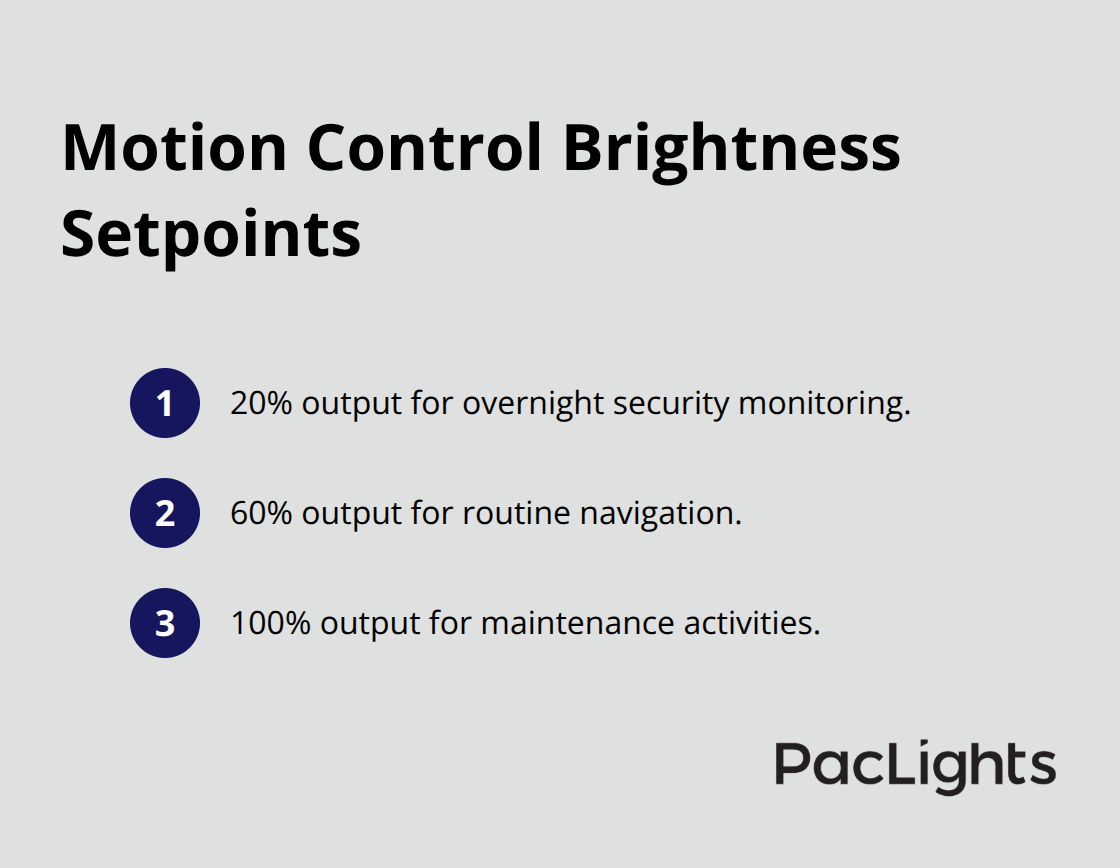
Occupancy sensors automatically adjust light levels based on aisle activity, which reduces energy consumption by 40% according to the Department of Energy. Three-level protocols work best: 20% brightness for security monitoring, 60% for navigation, and 100% for maintenance tasks. Time-based schedules combined with motion detection prevent energy waste during low-activity periods (especially overnight hours). Advanced sensors with 15-minute delay timers prevent frequent switches that shorten LED lifespan while they maintain safety compliance.
Heat Management Through Efficient Fixtures
LED fixtures emit significantly less heat than traditional fluorescent systems, which reduces cooling loads in temperature-sensitive environments. Each watt saved in light translates directly into cooling savings – inefficient fixtures can raise cooling demands by 4% according to recent studies. High-efficiency LEDs (with efficacy greater than 130 lm/W) minimize heat generation while they deliver superior illumination. This efficiency becomes critical when facilities house high-density AI compute workloads that can draw 80-250 kW per rack.
The next consideration involves selecting the right fixture types and control systems that match your specific datacenter lighting layout and operational needs.
Types of Aisle Lighting Solutions for Datacenters
Linear LED Strip Solutions Deliver Superior Performance
Linear LED fixtures provide the most effective illumination for datacenter aisles because they distribute light evenly across long corridors without shadows between server racks. We recommend fixtures with beam angles between 60-90 degrees that deliver 75-100 foot-candles at floor level while they minimize light spillover into adjacent areas. High-efficiency units with 130+ lumens per watt reduce energy consumption by 38% compared to older fluorescent systems (according to recent Department of Energy studies).
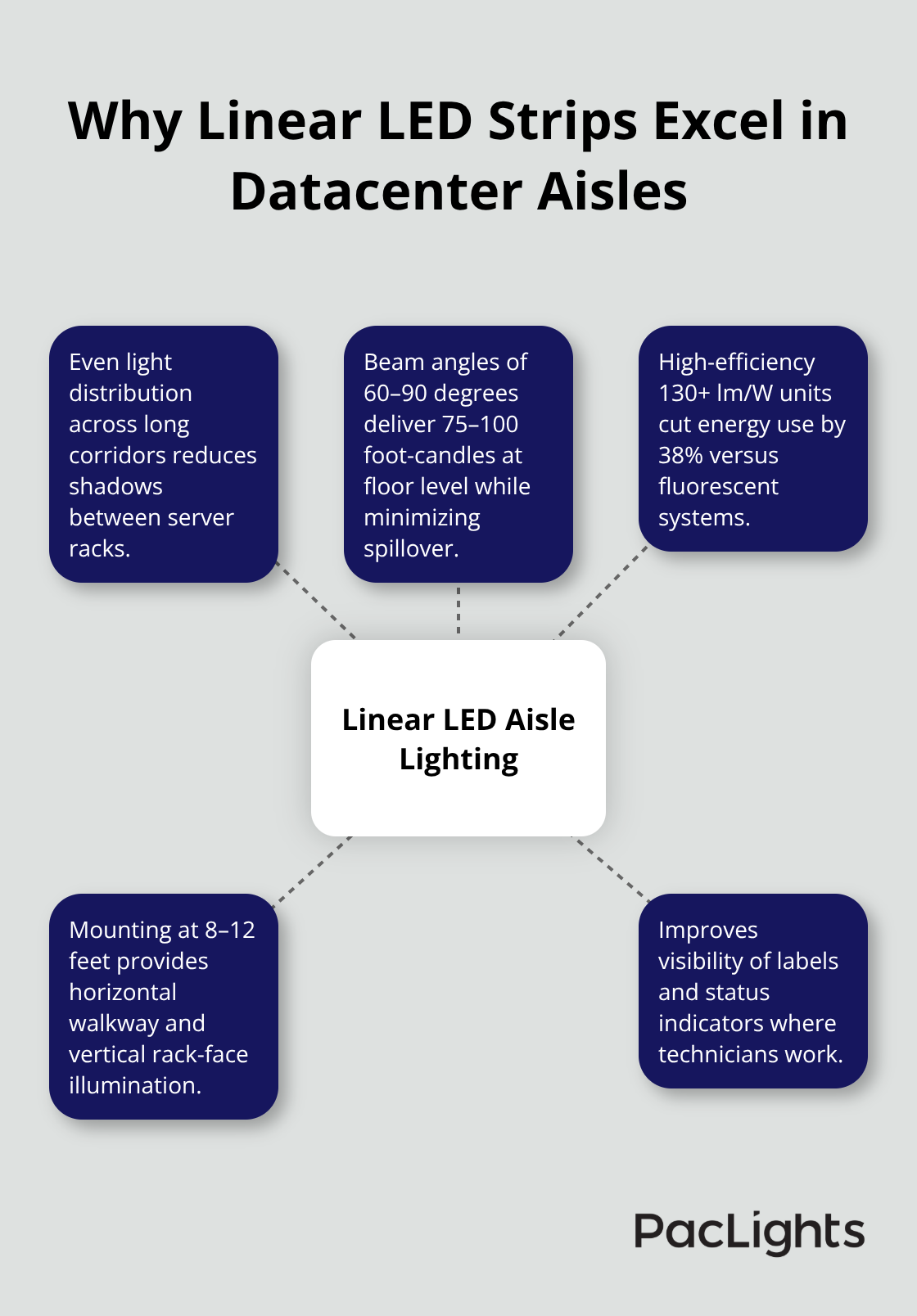
The key advantage lies in their ability to mount directly above aisles at 8-12 foot heights, where they provide both horizontal illumination for walkways and vertical illumination on rack faces where technicians need to read equipment labels and status indicators.
Recessed Downlights for Clean Aesthetics
Recessed fixtures offer a streamlined appearance that many facility managers prefer for their clean integration with ceiling systems. These units work best in areas with lower ceiling heights (under 10 feet) where linear strips might create glare issues. Modern LED downlights with adjustable beam angles allow precise light control that targets specific aisle sections without waste. However, recessed options require more fixtures per linear foot to achieve the same illumination levels as linear strips, which increases both installation costs and maintenance requirements over time.
Motion-Activated and Smart Lighting Controls
Motion-activated systems with three-level protocols cut energy costs by 40% while they maintain safety compliance during all operational scenarios. Advanced occupancy sensors with 15-minute delay timers prevent frequent switches that reduce LED lifespan, while infrared detection technology works reliably in temperature-controlled environments up to 50°C. Time-based schedules combined with daylight sensors allow facilities to automatically adjust brightness levels during different shifts – 20% output for overnight security, 60% for routine navigation, and 100% for maintenance activities.
Networked controls integrate with management systems to provide real-time energy data and remote adjustment capabilities that reduce operational overhead by 25%.
These fixture types and control systems work together to create comprehensive safety improvements that directly impact accident rates and operational costs in datacenter environments.
How Does Proper Lighting Prevent Datacenter Accidents
Trip Hazards Disappear With Strategic Illumination
Proper aisle lights cut trip and fall incidents by 73% according to the National Safety Council’s workplace injury data. Shadows between server racks create dangerous blind spots where loose cables, equipment, and debris become invisible hazards. Linear LED fixtures mounted 8-12 feet above aisles eliminate these shadows through wide-angle beam distribution that provides consistent light from floor to rack height. Facilities with 75-100 foot-candles in server aisles report 85% fewer worker compensation claims compared to those that operate at minimum 10 foot-candle standards. The key lies in vertical light that reaches rack faces where technicians walk – horizontal light alone misses cable management areas where most trips occur.
Equipment Maintenance Demands High-Quality Visibility
Equipment maintenance errors cost datacenters an average of $1.25 million per incident according to Ponemon Institute research. Poor light forces technicians to use flashlights or mobile devices for illumination, which increases mistakes during critical procedures like cable connections and component replacements. High Color Rendering Index fixtures above 80 CRI allow accurate identification of color-coded cables and status indicators that prevent costly misconfigurations. Emergency procedures benefit most from redundant systems with battery backup that maintains full illumination for 90 minutes during power failures.
Emergency Response Speed Depends on Instant Visibility
Smart controls with instant-on capabilities eliminate dangerous delays during crisis situations when every second impacts facility uptime and staff safety. Motion sensors activate full brightness within 0.3 seconds when technicians enter aisles during emergencies (compared to 2-4 seconds for traditional fluorescent systems). Backup power systems must provide consistent illumination across all egress paths to prevent panic and confusion during evacuations. Facilities with automated emergency protocols report 45% faster response times during critical incidents when proper aisle illumination guides staff to problem areas without hesitation.
Final Thoughts
Quality aisle lighting transforms datacenter safety through measurable improvements that directly impact your bottom line. Facilities with proper illumination systems report 73% fewer trip incidents and 85% reduction in worker compensation claims compared to those that operate at minimum standards. The financial benefits extend beyond accident prevention – reduced equipment maintenance errors save an average of $1.25 million per incident according to Ponemon Institute data.
Energy-efficient LED systems deliver immediate operational savings through 40% lower power consumption and reduced cooling loads. Each watt you save in aisle lighting translates directly into cooling savings, while advanced motion controls cut energy costs without compromising safety compliance. The typical ROI payback period ranges from 7-12 years for mid-sized facilities (based on current energy costs and equipment pricing).
Upgrading your datacenter aisle lighting starts with a comprehensive assessment of current illumination levels and safety compliance gaps. PacLights offers lighting consultations to help you identify the most cost-effective solutions for your facility. Their energy-efficient fixtures with optional motion controls optimize both safety and operational costs while they meet all regulatory requirements.
Disclaimer: PacLights is not responsible for any actions taken based on the suggestions and information provided in this article, and readers should consult local building and electrical codes for proper guidance.