

Office downlights consume roughly 20% of total building energy costs, yet most facilities operate them without any intelligent control strategy. At PacLights, we’ve seen firsthand how lighting controls for downlights transform energy waste into measurable savings.
The right control system cuts energy use by 30–50% while simultaneously boosting employee comfort and reducing maintenance overhead. This guide walks you through proven strategies that facility managers are already using to optimize downlight performance across their buildings.
How Lighting Controls Drive Real Energy Savings
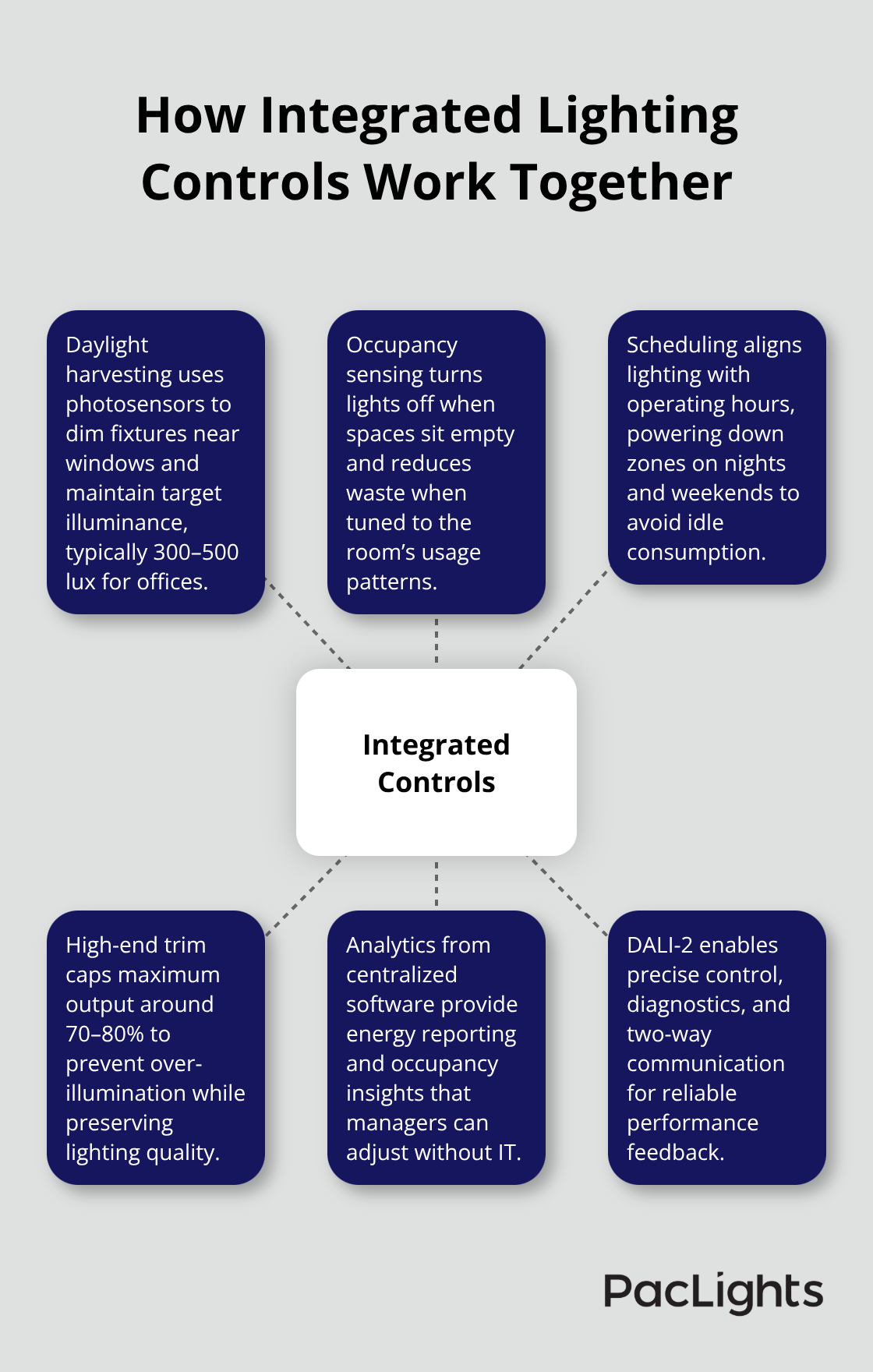
Automated dimming cuts downlight energy consumption by 30–50% because fixtures rarely need to operate at full brightness. Most offices waste energy running lights at maximum output even when natural daylight or task requirements don’t demand it. High-end trim sets a maximum output ceiling at around 70–80% of a fixture’s rated capacity, preventing over-illumination while preserving essential lighting quality. Occupancy sensors push savings further by turning downlights off when spaces sit empty-a critical advantage in conference rooms, break areas, and storage zones that see sporadic use.
The U.S. Department of Energy reports that daylight harvesting alone cuts lighting energy use by 30–40% in spaces near windows. Combining occupancy sensing with daylight dimming yields the largest reductions. Most commercial energy codes now require occupancy or vacancy sensing with typical timeouts around 20 minutes, which means your facility likely needs these controls to stay compliant anyway. Networked lighting control systems enable scheduling that matches operating hours, so lights power down automatically on weekends or holidays when the building sits empty. This combination of dimming, occupancy detection, and daylight response transforms downlights from constant energy drains into responsive systems that adapt to actual usage patterns.
Tunable White Lighting Aligns with Natural Rhythms
Tunable white downlights adjust color temperature throughout the day to align with natural light patterns, shifting from cooler 5000K in the morning to warmer 3000K in the afternoon. Research published in the Journal of Clinical Sleep Medicine confirms that circadian-aligned lighting improves sleep quality and daytime function, directly affecting how employees feel and perform. A standard office typically uses 3000K–4000K color temperature to balance warmth with productivity, but intelligent systems go further by varying intensity and warmth based on time of day.
Smart controls embedded in downlights or managed through networked systems make these adjustments seamless without manual intervention. Employees in spaces with adaptive lighting report better focus during morning hours and less fatigue by end-of-day, which translates to measurable productivity gains. Cornell University Design & Environmental Analysis research suggests that optimizing office lighting can boost productivity by up to 5%-for a 100-person office at $50,000 average salary, this represents roughly $250,000 in annual productivity value.
Digital Controls Enable Predictive Maintenance
Downlights with embedded digital controls collect performance data that flags maintenance needs before failures occur, eliminating surprise outages and emergency service calls. LED downlights typically last over 50,000 hours, dramatically reducing replacement frequency compared to traditional fixtures, but predictive monitoring systems track fixture health and alert facility teams to degrading performance or ballast issues. Centralized lighting control software provides real-time visibility across all downlights in a building, showing which fixtures underperform or consume excess power.
This data-driven approach allows you to schedule maintenance during planned downtime rather than responding to complaints, reducing labor costs and minimizing disruption to occupants. Smart controls also simplify troubleshooting because technicians access fixture-level diagnostics remotely instead of climbing ladders to inspect each unit individually. The visibility that networked systems provide transforms maintenance from reactive firefighting into proactive planning.
Understanding how these control strategies work in practice requires examining the specific systems available to facility managers and the installation approaches that maximize their effectiveness.
Control Systems That Actually Deliver Results
Daylight Harvesting Maximizes Natural Light Integration
Daylight harvesting stands out as the single most effective control strategy for offices positioned near windows, and the data backs this up unequivocally. Photosensors mounted in or near downlights continuously monitor incoming natural light and automatically dim artificial fixtures to maintain target illuminance levels, typically 300–500 lux for general office work. The Western Michigan University daylight harvesting study found that continuous dimming controlled by photosensors cuts lighting energy use by 30–40%, making this the quickest path to measurable ROI for many facilities.
The technology works best in perimeter zones within roughly 15–20 feet of windows, where natural light fluctuates throughout the day. Interior spaces away from windows see minimal benefit from daylight harvesting alone, which is why layering multiple control types matters. Proper sensor placement and calibration directly impact performance-facility managers should avoid mounting sensors in direct sunlight or positioning them where temporary obstacles block readings. Networked systems with centralized software allow you to verify sensor operation remotely and adjust sensitivity thresholds without site visits, a capability that separates effective deployments from installations that underperform due to poor calibration.
Occupancy Sensors Eliminate Waste in Intermittent-Use Spaces
Occupancy and motion sensors drive energy savings in spaces with intermittent use-conference rooms, storage areas, bathrooms, and break zones see the biggest gains because lights operate only when actually needed. Modern sensor technology has evolved beyond basic PIR motion detection to include dual-technology units combining passive infrared with ultrasonic capability, microwave sensors that detect subtle movement through obstacles, and millimeter-wave sensors offering superior accuracy in complex layouts.
Energy codes including ASHRAE 90.1 and IECC now mandate occupancy or vacancy sensing in most commercial spaces, with typical timeout settings around 20 minutes before lights power down. The distinction between occupancy and vacancy sensing matters operationally: occupancy sensors turn lights on when motion is detected, ideal for spaces where manual switching is inconvenient; vacancy sensors require manual activation but turn lights off automatically, working better in open offices where false triggers waste energy. Luminaire Level Lighting Controls embed sensors directly into downlight fixtures, eliminating the need for separate sensor wiring and making retrofits significantly faster and less disruptive than traditional approaches. Wireless LLLC systems reduce installation time by up to 70% compared to hardwired control networks, a substantial advantage when retrofitting occupied buildings.
Networked Lighting Control Systems Unify All Control Strategies
Networked lighting control systems represent the most comprehensive approach, consolidating dimming, occupancy sensing, daylight harvesting, and scheduling into a single integrated platform that communicates fixture-level data to centralized software. DALI-2 digital dimming protocol has become the industry standard because it enables precise control, fixture diagnostics, and two-way communication with management software, outperforming older 0-10V analog systems that lack performance feedback.
Systems listed on the Networked Lighting Control Qualified Products List ensure compatibility with dimming, occupancy detection, and daylighting controls while meeting energy code requirements. Centralized software provides actionable energy reporting by space type, occupancy pattern analytics, and customizable quick controls that facility managers can adjust without IT intervention. The real advantage emerges when you combine all three control types: daylight harvesting in perimeter zones reduces baseline energy draw, occupancy sensors prevent waste during unoccupied periods, and networked scheduling powers down entire zones during nights and weekends. Facilities pursuing this integrated approach typically achieve 40–50% total energy reduction, the upper range of what controls alone can deliver without retrofitting fixtures themselves.
With these control systems in place, the next critical step involves planning the actual installation to maximize performance and minimize disruption to your operations.
Planning Your Control Strategy Before Installation
Conduct a Lighting Audit to Map Your Current System
Start with a detailed lighting audit before purchasing any controls or scheduling installation work. This audit should map your current downlight locations, wattage, operating hours, and actual occupancy patterns across different zones-conference rooms, open offices, perimeter spaces, and back-of-house areas all demand different control approaches. Walk the building during typical business hours and document which spaces sit empty most of the day versus high-traffic zones. Photograph fixture conditions and note any existing dimming capability or sensor infrastructure already in place. This foundation prevents the common mistake of applying identical control solutions across dissimilar spaces.
Calculate baseline energy consumption by multiplying fixture wattage by operating hours, then model projected savings from different control combinations. Careful electrical planning and control system selection before work begins ensures you calculate total wattage loads early to avoid costly oversights. Most facilities find that 30–40% of their downlights occupy spaces where occupancy sensing alone justifies installation costs within 2–3 years, while another 30–40% sit in daylight zones where harvesting delivers measurable returns. The remaining fixtures in interior core areas typically need only basic dimming to meet code requirements and capture modest savings.
Prioritize Zones Based on Usage Patterns and Natural Light
A conference room used sporadically needs aggressive occupancy sensing with short timeout windows, while an open office floor plate benefits more from daylight harvesting in perimeter zones combined with gentle ambient dimming. Perimeter zones within 15–20 feet of windows should receive priority because daylight harvesting delivers the fastest payback, cutting energy use by 30–40% according to the Western Michigan University study. Interior zones far from natural light benefit more from occupancy sensing and scheduling than from daylight harvesting.
Intermittent-use spaces like conference rooms, storage areas, and break rooms justify wireless sensor installation because the upfront cost recovers quickly from eliminating unnecessary operation. Open offices with consistent occupancy patterns work better with ambient dimming tied to a centralized networked system rather than individual motion sensors that might trigger false positives. This zoning approach transforms installation complexity into manageable phases that minimize operational disruption.
Connect Controls to Your Building Management System
Successful integration of light control systems demands thoughtful planning, collaboration, and attention to detail throughout the design and installation process. Integration with your building management system determines whether controls operate independently at the fixture level or communicate fixture data back to centralized software for energy reporting and optimization. If your facility already runs a BMS for HVAC or security, networked lighting controls that feed performance data into that platform eliminate information silos and enable coordinated responses-for example, reducing lighting load when occupancy sensors confirm a zone is empty, signaling the BMS to adjust ventilation accordingly.
This integration requires upfront planning around network infrastructure, software licensing, and staff training on control interfaces. Facilities that skip this integration step often find their lighting controls operating in isolation, missing opportunities to coordinate with other building systems or leverage occupancy data for space utilization analysis that drives long-term strategic decisions about real estate allocation and workplace design.
Final Thoughts
Smart downlight controls deliver measurable financial returns that extend far beyond energy savings alone. Facilities implementing comprehensive control strategies report 30–50% reductions in lighting energy consumption, translating to thousands of dollars annually depending on building size and operating hours. A 50,000-square-foot office running lights 12 hours daily can expect annual energy savings of $15,000–$25,000 from controls alone, with payback periods typically falling between 2–4 years.
Productivity gains from circadian-aligned lighting and reduced glare add another $250,000+ in annual value for a 100-person facility, according to Cornell University research. Maintenance cost reductions from predictive monitoring and LED longevity compound these benefits over time, as fewer emergency service calls and extended fixture lifespans eliminate unexpected expenses. The ROI case strengthens when you factor in compliance with ASHRAE 90.1 and IECC energy codes, which now mandate occupancy sensing and daylight harvesting in most commercial spaces.
Start by conducting a lighting audit to map downlight locations, wattage, and usage patterns across different zones. Prioritize perimeter spaces for daylight harvesting and intermittent-use areas for occupancy sensing, then model projected savings from different control combinations. We at PacLights provide free lighting layout designs and ROI assessments to help you quantify returns before committing to installation, and our recessed downlights feature optional daylight and motion control plus advanced networked lighting controls that integrate seamlessly with your existing building systems.
Disclaimer: PacLights is not responsible for any actions taken based on the suggestions and information provided in this article, and readers should consult local building and electrical codes for proper guidance.